
A threat can remain hidden even when security tools are running. Managed threat hunting in the UAE adds proactive investigation: specialists search network, endpoint and cloud data for suspicious activity routine alerts may miss, then examine credible findings for signs of compromise.
Monitoring tools can identify many threats, but they do not explain every unusual behaviour or reveal what happened before an alert. Threat hunting combines available security data with human analysis to test focused hypotheses, investigate possible backdoors, misconfigurations or data exfiltration, and improve visibility across your environment.
This guide explains how managed threat hunting works and how SIEM, EDR, MDR and XDR can support it. It outlines when hunting may suit your organisation, compares approaches such as intelligence-driven, behavioural, endpoint, network and incident-based investigations, and explains how to assess scope and implementation. It also considers how UAE organisations can align hunting activity with their security and compliance priorities.
Key Takeaways
- Use proactive hunts to investigate suspicious activity that routine alerts may miss, rather than relying on security tools alone.
- Prioritise hunting around risks such as hidden backdoors, unsafe configurations and possible data exfiltration, guided by the telemetry available in your environment.
- Align network, endpoint and cloud monitoring so investigators can connect activity across systems and understand its scope.
- Choose between intelligence-led, behavioural, endpoint, network or incident-based hunting according to your organisation’s risks and security priorities.
- For UAE compliance planning, assess whether log collection, retention and incident management support applicable UAE Information Assurance Regulation (UAE IA) requirements.
What is managed threat hunting?
Managed threat hunting proactively searches security data for threats that existing detection may have missed.
Proactive and early threat detection
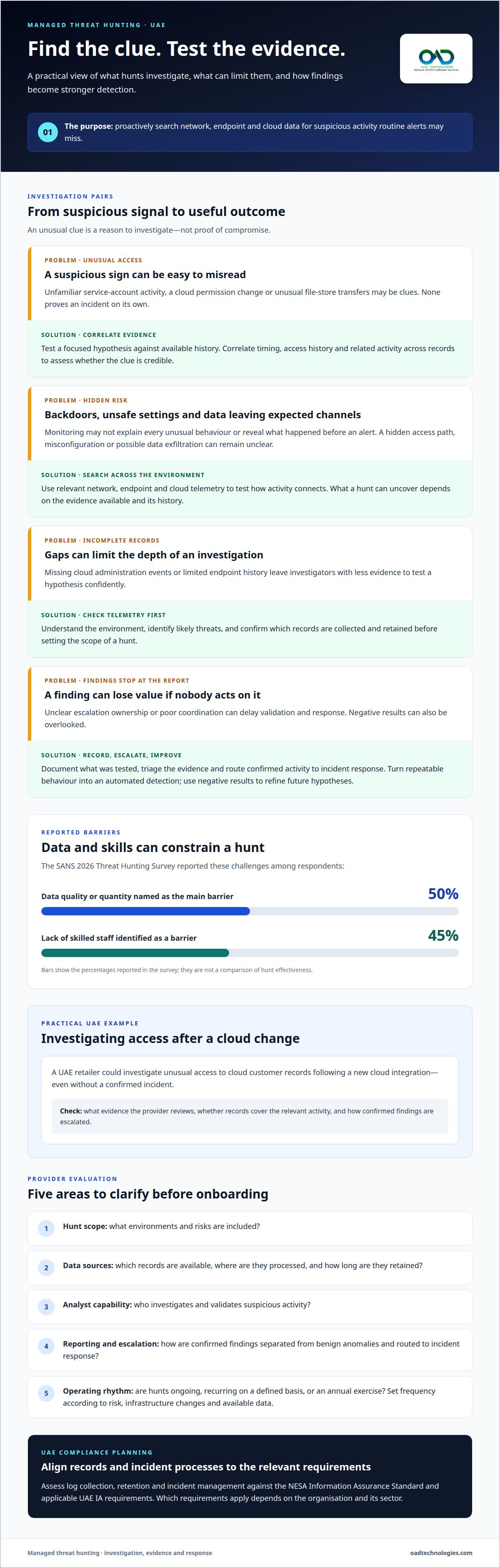
A hunt begins with a hypothesis, such as suspicious access to sensitive data. Analysts test it against available historical data, including network, endpoint or cloud activity. Unlike alert monitoring, hunting actively searches for evidence of attacker behaviour. For example, a UAE retailer could investigate unusual access to cloud records even without a confirmed incident.
What a hunt can uncover depends on the evidence available. Log quality and retention shape the investigation, while gaps in security data can limit its reach. Start by understanding your environment, identifying likely threats and checking which records can test those hypotheses. UAE organisations can assess log collection, retention and incident management against applicable UAE Information Assurance Regulation (UAE IA) requirements.
Hunting versus detection and response
Detection uses rules or analytics to flag activity matching known patterns; hunting investigates whether less obvious activity is present. Threat intelligence informs hunts with knowledge of threats and techniques, while incident response addresses confirmed activity. These functions complement one another: hunting explores, detection alerts, and incident response contains and investigates a confirmed incident.
Managed threat hunting has a distinct investigative focus, unlike MDR and SOC services more broadly. MDR typically combines monitoring, detection and response, while a SOC provides security operations that may include monitoring and incident handling. Hunting can be part of these services or delivered as a focused activity. In the UAE, managed security and SOC services can incorporate threat hunting.
Turning hunt findings into detections
A useful hunt produces more than a finding. Analysts assess the evidence, document the outcome and escalate confirmed activity to incident response. If a hunt identifies repeatable behaviour, teams can turn it into an automated detection rather than repeat the same investigation. Negative results matter too: they record what was tested and help refine future hypotheses.
A relevant national reference is the UAE Information Assurance Regulation (UAE IA), which can inform a proactive risk-management approach and assessments of logs, retention and incident management. Mandatory implementation applies to critical entities designated under the UAE Critical Information Infrastructure Protection policy; other organisations should identify the controls and sector requirements relevant to their environment.
Implementation follows a practical sequence: gather information about the environment, identify likely threats, and form testable hypotheses. Then select relevant telemetry, investigate activity, triage findings and route confirmed incidents to incident response. A final step converts repeatable findings into detections. The threat detection process can help connect investigation results with ongoing detection.
Backdoors, misconfigurations, and data exfiltration
A hunt examines infrastructure for hidden access, unsafe settings and signs that information is leaving expected channels. Analysts might investigate an unfamiliar service account, a cloud permission change or unusual transfers from a file store. None of these clues proves an incident on its own. Their significance depends on correlating timing, access history and related activity across available records.
Hunting depth depends on historical data. If logs omit cloud administration events or retain little endpoint history, investigators have less evidence to test a hypothesis. Data quality and a shortage of skilled analysts are common constraints that can limit what a hunt finds and how confidently teams respond.
Set hunt frequency according to risk, infrastructure changes and available security data, not the calendar alone. Establish whether the service conducts ongoing hunts, investigations on a defined recurring basis or an annual exercise. A new cloud deployment or significant identity change may warrant a focused investigation. Between hunts, threat intelligence can help prioritise relevant behaviours rather than drive undirected searches.
When evaluating a provider, examine the hunt scope, data sources, analyst capability, reporting and escalation process. Ask how findings distinguish confirmed activity from benign anomalies and how negative results are documented. For example, a UAE retailer might investigate access to customer records following a new cloud integration. The provider should explain what evidence is reviewed and how confirmed findings are escalated.
Data residency and privacy requirements depend on the organisation’s applicable UAE regime, sector and data flows. Before onboarding, map which logs contain personal or sensitive information, where they are processed, who can access them, and how long they are retained. Under UAE PDPL Article 9, a controller must notify the UAE Data Office once aware of a qualifying breach; the law sets no fixed number of hours.
Outsourcing can add specialist capacity, but it cannot compensate for incomplete security data, unclear escalation ownership or poor coordination with internal teams. Historical records limit investigation depth, while delayed access can slow validation and response. Define how analysts share evidence, who makes operational decisions and how findings inform controls to reduce potential harm.
A practical evaluation compares the provider’s proposed hunt approach with your risk priorities, retained data and incident process. If you’re shaping that scope, discuss your threat-hunting requirements in the context of your environment and compliance needs.
Monitoring networks, endpoints, and cloud systems
Effective monitoring connects activity across network, endpoint and cloud environments. This joined-up view helps investigators assess whether separate signals point to compromise.
Network and endpoint monitoring
Network records can reveal unusual connections, unexpected traffic patterns or access between systems. Endpoint data adds context about device activity, including unusual processes or changes to security settings. Reviewing both helps investigators trace how a suspicious event moves through an organisation’s infrastructure.
Cloud systems add another layer of evidence. A UAE logistics company, for example, could investigate an unfamiliar sign-in alongside unusual file access and traffic from a server. Collect relevant records from each environment, then correlate timestamps, accounts and systems. Monitoring only one source may leave investigators without enough context to understand the activity.
Threat investigation and remediation
A managed process can monitor collected data, detect suspicious activity, investigate its scope and impact, and address confirmed threats. Analysts first assess whether an alert is a genuine concern, then trace related activity across affected network, endpoint and cloud assets. Clear escalation paths show internal teams which actions require their involvement.
Remediation should address both the observed activity and its cause. If an investigation identifies unauthorised access through a compromised account, the response may include containing affected systems and reviewing related access. Findings can then inform changes to monitoring, access controls or other security measures. This connects detection with action instead of treating an alert as a complete investigation.
In the UAE, organisations may receive threat hunting within 24 X 7 managed monitoring after an assessment confirms that the required logs are in place. Continuous monitoring can surface activity between focused hunts, while scheduled retesting helps assess whether new detections identify previously investigated behaviour. The monitoring scope should reflect available logs and the systems the organisation needs to observe.
A managed SOC can coordinate monitoring and investigation. For a UAE healthcare group, relevant activity might span staff endpoints, network connections and cloud-hosted systems. Analysts can correlate these records, investigate potential compromise and document actions for the organisation’s response teams. Look for a clear path from security signal to investigation and remediation.
Before implementation, define which networks, endpoints and cloud environments are in scope, then map the available security data. Establish how analysts investigate alerts, communicate findings and coordinate remediation. Review coverage when infrastructure changes, such as after a cloud migration or the introduction of a new business system, so monitoring continues to reflect the operating environment.
XDR, MDR, threat intelligence and SIEM
XDR, MDR and SIEM can each support hunting in a different way. XDR correlates activity across security layers; MDR combines managed monitoring with investigation and response; SIEM collects and analyses event data from connected systems. Threat hunters use these capabilities as evidence sources, then apply human analysis to investigate suspicious patterns.
XDR can connect endpoint, network and cloud signals that might look unrelated in separate tools. For example, an unusual endpoint process followed by unexpected cloud access may warrant investigation as a sequence. Hunting tests whether the activity supports a plausible threat hypothesis instead of treating each alert as an isolated event.
MDR provides an operational service for detection and response. Hunting adds proactive investigation of activity existing alerts may not identify. The two can work together: MDR analysts handle detected incidents while hunters investigate less obvious behaviour and feed useful findings into monitoring. The service scope should explain how investigative findings reach response teams.
A SIEM can collect logs from identity systems, servers, endpoints and cloud platforms. Analysts can query these records to see whether an account’s activity differs from its usual pattern. The history available and the quality of collected data shape the investigation. SIEM supports a hunt, but does not replace a clear hypothesis or analyst judgement.
Threat intelligence helps prioritise investigations. It can describe relevant adversary techniques, indicators or emerging threats, while an organisation’s own environment shows where those patterns might appear. MITRE ATT&CK can help structure hunts around attacker tactics and techniques. Analysts still need to test intelligence against local evidence rather than assume every indicator signals compromise.
Consider a UAE financial services organisation investigating unusual access to a cloud-hosted account. Threat intelligence might suggest a technique to test; SIEM records can show sign-in context, while XDR may connect related endpoint activity. Analysts assess whether the evidence supports the hypothesis, then document confirmed findings for response and future detection. This is an example, not a claim about a specific incident.
When assessing these capabilities, map each tool to its role: the sources it collects, how it correlates activity and where analysts investigate. Establish how threat intelligence informs hypotheses, how findings are communicated and how confirmed patterns become detections. Understanding how XDR, MDR and SIEM work together helps align technology with the organisation’s threat priorities.
Managed threat hunting service types
Threat-hunting services differ in the evidence they examine and the questions they test. The right mix depends on your organisation’s risk posture, available security data and whether you need ongoing investigations or focused coverage of a particular concern.
- Proactive hunting: Analysts search for suspicious activity before an alert confirms a breach. This suits organisations that want investigations beyond routine detection.
- Intelligence-driven hunting: Threat intelligence shapes hypotheses around relevant adversary tactics and techniques. Analysts test those ideas against the organisation’s own activity, rather than treating external indicators as proof.
- Behavioural analysis: Hunts look for activity that differs from expected patterns, such as unusual account use or unexpected system changes. This can help investigate threats that do not match a known indicator.
- Endpoint hunting: Analysts focus on device records, including process activity and security changes. This approach can help investigate suspicious behaviour on workstations or servers.
- Network-traffic hunting: Investigators examine connections and traffic patterns for activity that warrants closer analysis. It can help trace communication between systems across a network.
- Incident-based hunting: A known incident or alert triggers a focused search for related activity. The investigation can establish scope and identify affected assets or accounts.
- Situational or entity-driven hunting: The hunt centres on high-value entities, such as sensitive data or critical computing resources. This can focus investigation effort on assets with greater business impact.
Hunt types can overlap. An investigation focused on sensitive cloud data, for example, may use intelligence-driven hypotheses and endpoint or network evidence. Define the risk or entity under investigation, then match the method to available data and operational priorities.
Assess whether a service provides ongoing hunts or only an annual exercise. Ask how the provider selects hypotheses, uses threat intelligence, documents findings and escalates confirmed activity. Review whether reports include negative results, which show what investigators tested and can guide later hunts. A clear scope makes it easier to align the service with internal incident processes.
Implementation and cost depend on infrastructure, tools, monitoring scope and threat complexity. A focused investigation of a critical entity differs from broader hunting across network, endpoint and cloud environments. For a UAE organisation, choose a service mix that reflects priority risks and the historical data available for analysis.
OAD Technologies
OAD Technologies helps organisations align threat-hunting priorities with practical security capabilities. Its enterprise-grade Managed Technology Services can combine 24 X 7 security monitoring with a Fully Managed, Defined Scope for threat hunting, SIEM/SOC and Managed Detection and Response (MDR). Where relevant, Nexoaura can support service delivery within OAD Technologies’ agreed operational scope; telemetry, coverage, investigation cadence and response responsibilities should be defined for each environment. Vulnerability Assessment and Penetration Testing (VAPT) can assess system weaknesses, while Data Loss Prevention (DLP) addresses risks involving sensitive information. The right combination depends on your environment, available security data and the risks you need to investigate.
If your organisation is defining its monitoring scope, evaluating telemetry or connecting investigation findings to security operations, contact OAD Technologies to discuss your requirements.
Build a hunting approach that fits your environment
For UAE organisations considering managed threat hunting, start by defining what the programme needs to achieve. Prioritise the systems and information most important to business operations, then align the hunt scope with available security data, investigation cadence and internal response ownership. This provides a practical basis for assessing how hunting fits existing security operations.
OAD Technologies can help shape an approach around your organisation’s environment and security priorities. Discuss the investigation questions that matter, the evidence available to answer them and how findings should inform ongoing security decisions. A tailored scope gives technical teams and business leaders a shared understanding of the work.
Clear priorities help turn interest into an actionable plan. Start with the risks your organisation most needs to understand, then develop a hunting approach that can adapt as systems and threats change.
A considered first step can help your organisation make informed security decisions over time.
Frequently Asked Questions
Which systems can be monitored?
Monitoring can cover endpoints, network infrastructure, cloud environments, servers and identity systems, depending on the security data available. An investigation into unusual activity on an employee account, for example, might draw on sign-in records, endpoint activity and cloud administration logs. Including business-critical applications can help establish whether suspicious activity affected essential operations. The useful scope is the set of systems that provide relevant evidence for your investigation priorities.
What is managed threat hunting and how does it work?
Managed threat hunting is a specialist investigation service that searches security data for activity routine alerts may not identify. The provider learns about the organisation’s environment, then develops hypotheses based on potential threats, observed techniques or weaknesses. Analysts test those hypotheses against available records, assess relevant findings and document the results. Confirmed activity can be escalated through the organisation’s incident response process.
What services and deliverables do UAE managed threat hunting providers offer?
Services can include an environment review, focused investigations, analysis of available security data, assessment of findings and incident escalation. Deliverables may include reports documenting the investigation, evidence and results. Negative findings can also be useful because they show which activity was examined. For UAE organisations, documentation can support compliance work, while log collection, retention and incident management can be assessed against applicable UAE Information Assurance Regulation (UAE IA) requirements.
Which UAE industries benefit most from managed threat hunting?
Managed threat hunting can be particularly relevant to organisations handling sensitive data, critical infrastructure or large networks, where overlooked activity could affect essential services or operations. A UAE healthcare provider might prioritise investigations into access to sensitive records and systems supporting care delivery. A large financial organisation might focus on suspicious activity across business-critical platforms. The deciding factors are asset value, exposure to threats and the evidence available for investigation.
Disclaimer
Content by OAD Technologies is for general informational purposes only and does not constitute professional or cybersecurity advice. No warranties are made regarding accuracy or completeness; reliance is at your own risk. OAD Technologies shall not be liable for any direct or indirect losses arising from use of this content.