
When evaluating MDR or SIEM services in the UAE, consider how they can support your organisation’s response to executive impersonation phishing. Attackers impersonate executives by email, phone, collaboration platform or fake online profile, then use urgency or authority to pressure employees into transferring money or sharing sensitive information. Ask providers how their services can help detect and investigate suspicious activity, alongside measures such as SPF, DKIM and DMARC to help authenticate email and separate-channel checks for sensitive requests.
It’s easy to focus on suspicious links and attachments, but a convincing impersonation message may contain neither. A familiar name, an unexpected payment change or a demand for secrecy can be just as important a warning sign. When choosing a service, consider how it fits with established approval procedures and how staff can independently contact the supposed sender using a known number or another trusted channel.
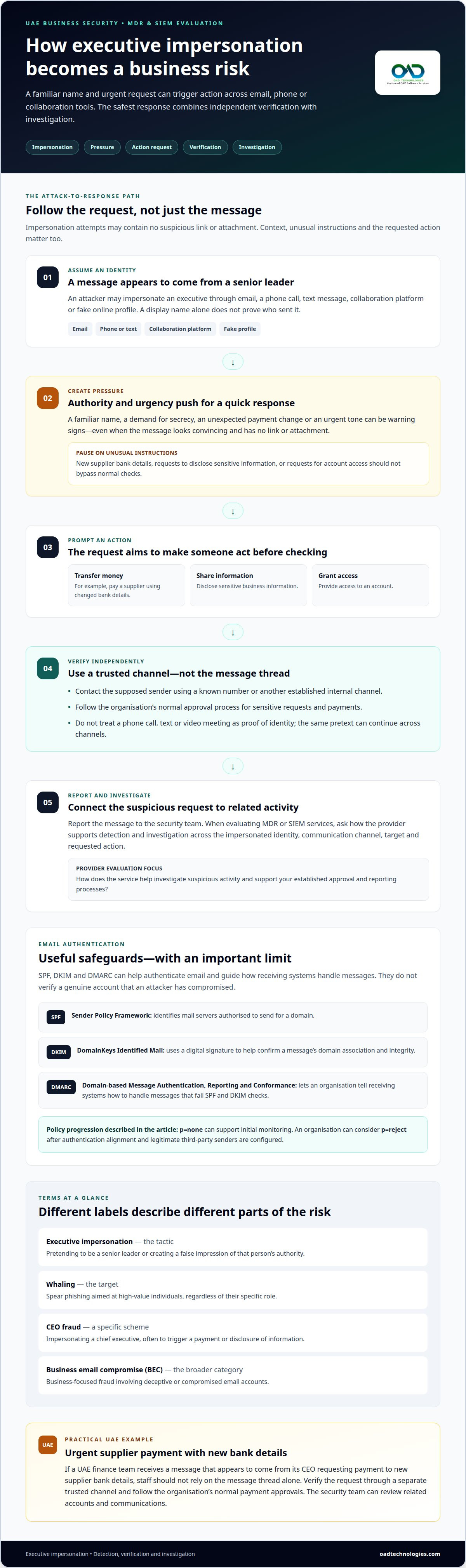
For example, if a UAE finance team receives an urgent message that appears to come from its CEO requesting a supplier payment to new bank details, staff should not rely on the message thread alone. They can verify the request through a separate channel and follow the organisation’s normal payment approvals. When assessing MDR or SIEM options, consider how they support the organisation’s processes for investigating such incidents. This article explains how these attacks work, how they differ from whaling and business email compromise, how to spot fake executive profiles, and how to verify requests in practice.
Key Takeaways
- When evaluating security services, compare how providers detect executive impersonation, whaling, CEO fraud and business email compromise.
- Assess phishing simulation and security awareness services for their fit with your employees, reporting processes and UAE/GCC operations.
- Evaluate how providers monitor executive profiles, lookalike accounts and domains, and investigate unusual behaviour.
- When selecting managed security services, check how they support independent verification of sensitive requests and appropriate approval controls.
- Compare SIEM, MDR, DLP and VAPT services for their ability to strengthen detection, response, data protection and security assessment.
1. How does an impersonation attack work?
Executive impersonation phishing is a targeted attempt to make an employee believe a message or request comes from a senior leader. The attacker uses that assumed authority to prompt a payment, disclose sensitive information or grant account access. The request may arrive by email, phone, text message or collaboration platform.
Business email compromise (BEC), often called CEO fraud when it impersonates a senior executive, commonly targets finance and operational teams. According to the FBI Internet Crime Complaint Center (IC3), in 2013 BEC scams often spoofed CEO or CFO email accounts to request wire payments to fraudulent locations. The technique has expanded beyond email, but the objective remains the same: persuade someone to act before checking the request.
Email authentication helps reduce domain spoofing. SPF identifies mail servers authorised to send for a domain, while DKIM uses a digital signature to help confirm a message’s domain association and integrity. DMARC lets an organisation publish how receiving systems should handle messages that fail SPF and DKIM checks. A p=none policy can support initial monitoring; organisations can consider p=reject after authentication alignment and legitimate third-party senders are configured. These controls strengthen email security, but they cannot verify a genuine account that an attacker has compromised.
Look beyond the display name. Check the complete sender address and domain for extra characters, substitutions or unfamiliar reply-to details. Treat sudden urgency, secrecy, unusual payment instructions and requests to change supplier bank details as warning signs. A link can also conceal a misleading destination, while a convincing email may contain no link or attachment at all. Follow the organisation’s normal approval process rather than relying on the message’s tone.
Attackers can continue the same pretext through voice calls, SMS messages, social media or video meetings. A cloned voice or deepfake video may seem to confirm an email, while a text can pressure an employee to move the conversation to a private channel. The communication method is not proof of identity. Use a known contact number or established internal channel to verify the person and request independently.
For example, a UAE-based company might receive an email apparently from its finance director asking for an urgent supplier payment to new bank details. Staff should pause the transaction, verify the change using a trusted contact method and obtain the approvals required by company procedure. Report suspicious messages to the security team, which can review related accounts and communications. This response helps contain the immediate request and gives the organisation information to investigate similar attempts.
2. Evaluating protections against executive impersonation, whaling, CEO fraud, and BEC
When evaluating anti-phishing protections, UAE organisations should consider the different attack patterns these terms describe. Executive impersonation is the tactic: a fraudster pretends to be a senior leader or creates a false impression of that person’s authority. Social engineering supplies the pressure, using a familiar name, sensitive business context or urgent request to influence an employee. The impersonated sender might appear in an email, phone call or another communication channel.
Whaling describes the target, rather than necessarily the person being impersonated. It is a form of spear phishing aimed at high-value individuals, regardless of their specific role. A threat actor might pose as a business partner to target a chief executive, or target a finance director with a request for confidential information. When comparing protections, check whether they address high-value targets as well as attempts to impersonate executives.
CEO fraud is a more specific label for schemes that impersonate a chief executive, often to trigger a payment or disclose information. The attacker may spoof an address, compromise a real account or use another channel. BEC, or business email compromise, is the broader category of business-focused fraud involving deceptive or compromised email accounts. When assessing a service, consider whether it can help identify CEO fraud and other BEC scenarios involving employees, suppliers or business contacts.
For a UAE organisation, these distinctions can help shape its requirements when selecting protections. A whaling attempt aimed at an executive calls for protections around that person’s accounts and sensitive access. A fraudulent invoice request impersonating a CEO requires finance procedures that independently verify payment instructions. A compromised supplier account may call for reviewing the full correspondence and confirming the request with a known contact. Ask providers how their services support investigation by target, impersonated identity, channel and requested action.
UAE cybersecurity and data-protection obligations depend on the organisation’s sector and circumstances. Under Article 9 of the UAE Personal Data Protection Law (PDPL), a controller must notify the UAE Data Office once aware of a qualifying personal data breach; the law sets no fixed number of hours. Regulated entities should also consider applicable sector requirements, including those set by the Central Bank of the UAE for financial services.
When comparing anti-phishing services, review how they track reports, successful simulations, compliance with verification procedures, time to detection and incidents involving compromised accounts or fraudulent payments. Compare these indicators over time and consider them alongside the effort needed to investigate alerts and support employees.
For example, a UAE-based finance team can record whether staff independently verify changed supplier details and whether suspicious messages reach its security team. Reviewing those results can expose gaps in communication, approval steps or detection coverage. Organisations assessing their anti-phishing controls and incident readiness can use these measures to focus improvements on their actual exposure.
3. How can UAE organisations evaluate phishing awareness services?
Executive phishing targets senior employees or uses their identities to deceive colleagues. An attacker may seek login credentials, confidential records, sensitive information or a payment. When evaluating a UAE security awareness service, organisations can assess whether it helps employees recognise these approaches, pause before acting and report suspicious communication through an established channel. The service should cover executives as potential targets and impersonated senders, not just general staff.
Role-based security awareness services connect scenarios to each team’s real decisions. Finance employees can practise handling urgent payment requests and supplier detail changes. Executive assistants can learn to scrutinise meeting invitations, document-sharing requests and messages claiming to come from leadership. Senior leaders need guidance on account security and the confidential information they share publicly. Tailoring examples to each role makes the appropriate response clearer.
Phishing simulations let employees practise with controlled examples and then review the cues they missed. A simulation might show a message from a lookalike domain requesting an urgent payroll file. Another could imitate a senior leader asking staff to share a confidential document. When choosing a service, assess whether it supports constructive review of results, rather than shaming people who interact with an exercise.
Ask providers how their service explains the decision points: inspect the full sender address, question an unexpected request, avoid entering credentials through an unfamiliar link and report the message. Training should also explain what to do after a mistake. Employees need a clear reporting route and prompt guidance to change exposed credentials or alert the security team. Timely reporting gives responders useful details, including the message, account and action taken.
For a UAE organisation evaluating a phishing awareness service, a practical exercise could simulate a message apparently sent by a UAE-based executive requesting a confidential client file before a meeting. Staff should verify the request using established internal procedures and report suspicious messages, rather than sending the file immediately. The exercise can test whether employees recognise a mismatched domain, identify pressure to act quickly and know where to report the attempt.
Security awareness services work best as part of a continuing process, not a one-off presentation. Review how the service reports simulation outcomes, employee reports and recurring errors, and whether those findings can identify which roles need more practice. Scenarios should be updated when the organisation’s processes or communication channels change. For example, repeated confusion over payment requests may point to a need for clearer approval steps alongside further training.
Assess service outcomes through practical behaviours: whether employees report simulated messages, follow verification procedures and avoid entering credentials on suspicious pages. Use the findings to refine the next exercise and address gaps without blaming individuals. When employees understand how to respond to targeted phishing attacks, they become active participants in protecting the organisation’s accounts and sensitive information.
4. How can companies select security services to detect fake executive profiles online?
When evaluating managed security services, ask providers how they detect and investigate impersonation targeting executives. Compare their coverage of account names, handles, biographies, photographs and work histories against established executive profiles. A recently created account, copied profile image, sparse activity or unusual spelling can indicate impersonation, especially when it contacts employees unexpectedly. Check whether the profile links to the organisation’s legitimate domain and established accounts. Treat these clues as reasons to investigate, not proof on their own.
Assess whether the service reviews communication behaviour as well as appearance. A fake profile may quickly request confidential documents, introduce a new payment process or pressure an employee to move a conversation into private messaging. Compare the request with the executive’s usual communication patterns and the organisation’s normal business procedures. A sudden change in tone, channel or requested action deserves scrutiny, even when the profile seems familiar.
Ask how a provider identifies impersonation infrastructure beyond social media. Attackers may create lookalike domains, register addresses resembling an executive’s name or misuse leaked credentials. Security teams can monitor for domains that imitate the organisation’s legitimate spelling, then assess whether suspicious messages or accounts reference them. They should also review employee reports and connect related indicators, such as similar profile names, sender addresses and payment instructions.
When implementing detection services, consider how behavioural signals add context that a profile review alone cannot provide. Security teams can investigate unusual account sign-ins, unexpected access to sensitive files, new forwarding rules or communications that differ from established patterns. These events may have legitimate explanations, so analysts should correlate them with other signals before deciding whether activity is malicious. An alert linking an unusual login with an unexpected executive payment request, for example, warrants prompt investigation.
Check whether the service supports verification procedures for deepfake audio and video. Visual or vocal cues can be misleading, so employees should not rely on appearance alone to confirm an executive’s identity. Test response procedures with simulations that include a voice message or video call requesting a sensitive action. The exercise should assess whether staff pause, follow approval steps and use a trusted channel to confirm the request.
AI-assisted detection can help security teams prioritise suspicious messages and account activity, but it should support, not replace, human review. Ask providers how correlated alerts identify connected threats across email, endpoints and user accounts. Extended Detection and Response can bring security signals together for investigation, helping teams determine whether a suspicious profile coincides with other activity.
For a UAE organisation choosing a managed detection service, a practical evaluation is to ask how it would record impersonating profiles, suspicious domains and associated messages in a single incident record. Security staff can compare the indicators, alert affected employees and follow internal procedures for reporting and containment. The record helps distinguish a legitimate executive account from a malicious copy and supports detection of repeat attempts.
5. Choosing security services for payment verification
UAE organisations evaluating managed security services should check how the provider supports controls for urgent payment and sensitive-information requests. Ask whether its service can help teams identify suspicious messages, route reports to the right staff and review activity across relevant communication channels. The service should support, not replace, the organisation’s approval process.
When comparing providers, assess how they handle impersonation attempts involving familiar display names, copied signatures or convincing caller ID. Ask how analysts help investigate unusual requests and what information the organisation needs to provide. Confirm that the service fits existing processes for contacting executives and checking instructions through established channels.
Before implementation, map payment, confidential-information and supplier-detail approvals to the service’s monitoring and incident-handling processes. Document which roles can authorise these actions and when a second approval is required under internal policy. Agree how reported requests and approval exceptions will be reviewed, so the service reinforces existing controls rather than bypassing them.
- Assess coverage: Identify the communication channels and business processes the service will monitor.
- Review reporting: Confirm how staff can submit suspicious requests to the provider or security team.
- Agree escalation: Define how suspected impersonation and payment-change requests reach authorised staff.
- Integrate approvals: Ensure the service supports documented confirmation and second-authorisation processes.
- Measure performance: Review reported requests, verification outcomes, approval exceptions and suspicious sender details.
For supplier payment-detail changes, confirm that the provider’s service supports the organisation’s existing verification and escalation procedures. Finance staff should still contact suppliers through established business contacts, confirm changes with authorised representatives and follow documented approvals. An email reply or a new phone number in a message should not count as independent confirmation.
When assessing protection against CEO fraud by phone or video, ask how the service helps staff report suspected impersonation and how alerts are handled. Agree how urgent requests are escalated without bypassing controls. The organisation should continue to verify legitimate instructions through established processes.
During implementation, agree which records the service will help teams review, including reported requests, verification outcomes, approval exceptions and suspicious sender details. Use these records to assess whether monitoring and employee guidance suit the organisation’s risks. A provider should explain how it will share relevant patterns with the security team without weakening established payment procedures.
For example, a UAE logistics company implementing a managed security service can agree how an unexpected supplier bank-detail change is reported and escalated. Finance staff can pause the update, call their existing supplier contact and document the confirmation, while reporting any mismatch or pressure to bypass approvals. This gives finance and cybersecurity teams a clear record to review.
OAD Technologies
OAD Technologies helps organisations strengthen their response to executive impersonation through complementary cybersecurity services. The first line of defence is email security: OAD deploys and manages Mimecast and Trustifi, its trusted email security partners, to detect impersonation attempts, lookalike domains and display-name spoofing, enforce DMARC alignment and support security awareness training for staff. When suspicious activity needs broader visibility, Security Information and Event Management (SIEM) and Managed Detection and Response (MDR) can support the monitoring and investigation of security events. CrowdStrike endpoint protection helps detect follow-on compromise of user devices, Data Loss Prevention (DLP) helps address risks involving sensitive information, and Vulnerability Assessment and Penetration Testing (VAPT) can assess security weaknesses relevant to an organisation’s exposure. OAD holds ISO 9001, ISO 14001, ISO 45001 and ISO/IEC 27001 certifications and backs its SOC with sub-15-minute response times.
These services are most useful when an organisation needs to assess its detection coverage, protect confidential data or understand vulnerabilities that could enable an attack. The right combination depends on existing controls, business processes and risk priorities. For UAE teams reviewing how their security measures address executive impersonation, contact OAD Technologies to discuss the organisation’s requirements.
Make verification part of everyday operations
For UAE organisations assessing managed security services, executive impersonation phishing should be considered as part of broader detection and response requirements. When comparing providers, evaluate how their service supports reporting, investigation and escalation of suspicious contact, and how it fits with your existing finance and approval processes.
For example, a UAE business reviewing MDR options can ask providers how they would help investigate a message requesting a supplier’s revised payment details and coordinate with finance before action is taken. This gives decision-makers a practical basis for evaluating service coverage against business risks.
Compare service scope, response processes and implementation requirements to find an approach that suits your organisation. OAD’s security experts can help you assess relevant options for your UAE operations.
Evaluate how a security service can support your organisation’s response to impersonation risks and fit its day-to-day operations.
Frequently Asked Questions
How does an impersonation attack work?
An impersonation attack uses a false identity to make someone trust a request or share access. For example, a message may appear to come from a director asking an employee to review a confidential document. The attacker may be seeking credentials, data or a business action. If an attack is suspected, preserve the message and related communications so the security team can investigate the identity and request.
What is CEO fraud?
CEO fraud is a scam in which a criminal pretends to be a chief executive to influence an employee’s decision. A common scenario involves a request presented as an executive priority, such as paying an invoice or sending a document. The name alone does not determine whether a request is genuine. Employees should follow the organisation’s standard authorisation process, even when a message seems to come from the top.
What is email impersonation, and why does it matter?
Email impersonation is a deceptive message designed to look as though it came from a trusted person or organisation. It matters because recipients may trust a familiar name, logo or writing style without examining the message’s context. For example, a copied signature can lend credibility to a request the purported sender never made. Treat identity cues as signals to assess, not proof of legitimacy.
What is executive phishing?
Executive phishing targets senior leaders or uses their identities to pursue access, information or business actions. A targeted message might refer to a board meeting or internal project to make its request seem plausible. Executives can be targets themselves, while colleagues may be targeted through their apparent authority. Include leadership communications and sensitive executive accounts in security awareness planning.
Can hackers spoof an email address of your own domain?
Yes. Attackers can make a message appear to use an organisation’s domain, but a displayed sender address alone does not prove that the message came from its mail system. Recipients should report suspicious messages rather than rely on the visible name or address. Security teams can examine message details and authentication results to distinguish spoofed mail from legitimate communications or activity involving a compromised account.
How can companies detect fake executive profiles online?
Compare a suspicious profile with the executive’s established public presence, including its account name, employment details and prior posts. A copied photograph or similar username can be a clue, but neither proves fraud on its own. For example, an account claiming to represent a finance director and asking employees to join a private chat merits investigation. Record the profile details and report it through the organisation’s security process.
What is whaling?
Whaling is a type of targeted phishing aimed at high-value individuals, such as senior executives. The attacker may impersonate a supplier or business contact instead of pretending to be the executive. For example, a leader might receive a tailored message requesting access to a confidential project file. The term describes the target of the attack, while the false identity and requested action provide separate clues for assessment.
Disclaimer
Content by OAD Technologies is for general informational purposes only and does not constitute professional or cybersecurity advice. No warranties are made regarding accuracy or completeness; reliance is at your own risk. OAD Technologies shall not be liable for any direct or indirect losses arising from use of this content.