
A threat can move through a network without triggering a clear perimeter alert. Network detection and response in the UAE helps security teams examine network traffic, spot suspicious activity and investigate potential incidents that other controls may not reveal.
It makes sense to want more than another stream of alerts. Security teams need context to judge which activity matters and where to focus. Network detection and response (NDR) can bring network signals into investigations and help prioritise risks according to their potential impact.
For example, a UAE organisation with office systems, cloud workloads and remote users can use network visibility to trace unusual communications across those environments. This article explains what NDR does, how it supports incident response and risk prioritisation, and what to assess when evaluating integrations, network coverage and potential attack paths. The aim is to help decision-makers connect detection capabilities with the systems, workflows and business risks they need to manage.
Key Takeaways
- Understand how network traffic analysis and behavioural detection help surface suspicious activity that perimeter controls may miss.
- See how network context can help security teams investigate incidents, organise alerts and prioritise risks.
- Learn how NDR has developed from traffic analysis into a capability that supports threat detection and response.
- Assess whether integrations with tools such as EDR, SIEM and XDR can connect network signals to existing security workflows.
- Consider how visibility across cloud, hybrid and connected environments can help reveal attack paths and inform network security decisions.
What is network detection and response (NDR)?
Network detection and response (NDR) analyses network traffic to identify suspicious activity and support security investigations. For organisations assessing network detection and response in the UAE, its value depends on which traffic it can observe and how its findings fit existing security operations.
NDR definition and behavioural traffic inspection
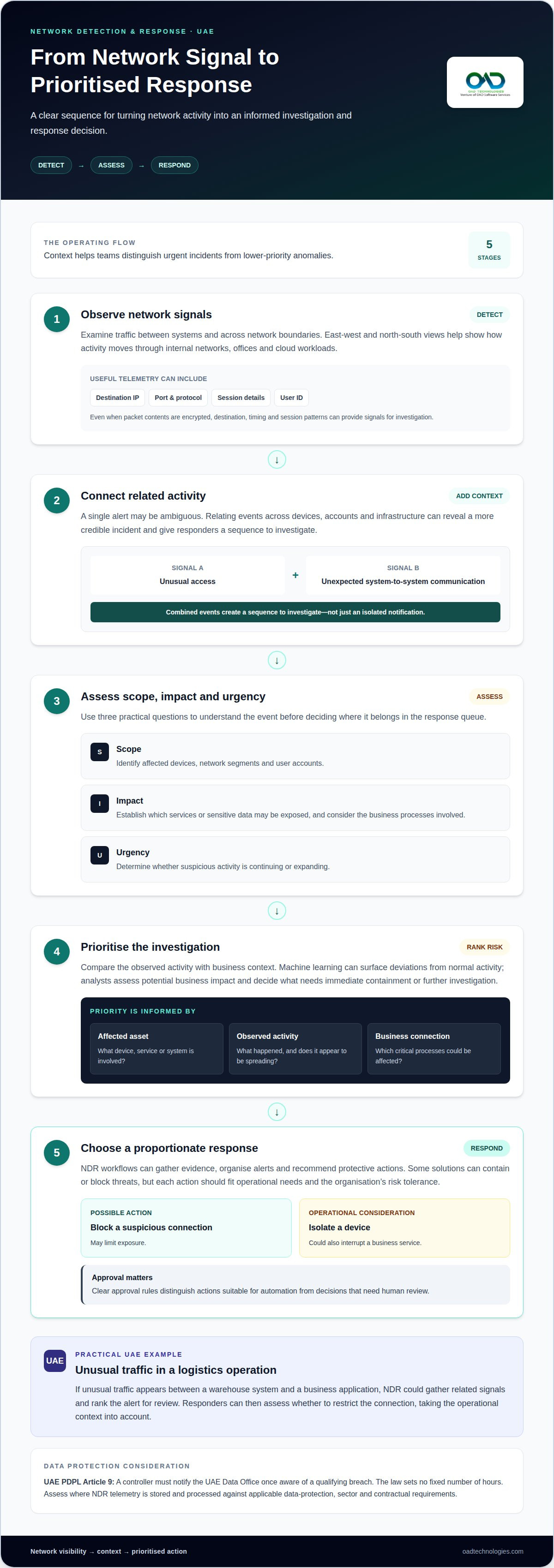
NDR examines traffic between systems and across network boundaries to identify activity that may warrant investigation. This gives an enterprise context about communications, rather than alerts at its perimeter alone. Sensors can passively observe traffic, while telemetry such as destination IP, port, protocol, session details and user ID helps analysts understand which devices communicated and how.
East-west and north-south monitoring
East-west monitoring tracks traffic between internal systems, while north-south monitoring follows traffic entering or leaving a network. Both views help teams understand how activity moves through an environment. An external connection may indicate initial access, while later exchanges between internal servers can reveal movement between systems. For a hybrid enterprise, tracing both directions helps connect activity across office networks and cloud workloads.
Network traffic analysis techniques
NDR can combine flow analysis, deep packet inspection, signature recognition and behavioural analytics to identify patterns for investigation. Flow records show which systems communicated, when and through which protocol; signatures can match known threat indicators. Behavioural analysis adds context by flagging deviations, such as an unusual traffic spike that could indicate a denial-of-service attempt.
Network traffic analysis originally extracted models from raw traffic data. Gartner renamed the network traffic analysis category NDR in 2020, as behavioural analysis and threat response capabilities became part of the category. This shift reflects a move from describing traffic patterns towards using those patterns to detect and investigate potential threats.
Encryption can limit visibility into packet contents, but connection metadata still provides useful signals. NDR can examine destination, port, protocol, timing and session patterns without relying solely on readable payloads. Repeated connections to an unusual destination, for example, can prompt investigation even when the traffic itself is encrypted.
In the UAE, NDR can help an enterprise map communications across its infrastructure and cloud services. This can inform network security decisions by revealing observed traffic paths, rather than relying only on intended connection diagrams. For example, teams can assess whether communications between a business application and a cloud workload fit operational needs, then use those observed relationships to guide infrastructure security decisions.
Incident response and risk prioritisation
NDR helps security teams connect network alerts with incident context, then prioritise investigation and response. For personal data, UAE PDPL Article 9 requires a controller to notify the UAE Data Office once aware of a qualifying breach; it sets no fixed number of hours. Assess where NDR telemetry is stored and processed against applicable data-protection, sector and contractual requirements.
Cyber incident detection
Cyber incident detection uses network signals to identify activity that may indicate compromise. A single alert can be ambiguous, but related events across devices, accounts and infrastructure can point to a more credible incident. For example, unusual access followed by unexpected communication between systems gives responders a sequence to investigate, rather than an isolated notification without context.
Risk prioritisation turns signals into a reasoned order of work. Teams can consider the affected asset, the activity observed, its connection to critical business processes and whether the event appears to be spreading. Machine learning can help surface deviations from normal activity, while analysts assess business impact and decide whether an alert needs immediate containment or further investigation.
- Scope: identify affected devices, network segments and user accounts.
- Impact: establish which services or sensitive data may be exposed.
- Urgency: determine whether suspicious activity is continuing or expanding.
These factors help cybersecurity teams distinguish urgent incidents from lower-priority anomalies, rather than treating every alert as equally serious.
Automated incident response
Automated incident response uses predefined workflows to collect evidence, organise alerts and recommend protective actions. This can help security teams coordinate across several environments while limiting unnecessary disruption. An NDR workflow could enrich an alert with related network activity and send it into an established investigation process, giving responders more context.
Some NDR solutions can automatically contain or block threats, but response actions should reflect the organisation’s risk tolerance and operational needs. Blocking a suspicious connection may limit exposure; isolating a device could also interrupt a business service. Clear approval rules help teams distinguish actions suitable for automation from decisions that need human review.
Consider a UAE logistics operation where unusual traffic appears between a warehouse system and a business application. NDR could gather related signals, rank the alert for review and inform a decision about restricting the connection. This helps responders investigate the incident and understand its scope before choosing broader action.
For UAE organisations, data residency assessment should include the content of telemetry, its storage and processing locations, and applicable sector obligations. To discuss how incident prioritisation can fit your environment, talk through your NDR requirements.
Evaluating NDR coverage for UAE and GCC networks
When evaluating NDR, UAE and GCC buyers should focus on the network areas it can monitor, the telemetry it collects and how its alerts fit existing security operations. Deployment choices affect visibility across internal systems, network boundaries and cloud workloads.
Assessing NDR deployment and visibility
Review where sensors will observe traffic and whether the deployment can cover communications between systems and across network boundaries. Ask which telemetry is available, including destination IP, port, protocol, session details and user ID, and how analysts can use it to identify communicating devices. These criteria help buyers assess whether a proposed deployment provides useful visibility beyond perimeter alerts.
Checking coverage and analysis methods
Confirm that the deployment covers both east-west and north-south traffic, and ask the provider to demonstrate how flow analysis, behavioural detection and encrypted-traffic metadata are combined in a real investigation, rather than relying on a feature list.
In a UAE enterprise, combining these traffic views can help teams map communications across local infrastructure and cloud services. For example, a buyer assessing NDR coverage can check whether the proposed deployment shows traffic paths across both environments. Network infrastructure security decisions can then account for observed traffic paths, instead of relying only on a diagram of intended connections.
Evaluating NDR solutions and integrations
Evaluate NDR by how well it fits your deployment, integrates with security tools and covers your changing environment.
Cloud, on-premises and hybrid NDR
Cloud, on-premises and hybrid NDR describe where monitoring components and analytics operate. The right model depends on network coverage, data handling and existing infrastructure. A business with cloud workloads may need visibility there as well as across its office network; an organisation with sensitive systems may consider where telemetry is processed and stored. Hybrid designs can span both environments.
NDR vendors in the UAE
UAE organisations can assess NDR solutions by their deployment model and ability to interoperate with EDR, SIEM, XDR and SOAR. Rather than selecting a solution based on a feature label alone, map its supported integrations to the tools security teams already use. This shows whether threat information can reach the right workflow and whether the solution can scale as devices and network connections grow.
Integration should make existing cybersecurity operations more useful, not create disconnected alerts. EDR adds endpoint activity; SIEM can correlate network signals with other security events. XDR can bring multiple security sources together, while SOAR can help structure response workflows. During an evaluation, trace a sample alert from network detection through investigation and escalation. Confirm that its context and status remain clear at each hand-off.
Coverage also depends on what the platform can see. Unmanaged assets may communicate across the network without appearing in an endpoint inventory, so network telemetry can help identify their connections and behaviour. For example, an unfamiliar device communicating with a business server should appear as a relationship to investigate. Assess whether the solution distinguishes observed assets and traffic patterns clearly enough to support proactive risk reviews.
Scrutinise machine-learning claims. Evaluate whether detection models use data with enough variety, volume and velocity to reflect the organisation’s actual traffic. A model based on limited patterns may struggle when a UAE business adds cloud services, new branches or different device types. Ask how the solution uses network data to adapt detection and how analysts can understand why an alert was raised.
A practical evaluation can follow one scenario: a new cloud workload communicates with an endpoint, triggering an NDR alert. Check whether EDR or SIEM receives useful context, whether the event can be prioritised, and whether response actions fit existing approval processes. For a cloud-first organisation, also assess telemetry storage and processing alongside network coverage. Discuss NDR integration requirements before choosing a deployment model.
Network visibility and attack path tracing
Network visibility gives security teams a view of connected assets, users and data flows. Attack path tracing uses these relationships to show how suspicious activity could move between systems.
Cloud and hybrid network visibility
Cloud and hybrid visibility monitors network activity across cloud services and on-premises infrastructure. This matters because an organisation’s systems and data flows can span both environments. In a UAE business with offices and cloud-hosted applications, a view limited to office traffic may miss connections between cloud workloads and internal systems.
Coverage also matters for connected devices and operational technology, including devices with limited built-in security controls. Monitoring their network connections can show which systems communicate and where unexpected paths appear. For example, a facilities device connecting to a business application may warrant review if that link does not fit its operational role.
Organisations can use this visibility alongside zero-trust capabilities to understand assets, user behaviour and data flows. That context helps teams assess whether access between a user, device and application fits the expected business relationship. In a hybrid environment, the same review can connect activity across local infrastructure and cloud services.
Real-time network visibility
Real-time network visibility means monitoring traffic as activity occurs, rather than relying only on periodic reviews. This matters because a developing attack can create a changing sequence of connections. For a UAE organisation, observing activity across office networks and cloud workloads can help security teams investigate unusual communications while those systems remain in use.
Traffic context can include destination, protocol, session details, device role and user identity. Together, these details help analysts interpret an alert and distinguish an unfamiliar but legitimate connection from a possible threat. A sudden change in a server’s communication pattern, for instance, can prompt investigation of related connections and affected assets.
Attack path tracing connects these observations to show potential movement through an environment. Teams can follow a path from an account to a device, then to connected systems and data flows. This helps reveal which assets may be exposed and which connections to investigate first, rather than treating every network alert as an isolated event.
For example, a UAE hospital could map connections between clinical devices, administrative systems and cloud applications. If an unexpected link appears, analysts can assess its reach and operational implications. This view supports informed decisions about access and segmentation without assuming every connection signals an attack.
As organisations expand cloud services or add connected devices, visibility should extend to new traffic paths. Combining asset relationships, user behaviour and network activity helps teams understand how an attack could progress and where to focus investigation. Organisations planning this coverage can talk to a security expert about their environment.
OAD Technologies: Network Security Solutions
OAD Technologies provides Network Security Solutions to help UAE organisations address network security needs. Consider this capability when you need to strengthen network protection or align monitoring with your infrastructure and risk priorities.
OAD’s 24 X 7 SIEM/SOC correlates network signals with endpoint and identity events and responds within 15 minutes. Managed Detection and Response (MDR) is built on CrowdStrike endpoint protection, with Sangfor EDR, XDR and MDR, including Sangfor’s network detection capabilities, as an alternative. Zero Trust access and segmentation limit how far an attacker can move. Data Loss Prevention (DLP) focuses on reducing the risk of sensitive information leaving the organisation, while Vulnerability Assessment and Penetration Testing (VAPT) helps identify security weaknesses for assessment. OAD holds ISO 9001, ISO 14001, ISO 45001 and ISO/IEC 27001 certifications. The right combination depends on your environment, operational needs and the risks under review.
To discuss your network security requirements, contact OAD Technologies.
Shape your next network security decision
For network detection and response in the UAE, start by connecting security priorities with the environment they protect. Define which business systems matter most, how network activity supports them, and who will assess alerts and coordinate action. This gives technical teams and decision-makers a shared basis for shaping an approach that fits operational needs.
OAD Technologies can align Network Security Solutions with related requirements through Managed Detection and Response (MDR), Data Loss Prevention (DLP) and Vulnerability Assessment and Penetration Testing (VAPT). These capabilities address different parts of security, from response and data protection to identifying weaknesses. Their relevance depends on your organisation’s network, risk priorities and existing security processes.
A focused discussion can turn evaluation criteria into a practical direction for your environment. Bring your team’s questions about coverage, integrations and response ownership to guide the next decision.
A clear, well-scoped decision provides a sound foundation for evolving security with confidence.
Frequently Asked Questions
How should UAE organisations assess their need for NDR?
When evaluating NDR in the UAE, consider whether your team needs more network-level context to investigate suspicious activity. Organisations with distributed systems, cloud workloads or connected devices may need to assess how well a solution covers their traffic. Before choosing one, check whether your team can review and act on its alerts, and whether its coverage addresses a visibility gap left by existing controls.
What should buyers check about NDR coverage and integration?
Compare how each NDR solution collects network observations, analyses activity and presents findings for investigation. Check which parts of your environment its sensors can observe, and how its findings can be used alongside existing security information. If activity looks unusual, the solution can raise an alert or support a response workflow. Confirm that analysts can assess the context, determine business impact and decide on an appropriate action.
Which NDR capabilities matter for UAE and GCC organisations?
Prioritise capabilities that give security teams useful context about network activity and help them investigate alerts. Consider whether the solution can show relationships between systems and help with risk prioritisation when an event involves several assets or unusual data flows. For example, a UAE organisation reviewing a suspicious connection can use network records to identify related communications and give incident responders a clearer starting point for investigation.
What network visibility gaps should an NDR purchase address?
Assess whether NDR can address visibility gaps across your connected environments. A solution may surface unexpected traffic patterns, suspicious internal connections and activity involving devices that may not provide endpoint telemetry. It does not remove the need for investigation or sound security controls. When comparing options, consider whether the network evidence they provide will help your team assess possible threats and their potential reach.
How should NDR fit into a UAE SOC?
NDR can provide network evidence to a security operations centre (SOC), alongside endpoint and other security information. When evaluating a solution, check whether documented triage criteria can help analysts decide which alerts need investigation, escalation or containment. Define who owns each decision and how NDR findings support existing incident procedures. This makes network evidence part of coordinated operations rather than a separate queue.
Who owns NDR investigation and response?
NDR monitors network activity, identifies patterns that may signal threats and helps security teams investigate them. It can provide context about communications between devices, applications and services, then organise findings for review or response. Before implementation, agree who will review alerts and own response decisions. Analysts remain responsible for interpreting the evidence and selecting appropriate actions.
Disclaimer
Content by OAD Technologies is for general informational purposes only and does not constitute professional or cybersecurity advice. No warranties are made regarding accuracy or completeness; reliance is at your own risk. OAD Technologies shall not be liable for any direct or indirect losses arising from use of this content.