A lower firewall quote can carry a higher long-term cost if it leaves implementation, maintenance or monitoring outside the monthly fee. In the UAE, what managed firewall services cost depends on the scope of management, network capacity, number of sites and whether the arrangement includes equipment or ongoing support.
It’s reasonable to compare the recurring cost of a managed service with the upfront investment in firewall equipment. Look beyond the monthly fee: consider what the service monitors and maintains, how traffic affects the design, and which costs continue over time.
This guide explains what managed firewall services can include, how service scope and bandwidth affect pricing, and how capital expenditure compares with operating expenditure. It also offers a practical UAE business example and a decision guide to help you assess which model fits your network and operational priorities.
Key Takeaways
- Assess what management covers, including configuration, monitoring and support, so the quoted service scope is clear.
- Account for implementation and policy configuration separately from recurring maintenance and subscription fees.
- Compare equipment ownership with a managed operating-cost model over the period you expect to use the firewall.
- Bandwidth, site count and pricing by device, user or capacity can all shape the service design and its overall cost.
- Use a UAE business scenario to map network requirements and operational priorities to a suitable cost model.
What do managed firewall services actually include?
Managed firewall services may cover configuration, monitoring, rule changes, firmware maintenance and incident response, depending on the agreement. Before comparing models, review the service scope and SLA for responsibilities, escalation steps, exclusions and availability.
Implementation and configuration costs
Implementation involves more than installing hardware. Engineers map network flows, migrate existing rules, set access policies and test business applications. Configuration complexity varies between a single office and a UAE business connecting branches, cloud workloads and remote staff. Undocumented rules or overlapping network segments can extend migration work and require extra testing before traffic moves.
Hardware and firewall-as-a-service costs
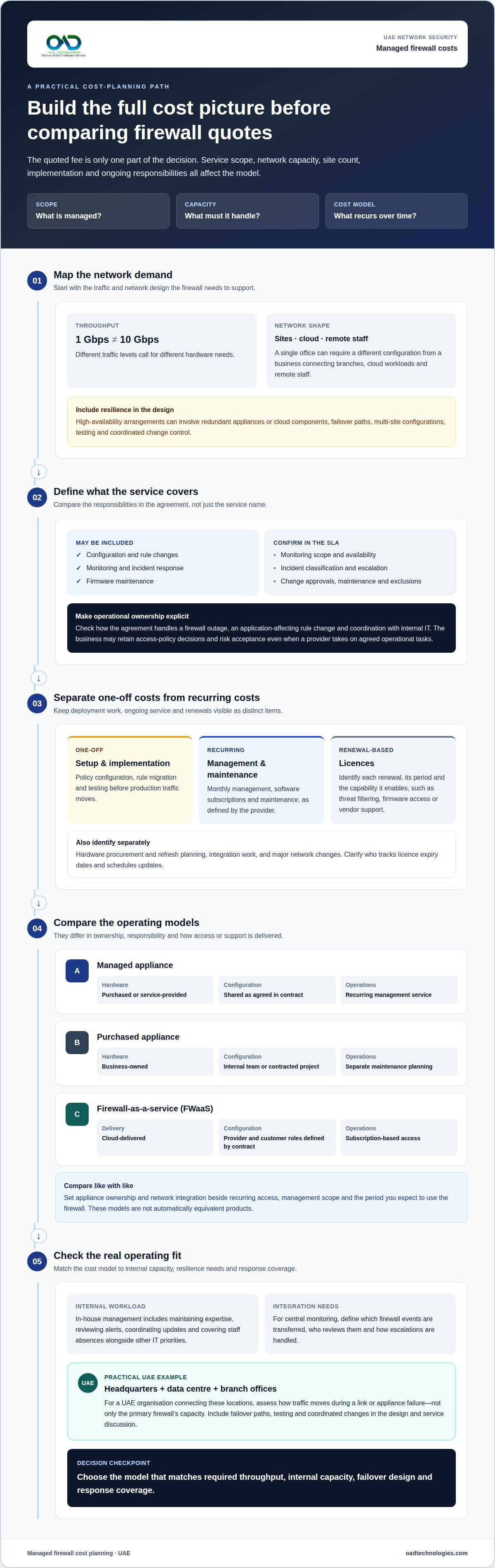
A purchased appliance places hardware selection and refresh planning with the business; firewall-as-a-service (FWaaS) shifts the model towards a subscription tied to cloud-delivered capacity. The required throughput matters: a firewall processing 1 Gbps of traffic has different hardware needs from one processing 10 Gbps. Compare appliance ownership and network integration with recurring access and management scope, rather than treating either model as a like-for-like product.
Service contracts and SLAs
Contracts and service-level agreements (SLAs) vary in how clearly they assign operational duties. Look for defined monitoring scope, incident classification, response and escalation procedures, change approvals, maintenance responsibilities and exclusions. Check how the agreement addresses a firewall outage, an application-affecting rule change and coordination with internal IT. These terms show what the service delivers when network security needs attention.
In-house management involves operational costs beyond an engineer’s salary. Staff need to maintain firewall expertise, review alerts, coordinate updates and cover absences, all alongside other IT priorities. A managed service can take on agreed tasks, while the business retains decisions such as setting access policies and accepting risk.
Enterprise high-availability designs add complexity through redundant appliances or cloud components, failover paths and multi-site configurations. Each element needs testing and coordinated change control. A UAE organisation connecting its headquarters, a data centre and branch offices should account for how traffic moves during a link or appliance failure, not just the primary firewall’s capacity.
| Option | Hardware ownership | Configuration responsibility | Operational model |
|---|---|---|---|
| Managed appliance | Purchased or service-provided | Shared as agreed in contract | Recurring management service |
| Purchased appliance | Business-owned | Internal team or contracted project | Separate maintenance planning |
| FWaaS | Cloud-delivered | Provider and customer roles defined by contract | Subscription-based access |
Choose a model that matches your required throughput, internal capacity, failover design and response coverage.
Maintenance and subscription fees
Recurring firewall charges may combine service management, software subscriptions and maintenance, but providers define these items differently. For UAE businesses, separate the monthly management fee from licence renewals and integration work. This clarifies the operating budget and shows which capabilities continue if the service scope changes. A clear breakdown also helps procurement distinguish recurring obligations from deployment work or major network changes.
Annual licence renewals
A firewall licence may enable capabilities such as threat filtering, firmware access or vendor support. Renewal terms depend on the appliance and subscription model, so identify each licence, its renewal period and the function it enables. An organisation with firewalls across several UAE sites can map each renewal to the device and capability it supports, rather than treating every licence as a general maintenance cost.
Establish who tracks expiry dates and applies updates. If internal IT owns renewals, assign responsibility for checking the vendor portal and scheduling changes. If a provider manages them, the agreement should state whether renewal administration and deployment are included. These distinctions affect ongoing workload even when licences remain a separate charge, and clarify who coordinates updates with business teams.
Setup and implementation fees
Setup is a one-off cost, separate from monthly service fees and annual renewals. It may cover initial policy configuration, migration from an existing firewall and testing before production traffic moves. Replacing an older appliance may require rule reviews and application testing, while a new site may need configuration tailored to its network design and approved access requirements.
Separate implementation labour from hardware procurement, subscription activation and ongoing management. This helps finance teams distinguish initial project expenditure from recurring operating costs. In an enterprise rollout, staged deployment across sites can affect the schedule and the internal teams needed for each transition. Recording these tasks makes the implementation scope easier to compare with the recurring service.
Integration and recurring scope
Integration can add work when firewall alerts or records need to connect with existing security tools. The effort depends on log formats, access permissions and the internal security team’s reporting requirements. A retailer linking branch firewalls to a central monitoring process, for example, should define which events are transferred, who reviews them and how escalations are handled.
Check whether the monthly subscription covers configuration changes, routine maintenance, reporting and support coordination. A lower recurring fee may cover fewer tasks, while broader capabilities can change the service scope. Record included activities alongside exclusions, renewal responsibilities and the process for approving additional work. This gives you a clearer view of the full operational commitment.
- List each firewall licence and renewal period.
- Separate one-time setup from monthly management.
- Document integration tasks and the team responsible for them.
- Match the subscription scope to required reporting and maintenance.
For a UAE organisation planning a renewal or network change, this breakdown gives procurement and IT a shared view of recurring obligations. To discuss the cost factors for your environment, get in touch about your firewall requirements.
Capital expenditure versus operating expenditure
Firewall ownership and managed services place costs in different budget periods. Capital expenditure (CapEx) funds equipment upfront, while operating expenditure (OpEx) spreads costs through recurring service or subscription payments. Compare total cost of ownership over a 3-5 year horizon, including equipment, renewals, implementation, internal labour and support. A lower initial outlay alone doesn’t show which model costs less over time.
How the two models affect budgeting
With CapEx, an organisation buys hardware and manages its lifecycle. This gives internal teams direct control over configuration and capacity, but also makes them responsible for maintenance, renewal planning and replacement. Managed services shift some operational tasks into a recurring expense. The agreement determines which duties move, so assess the monthly fee alongside the work that remains in-house.
Firewall equipment is typically refreshed on a multi-year cycle, making the replacement schedule relevant to long-term budgeting. A purchased appliance can create a larger budget requirement when replacement falls due. An operating model can distribute service costs over time, but recurring fees continue throughout the agreement. Include licence renewals and any separate integration or support charges in either comparison.
| Cost criterion | CapEx ownership | OpEx managed model |
|---|---|---|
| Initial budget | Equipment purchase and deployment | Service start-up and any included equipment terms |
| Ongoing costs | Licences, maintenance and internal effort | Recurring service, subscriptions and excluded tasks |
| Operational responsibility | Primarily internal, based on team capability | Allocated between provider and organisation by contract |
| Refresh planning | Organisation plans replacement cycle | Agreement defines equipment and lifecycle responsibilities |
A UAE retailer with a main office and branches across the country, for example, could compare buying appliances for each site with a managed arrangement. First map site connectivity, traffic growth and application dependencies. Then finance can model the same operating period, including replacement planning, licences and staff time. This avoids comparing a hardware-only purchase with a service that includes ongoing operational work.
Account for hidden internal expense
In-house ownership requires staff to review firewall alerts, maintain rules and coordinate updates. Those hours remain a cost even when there is no new invoice. If endpoint threats also need investigation, firewall administration can compete with other security work. Include internal effort in the comparison, then assess whether managed coverage changes those responsibilities or simply adds another layer.
Choose CapEx when direct ownership and internal operating capacity align with the organisation’s needs. Consider OpEx when predictable recurring budgeting and delegated operational tasks matter more, after reviewing the agreement’s scope. For either model, compare the same 3-5 year horizon and include refresh, licensing, implementation and internal effort.
Managed firewall service price ranges
Managed firewall services cost depends on service scope, network scale and monitoring depth, not just the number of appliances. For UAE buyers, compare what each tier covers: routine rule administration, security inspection, alert handling, reporting and incident response. A monthly quote is useful only when its inclusions and exclusions are clear.
What separates service tiers?
A basic tier may focus on routine firewall administration and scheduled reviews. A broader service may add continuous monitoring, policy changes and response coordination. Enterprise arrangements often need tailored coverage across sites, higher traffic volumes and complex network dependencies. Additional responsibilities can change the work involved, so compare scope before treating monthly fees as equivalent.
Monitoring hours also shape the service. Business-hours review differs from 24 X 7 monitoring, which requires continuous alert coverage. Ask how alerts are classified, who investigates them and what response actions fall within the agreement. These details help explain why two providers may quote different amounts for apparently similar cybersecurity services.
How to read a quote
Separate recurring service fees from one-off implementation, hardware and annual licence charges. Then check whether the quote includes configuration changes, firmware maintenance, log inspection and reporting. An organisation with a head office and several sites should confirm that each location is included, rather than assume one price covers the whole network.
Traffic capacity matters too. A firewall sized for modest office traffic has different requirements from one inspecting heavier cloud and branch traffic. Higher throughput, encrypted traffic inspection and redundancy can require more capable infrastructure or additional service effort. Ask for the capacity assumptions behind the quoted price and how growth could affect the service tier.
Compare like with like
Use the same assumptions for every offer: covered sites, expected traffic, monitoring window, configuration work, reporting and response duties. A low quote may exclude tasks included elsewhere. Enterprise buyers should also separate recurring charges from initial integration, annual renewals and internal staff time to understand the full budget.
For a Sharjah logistics business connecting warehouse operations with cloud applications, compare options against peak traffic, site links and required alert handling. The right tier should match those needs without paying for capabilities the organisation won’t use. Review the agreement’s change process as well, since new sites or traffic patterns may alter service scope.
There is no useful price comparison without a common scope. Rank each proposal by monitoring coverage, inspection depth, capacity assumptions, included administration and additional charges. Then weigh the annual cost against the operational work retained internally. This approach turns headline rates into a practical comparison for UAE procurement and cybersecurity planning.
How are managed firewall services priced: per device, user, site, or bandwidth?
Providers commonly calculate fees by device, user, site or network capacity. Each model reflects a different driver of service effort. For UAE businesses, identify the pricing basis, then match it to the networks and users covered. A quote priced per firewall appliance may not compare directly with one based on sites or traffic capacity.
Per device
A per-device model ties charges to each managed firewall appliance. It can be straightforward for a single office with one gateway, but costs may rise as branches add equipment. Check whether high-availability designs count standby appliances. Also clarify whether device management includes configuration, monitoring and reporting, or only selected tasks.
Per user
Per-user pricing is more commonly associated with cloud-delivered firewall services, where access and security policies follow users across locations. This can suit organisations with mobile staff or remote access needs. The cost driver is the number of users covered, not simply the number of offices. Confirm how contractors, shared accounts and headcount changes are treated.
Per site
A site-based fee groups service around each office, branch or facility. A Dubai headquarters and an Abu Dhabi branch may have different traffic patterns and network designs, even with one organisation-wide policy. Clarify whether each location receives separate monitoring and configuration support. Site pricing can otherwise obscure differences in local infrastructure and operational requirements.
By bandwidth
Capacity-based pricing reflects the traffic a firewall must process. Tiers may be defined around 500 Mbps, 1 Gbps or 10 Gbps. Higher throughput requirements can affect hardware or cloud capacity, particularly when the firewall performs detailed traffic inspection. Use actual peak traffic and expected growth to select a tier, rather than relying only on average usage.
For example, a UAE retailer with a Dubai office, Abu Dhabi branch and cloud-hosted applications could receive very different quotes under each model. Device pricing counts appliances; site pricing counts locations; user pricing follows staff access; bandwidth pricing reflects traffic capacity. Compare proposals using the same sites, users, devices and capacity assumptions, then identify any limits or additional charges.
Before choosing a pricing basis, map the network inventory, user population, locations and peak traffic. Then check whether the monthly service includes monitoring, configuration changes and incident handling. A blended model may combine a site fee with capacity limits, so document each unit and what happens when usage or network design changes.
OAD Technologies
OAD Technologies helps UAE organisations assess how firewall decisions fit their wider cybersecurity priorities. When comparing service models, a Vulnerability Assessment and Penetration Testing (VAPT) engagement can help identify network weaknesses that inform protection priorities. Managed Detection and Response, built on CrowdStrike endpoint protection with Sangfor EDR, XDR and MDR as an alternative, and OAD’s 24 X 7 SIEM/SOC with sub-15-minute response times support broader threat detection alongside firewall planning. Zero Trust access, email security, private cloud/HCI, backup and disaster recovery, and fully managed services complete the picture. OAD holds ISO 9001, ISO 14001, ISO 45001 and ISO/IEC 27001 certifications.
OAD Technologies can help connect network requirements, monitoring needs and risk priorities when shaping a security investment. The right approach depends on your environment, existing controls and operational needs, rather than a standard package.
Contact OAD Technologies to discuss your requirements.
Build a security investment that can evolve
Firewall planning is also an opportunity to align network controls with the wider security priorities of your UAE organisation. A managed firewall services cost estimate becomes more useful when it reflects how the network may change, which risks matter most, and how protection should work alongside existing controls.
OAD Technologies supports this broader view through Vulnerability Assessment and Penetration Testing (VAPT), Managed Detection and Response (MDR), and Data Loss Prevention (DLP). These services address different security needs, from identifying weaknesses to responding to threats and protecting sensitive information. They can inform a joined-up investment discussion without assuming every organisation has the same requirements.
As your sites, cloud use or business priorities evolve, revisit whether your security design still fits. Discuss your environment and the outcomes you need, then shape an approach around those priorities.
Clear priorities make it easier to move forward with confidence and build security that can adapt with your organisation.
Frequently Asked Questions
How can you reduce network firewall costs?
Avoid unnecessary expense by matching firewall capacity and service scope to actual network needs. A company adding cloud applications, for example, can review traffic patterns before increasing capacity. Retire unused rules and devices through a controlled change process, and avoid paying for monitoring or reporting that does not support business requirements. Keep access policies documented so routine changes do not require repeated discovery or create avoidable configuration work.
How does managed firewall pricing compare with in-house firewall management?
Managed pricing turns agreed operational work into a service charge, while in-house management uses internal staff and existing tools. Compare the total workload, not just the service fee: include alert review, policy administration, staff coverage, training and continuity if a key engineer leaves. A lean IT team may value external operational support, while an organisation with specialist staff may prefer to retain more firewall tasks internally.
Should you choose a hardware firewall or firewall-as-a-service?
Choose a hardware firewall when direct appliance control and local network integration suit your architecture. Firewall-as-a-Service may suit distributed users or cloud-first access, as security policies can be delivered as a cloud service. An organisation with workloads across offices and cloud platforms should compare connectivity, traffic routing, data handling and reliance on internet access. The right fit depends on network design, not a general preference for appliances or subscriptions.
What factors increase the cost of a firewall?
Firewall ownership costs can grow with higher-capacity hardware, additional security subscriptions, deployment work and ongoing maintenance. Network complexity matters too: integrating a new firewall with identity systems or cloud environments can require extra design and testing. A company adding a branch, for example, may need new equipment and changes to network rules. Consider these project and lifecycle costs alongside the initial appliance purchase.
What is the average cost of managed firewall services in the UAE?
There is no useful average for every UAE organisation because service scope and network requirements vary. Managed firewall services cost depends on factors such as sites covered, traffic capacity, monitoring scope, implementation needs and included support. Pricing is assessed for the individual environment and provided in AED following a quote request. A clear summary of requirements helps align the quote with the intended service and budget.
How much do managed firewall services cost per month in Dubai and Abu Dhabi?
Monthly fees depend on the network and service scope, not the city alone. Compare proposals using the same number of sites, capacity assumptions, monitoring coverage and response responsibilities. A business operating across several locations may need broader coverage than a single-site organisation with a similar number of staff. Before assessing the total, review what the monthly service includes and which licensing, implementation or integration charges are separate.
What factors affect managed firewall service pricing?
Pricing reflects the managed devices, users or sites covered, traffic capacity, monitoring hours and operational support required. Contract scope matters too: policy administration, reporting, incident escalation and maintenance may be treated differently. For a growing organisation, expected changes to locations, cloud use or network traffic can affect the service design. Define these assumptions consistently across proposals to understand which differences reflect real requirements.
Disclaimer
Content by OAD Technologies is for general informational purposes only and does not constitute professional or cybersecurity advice. No warranties are made regarding accuracy or completeness; reliance is at your own risk. OAD Technologies shall not be liable for any direct or indirect losses arising from use of this content.