
A signed deal doesn’t make inherited cyber risk disappear. A due diligence security assessment examines the target’s security infrastructure, incident response, regulatory compliance, incident history and employee security awareness, giving decision-makers a clearer view of risks that could affect the transaction.
A professional due diligence security assessment should go beyond a questionnaire. In a UAE acquisition, for example, reviewing how a target handles sensitive business data and manages access to its systems can reveal issues to address before environments are connected. Its value depends on how carefully the reviewer tests evidence against the target’s actual systems and practices.
This article explains what a security review covers, how professionals assess evidence and how findings can inform deal terms and post-acquisition integration. It also outlines what to look for when choosing a provider, helping you understand the process and make decisions based on risks relevant to your transaction.
Key Takeaways
- Scale review depth to the target’s risk, system access and potential impact on the acquiring organisation.
- A missing SOC 2 report does not automatically indicate a security problem; targeted technical evidence can help assess controls.
- Compare questionnaire claims with contractual commitments and system configurations to identify inconsistencies that need follow-up.
- Keep evidence and decisions organised, since manual questionnaire handling can create gaps, errors and delays.
- Choose a diligence provider that can translate technical findings into clear implications for the transaction and integration.
How does a professional adjust review depth for higher-risk vendors?
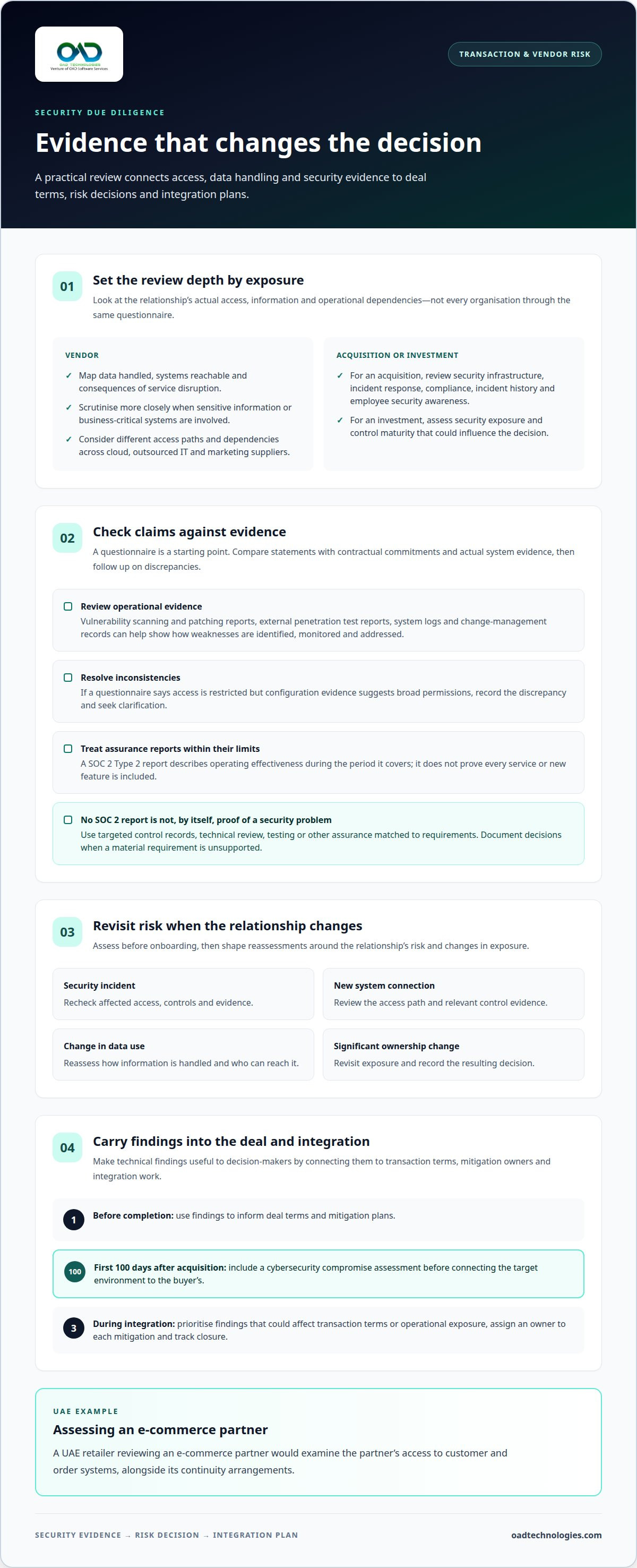
For a vendor, a review focuses on access, data handling and service continuity. For an acquisition, it examines the target’s security environment and post-deal integration risks. For an investment, it assesses security exposure and control maturity that could influence the investment decision.
Third-party risk management tailors the depth of a review to the risks of the proposed relationship. A vendor handling sensitive information or connecting to business-critical systems warrants closer scrutiny than a partner with limited access. Reviews take place before onboarding and continue throughout the relationship, with reassessments shaped by risk. This ties the assessment to actual exposure instead of applying the same questionnaire to every supplier.
Scope matters. A cloud provider, outsourced IT partner and marketing supplier may each create different access paths and operational dependencies. A professional maps the information a vendor handles, the systems it can reach and the consequences of disruption. For example, a UAE retailer assessing an e-commerce partner would examine access to customer and order systems, along with the partner’s continuity arrangements.
Risk assessment also tests whether security controls work in practice. Reviewers examine vulnerability management processes, including scanning and patching reports, then compare stated practices with technical evidence. External penetration test reports, system logs and change-management records can show how weaknesses are identified, monitored and addressed. A patching gap matters more if it affects a system accessible to the buyer or a critical service.
Risk can change after onboarding, making event-driven reviews important alongside scheduled reassessments. A major security incident, new system connection, change in data use or significant ownership change can alter a vendor’s exposure. Each event should prompt a review of affected access, controls and evidence, with the decision recorded in the organisation’s risk-management process.
In an M&A transaction, the review extends beyond a supplier’s controls to the target company’s information security infrastructure, incident response, regulatory compliance, incident history and employee security awareness. Findings should inform deal terms and mitigation plans before completion. Reviewers also consider how security operations will be integrated after closing, including access controls and monitoring across environments.
Integration sequencing is critical: include a cybersecurity compromise assessment early in the integration, before connecting the target environment to the buyer’s. Prioritise findings that could affect transaction terms or operational exposure, assign an owner to each mitigation, and track closure through integration. This connects evidence to deal decisions and post-acquisition responsibilities.
What is due diligence in security and risk management?
Security due diligence examines evidence to understand the cyber risks associated with a vendor, transaction or investment. Its value lies in connecting technical findings to decisions about access, contracts and integration.
Evidence requests and alternatives
Evidence requests are documented materials used to assess whether a vendor’s stated security controls operate as described. A SOC 2 Type 2 report describes operating effectiveness during the period it covers, but it doesn’t prove every service or new feature is included.
If a vendor lacks a SOC 2 report, the review can use other evidence matched to the buyer’s requirements. This may include targeted control records, technical review, testing or other assurance. For example, a UAE company assessing a cloud provider can examine vulnerability management reports, system logs and change-management records. A missing report alone doesn’t establish that a vendor is unsafe; an unsupported material requirement calls for a documented decision on the affected use.
Vendor assessment across the lifecycle
Lifecycle assessment means evaluating a vendor before onboarding and revisiting relevant risks as the relationship or technology changes. It connects cybersecurity review with vendor management, rather than treating approval as a one-off event.
Before integration, reviewers examine the vendor’s access, information handling and continuity evidence. During service delivery, monitoring records and incident information can show whether the risk profile has changed. A new connection to customer data, for instance, may require renewed scrutiny of access controls. Where the EU General Data Protection Regulation (GDPR) applies to the relationship, reviewers should consider it alongside the UAE PDPL.
Vendor engagement and information gaps
Vendor engagement involves obtaining explanations and evidence directly from the organisation being assessed. Clear requests help reviewers distinguish a genuine control gap from an incomplete or misunderstood response.
If a vendor’s questionnaire says access is restricted but configuration evidence suggests broad permissions, the assessor records the discrepancy and seeks clarification. The evidence should support a finding, an owner and a decision. If the vendor cannot substantiate a material requirement, the organisation can defer the affected use or document an exception for an authorised decision-maker.
Assessment steps, cost and timing
A professional defines the scope, gathers records, reviews controls, tests relevant evidence, discusses gaps with the vendor and documents findings for decision-makers. This process connects technical observations to contract terms and integration choices.
In the UAE, the cost depends on the scope, systems involved, evidence available and depth of technical review; pricing is provided after a quote request. Timing depends on the same scope, the vendor’s responsiveness and whether testing or follow-up is needed. For example, reviewing a single service with organised records differs from assessing several interconnected platforms. To discuss an appropriate assessment scope, contact the team.
Reconciling questionnaires, contracts, and configurations
A professional compares questionnaire answers with contract language and technical evidence, then records any mismatch. This links the vendor’s stated controls to the commitments governing the relationship and the settings used in daily operations.
The review starts by mapping important answers to evidence and contractual obligations. For example, a questionnaire may state that access requires approval, while the contract sets no approval or access-review requirement. The assessor then examines configuration records to see how permissions are assigned in practice. Each difference becomes a finding, supported by evidence and an assessment of business impact and proposed action.
Configuration evidence needs context. A platform setting may show that a control exists, but not who monitors alerts or handles exceptions. Reviewers compare system records with procedures, assigned responsibilities and recent operational evidence. For instance, if a UAE organisation is acquiring a local payments business, the diligence team can compare access commitments in transaction documents with account permissions for systems holding customer information.
A virtual data room supports the controlled review of confidential deal documents. The transaction team manages permissions, limits document sharing to authorised participants and monitors access activity. A record of who viewed or downloaded a file helps identify unexpected exposure. Deal communications should also use secure channels, so sensitive findings and configuration details remain restricted to those involved in the transaction.
Reconciliation should cover policies and access controls, not just questionnaire responses. Reviewers compare written security policies with actual practices, then assess whether permissions match each person’s role. For a cloud platform, they may examine how administrative access is granted, how changes are recorded and whether monitoring produces usable activity logs. These checks reveal whether documented procedures align with operations.
Signing a contract does not end vendor oversight. The parties should retain the assessed evidence, record agreed actions and assign responsibility for open findings. Ongoing monitoring can then track relevant changes, such as a new service, altered access or a reported incident. A contract requiring encryption within six months provides a concrete milestone for reviewing implementation evidence, rather than treating the commitment as complete once signed.
Keep a traceable record linking each answer to its supporting document, contract clause, configuration evidence and decision. This helps the deal team distinguish an accepted risk from a control gap requiring remediation. During integration, the same record helps teams carry forward access restrictions and monitoring responsibilities instead of relying on assumptions made during negotiations.
Challenges of manual questionnaire processes
Manual questionnaires can make third-party risk reviews difficult to track and compare. Email, spreadsheets and PDFs create separate versions, while lengthy forms can weaken the quality of responses. Very long questionnaires can reduce response quality, so concise, risk-focused requests are often more useful.
Version control is a practical challenge. A vendor may answer an old spreadsheet while the assessor reviews a revised copy, leaving a control gap hidden between documents. A professional records the questionnaire version, response date, evidence received and follow-up action in a central file. This audit trail shows which answer informed the decision and who approved any exception.
Escalation needs a defined route. If a vendor reports an incident, cannot support a material control or gives conflicting answers, the assessor records the issue and assigns an owner. The issue then goes to the authorised decision-maker if it could affect onboarding, contract terms or system access. For example, a supplier requesting privileged access before providing supporting evidence may warrant a documented pause or exception.
Privacy records also require careful handling. A review may involve records of processing, privacy notices and data-processing agreements, alongside security evidence. In a UAE transaction, the parties should consider applicable privacy obligations, including the UAE PDPL where relevant, and restrict sensitive records to authorised reviewers. A data room should preserve access records while limiting unnecessary copies of personal information.
Policies and procedures can become outdated when teams reuse answers without checking current practice. An assessor compares policy documents with actual operations, then records the date and source of each supporting item. For instance, a written access policy should be considered alongside current account permissions and activity logs. The update process should also capture changes to services, platforms or data use.
Manual processes can obscure a vendor’s ability to meet its obligations across different business units. A shared answer may describe central policy, while a specific service uses separate systems or subcontractors. The assessor links each response to the service under review and identifies unanswered points. This prevents a general statement from being treated as evidence for every platform or operation.
For a UAE retailer assessing an online fulfilment partner, the review could include security policies, access records, incident procedures and data-processing documents. A structured evidence register helps the assessor distinguish missing paperwork from an unsupported control. It also gives the decision-maker a clear record of risk, escalation and the action required before access or integration proceeds.
Choosing and assessing a diligence provider
The right provider connects technical evidence to transaction decisions, rather than delivering a report detached from the deal. For an acquisition, the scope should cover the target’s security infrastructure, incident response, compliance, incident history and employee awareness. Agreeing these areas early helps the deal team understand what the review will examine and how findings will inform decisions.
Start by assessing the provider’s method. A sound proposal explains how reviewers will examine questionnaires, policies, technical records and interviews, then reconcile differences between them. It should also explain how the team will distinguish evidence gaps from confirmed control weaknesses. For example, an unanswered question about backup testing calls for a different finding from records showing that recovery procedures were never tested.
Check that the provider can link technical findings to commercial impact. In an M&A review, the diligence process should identify the material findings that could affect purchase price or deal terms. The provider should explain how it prioritises issues, identifies likely consequences and presents practical mitigation options before completion. This gives executives a clear basis for decisions without reducing complex security risks to a generic score.
Regulatory compliance should reflect the target’s actual activities and markets. In a UAE financial-services acquisition, for instance, the review should identify which CBUAE cybersecurity requirements apply to the target and buyer, and assess relevant controls against those requirements and internal policies. The provider should map applicable requirements to evidence, identify where controls need further examination and avoid treating a certificate as proof that every system meets every obligation.
Ask how the provider involves technical and business stakeholders. Interviews with those responsible for IT, security, legal and operations can clarify who owns controls and how incidents are handled. The reviewer should turn these discussions into traceable findings, with supporting evidence and clear implications for integration. This can also reveal dependencies that a document-only review might miss.
Agree the deliverables before work begins. A useful report identifies material findings, supporting evidence, business impact, proposed action and accountable owners. It should distinguish urgent exposure from longer-term improvement work and help the buyer plan security operations after closing. For example, a finding about excessive administrator access should lead to a defined integration decision, not simply a note in an appendix.
Finally, assess how the provider handles confidential deal information and follow-up. Clear data-room access controls, defined review responsibilities and a documented escalation route help protect sensitive material. The provider’s approach should fit the transaction’s scope and timetable, while allowing decision-makers to act on evidence rather than broad assurances.
OAD Technologies: Vulnerability Assessment and Penetration Testing (VAPT)
OAD Technologies provides Vulnerability Assessment and Penetration Testing (VAPT) to help assess a target’s technical security exposure. During M&A due diligence, this work can provide technical evidence when questionnaire answers or existing reports leave questions about vulnerabilities and defensive controls.
Consider VAPT when the transaction review identifies systems needing closer technical examination, or when the buyer needs clearer evidence before planning integration. Findings can help decision-makers prioritise remediation and carry relevant risks into post-deal planning. If the assessment also raises concerns about sensitive information or ongoing threat detection, Data Loss Prevention (DLP), OAD’s 24 X 7 SIEM/SOC with sub-15-minute response times, and Managed Detection and Response (MDR) built on CrowdStrike endpoint protection (with Sangfor EDR, XDR and MDR as an alternative) can address related needs. Zero Trust access and backup and disaster recovery help secure the combined environment during integration. OAD holds ISO 9001, ISO 14001, ISO 45001 and ISO/IEC 27001 certifications.
Contact OAD Technologies to discuss your M&A security assessment.
Carry security decisions into integration
A transaction decision is more useful when security findings shape what happens after signing. Treat the diligence record as an input to integration planning: assign owners, preserve the reasons for decisions and revisit assumptions as systems, access paths and responsibilities change. This keeps a due diligence security assessment connected to business decisions rather than filed away as a transaction document.
For UAE deal teams, align cyber-risk actions with integration priorities, data handling and applicable regulatory obligations. Separate issues to address before connecting environments from those that can follow a tracked remediation plan. Clear ownership gives technical and executive teams a shared way forward as the acquired business becomes part of daily operations.
Use the transition to turn assessment findings into a practical plan with clear ownership. Responsibilities and decisions grounded in evidence help your teams move forward with greater clarity.
Build the next stage of your M&A journey on informed security decisions.
Frequently Asked Questions
How does a professional review evidence for a due diligence security assessment?
A professional checks whether evidence is relevant, current and tied to the service being assessed. They may compare document dates, system scope and control ownership, then identify exclusions that limit what a report demonstrates. For example, a certification may cover a parent organisation but not the acquired business unit. The reviewer records how each item supports a finding and where further examination could change the transaction decision.
What is a Due Diligence Questionnaire (DDQ)?
A due diligence questionnaire is a structured set of questions for collecting information about an organisation and assessing potential risks. It can cover ownership, financial stability, compliance, information security, internal controls and business continuity. Clear questions help reviewers compare responses across vendors or targets. A well-designed DDQ combines concise yes-or-no questions with space for explanations and supporting evidence when a simple answer could obscure important context.
What should you provide during a professional vendor due diligence assessment?
Provide records that describe the service, the systems involved, the data handled, access granted and accountable control owners. Include current policies and relevant technical evidence, clearly indicating what each document covers. If a third party supports the service, identify its role and responsibilities. For a UAE business using a hosted platform, a data-flow description can explain which information moves between the business, vendor and subcontractors.
What is a due diligence security assessment?
A due diligence security assessment is a professional review of cyber risks associated with a transaction, investment or business relationship. It evaluates evidence about security controls and identifies issues that could affect decisions, contractual terms or future operations. The review is scoped to the organisation and proposed relationship, so a supplier assessment and an acquisition review examine different exposures and decision-making needs.
What areas does a security due diligence assessment cover?
Coverage commonly includes information security, technology architecture, data protection, regulatory alignment, incident response, business continuity and dependencies on personnel or service providers. The scope depends on the organisation’s activities and the transaction’s risks. For example, a company handling sensitive research may need closer examination of intellectual-property access and who controls newly created work. Findings should link each area to a business decision or follow-up action.
What documents and evidence should be requested from a company?
Request evidence that helps reviewers understand both documented controls and actual operating practices. This can include an asset or service inventory, security policies, risk assessments, external test reports, monitoring records, change records, incident summaries and continuity documentation. Ask for the scope and date of each item, along with any systems or services it excludes. These details help prevent an older or limited report from being treated as evidence for the entire organisation.
Disclaimer
Content by OAD Technologies is for general informational purposes only and does not constitute professional or cybersecurity advice. No warranties are made regarding accuracy or completeness; reliance is at your own risk. OAD Technologies shall not be liable for any direct or indirect losses arising from use of this content.