
A useful cybersecurity risk assessment in Dubai does more than list vulnerabilities. It links threats to business impact, weighs likelihood against impact, and prioritises risks based on exposure, exploitability and existing controls. The scope can also account for regulatory obligations, third-party suppliers, connected systems and emerging technologies.
That matters because a technical finding only helps when decision-makers can see what it could disrupt and what action should follow. For example, a Dubai business moving customer services to cloud platforms may need to consider supplier access, data exposure and the effect of a service disruption together.
This article explains what an assessment covers, how it can support alignment with UAE requirements such as the PDPL and CBUAE rules, and what its deliverables should show. It also outlines how assessors evaluate vendor and connected-system risks, consider emerging technologies and turn findings into prioritised business actions.
Key Takeaways
- Connect technical findings to the business operations and consequences they could affect, then prioritise risks by exposure, exploitability and available controls.
- Map the assessment scope to relevant UAE privacy, regulatory and sector requirements so findings can inform compliance decisions.
- Include third-party suppliers and connected systems in the risk picture, with clear ownership and ongoing oversight of supplier exposure.
- Choose assessment methods that fit your organisation’s risk context, including new technologies and changing digital services.
- Look for deliverables that document evidence, assign action owners and dates, and support review as risks change.
What is a cybersecurity risk assessment?
A cybersecurity risk assessment connects technical weaknesses to business consequences. In Dubai, it helps an enterprise understand which exposures could disrupt operations, affect data, or create regulatory concerns.
Likelihood and impact scoring
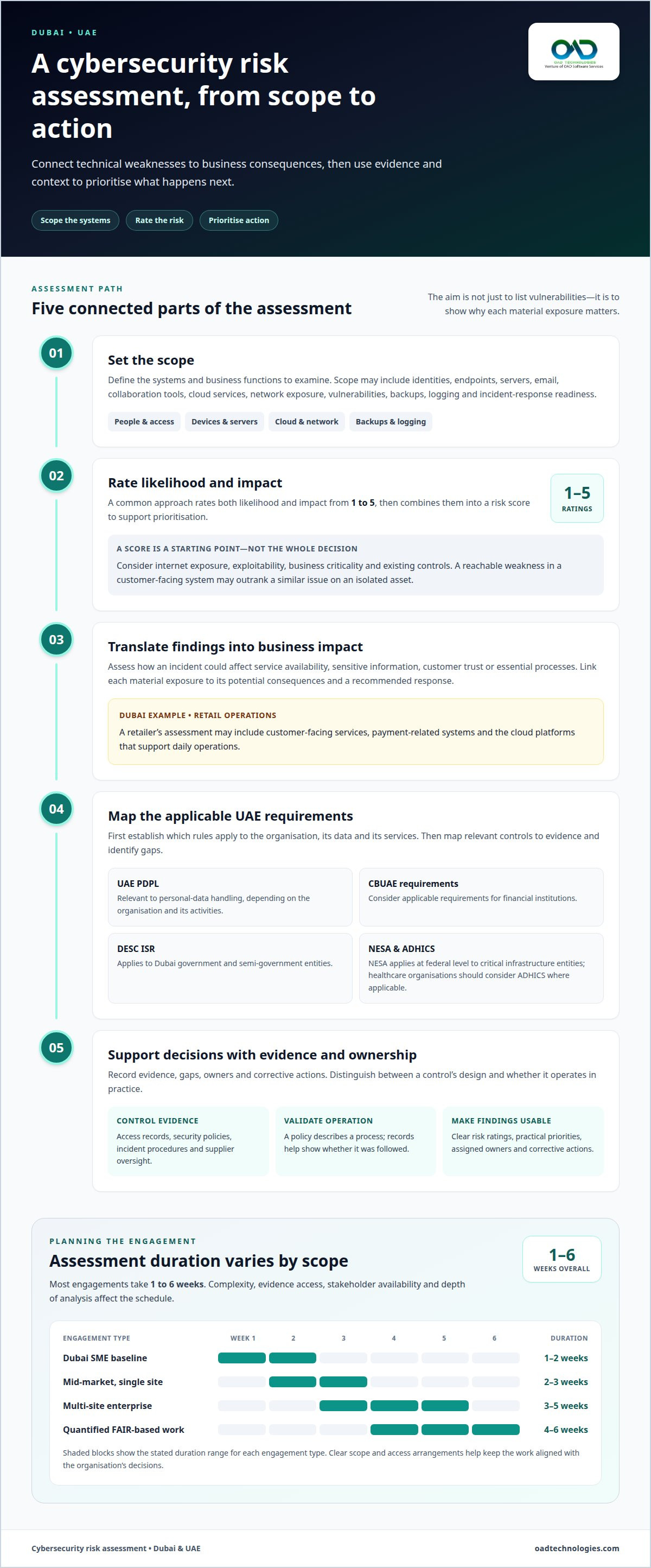
Assessors estimate how likely an attack or incident is, then rate its potential impact. A common method uses likelihood and impact ratings from 1 to 5, combining them into a risk score. The score supports prioritisation, but it should not replace context: internet exposure, exploitability, business criticality, and existing controls all influence the decision. A reachable weakness in a customer-facing system may outrank a similar issue on an isolated asset.
Choose a provider by checking whether its assessment scope reflects your systems, business priorities, and UAE regulatory context. Look for evidence-based findings, clear risk ratings, practical remediation priorities, and deliverables that assign ownership. Dubai and the wider UAE market include cybersecurity consultancies and specialist security firms. Compare the proposed methodology and outputs against your enterprise’s needs, not just the length of the final report.
Assessment cost depends on the scope and work involved. The number of sites and systems, assessment methods and required deliverables all affect the effort. A useful proposal explains how these factors shape coverage, rather than treating every organisation as if it had the same exposure.
Assessment scope and inclusions
Scope sets the systems and business functions assessors examine. It can cover identities, endpoints, servers, email, collaboration tools, cloud services, network exposure, vulnerabilities, backups, logging, and incident-response readiness. For a Dubai retailer, this might include customer-facing services, payment-related systems, and the cloud platforms supporting daily operations. A cybersecurity assessment in Dubai can align technical review with the organisation’s operational priorities.
Business impact gives findings their meaning. Assessors consider how a successful attack could affect service availability, sensitive information, customer trust or essential processes. Regulatory and legal impacts also matter: the UAE PDPL and CBUAE requirements may be relevant, depending on the organisation and its activities. A risk register should link each material exposure to its potential consequences and a recommended response.
Assessment duration
Duration depends on scope and methodology. A baseline review of a single-site business is usually shorter than a multi-site enterprise assessment, and quantified analysis such as FAIR-based work generally needs more time for data gathering and modelling. A provider should give an indicative schedule once the scope is agreed.
To plan a realistic schedule, assessors consider system complexity, access to evidence, stakeholder availability and the depth of analysis required. The work should allow time to validate findings and explain their business impact, not just conduct technical scans. Clear access arrangements and a defined scope help keep the assessment aligned with the organisation’s decisions.
Security assessments and regulatory compliance
In the UAE, a security assessment can help connect information security controls with applicable legal and sector requirements. The value lies in mapping evidence to obligations, then recording gaps, owners and corrective actions.
Regulatory readiness and audit preparation
Regulatory readiness starts by identifying which rules apply to the organisation, its data and its services. The UAE Government identifies the personal data law as Federal Decree-Law No. 45 of 2021. An assessment can map relevant controls to evidence, such as access records, security policies, incident procedures and supplier oversight. This gives governance teams a structured basis for audit discussions and remediation planning.
When preparing for an audit, distinguish between control design and operation. A documented policy may describe an approval process, while access records show whether staff followed it. Assessors can map each requirement to evidence, identify gaps and assign owners and actions. A compliance risk review can organise findings around the requirements relevant to the business.
Dubai regulatory context
Requirements vary according to an organisation’s activities and ownership. DESC’s Information Security Regulation applies to Dubai government and semi-government entities, while NESA applies at the federal level to critical infrastructure entities. Financial institutions also need to consider applicable CBUAE requirements. The assessment should establish the organisation’s regulatory context before testing controls or identifying gaps.
For example, a Dubai semi-government entity should consider DESC ISR when documenting its information security controls. A healthcare organisation should also account for relevant sector requirements, including ADHICS where applicable. These examples show why a standard control checklist may miss important context. Assessors should trace each requirement to the systems, data and business processes it affects.
UAE regulatory risk
Regulatory risk arises when a control weakness affects a legal, regulatory or sector obligation. A cloud access issue, for instance, could create both a technical exposure and a concern about handling personal data. The assessment should link the threat to the affected information, applicable requirements, current controls and potential business consequences.
For UAE operations, relevant sources may include the UAE PDPL, CBUAE requirements, DESC ISR and NESA, depending on the organisation. The assessment should record why each source applies, what evidence supports current controls and where remediation is needed. This helps governance teams understand compliance-related security risks without treating an assessment as a certification.
Assessment frequency
Annual cyber risk reassessment is common practice for regulated or fast-changing businesses. Organisations should also reassess periodically and after significant changes to IT infrastructure. A major cloud migration, new customer platform or material supplier change can alter exposure before the next annual review.
Frequency should reflect changes in threats, systems and regulatory context. A regulated Dubai business may schedule a recurring review, then reassess affected controls after a significant technology change. The assessment record can show what changed, which risks need renewed attention, and whether previous actions remain relevant. For a practical review, discuss your assessment requirements in light of your organisation’s obligations and systems.
Third-party and connected-system risks
A supplier can become part of an organisation’s attack surface through system access, data handling or network connections. A third-party assessment therefore examines how external services interact with business assets, rather than treating vendor risk as a separate procurement issue.
For each material supplier, assessors can map the service provided, data handled, access granted and systems connected. They then consider the supplier’s cyber security maturity, the business impact of disruption and the evidence supporting its control claims. This gives the organisation a clearer view of supply chain exposure, including dependencies that may not appear in its internal asset inventory.
Evidence may include security policies, access records, incident processes and relevant assessment results. The goal is not to collect documents for their own sake, but to compare the evidence with the supplier’s role and access. A provider with privileged access to a production environment presents a different risk from a supplier with no access to organisational systems.
Contracts should clarify who owns cyber risk decisions, how security responsibilities are divided and how incidents are communicated. Clear allocation matters when a service depends on controls managed by both the organisation and the vendor. Ongoing monitoring can then track changes in supplier services, access, ownership or exposure, rather than relying only on a procurement-stage review.
Connected systems need similar attention. CCTV and access-control equipment can introduce network, identity, supplier and data risks when connected to enterprise systems. An assessment can include these systems when authority and ownership are established. It examines network paths, user privileges, data flows and maintenance arrangements, focusing on how a compromise could affect other assets.
For example, a Dubai hotel may rely on an external provider to maintain connected building systems. The assessment would map the provider’s access, identify which systems it can reach, and consider whether that connection could expose business networks or operational data. The hotel’s internal team and supplier should have clear responsibility for access decisions and corrective action.
NIST CSF SCRM provides a reference for supply chain risk management and third-party vendor risk scoring. Assessors can use a consistent approach to group suppliers by access, service importance and potential business impact. The resulting register should record supporting evidence, the risk owner and agreed actions, making it easier to review vendor exposure as services evolve.
Security Information and Event Management (SIEM) can improve visibility by bringing security event information together for analysis. In a supplier-risk assessment, this can help teams examine relevant activity across connected environments when logging is in scope. The assessment should clarify what evidence is available and how it informs ongoing oversight.
Cyber risk concepts and assessment frameworks
A risk assessment framework gives teams a consistent way to identify, analyse and treat cyber risk. It helps connect controls to business priorities, while leaving room for the organisation’s sector, technology and regulatory context. The framework guides the work; it does not replace informed decisions about which exposures need action.
According to the National Institute of Standards and Technology, NIST Cybersecurity Framework (CSF) 2.0 is a cybersecurity risk assessment framework. Its core functions provide a structure for considering the full security lifecycle, from understanding assets and safeguards to preparing for incidents and restoring operations.
Other references serve different purposes. ISO 27005 provides guidance on information security risk management, while ISO 27001 is an information security management system standard. ISO 27005-aligned assessments can suit organisations pursuing or holding ISO 27001. FAIR supports quantitative cyber risk analysis, helping decision-makers express potential exposure in business terms rather than relying only on technical severity labels.
A provider conducting an assessment in the UAE typically starts by agreeing scope, business objectives and applicable requirements. The provider then identifies assets, threats and existing controls, gathers evidence, analyses risk, and recommends treatment actions. The final deliverable should connect findings to owners and decisions, rather than presenting an unprioritised inventory of technical issues.
Framework selection should reflect the organisation’s sector and intended outcome. A financial institution may need to examine AI-driven fraud, API abuse, cloud concentration, insider risk and cross-border data exposure. A healthcare organisation may focus more on clinical system availability and sensitive information. These examples show why reference models need to be adapted to business operations and relevant UAE requirements.
Emerging technology raises questions that traditional control reviews may overlook. For an AI-enabled service, assessors can examine how data enters the system, who can access it and how outputs affect decisions. NIST AI RMF is a reference for AI security governance. AI-assisted assessment tools can organise evidence and identify patterns, while authorised people validate findings and approve material actions.
Frameworks support resilience, but an assessment alone does not secure an organisation. Teams still need to implement agreed controls, monitor changing exposure, test response capabilities and review risks after meaningful changes. For example, launching a new API should prompt a review of its access controls, data flows and monitoring, alongside the business service it supports.
What does a cybersecurity risk assessment in Dubai include?
A cybersecurity risk assessment turns an agreed scope into evidence, prioritised findings and practical actions. While serving clients across the UAE, assessments tailored for businesses operating in Dubai and wider emirates reflect specific system topologies, operational structures and applicable requirements, rather than assuming every organisation has the same exposure.
The assessment begins by defining boundaries: business units, locations, cloud environments, suppliers and critical services. Assessors identify key assets and dependencies, then examine how disruption or unauthorised access could affect operations. For a UAE logistics company, that might mean considering the systems supporting shipment coordination alongside the data and services those systems rely on.
Within the agreed scope, assessors may review:
- Identities, access rights and authentication controls.
- Endpoints, servers, email and collaboration services.
- Cloud platforms, network exposure and known vulnerabilities.
- Backup arrangements, logging and incident-response readiness.
- Relevant supplier connections and the evidence supporting security controls.
Evidence collection may include policy documents, system configurations, access records and interviews with technical or business owners. Depending on the agreed scope, an assessor from OAD Technologies may use automated vulnerability scanning, information security testing and evaluation, or penetration testing. Each method answers a different question: scanning identifies potential weaknesses, while controlled testing can determine whether selected weaknesses are exploitable.
Validate findings before using them to make business decisions. Assessors correlate technical evidence with asset importance, exposure, available safeguards and plausible consequences. For example, a weakness affecting a customer-facing booking service may need different treatment from a similar issue on a restricted test system. Recording the evidence and reasoning helps stakeholders understand why findings receive different priorities.
The main deliverable is usually a risk register or equivalent findings record, supported by evidence and recommendations. Useful entries describe the affected asset, observed weakness, potential business impact, existing controls and proposed treatment. They should also assign an action owner and target date, so teams can manage remediation instead of leaving findings as observations.
Scope and reporting should also reflect the organisation’s UAE regulatory context. Where personal data, financial services or sector-specific obligations are relevant, assessors can map findings to the identified requirements. The report should distinguish technical remediation from governance actions, such as clarifying ownership or improving evidence retention. This makes the results useful to both technical teams and decision-makers.
Finally, an assessment should support ongoing review. Teams can track whether actions are complete, controls have changed, or new systems and suppliers have altered exposure. A new cloud service, network connection or business application may prompt a scope update. This record gives the next review a clear starting point and helps keep security decisions aligned with operational change.
OAD Technologies: Vulnerability Assessment and Penetration Testing (VAPT)
OAD Technologies provides Vulnerability Assessment and Penetration Testing (VAPT) for organisations that need technical weaknesses assessed and validated. It is a relevant next step when a risk assessment identifies exposed systems, vulnerabilities or questions about how existing controls perform. VAPT findings can add technical detail to wider risk management and remediation decisions.
When compliance planning is also a priority, Governance, Risk, and Compliance (GRC) can support efforts to align risk considerations with organisational requirements. For healthcare organisations, Healthcare IT and Cybersecurity addresses the sector’s distinct technology and security context. Where findings call for ongoing protection, OAD’s 24 X 7 SIEM/SOC with sub-15-minute response times, Managed Detection and Response (MDR) built on CrowdStrike endpoint protection (with Sangfor EDR, XDR and MDR as an alternative), Zero Trust access, Data Loss Prevention (DLP), and backup and disaster recovery can address related needs. OAD holds ISO 9001, ISO 14001, ISO 45001 and ISO/IEC 27001 certifications. The right focus depends on the systems and business risks being assessed.
Contact OAD Technologies to discuss your assessment requirements.
Turn assessment findings into sustained action
A cybersecurity risk assessment in Dubai can shape more than a report. Use its findings to decide which technical weaknesses need focused testing, where sensitive information needs stronger protection, and how your organisation should respond as its systems evolve. That turns risk priorities into a practical direction for ongoing security decisions.
OAD Technologies provides Vulnerability Assessment and Penetration Testing (VAPT) to assess technical weaknesses, Data Loss Prevention (DLP) to address risks to sensitive information, and Managed Detection and Response (MDR) to support threat detection and response. These services are relevant next steps when assessment findings point to those needs.
Choose the next action based on your organisation’s exposure, business priorities and regulatory context. Clear ownership and continued review help security decisions keep pace with digital change and support resilient operations.
Frequently Asked Questions
What UAE laws and regulations apply to cybersecurity risk assessments?
Applicable requirements depend on an organisation’s data, sector and role. The UAE Government identifies Federal Decree-Law No. 45 of 2021 as the UAE personal data law. Other relevant requirements may include CBUAE rules for financial institutions, DESC ISR for Dubai government and semi-government entities, and NESA requirements for federal critical infrastructure entities. A healthcare organisation should also consider applicable sector-specific requirements when defining assessment coverage.
How do Dubai government and industry cybersecurity requirements differ?
Government requirements can include DESC ISR, which applies to Dubai government and semi-government entities. Industry requirements vary according to an organisation’s sector and activities. For example, financial institutions consider applicable CBUAE requirements, while federal critical infrastructure entities fall within NESA’s scope. A private company outside those categories should identify its own legal, regulatory and sector obligations, rather than assume government requirements apply equally to every organisation.
How much does a cybersecurity risk assessment cost in Dubai?
Cost depends on the scope: the number of sites and systems, the assessment methods used, the depth of technical testing and the deliverables required. Pricing is provided in AED after a quote request, so define the systems, business services and reporting needs first to make proposals comparable.
Which cybersecurity risks are most common for Dubai businesses?
Risks to assess include exploitable vulnerabilities, supplier access, data exposure and service disruption. Their priority depends on exposure, exploitability, business impact and existing controls.
Disclaimer
Content by OAD Technologies is for general informational purposes only and does not constitute professional or cybersecurity advice. No warranties are made regarding accuracy or completeness; reliance is at your own risk. OAD Technologies shall not be liable for any direct or indirect losses arising from use of this content.