The most secure email encryption option can still be the wrong choice if recipients can’t open the message. Choosing email encryption solutions for business means balancing the protection sensitive information needs with the way employees and external contacts actually work. A control that adds too much friction may be bypassed; one that only protects data in transit may not provide the message-level protection a situation calls for.
It’s reasonable to expect encryption to keep confidential content private, but different approaches protect different parts of an email journey. This guide explains the distinction between transport and message-level protection, and compares common approaches by recipient access, administration and operational fit. It also sets out practical criteria for assessing policy triggers, key management, mobile use and auditability, without treating encryption as a complete answer to every email threat.
For a UAE example, consider a healthcare operator sharing diagnostic reports with external specialists. The right approach should account for sensitive patient information, recipient access and applicable requirements, rather than relying on a single security label. You’ll see how to assess that workflow and connect encryption decisions with wider email security and data protection, including OAD Technologies’ Managed Email & Data Protection capabilities.
Key Takeaways
- Match protection to the information being shared: transport encryption and message-level controls address different risks.
- Compare email encryption solutions for business by recipient access, administration and fit with everyday workflows, not by labels alone.
- Assess data sensitivity, user access and policy controls before selecting an approach, including how external recipients will open protected messages.
- Plan a UAE rollout with clear responsibilities, testing and review, taking relevant requirements such as the UAE Personal Data Protection Law (PDPL) into account.
- Connect encryption decisions with wider email and data protection; OAD Technologies’ Managed Email & Data Protection includes policy management, DMARC and DLP.
What business email encryption protects, and what it does not
Email encryption changes information into a form that cannot be read without the means to restore it. For a business, that can help protect message content from unauthorised access while it is being sent or stored, depending on how encryption is applied. The key buying question isn’t simply whether an email is “encrypted”, but where protection begins and who can access the readable message.
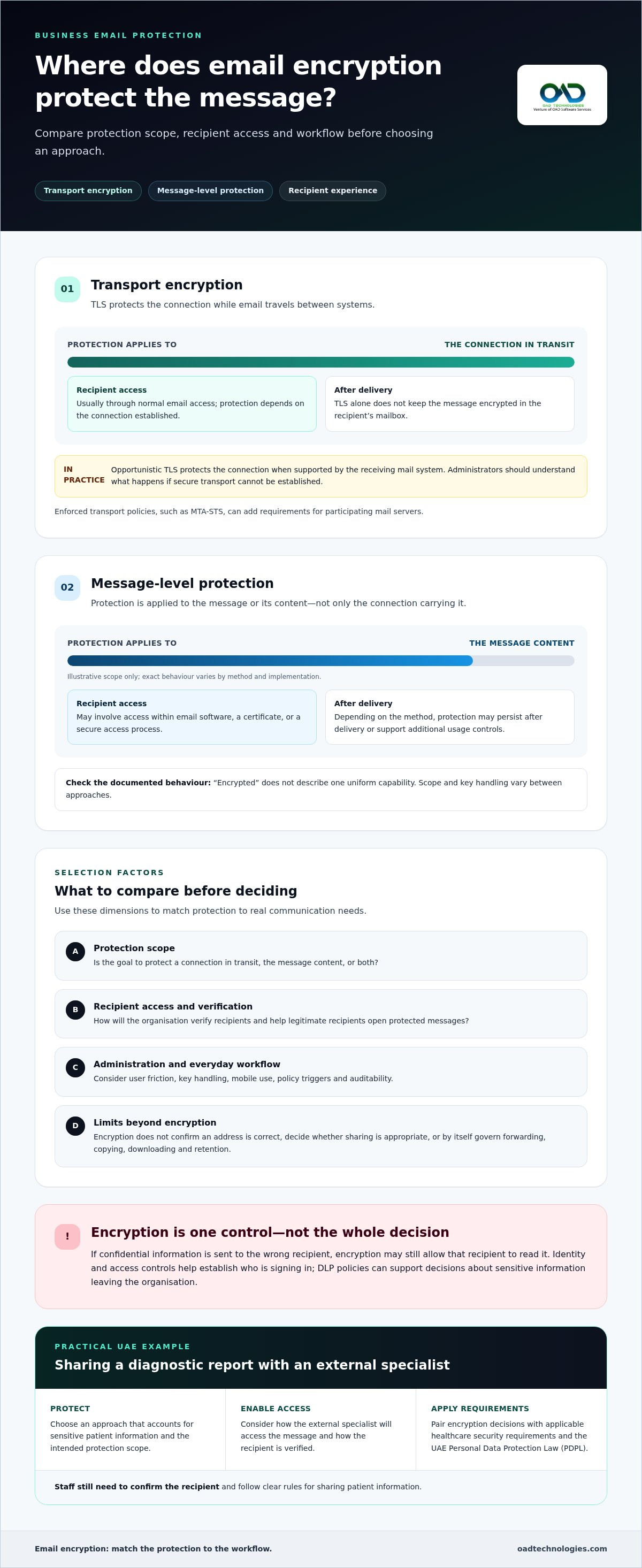
Encryption in transit protects an email while it travels between systems; message-level encryption protects the message content itself so that only authorised recipients can read it, subject to the method and key handling. Transport protection can secure a connection between mail systems, while message-level protection is applied to the message and may remain relevant after delivery. Neither should be assumed to conceal all email details: information such as sender, recipient and subject may still be visible, depending on the approach.
What happens when a business email is encrypted?
Think of a readable email as a note written in plain language. Encryption turns that note into ciphertext, which looks like unreadable characters to someone without the necessary means to decrypt it. An authorised recipient can regain readable access through the method used, such as handling a key or completing an authentication step. The exact process varies between approaches.
That difference affects day-to-day use. A recipient might access a protected message within their email software, use a certificate, or follow a secure access process. The sender’s organisation needs to consider how it verifies the recipient and what happens when that person changes device, loses access or forwards the message. A secure design should protect sensitive content without leaving legitimate recipients unsure how to open it.
What encryption alone cannot decide
Encryption protects content; it doesn’t decide whether an employee should send that content, who should receive it or whether the address is correct. If someone sends a confidential attachment to the wrong recipient, encryption may still allow that recipient to read it. Nor does encryption itself govern what a recipient can do with information once they can access it. Forwarding, copying, downloading and retention depend on additional controls and the specific solution.
Keep the roles distinct. Identity and access controls help establish who is signing in and what they can access. Data loss prevention (DLP) policies can support decisions about sensitive information leaving the organisation. Encryption then protects message content according to its scope. Together, these measures can support a considered email security approach, but encryption alone doesn’t guarantee compliance or prevent phishing, compromised accounts or careless handling.
For UAE organisations handling clinical information, the choice should sit alongside relevant healthcare security requirements and the UAE Personal Data Protection Law (PDPL), rather than being treated as a complete compliance measure. OAD Technologies’ healthcare solutions provide relevant context for organisations assessing protection across healthcare operations. A practical example is a provider sharing a diagnostic report with an external specialist: protecting the message matters, but staff still need to confirm the recipient and follow clear rules for sharing patient information. The fundamentals behind different email encryption methods and protocols help explain why protection depends on the approach selected.
Compare business email encryption approaches by protection and recipient access
Approaches differ in where they protect a message, how recipients open it and what administrators need to manage. Comparing these dimensions helps match email encryption solutions for business to real communication needs, rather than assuming every method provides the same control after delivery.
Transport encryption versus message-level protection
TLS encrypts a connection while email travels between systems. It helps protect information in transit, but does not, by itself, keep the message encrypted in a recipient’s mailbox after delivery. Enforced transport policies, such as MTA-STS, can add requirements for participating mail servers. For technical background on STARTTLS and TLS configurations, see this email transit-security guidance.
Message-level approaches apply protection to the message or its content. Depending on the method, that protection may persist after delivery or support additional usage controls. The scope varies, so assess each implementation’s documented behaviour rather than treating “encrypted” as a single, uniform capability.
| Approach | Protection scope | Recipient access | Administration and workflow |
|---|---|---|---|
| Opportunistic TLS | Protects the connection when supported by the receiving mail system. | Usually works through normal email access; protection depends on the connection established. | Low user friction, but administrators should understand what happens when secure transport cannot be established. |
| Enforced TLS | Requires specified transport conditions between mail systems, subject to configuration and recipient-system support. | Typically uses the recipient’s usual mail service. | Requires policy configuration and coordination for partner domains. MTA-STS is one mechanism for publishing a transport policy. |
| S/MIME | Can encrypt message content for intended certificate holders and support message signing. | Recipients generally need compatible software and the relevant certificate and private key. | Certificate issuance, distribution and lifecycle management add administration, particularly across organisations. |
| OpenPGP | Encrypts message content using recipients’ public keys. | Recipients need compatible tools and access to their private keys. | Key exchange and trust management shape setup and ongoing use. |
| Portal or envelope messaging | A service protects access to a message through a managed delivery process. | External recipients may authenticate through a portal or another configured process. | Can simplify access for recipients without certificates, but the workflow depends on service configuration. |
| Rights-management approach | May apply usage restrictions to protected content, depending on the solution. | Access can depend on identity, application and configuration. | Review supported actions and compatibility; Microsoft Purview Message Encryption is one documented example, not an endorsement. |
How recipient access changes between approaches
Certificate-based methods can suit established business relationships where both sides can manage certificates and keys. Service-managed delivery may reduce that setup for external recipients, though authentication steps still affect usability. Before adoption, check product documentation for how forwarding, reading, downloads and revocation work; these capabilities aren’t identical across solutions.
For a UAE organisation, the right fit may combine transport protection for routine exchanges with message-level controls for sensitive content. OAD Technologies’ email security capabilities can be considered alongside these requirements, with the final design shaped by recipient workflows and the organisation’s existing controls.
How to evaluate email encryption solutions for business
Start with the communication, not the product label. A useful assessment connects the information being shared with its sensitivity, the people who need to read it and the way they already exchange email. That makes it easier to identify required protections without introducing steps that staff or recipients may work around.
Match protection to information and business use
Map common email scenarios to your organisation’s data classifications and handling policies. The same department may send routine internal updates, customer documents and sensitive material to external partners, each with different access needs. Consider who needs to read a message, whether recipients use managed or personal email environments, and how long they need access. Avoid choosing a method before those requirements are clear.
- Staff-to-staff: Consider how the approach fits existing accounts, devices and internal collaboration.
- Business-to-customer: Assess whether recipients can access protected messages without complicated setup or repeated support.
- External partners: Account for different email systems, identity processes and established ways of exchanging information.
These distinctions help turn broad requirements into testable use cases. For example, a policy might identify which classes of information need additional protection when sent outside the organisation, while leaving lower-risk messages within ordinary workflows. The decision should reflect your own classification scheme, not a generic assumption about every email.
Evaluate usability, administration and integration
Test the recipient journey across the email environments your organisation actually encounters, including mobile access where relevant. Record each step from message delivery to successful reading. Note where recipients need to create an account, authenticate or use particular software, and whether those steps work for external contacts. A method that appears simple for employees may create obstacles for people outside the organisation.
Assess administrative effort as well as the user experience. Who manages policies, certificates or keys where applicable? How are access issues handled, and can authorised staff resolve them without weakening the intended controls? Define exception handling before rollout: specify who can approve an exception, how it is recorded and when it should be reviewed. Clear ownership reduces ad hoc decisions.
Encryption also needs to fit wider email controls. Consider how it works alongside inbound and outbound security, data-loss policies and identity controls. OAD Technologies’ Email Security can be considered as part of that broader view, rather than treating encryption as a standalone decision. Wider encryption and data security requirements can help shape how protections align across information flows.
Check exceptions and operational oversight
Before selection, test realistic scenarios: a message sent to the wrong domain, a recipient who cannot complete authentication, a staff member changing roles, or a legitimate business process that needs an exception. Confirm how the solution records relevant actions and how administrators review policy outcomes. Use a controlled pilot, gather feedback from senders and recipients, then refine guidance and settings before broader adoption.
Plan a UAE business rollout with clear controls and responsibilities
A successful rollout is an operational change, not just a technical setting. Assign owners across IT, information security, legal, compliance and the teams that send sensitive messages. Together, they can define when protection applies, who can approve exceptions and how recipient access issues are resolved. This makes it easier to choose email encryption solutions for business that fit real workflows while supporting wider data-protection measures.
A practical rollout sequence for business teams
Use a controlled sequence, with an accountable owner for each decision and a record of what the organisation tests and approves.
- Identify use cases. Map sensitive email scenarios, such as staff sharing records internally or a UAE healthcare organisation sending a diagnostic report to an external specialist. Name the business owner and the intended recipient groups.
- Define policy. Set out which information requires protection, who may receive it, what access experience is acceptable and how staff should handle exceptions. Align the policy with the organisation’s data classifications.
- Assign responsibilities. Establish who configures controls, approves policy changes, supports users and escalates failed delivery or access. Keep business owners accountable for the purpose and recipients of their communications.
- Configure controls. Translate approved policy into system settings and connect it with relevant email and data-handling processes. Document exceptions so they don’t become informal workarounds.
- Test recipient journeys. Trial representative internal and external exchanges, including the healthcare report scenario. Check that intended recipients can access messages and that staff know how to respond to access problems.
- Train and review. Give employees concise guidance on selecting recipients, handling sensitive information and reporting issues. Review feedback, exceptions and policy operation, then update the approach when business processes change.
Apply UAE requirements without assuming compliance
For the healthcare example, the organisation should assess the UAE Personal Data Protection Law (PDPL) and any applicable sector requirements, including the Abu Dhabi Healthcare Information and Cyber Security Standard (ADHICS) where relevant. Applicability and specific duties depend on the organisation and its activities, so validate them against authoritative UAE sources and qualified legal or compliance advice. Encryption can support data-protection efforts, but its use alone doesn’t establish compliance.
Keep the controls connected. Data Loss Prevention (DLP) can support policy decisions about sensitive information leaving the organisation, while encryption protects content according to its configured scope. OAD Technologies’ Data Loss Prevention capabilities can be considered alongside email protection and organisational data-handling policies. Governance, Risk, and Compliance (GRC) processes can help assign ownership, document decisions and review exceptions, rather than leaving responsibility solely with IT.
For each use case, retain a clear record of the information involved, the policy owner, the intended recipients, the access process and the review responsibility. That gives operational teams a practical basis for testing and adjustment without treating a technical control as a substitute for regulatory assessment.
Connect email encryption decisions with OAD Technologies’ email and data protection
Selecting a protection method is only part of the work. Organisations also need to consider how email policies, data-handling practices and security controls fit together. OAD Technologies provides Email Security and Managed Email & Data Protection, with policy management, DMARC and Data Loss Prevention (DLP) among the stated components. These capabilities can inform a broader discussion of email and data-protection requirements without assuming that a particular encryption feature is included.
Where email security and data protection meet
Encryption decisions make more sense when considered alongside the rules that guide how information is sent and protected. Policy management helps organisations address email requirements; DMARC is an email-authentication policy mechanism; and DLP relates to identifying and managing sensitive information. Each has a distinct role, so organisations should define how the controls relate to their own processes rather than treating one as a substitute for another.
For example, a business may need to decide which types of information require added protection, how staff should handle exceptions and which email controls support those decisions. Reviewing Data Loss Prevention services alongside email encryption solutions for business requirements can help keep attention on the wider handling of sensitive information, not just the final act of sending a message. The right scope depends on the organisation’s data, recipients and operational needs.
This joined-up view also helps separate technical selection from policy ownership. IT teams can assess how controls fit current email operations, while business and compliance owners define acceptable use and responsibilities. The aim is a considered set of controls that staff can understand and apply, with clear ownership for decisions and ongoing review.
Discuss requirements and agreed scope
A useful discussion starts with specific use cases: what information is sent, who receives it, which recipient workflows matter and where existing email controls already play a role. From there, teams can identify requirements across email security and data protection, prioritise operational constraints, and agree the scope for further assessment. This avoids assuming that one encryption approach, integration or configuration suits every organisation.
OAD Technologies can discuss requirements across agreed email and data-protection scope. That conversation can consider policy management, DMARC and DLP in relation to the organisation’s existing controls and operating model, without treating encryption as an automatic compliance outcome. Applicable obligations still need to be assessed in the context of the organisation and its activities.
Before moving forward, bring together the people who own email operations, information security and data-handling policy. A shared understanding of recipient needs and responsibilities gives technical decisions a practical foundation and helps keep protection aligned with business workflows as they evolve.
Make email protection part of ongoing business planning
Use your encryption decision as a point to strengthen how the organisation manages information over time. As teams, systems and external relationships change, revisit whether the chosen approach still supports the way people need to exchange sensitive messages. Treat feedback and recurring access issues as useful signals for refining policy and user guidance, not simply as technical faults.
The right email encryption solutions for business should remain aligned with operational needs as well as data-handling responsibilities. OAD Technologies lists ISO 27001 among its certifications. That provides relevant organisational context, but a certification does not guarantee a particular outcome for your email protection or compliance obligations.
A focused discussion can help translate your requirements into a practical next step, with scope shaped around your environment and priorities.
With clear ownership and regular review, your organisation can adapt its protections as its communications evolve.
Frequently Asked Questions
Is email encryption enough to prevent business data loss?
No. Encryption can protect information in defined situations, but data may still be exposed if an employee sends it to an unintended address, grants access too broadly or mishandles a copy after receipt. Treat encryption as one safeguard alongside DLP and email policies. For example, set out who can approve an exception if a supplier can’t use the usual protected-message process, and how that decision is recorded.
Can recipients read an encrypted business email without using the same email system?
Sometimes, but access depends on the selected method and how it’s implemented. A recipient may need a compatible certificate and software, or may use a service-mediated process with its own access steps. Don’t assume that different email environments will work together seamlessly. Before choosing email encryption solutions for business, test the recipient journey with the external organisations your staff actually communicate with.
Do encrypted emails protect attachments as well as message text?
They may, depending on how the chosen solution applies protection to message content and attached files. Handling can differ by method, configuration and file type, so don’t infer attachment protection from a general “encrypted email” label. Review the relevant product documentation and test representative workflows, such as sending a spreadsheet and a PDF to an external recipient, to understand what remains protected and how the recipient opens each item.
Can email encryption stop a message being sent to the wrong person?
No. Encryption doesn’t, by itself, confirm that the sender selected the intended recipient. A protected message sent to the wrong address may still expose its contents if that recipient can access it. Organisations should consider separate measures such as recipient-checking procedures, clear sending policies and staff guidance for lookalike names or autocomplete errors. Test those processes as part of normal email handling, rather than relying on encryption to correct addressing mistakes.
Does email encryption automatically meet the UAE Personal Data Protection Law (PDPL)?
No. Using encryption alone doesn’t establish compliance with the UAE Personal Data Protection Law (PDPL). Organisations need to assess which obligations apply to their activities and how email fits into their wider data-handling practices and controls. Seek qualified legal or compliance advice and use authoritative UAE sources to inform that assessment. Treat encryption as a possible part of protection, not as proof that all applicable requirements have been met.
What should a business do if an external recipient cannot open an encrypted email?
Follow a documented process suited to the encryption method and the recipient’s setup. First, verify the recipient and identify where access is failing, then use the organisation’s approved support or escalation route. If the normal method remains unavailable, use an approved secure alternative and retain the protection required by policy. Test access with representative external recipients before relying on a workflow for time-sensitive or sensitive communications.
Disclaimer
Content by OAD Technologies is for general informational purposes only and does not constitute professional or cybersecurity advice. No warranties are made regarding accuracy or completeness; reliance is at your own risk. OAD Technologies shall not be liable for any direct or indirect losses arising from use of this content.