
An accounts team at a UAE organisation receives an email that appears to come from a trusted supplier, requesting a change to the bank details for an invoice. The sender may be using a lookalike domain, or the supplier’s real account may have been compromised. These are different threats, and neither is solved by a single email setting. Preventing domain spoofing and abuse starts with knowing what each control can address, and where its limits lie.
It’s understandable to look to SPF, DKIM and DMARC as the answer: they help verify authorised use of your domain, but they don’t stop lookalike domains or misuse of compromised accounts. This guide explains the main forms of domain abuse, how to layer authentication, email security, brand monitoring and response, and how to assign practical responsibilities across your organisation. It also considers how domain protection can support governance discussions involving the UAE Information Assurance (IA) Standard, the Dubai Information Security Regulation (ISR) and the UAE Personal Data Protection Law (PDPL), without treating any one control as a guarantee of compliance.
Key Takeaways
- Start preventing domain spoofing and abuse by building a reliable inventory of your organisation’s domains and the services authorised to send email for them.
- Use SPF, DKIM and DMARC to strengthen email authentication, while recognising that each control has a defined scope.
- Pair email authentication with domain monitoring, DNS hygiene and user reporting to identify different forms of impersonation.
- Assign clear responsibilities for triage and response across security, IT, communications and business leadership.
- OAD Technologies’ Managed Email & Data Protection includes policy management, DMARC and DLP, alongside brand protection as part of a broader security approach.
What Preventing Domain Spoofing and Abuse Actually Means
Preventing domain spoofing and abuse means protecting both the domains your organisation controls and its identity across the wider internet. That calls for distinct controls: email authentication can help receiving systems assess messages claiming to come from your domain, while domain monitoring and reporting can help identify similar domains or suspicious use of subdomains. Treating every impersonation attempt as an email-authentication problem leaves important gaps.
Domain spoofing is the use of a forged or misleading domain identity to make a message or online interaction appear connected to someone else. Sender impersonation is the broader attempt to pose as a person or organisation. A lookalike domain is a separate domain registered by someone else, often with a small spelling change, that may appear familiar to recipients. The general concept of a spoofing attack includes several ways of misleading a target, so the specific technique matters when deciding how to respond.
How does email domain spoofing differ from a lookalike domain?
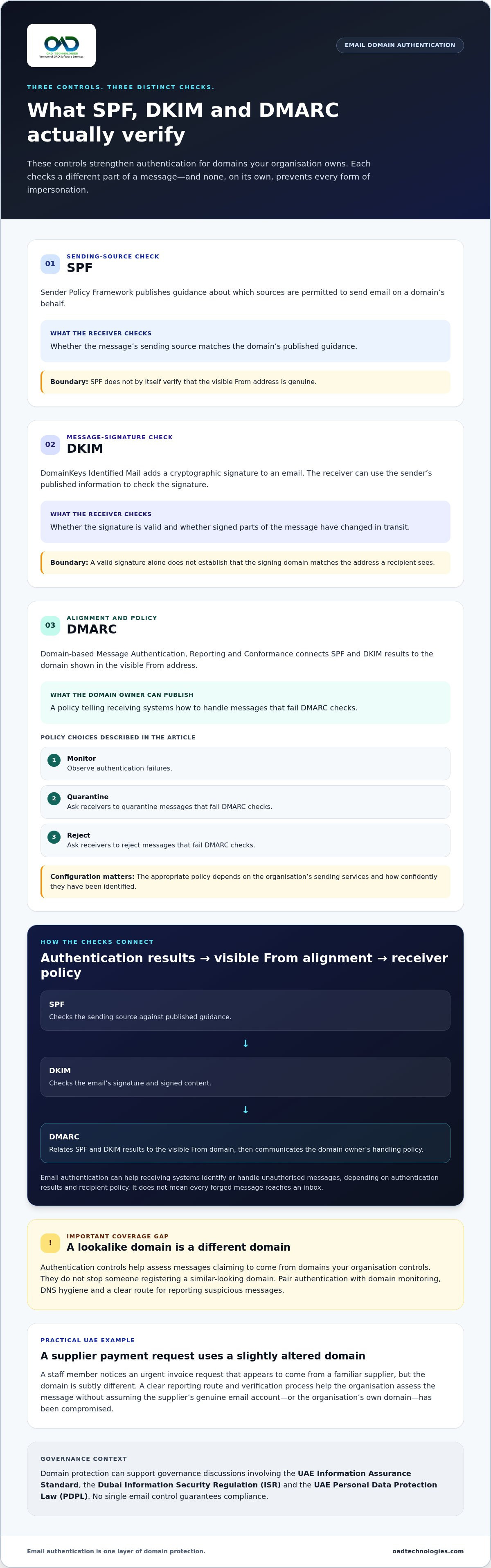
With exact-domain spoofing, an attacker forges the sender details to claim an address at an organisation’s real domain, without necessarily controlling that domain. Email authentication can help receiving systems identify or handle unauthorised messages, depending on the authentication results and recipient policy; it doesn’t mean every forged message reaches an inbox.
A lookalike-domain attacker instead controls a different domain. For example, a fictional organisation using cedar.example might be imitated through cedarr.example. The extra letter is part of the real address, not a forged display of the original domain, so the recipient may be deceived even when email authentication works correctly for the attacker’s domain.
In short, sender spoofing forges the apparent sending identity, while lookalike-domain impersonation uses a separate, attacker-controlled domain designed to resemble a trusted one.
Which forms of domain abuse should executives recognise?
Executives should distinguish the technique from the possible business impact. Phishing or business email compromise may use these methods, but they aren’t inevitable outcomes of domain abuse. The signal to investigate depends on where the activity appears and what identity it imitates.
- Exact-domain spoofing: Targets the organisation’s email identity. A message claims to come from its domain, but authentication results or sending activity may not align with authorised use.
- Lookalike registration: Targets staff, customers or suppliers who may overlook a subtle spelling or character difference in a domain, link or sender address.
- Exposed subdomain: Targets trust in a legitimate subdomain, including one that is no longer actively managed. Review unfamiliar activity and ownership records across subdomains, not only the primary domain.
For UAE organisations, consider a practical case: a staff member sees an urgent payment request that appears to come from a familiar supplier but uses a slightly altered domain. The visible difference may be easy to miss. A clear reporting route and verification process can help the organisation assess the message without assuming the supplier’s genuine email account or the organisation’s own domain has been compromised.
This distinction gives prevention a more useful starting point: authenticate domains you own, monitor for confusingly similar identities, and make it straightforward for people to report suspicious messages.
How SPF, DKIM and DMARC Reduce Email Domain Spoofing
These three email authentication controls work together, but each checks a different part of a message. Understanding the sequence helps organisations decide what to publish in their domain records, interpret authentication results and avoid assuming that one setting can prevent every form of impersonation. For preventing domain spoofing and abuse, configuration must reflect the organisation’s actual email services and be reviewed as those services change.
What do SPF and DKIM check?
Sender Policy Framework (SPF) is a domain’s published guidance about which sending sources are permitted to send email on its behalf. A receiving system can compare the source of a message with that guidance. SPF checks the sending path, but it doesn’t by itself verify that the visible From address is genuine.
DomainKeys Identified Mail (DKIM) adds a cryptographic signature to an email. The receiving system can use the sender’s published information to check whether the signature is valid and whether signed parts of the message have changed in transit. DKIM can help establish that a message was signed for a domain, but a valid signature alone doesn’t establish that the domain matches the address a recipient sees.
What does DMARC add to email authentication?
Domain-based Message Authentication, Reporting and Conformance (DMARC) connects SPF and DKIM results to the domain shown in the visible From address. It allows a domain owner to publish a policy for how receiving systems should handle messages that fail DMARC checks. Policy choices include monitoring failures, asking receivers to quarantine messages, or asking them to reject them. The appropriate approach depends on an organisation’s sending services and how confidently it has identified them.
DMARC reporting can help domain owners see authentication outcomes and identify sending sources that may need attention. Reports require interpretation: an unfamiliar source could indicate unauthorised sending, but it could also be a legitimate service that hasn’t been accounted for. Configuration and review matter, particularly when services are introduced, retired or changed. A policy that is too strict before legitimate senders are understood can affect valid mail; a monitoring-only policy offers visibility but does not ask receivers to reject failing messages.
SPF
Purpose: identifies sending sources permitted by a domain’s published policy.
Limitation: doesn’t authenticate the visible From domain by itself.
DKIM
Purpose: enables a receiver to validate a message’s cryptographic signature.
Limitation: a valid signature alone doesn’t confirm alignment with the visible From address.
DMARC
Purpose: connects SPF or DKIM authentication to the visible From domain and communicates a handling policy.
Limitation: doesn’t prevent use of a separate lookalike domain or stop abuse of a compromised legitimate account.
Together, the controls give receiving systems evidence and guidance, not certainty. Email security and DMARC are most useful when the organisation maintains an accurate record of its sending services and reviews authentication reports as part of its wider email security work. OAD Technologies’ Email Security solutions are relevant to that broader approach. Organisations shaping or reviewing their controls can discuss email authentication requirements with OAD Technologies.
Why DMARC Alone Cannot Prevent Every Form of Domain Abuse
DMARC evaluates messages that claim to come from a domain and gives receiving systems guidance on handling messages that fail its checks. It doesn’t control who can register a different, similar-looking domain, manage an organisation’s DNS records or use a compromised legitimate account. Preventing domain spoofing and abuse therefore means pairing email authentication with controls that cover these separate risks.
DMARC does not authenticate a different lookalike domain: it checks alignment with the domain in a message’s visible sender address, not whether a similar domain registered by someone else is trustworthy. A lookalike may pass authentication for its own domain while still misleading a recipient who doesn’t notice the difference.
How do lookalike domains and DNS weaknesses create separate risks?
A deceptive spelling can make an attacker-controlled domain appear familiar. Separately, an exposed subdomain may remain visible or in use after its purpose has changed, while a DNS misconfiguration can leave records inaccurate or unmanaged. These are distinct issues: one concerns confusing naming, another concerns oversight of an organisation’s own domain namespace and records.
For example, a fictional UAE trading company receives an invoice message from a supplier using a domain with one extra letter. The message asks the accounts team to use revised payment details. This alone doesn’t prove a compromise, but it warrants verification through an established channel and a report to the organisation’s security team.
Which controls complement DMARC?
Each measure covers a different point in the lifecycle. Monitoring can surface suspicious domains or activity for assessment; it doesn’t, by itself, remove a domain, block every message or resolve a DNS issue. Pair discovery with ownership, review and response processes so findings reach the team able to act.
- Owned-domain inventory: Maintain a current record of registered domains, subdomains, business owners and legitimate email-sending services. Use it to spot gaps and clarify who is responsible for review.
- DNS record governance: Keep records accurate and managed through defined change and review processes. Pay attention to records tied to email and to subdomains whose business purpose has changed.
- Domain-abuse monitoring: Watch for domains or online activity that may imitate the organisation, then assess whether each finding is relevant. Domain monitoring controls can support this discovery work.
- Email security and user reporting: Use email security controls to help assess suspicious messages, and give staff a clear route to report them. Reports can help connect a message’s sender, links and context to a broader investigation.
The value comes from coordinating these measures, not treating any one of them as a complete defence. Assign ownership for reviewing alerts, validating DNS changes and investigating reports, then use what the organisation learns to refine its coverage. Organisations considering how domain-abuse monitoring fits with email protection can discuss their requirements with OAD Technologies.
A Practical Domain-Abuse Prevention and Response Process for UAE Organisations
Clear ownership turns domain protection from a collection of technical settings into an operational practice. Assign responsibilities before an alert arrives, then follow a repeatable sequence for prevention, investigation and review. This helps teams distinguish a forged message from a separate lookalike domain and route each concern to the people equipped to assess it.
- Inventory: IT maintains a record of the organisation’s registered domains, subdomains, email services and business owners. Security uses it to identify gaps and clarify what activity is expected.
- Authenticate: IT and security coordinate the configuration and review of email authentication for owned domains. Record authorised sending services and reassess them when business systems change.
- Monitor: Security reviews authentication reports and domain-abuse alerts, then records findings for investigation. Communications helps identify which public names and brands need attention.
- Triage: The security team collects the reported message and context, checks the sender domain and assesses whether the issue involves a forged address, lookalike or another form of impersonation.
- Respond: Security coordinates technical investigation; IT reviews relevant domain and email settings; communications prepares appropriate internal or external messaging. Business leadership supports decisions that affect operations, suppliers or customers.
- Review: The responsible teams document what happened, what actions they took and what should change. Leadership reviews recurring issues and confirms that owners and escalation routes remain clear.
For example, an employee at a fictional UAE logistics company receives a message that appears to come from a regular supplier and asks for a copy of a shipment document. The employee reports it rather than replying. Security preserves the message and checks the sender details; IT compares the domain and authentication information with known records. If the message affects supplier communications, the authorised communications and business owners coordinate next steps through established channels.
How should an organisation assess a suspected spoofing incident?
Preserve the original message in the approved reporting process, along with its sender address, links, time received and the recipient’s account of what seemed unusual. Avoid relying only on a screenshot, which may omit useful message details. Security should determine whether the visible sender was forged or whether the message came from a newly registered lookalike domain. Escalate findings to authorised security and communications owners, who can coordinate investigation and messaging without assuming an incident’s scope or outcome.
What should UAE leaders consider in governance and review?
Regulatory context depends on the organisation and its activities. The Dubai Information Security Regulation (ISR), UAE Personal Data Protection Law (PDPL), CBUAE requirements or ADHICS may be relevant in particular circumstances; their mention here doesn’t establish applicability or mean a security control fulfils an obligation. Seek authoritative interpretation for the organisation’s situation. Documented ownership and regular review make domain-risk oversight repeatable by clarifying who maintains controls, assesses alerts and approves response actions.
How OAD Technologies Can Support Domain Spoofing Prevention
Preventing domain spoofing and abuse calls for controls that reflect how an organisation sends email, manages its domains and responds to suspected impersonation. OAD Technologies can discuss these needs with UAE organisations as part of a broader cybersecurity approach, connecting email protection and DMARC with brand protection rather than treating authentication as a complete answer.
Where do email security and brand protection fit?
Email security and DMARC help address unauthorised messages that claim to use an organisation’s domain. Their value depends on accurate configuration, awareness of legitimate sending services and ongoing review. They can contribute to a wider prevention approach, while separate measures are needed to consider lookalike domains and other forms of brand impersonation.
OAD Technologies’ Managed Email & Data Protection includes policy management, DMARC and Data Loss Prevention (DLP). These areas provide a basis for discussing email policies, domain authentication and data protection priorities in the context of an organisation’s environment. The service should be considered as one part of a wider programme, not as a guarantee that every spoofing or impersonation attempt will be prevented.
Brand protection is also relevant when an organisation needs to consider how its identity may be misused beyond email. Its role can be discussed alongside domain authentication and email security, with priorities shaped around the organisation’s risks. OAD Technologies’ cybersecurity solutions provide a broader context for connecting these concerns with an organisation’s cybersecurity needs.
What can leaders discuss with OAD Technologies?
A useful discussion starts with the organisation’s current position, not an assumed standard design. Leaders can bring together security, IT, communications and business owners to explore:
- Which domains and email-sending services the organisation needs to account for, and how ownership is documented.
- How existing email security and DMARC controls are configured, reviewed and connected to internal reporting.
- How staff and relevant teams assess suspicious messages or potential lookalike domains, and who coordinates follow-up.
- Where brand protection fits with the organisation’s wider cybersecurity priorities and governance context.
This conversation can help clarify responsibilities and identify where controls or processes need further assessment. The right approach depends on the organisation’s domain estate, email services and operating priorities. OAD Technologies can discuss how email security, DMARC, Managed Email & Data Protection and brand protection relate to those needs, without treating any service as a substitute for organisational oversight or a guarantee of regulatory compliance.
Make Domain Protection Part of Ongoing Operations
Use the guidance in this article to identify which trust relationships matter most to your organisation, such as customer communications, supplier transactions and digital services. That business view can help you decide where to focus next, rather than treating every domain-related risk as equally urgent. Preventing domain spoofing and abuse is an investment in the confidence people place in your organisation’s communications.
A focused conversation can help turn that priority into a practical direction suited to your environment and existing security investments. OAD Technologies can discuss your requirements and how relevant cybersecurity services may support your objectives.
Talk to a security expert
Take the next step with a clear view of the trust your organisation needs to protect.
Frequently Asked Questions
Does DMARC prevent all domain spoofing?
No. Treat DMARC as one part of email risk management, not a guarantee against every impersonation attempt. Review authentication reports for recurring patterns, such as legitimate business mail that is being rejected or unexpected sources using the organisation’s identity. Use those findings to guide decisions about configuration and escalation, and document why policy changes are made. This helps teams balance protection with the reliable delivery of valid business communications.
Can SPF stop someone from using a lookalike domain?
No. SPF applies to the domain whose sending policy is being evaluated, so it doesn’t give your organisation control over a separate domain. For a practical safeguard, make sensitive requests subject to established business verification procedures. For example, staff should use a known contact channel to validate unexpected requests to change supplier records, rather than relying on contact details supplied in the message itself.
How can I tell whether an email is spoofed or comes from a lookalike domain?
Start by checking the full sender address and the destination of any link, then pass the message to your organisation’s authorised security team for assessment. Staff shouldn’t click links or reply to test a suspicious message. Security analysts can examine the original message details and compare them with expected correspondence. A visible sender name alone isn’t enough to establish who sent a message or whether it should be trusted.
What should an organisation do if it finds a lookalike domain?
Record the exact domain and where it was encountered, then route the finding through the organisation’s approved security escalation process. Include relevant context, such as whether the domain appeared in an email, website or customer report. Communications and business owners can assess whether staff, customers or suppliers need guidance. Keep an internal record of the assessment and decisions so teams can handle later reports consistently.
Does email security protect an organisation from domain abuse?
Email security can contribute to reducing risks associated with suspicious messages, but it shouldn’t be treated as coverage for every use of an organisation’s identity. Leaders should consider how email controls fit with reporting procedures, approval processes and the organisation’s wider security responsibilities. Review how staff raise concerns and how authorised teams route them for assessment. This helps ensure that technology and business processes support each other.
Which UAE regulations should organisations consider when addressing domain spoofing?
Consider regulatory requirements that may apply to your organisation and sector, including the UAE IA Standard and NESA / SIA, the Dubai Information Security Regulation (ISR), the UAE Personal Data Protection Law (PDPL), CBUAE requirements or ADHICS. Applicability depends on the organisation’s circumstances. A practical governance step is to record which requirements have been assessed, who owns that assessment and when it should be revisited, using authoritative guidance.
Is domain monitoring enough to prevent brand impersonation?
No. A monitoring programme needs an operating process for evaluating findings and deciding what action, if any, is appropriate. Define how teams prioritise alerts, record their disposition and escalate cases that may affect business operations or public communications. Periodically review unresolved findings and recurring patterns with the relevant owners. This turns monitoring output into information leaders can use to assess risk and refine organisational priorities.
Disclaimer
Content by OAD Technologies is for general informational purposes only and does not constitute professional or cybersecurity advice. No warranties are made regarding accuracy or completeness; reliance is at your own risk. OAD Technologies shall not be liable for any direct or indirect losses arising from use of this content.