
What if a vulnerability ticket marked “closed” still leaves the original attack path open? A ticket records that someone took action; it doesn’t prove the weakness is no longer exploitable. Remediation validation testing checks whether a fix addressed the finding, rather than relying on ticket status alone.
That distinction matters when teams need to verify fixes without treating every evidence review as a full retest. A change record or configuration screenshot may support a decision, but the right method depends on the finding, the fix and the assurance required. Define pass, fail and further-action criteria before checking the evidence so teams can make consistent decisions and document them clearly.
This guide explains how to choose a proportionate verification method, set meaningful acceptance criteria and record the evidence. It also shows how Vulnerability Assessment and Penetration Testing (VAPT) can inform the wider cycle of identifying weaknesses and assessing remediation. For organisations in the UAE, a structured approach connects technical findings with accountable risk management. OAD Technologies provides VAPT to help organisations assess security weaknesses and plan their next steps.
Key Takeaways
- Use remediation validation testing to determine whether the corrective action addressed the original security finding, not simply whether the ticket was closed.
- Match documentary and technical evidence to the affected asset, original finding and agreed acceptance criteria.
- Choose between document review, configuration review and technical retesting based on the assurance needed and each method’s limitations.
- Define scope and pass, fail or follow-up criteria before validation, then record the method, evidence and outcome.
- Connect VAPT findings with a tailored verification approach to support clear remediation decisions and accountable risk management.
What Does Remediation Validation Testing Prove After a Security Fix?
Cybersecurity remediation validation checks whether a corrective action addressed a security finding. It assesses the outcome against the weakness that was identified, rather than treating a patch or setting change as proof that risk has fallen. The practical question is whether the original weakness can still be exploited under the conditions in which it was found.
Implementation evidence and security outcomes are not the same thing. A change record may show that a software update was installed, while a configuration screenshot may show that a setting was altered. Both can explain what the team did, but neither necessarily demonstrates that the affected service now behaves securely.
This section uses “remediation” in the cybersecurity sense. It doesn’t refer to contaminated-land remediation, environmental sampling or site suitability assessments, which follow a different process and answer different questions.
How validation differs from remediation and verification
Remediation is the corrective action taken to address an identified weakness. Validation checks that action against agreed security objectives, such as whether a vulnerable component has been updated or an access control now blocks unauthorised access. Verification is the evidence-gathering process used to determine whether the intended outcome was achieved.
Teams don’t use these terms identically in every framework or organisation. Some use “verification” and “validation” interchangeably; others distinguish checking that a fix was applied from testing whether it resolved the finding. The general concept of remedial action describes steps taken to correct a problem. In cybersecurity, the specific objective is to address a security weakness.
Retesting is one way to gather technical evidence: assess the affected system again to see whether the original issue remains reproducible. It may be appropriate when a finding depends on runtime behaviour or an exploitable path. Evidence review may suit a change that can be assessed through reliable records or configuration data, but the method should match the assurance the finding requires.
Why security teams validate closed findings
A closed ticket records a workflow decision, not necessarily a changed security condition. A patch may have reached a different server from the vulnerable one, a configuration change may cover only one route, or a workaround may block the observed symptom while leaving the underlying weakness in place. Validation brings the original finding back into view and checks the fix against its actual scope.
Technical retesting can reveal residual exposure, including a weakness that still reproduces or returns after a change. That evidence helps the team decide whether to reopen the finding, apply further remediation or accept the remaining risk through the organisation’s established process. The result should state what was checked, what evidence supports the conclusion and what remains unresolved.
Validation supports risk decisions, but it can’t guarantee security. A test addresses a defined finding, asset and set of conditions; it doesn’t prove that every weakness has been found or that the system is safe from future threats. Treat the result as a reasoned assessment of the fix, with its limitations clearly recorded.
What Evidence Should Remediation Validation Testing Examine?
Useful evidence connects four things: the original finding, the affected asset, the corrective action and the acceptance criteria agreed for the fix. Without that chain, a record can be accurate but irrelevant. A change may have been completed on a different system from the one identified in the assessment, for example. Remediation validation testing should let a reviewer trace the finding to the evidence and understand why it supports the decision.
Build the evidence around the original finding, rather than gathering documents first and deciding later what they prove. The assessment context also matters: understanding how a weakness was identified helps teams choose a relevant way to check the fix.
Documentary evidence and change records
Documentary evidence can include approved change records, remediation notes, configuration snapshots and records identifying the affected asset. Check that each item describes what changed, where the change was made and which finding it addresses. Dates or version details can help establish that the evidence relates to the remediation under review, rather than an earlier or separate change.
These records demonstrate activity and support traceability, but they don’t automatically prove technical effectiveness. A change ticket can show that a configuration update was approved and applied. It can’t, by itself, show that the exposed route is no longer accessible or that the control works as intended.
Technical evidence from controlled retesting
Where a finding depends on system behaviour, technical evidence may provide stronger assurance. Retest the original condition against the agreed asset and scope, with authorisation in place before testing. Record the method and relevant conditions, then state whether the original behaviour could be reproduced. Avoid implying that a result covers systems or scenarios outside the test scope.
Document limitations alongside the result. The system may be unavailable, access may have changed, or the test environment may differ from the one where the finding was observed. Those factors affect what the evidence supports. If the issue can’t be reproduced under changed conditions, further assessment may be needed rather than an unqualified pass.
For example, suppose a finding concerns a management interface accessible without the intended access control. The team records an approved configuration change and a snapshot showing the new setting. A scoped, authorised retest then checks whether the original access path remains available. The configuration record shows the intended change; the retest provides technical evidence of how the interface responds. Together, they give a clearer basis for assessing the fix than either item alone.
- Finding: reference the original issue and affected asset.
- Action: record what was changed and where.
- Evidence: identify documents and technical checks, including their limitations.
- Outcome: compare the evidence with the agreed acceptance criteria.
OAD Technologies provides VAPT to help organisations assess security weaknesses. To discuss how evidence requirements fit your assessment objectives, visit OAD Technologies.
Which Remediation Validation Testing Method Fits the Finding?
The right method depends on what the original finding claims, how the fix works and what evidence the organisation needs to make a risk decision. Remediation validation testing isn’t always a choice between “paperwork” and “testing”. Documentary, configuration and technical evidence can each add value, but they provide different levels of assurance and have different limits.
| Method | Useful evidence | Limitations | Suitable finding context |
|---|---|---|---|
| Document review | Approved change record, remediation notes, version or deployment record | Shows recorded activity, not whether the weakness is exploitable or fully addressed | Clear, straightforward changes with traceable records and low uncertainty |
| Configuration review | Relevant settings, access rules or system configuration evidence | A snapshot may not reflect live behaviour or every affected asset | Findings tied directly to a specific control or configuration state |
| Technical retesting | Results from a scoped attempt to reproduce the original condition | Applies only to the agreed scope and test conditions; system changes may affect results | Technically exploitable or higher-impact findings where direct assurance is warranted |
When evidence review may be proportionate
A traceable change record may be proportionate when the corrective action is straightforward, the affected asset is clear and the record shows what was changed. Configuration review can add confidence that the intended setting is present on the relevant system. If implementation, asset coverage or the meaning of the evidence is uncertain, strengthen the review. Documents alone can’t establish whether an attack path remains exploitable.
Consider a finding caused by a specific access-control setting. If the team can link an approved change and configuration evidence to the affected system, a review may provide useful assurance that the setting was updated. But if the evidence comes from a test environment, omits some assets or doesn’t show effective live behaviour, it may not support closure without further checking.
When technical retesting adds assurance
A focused retest can add direct evidence when the original issue can be safely and lawfully tested within an agreed, authorised scope. It asks whether that particular condition can still be reproduced after remediation. This differs from a new, broader penetration test, which assesses a wider scope for other security weaknesses. Retesting offers focused assurance, not a general statement about the security of an environment.
Test conditions matter. If access has changed, a system is unavailable or the affected component has been replaced, the retest may not reproduce the original conditions. Record such limitations and consider whether other evidence or further testing is needed. Higher-impact findings or findings with a clear exploit path may warrant technical retesting, but no single method suits every environment.
OAD Technologies provides Vulnerability Assessment and Penetration Testing (VAPT) for organisations assessing security weaknesses. Discuss your requirements to explore how VAPT objectives and evidence needs can be defined for your organisation.
How to Run Remediation Validation Testing Step by Step
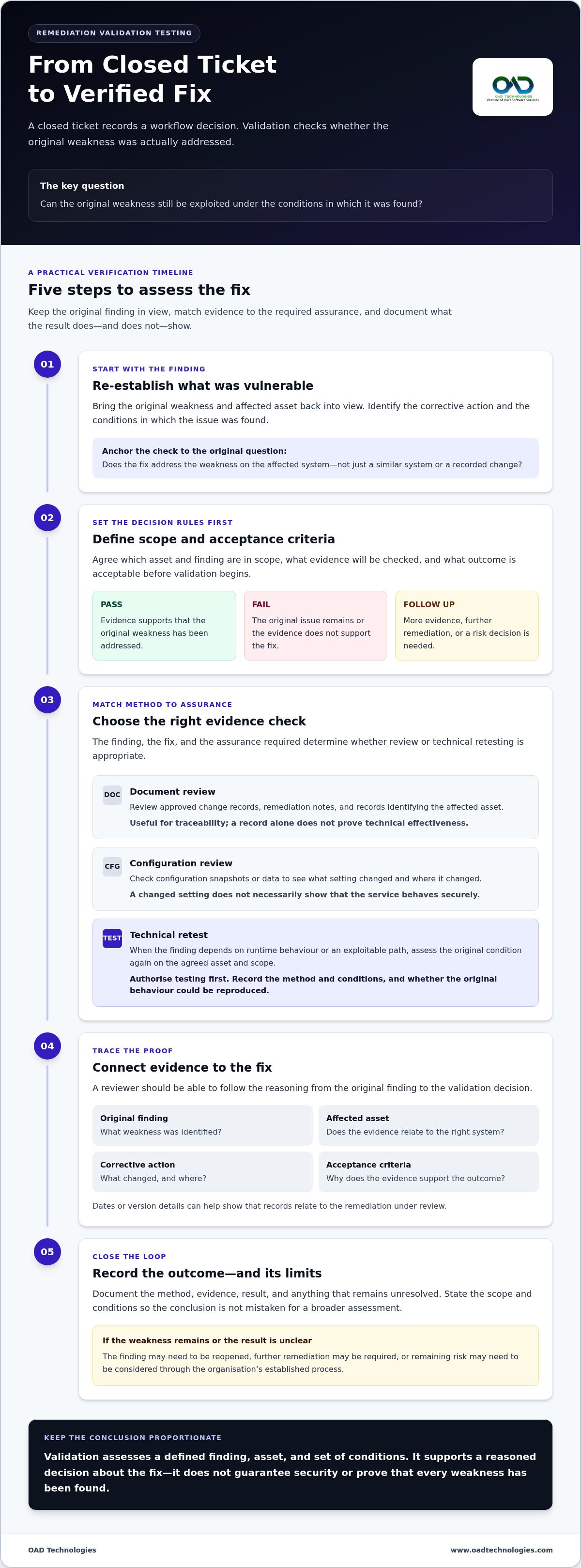
A controlled workflow makes remediation validation testing easier to repeat, review and explain. Agree the expected outcome before checking the fix, then keep the evidence and decisions tied to the original finding. This helps technical teams and risk owners understand whether the fix passed and what to do if it did not.
Set scope and acceptance criteria before testing
Before reviewing evidence or conducting a technical retest, identify the original finding, affected assets, remediation action and boundaries of the check. Agree the test scope and obtain authorisation before any technical retest. Define in advance what evidence would support closure, and note dependencies or changed conditions that could affect the result.
- Revisit the finding. Capture its reference, original condition, affected assets and the risk or behaviour it described. Resolve discrepancies between the finding and current asset records before proceeding.
- Describe the corrective action. Record the change made, the components it should affect and any dependencies. If the fix applies only to certain systems or versions, make those boundaries explicit.
- Set acceptance criteria. State what evidence will count as a pass. For a technical finding, this might mean the original condition can no longer be reproduced within the agreed test scope. Define in advance what would count as partial or inconclusive evidence.
- Agree scope and authorisation. Confirm which assets, accounts, environments and test activities are in scope. Obtain authorisation before a technical retest, and account for restrictions that could affect safe execution.
- Carry out the planned check. Use the method that fits the finding and criteria. Compare evidence with the original condition, and record relevant test conditions rather than relying on a simple “pass” label.
- Classify the result. Mark the finding validated when evidence meets the closure criteria; partially validated when the fix addresses only some assets or conditions; unresolved when the weakness remains; or inconclusive when available evidence can’t support a reliable conclusion.
Record outcomes and manage unresolved findings
Keep a concise record that links the finding to its affected assets, corrective action, method, evidence, limitations, status and decision owner. Separate confirmed remediation from partial, failed or inconclusive checks so that dashboards and reports don’t imply more assurance than the evidence supports. Preserve enough detail for another reviewer to understand the conclusion without repeating the work.
A failed check should return to remediation planning, with a named owner and a considered next action, such as correcting the implementation or arranging another validation. An inconclusive result also needs ownership: decide whether to restore access, clarify scope, gather additional evidence or reassess the risk. Don’t close either outcome as validated simply to clear a queue. Record any risk decision through the organisation’s established process, then set a follow-up point.
OAD Technologies provides Vulnerability Assessment and Penetration Testing (VAPT) to help organisations assess security weaknesses. Discuss your VAPT requirements and how validation objectives can be defined for your organisation.
How OAD Technologies Connects VAPT with Remediation Validation
Vulnerability Assessment and Penetration Testing (VAPT) helps organisations identify and understand security weaknesses. Once a finding is recorded, the organisation can use its risk context and business priorities to decide what to address first, who owns remediation and what evidence would support a later validation decision. These are connected activities, but they serve different purposes: identifying a weakness does not demonstrate that a subsequent fix has resolved it.
OAD Technologies provides VAPT for organisations assessing their security posture. Connecting assessment findings with remediation validation means defining the objectives and boundaries for each stage in a way that fits the organisation’s requirements. That clarity helps technical teams, risk owners and decision-makers share an understanding of the finding and the assurance they need.
Where VAPT fits in a remediation assurance plan
VAPT findings can inform prioritisation by giving teams a basis to consider the nature and potential impact of identified weaknesses. The organisation remains responsible for deciding remediation ownership, timing and risk treatment. Set validation objectives for the chosen corrective action rather than assuming the original finding or a recorded change proves the issue has been resolved.
Governance connects technical decisions to accountability, oversight and organisational risk. A broader GRC strategy can help frame how security findings and remediation status fit into risk and governance discussions. VAPT and validation can contribute useful information to those discussions, but neither should be represented as automatically satisfying a regulatory or compliance requirement.
What to define when discussing requirements
Before planning an assessment or validation activity, clarify the business question it needs to answer. Is the priority to understand weaknesses in a defined scope, review a particular finding after corrective action, or establish what evidence will support a risk decision? A clear objective helps define relevant boundaries without assuming every organisation needs the same approach.
Useful points to bring into the discussion include:
- Relevant findings: identify the issues or areas of concern and the business context behind them.
- Scope: describe the systems, assets or environments the organisation wants considered, along with any boundaries.
- Evidence objective: explain what decision the evidence should inform and what level of assurance is sought.
- Accountability: identify who owns remediation, who reviews validation outcomes and how unresolved risk will be handled.
This preparation supports a clearly defined scope shaped around the organisation’s objectives. It also keeps assessment, remediation and validation decisions distinct, so evidence can be interpreted in context rather than treated as a generic pass or compliance statement. OAD Technologies can discuss VAPT requirements and the role assessment findings may play in a wider security process.
To explore the requirements for your organisation, Discuss your requirements with OAD Technologies or Book a meeting.
Make Validation Part of the Next Security Decision
Use remediation validation testing to connect technical teams with the people accountable for business risk. A clear outcome can help decision-makers understand where remediation is progressing, where exposure may remain and which issues need attention next. Consistent records can also help organisations spot recurring weaknesses and improve how they plan and assess corrective work.
Consider how validation fits your organisation’s risk priorities, existing assessment work and decision-making process. That doesn’t require a one-size-fits-all model. Define what you need to learn, who will act on the findings and what evidence will support the resulting decision.
OAD Technologies provides Vulnerability Assessment and Penetration Testing (VAPT) for enterprise technology and security decision-makers. Discuss your requirements to explore how VAPT can align with your organisation’s security objectives. Clear objectives and accountable follow-through help each finding inform a deliberate security decision.
Frequently Asked Questions
Is remediation validation testing the same as penetration testing?
No. Penetration testing examines security weaknesses within an agreed scope, while remediation validation asks whether a particular corrective action addressed a finding. A technical retest may use penetration-testing techniques, but evidence review may be more suitable for some changes. For example, a team might check a recorded software version update against the affected asset, then decide whether the finding’s technical behaviour also needs to be tested.
Can a vulnerability be marked resolved without technical retesting?
Yes, an organisation may mark an action complete under its internal process, but that status alone doesn’t establish that the weakness is no longer exploitable. A record that a patch was installed, for example, may not show whether it reached every affected instance. The evidence needed depends on the finding and the organisation’s acceptance criteria. If uncertainty remains, a scoped retest may add assurance, with any test limits recorded.
How do you validate a security fix after a penetration test?
Begin by linking the original finding to the corrective action and identifying what decision the check needs to support. If a finding relates to an exposed function, define which authorised environment and behaviour are relevant before testing. Review implementation evidence, then retest the original condition where appropriate. Record the outcome and constraints, including whether a changed environment prevented a meaningful comparison with the original assessment.
What happens if remediation validation testing fails?
A failed result means the available evidence didn’t demonstrate the intended outcome. Determine what the check established, such as whether the original issue remains reproducible or only some affected assets were assessed. Assign an owner to decide the next action, which may include further remediation or a risk review. Keep the finding open or otherwise accurately tracked until the organisation reaches a supported decision.
Is remediation validation testing required for every vulnerability?
No universal rule makes the same validation approach necessary for every vulnerability. An organisation can set a risk-based policy that considers business impact, the nature of the weakness and the corrective action. For instance, a change affecting a critical service may call for stronger assurance than a low-impact issue with clear, auditable evidence. Document why the chosen check is proportionate, without treating this general guidance as a legal requirement.
Can configuration evidence prove that a vulnerability has been fixed?
Configuration evidence can show that a relevant setting appears to have changed, but it may not show how the live system responds. Its usefulness depends on whether the record represents the affected asset and conditions tied to the finding. A screenshot of a security setting, for instance, may need context such as the asset identifier and configuration version. For an exploitable issue, behavioural testing may provide a different kind of assurance.
What should a remediation validation report include?
A useful report should let a reviewer understand the basis for the status without relying on undocumented assumptions. Include a finding reference, affected assets, corrective action, validation scope, evidence and outcome. Add the date or test conditions where relevant, plus limitations such as inaccessible systems. State whether an outcome applies to all listed assets or only those examined, so risk owners can make informed follow-up decisions.
Disclaimer
Content by OAD Technologies is for general informational purposes only and does not constitute professional or cybersecurity advice. No warranties are made regarding accuracy or completeness; reliance is at your own risk. OAD Technologies shall not be liable for any direct or indirect losses arising from use of this content.