

A useful social engineering test measures how resilient your processes are, not which employee can be blamed. Social engineering penetration testing can reveal how people, policies and support workflows respond to realistic manipulation, but only when the assessment has clear boundaries and a learning-focused purpose.
It is reasonable to ask what a test should cover and whether it could disrupt work or undermine staff trust. Agreeing objectives, approvals, safeguards and a communication plan in advance helps manage these risks. The aim is to identify where controls or processes need attention, then turn findings into practical improvements.
This guide explains what an assessment may examine, how to scope it around business risks, and what responsible safeguards and useful reporting should include. It also provides criteria for comparing proposed scopes and deciding what evidence will help your organisation act on the results. For UAE enterprises considering how these objectives fit within a broader VAPT programme, OAD Technologies can discuss assessment requirements in the context of your security priorities.
Key Takeaways
- Understand how social engineering penetration testing differs from vulnerability scanning, technical penetration testing and awareness training.
- Build a responsible scope by linking each objective to a business risk, defining authorised targets and setting clear boundaries.
- Compare proposed engagements by their authorisation, safeguards, reporting approach and alignment with organisational objectives.
- Prepare stakeholders, approvals and exclusions before commissioning an assessment to help protect operations and staff trust.
- Connect assessment priorities with OAD Technologies’ Vulnerability Assessment and Penetration Testing (VAPT) service to inform your next steps.
What social engineering penetration testing assesses, and what it does not
Social engineering penetration testing examines how people-facing processes respond to authorised scenarios designed to influence people or prompt actions. It focuses on the interaction between people, procedures and security controls, rather than treating an individual employee as the weakness. Social engineering can exploit trust or routine, so the assessment should test only scenarios the organisation has explicitly authorised.
The scope determines what an assessment can tell you. Agree objectives, authorised participants or systems, boundaries and safeguards in advance. There is no single method every organisation must use. Choose scenarios that reflect the risks and business processes you want to understand. For example, an assessment could examine a defined identity-verification procedure without extending to other teams or systems.
This differs from vulnerability scanning, which uses tools to identify potential technical weaknesses, and from awareness training, which helps staff recognise and respond to threats. A human-focused assessment observes how controls work in an authorised scenario. It is not a staff examination or a substitute for training. For an overview of the broader concept, see social engineering (security).
Which organisational risks can a human-focused assessment examine?
An assessment can help an organisation examine whether information-handling practices, identity checks and established business processes hold up under pressure. The purpose is to identify where a process may need clearer guidance, stronger verification or better escalation routes, not to rank employees or assign blame.
Hypothetical example: an organisation could assess whether a defined access-request process follows its identity-verification steps. If the scenario reveals uncertainty about who can approve the request, the finding points to a process-design issue. It does not, by itself, establish that anyone acted carelessly or that a real incident occurred.
- Information handling: Do approved procedures guide staff when a request seeks sensitive information?
- Identity verification: Are identity checks clear and consistently built into relevant interactions?
- Business processes: Do escalation and approval routes work as intended in the authorised scenario?
How is social engineering testing different from penetration testing?
Penetration testing evaluates security weaknesses within an agreed technical scope. Social engineering testing focuses on human-facing controls and processes. In short, social engineering testing is an authorised assessment of how people-facing controls respond to agreed manipulation scenarios, rather than a technical-only test of systems.
The two approaches can sit alongside one another in a broader Vulnerability Assessment and Penetration Testing (VAPT) programme, but their scopes do not need to be identical. A technical test might examine an application or network; a human-focused assessment might examine a specific verification workflow. Organisations planning a wider assessment can explore the Vulnerability Assessment and Penetration Testing guide to understand how VAPT fits into a structured security programme.
How to define a responsible social engineering test scope
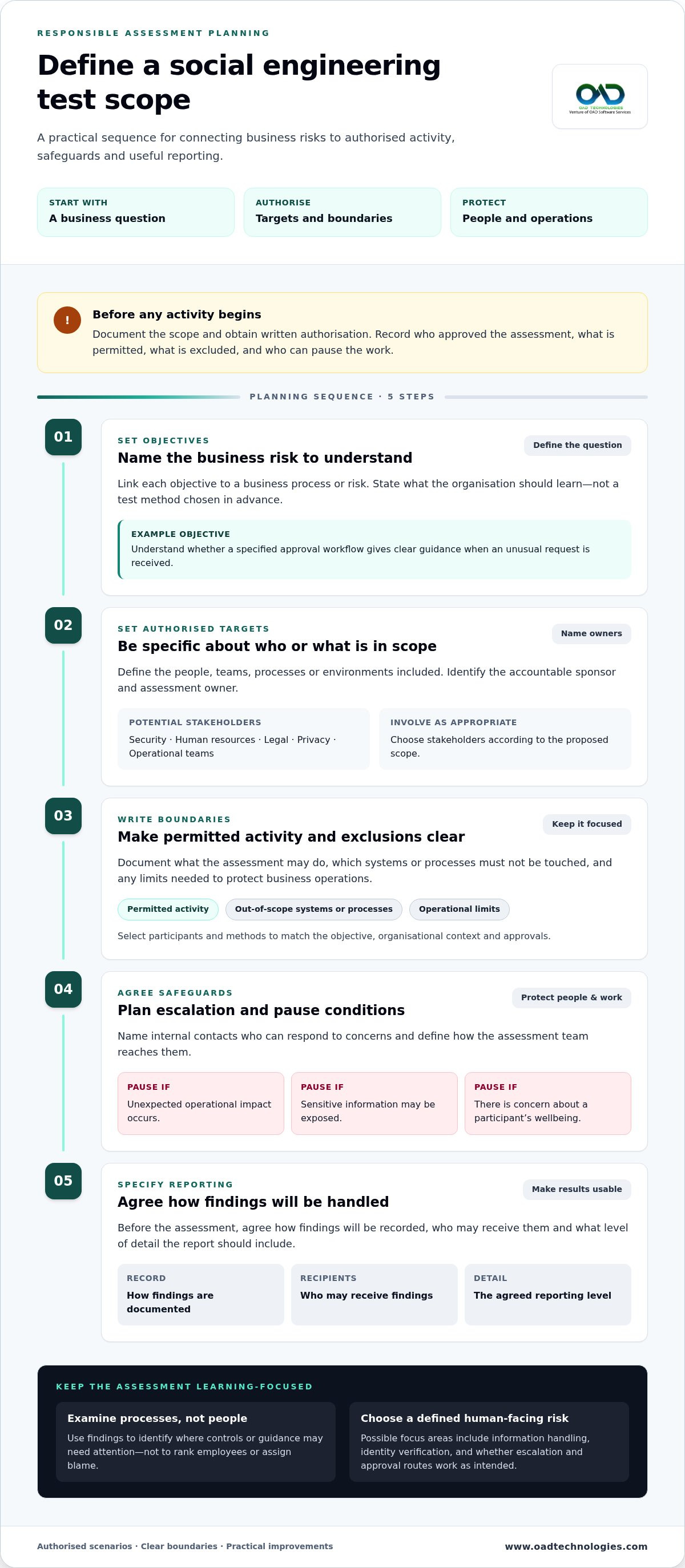
Start with a business question, not a predetermined test method. Social engineering penetration testing should examine a risk the organisation wants to understand, such as whether a defined identity-checking process is clear and consistently applied. Translate that objective into authorised activity, practical safeguards and reporting that can guide decisions.
Documented scope and written authorisation are prerequisites for controlled testing. Before activity begins, record who approved it, what is permitted, what is excluded and who can pause the work. A clear plan helps protect staff, customers, sensitive information and day-to-day operations while keeping the assessment focused.
Use this planning sequence to shape the engagement:
- Set objectives. Link each objective to a business process or risk. For example, you may want to understand whether a specified approval workflow gives clear guidance when an unusual request is received. State what the assessment should help the organisation learn.
- Identify authorised participants or systems. Define the people, teams, processes or environments in scope, and name the accountable sponsor and assessment owner. Involve relevant stakeholders, such as security, human resources, legal, privacy and operational teams, as appropriate to the proposed scope.
- Write boundaries and exclusions. Document permitted activity, systems or processes that must not be touched, and any limits needed to protect business operations. Choose participants and methods according to the objective, organisational context and approvals.
- Agree safeguards and escalation. Name the internal contacts who can respond to concerns and define how the assessment team reaches them. Set conditions for pausing the work if there is unexpected operational impact, potential exposure of sensitive information or concern about a participant’s wellbeing.
- Specify reporting expectations. Agree how findings will be recorded, who may receive them and what detail will support remediation. Focus the report on process conditions, control gaps and improvement priorities, rather than identifying or blaming individual employees.
Set objectives, boundaries, and approval responsibilities
Approval should make it easy to distinguish authorised activity from an actual incident. The sponsor provides organisational accountability; the assessment owner coordinates scope and decisions; and relevant stakeholders advise on operational, privacy and people-related considerations. Record exclusions in plain language and name the person authorised to resolve questions or suspend activity. This keeps the test aligned with its purpose.
Build safeguards that protect people and operations
Plan for privacy and continuity before testing starts. Collect only the information needed to assess the agreed objective, restrict access to findings and set expectations for handling or deleting assessment data. Consider whether planned activity could interfere with critical work or cause undue distress, and establish a straightforward route to pause and escalate. Treat participants respectfully: the goal is to improve systems and processes, not to embarrass people.
For organisations shaping a broader VAPT programme, OAD Technologies’ Vulnerability Assessment and Penetration Testing work provides a relevant context for discussing assessment objectives and scope. You can discuss your security assessment requirements with OAD Technologies in relation to your organisation’s priorities.
How to compare social engineering testing providers
A proposal is easier to assess when it explains what the engagement will test, what it will leave untouched and how your organisation can use the findings. For social engineering penetration testing, compare the substance of the scope rather than broad promises or the number of activities named. A tightly bounded proposal makes it clearer whether the work addresses your business risks and allows you to compare approaches against consistent criteria.
Use this framework to evaluate each proposed engagement:
| Criterion | What a clear proposal should explain |
|---|---|
| Scope clarity | Objectives, authorised participants or processes, boundaries and explicit exclusions. |
| Authorisation | Who approves the work, who owns the engagement and how questions or concerns are escalated. |
| Safeguards | How the plan accounts for privacy, sensitive information, business continuity and conditions for pausing activity. |
| Reporting | How observations, business relevance and remediation considerations will be presented, and how confidential or personal information will be protected. |
| Business alignment | How each proposed activity relates to a stated organisational objective or risk. |
These criteria make comparisons more meaningful. One proposal may describe a broad range of possible activities, while another may focus on a specific process. Without agreed objectives and boundaries, the offers are difficult to compare because “comprehensive testing” can mean different things to different organisations. A clear scope makes intended coverage and limitations visible before work begins.
What should a credible scope and reporting approach make clear?
Look for written objectives, agreed boundaries, documented exclusions and named escalation arrangements. Reporting should connect observations to the business process or control involved, explain why the finding matters and offer practical remediation considerations. It should distinguish a process weakness from an individual performance judgement. Reports also need appropriate handling: include enough detail to support action while avoiding unnecessary personal information or exposure of confidential material.
How does human-focused testing fit into wider security?
Human-facing processes operate alongside identity governance, access controls and incident detection. A finding about how an access request is handled, for instance, may be easier to interpret alongside the organisation’s identity and access management policies. Detection and response arrangements also provide context. Decision-makers can consider whether relevant activity would be recognised and escalated, without assuming that one assessment proves overall readiness.
OAD Technologies’ Identity and Access Management strategic framework discusses how identity governance supports security planning. OAD Technologies’ VAPT offering can also provide a wider context for aligning assessment priorities with organisational security objectives.
What to prepare before commissioning an assessment
Preparation turns an assessment from a general security exercise into a decision-making tool. Before commissioning social engineering penetration testing, clarify the business question, identify the processes that matter most and agree how the work must protect people and operations. This gives stakeholders a shared basis for approving the scope and acting on the results.
Clear objectives, proportionate scope and actionable reporting make an assessment more useful. Use this checklist to prepare a brief:
- Objectives: State the business risk or process you want to understand and the decision the assessment should inform.
- Stakeholders: Name the accountable sponsor, assessment owner and internal teams that need to review or approve the plan.
- Authorisation: Record who can approve activity, answer scope questions and pause the assessment.
- Boundaries: Identify authorised processes or systems, business-critical periods and activities that must be explicitly excluded.
- Reporting needs: Decide who will receive findings, how they should be prioritised and what level of detail will support remediation.
Think beyond the security team. A process involving customer support, finance or access administration may have different operational owners and sensitivities. The appropriate scope depends on your objective, so identify critical workflows and their owners before proposing activity. Record constraints such as peak business periods, sensitive information or processes where disruption could affect essential services.
Create an assessment brief that supports useful decisions
Summarise the business question, intended audience and decisions the findings should inform. For example, clarify whether leadership needs to prioritise a process redesign, strengthen an approval control or improve internal guidance. Include organisational constraints, sensitive workflows and approval responsibilities. Specify how findings should be prioritised, who should receive them and how confidential details should be handled. This keeps the assessment connected to decisions, rather than activity for its own sake.
Agree escalation arrangements before work begins. Set out who should be notified if activity raises an operational concern, how the assessment can be paused and who has authority to resume it. Define stop conditions in practical terms, such as unexpected effects on a critical workflow or discovery of information outside the agreed objective. These controls help teams respond consistently rather than improvising under pressure.
Connect findings to risk governance without overstating compliance
Assessment findings can inform risk registers, control reviews and remediation planning, but they do not automatically demonstrate regulatory compliance. If a regulatory framework or obligation is relevant, confirm its applicability and wording with authoritative sources and the organisation’s appropriate legal or compliance stakeholders. Keep the assessment objective distinct from any compliance conclusion, and document how findings will feed into existing governance processes.
OAD Technologies’ Vulnerability Assessment and Penetration Testing (VAPT) work can provide context for aligning assessment priorities with wider security objectives. Discuss your assessment requirements with OAD Technologies to relate the business question, proposed boundaries and reporting needs to your organisation’s priorities.
Discuss social engineering assessment requirements with OAD Technologies
A well-framed assessment begins with the business question it needs to answer. Identify the process or risk you want to understand, define what activity is authorised and decide what reporting would help your organisation take practical next steps. These foundations help turn social engineering penetration testing from a broad idea into a considered assessment decision.
OAD Technologies provides cybersecurity services for enterprise audiences across the UAE. Its Vulnerability Assessment and Penetration Testing (VAPT) service provides a relevant context for discussing how assessment priorities connect to wider security objectives. The conversation can start with your organisation’s requirements, rather than an assumed method or one-size-fits-all scope.
Frame the conversation around business risk and assessment scope
Bring a concise description of the process you want to examine and the security question behind it. You might be considering how an approval workflow supports identity checks, or how staff should escalate an unusual request. These are examples of business questions, not default test scenarios. Explain the operational context, relevant stakeholders and any boundaries that matter so the discussion can stay specific to your organisation.
It may help to prepare a short outline covering:
- Business objective: What do you want the assessment to help you understand?
- Process and ownership: Which business process is relevant, and who is responsible for it?
- Authorisation and limits: Who can approve the work, and what should remain outside scope?
- Useful findings: What information would help your team prioritise improvement?
Clear answers give stakeholders a practical starting point for considering a proportionate scope and appropriate safeguards. They also help distinguish business priorities from assumptions about which testing activities should be used.
Choose a considered next step
You do not need to settle every scope detail before starting a discussion. You can outline your requirements, explore how those priorities relate to VAPT and consider how an assessment should be framed before deciding on next steps. Keep the focus on authorised activity, operational considerations and reporting that can inform decisions. This distinguishes discussing an assessment from promising a particular method, result or compliance outcome.
Share the business processes and security questions that matter to your organisation, along with any constraints or exclusions you already know. OAD Technologies can discuss these requirements in the context of its VAPT service and your wider security priorities. To begin, visit the OAD Technologies website or Book a meeting.
Turn your assessment priorities into a practical next step
The value of social engineering penetration testing lies not in the test alone, but in what your organisation chooses to learn and improve. Treat the assessment as an opportunity to strengthen the connection between security controls and the decisions people make during routine work. A focused conversation can help shape an approach around your priorities and keep the next step grounded in business needs.
Consider what you want to understand, who needs to be involved and how findings could support future security decisions. Your team can then decide whether to discuss requirements or arrange a meeting with OAD Technologies.
Discuss your assessment requirements with OAD Technologies, or Book a meeting to explore your priorities.
Frequently Asked Questions
Is social engineering penetration testing the same as phishing simulation?
No. A phishing simulation is one possible, comparatively narrow exercise, while social engineering penetration testing can assess a wider set of authorised, people-facing processes. The exact scope depends on the organisation’s objectives; do not assume it includes every communication channel or workflow. For example, you might want to assess how a particular identity-checking process is applied rather than focus solely on how staff respond to a simulated email.
Can social engineering testing be conducted without disrupting business operations?
It can be planned to reduce operational impact, but no assessment should promise zero disruption. Identify critical workflows and busy periods before agreeing the scope, and define escalation contacts and pause conditions. For example, an organisation could exclude a time-sensitive process during a peak period and specify who can suspend activity if an unexpected issue arises. These controls help teams manage operational concerns while keeping the agreed objective in view.
What approvals should an organisation obtain before a social engineering assessment?
Obtain written approval from an accountable organisational sponsor and document the assessment owner, authorised scope and exclusions. Involve internal stakeholders whose responsibilities may be affected, such as security, privacy, legal, human resources and process owners, as relevant to the planned work. Agree who can address scope questions and stop activity. If third-party systems or services could be involved, establish the necessary permissions before including them in the assessment.
How should an organisation handle information collected during a social engineering test?
Handle collected information under the organisation’s approved privacy and information-handling processes. Before testing, decide what data is needed to meet the objective, who may access it, how it will be protected and when it should be deleted or retained under applicable policy. Reports should avoid unnecessary personal details. If the activity reveals information outside the authorised purpose, use the agreed escalation route to guide containment and review.
What should a social engineering penetration testing report include?
A useful report connects each observation to the agreed objective and relevant business process. It should explain the control or workflow involved, the potential business significance and practical remediation considerations. Include scope limitations so readers do not mistake an observation for a finding about systems or teams that were not assessed. Present findings in a way that supports prioritisation, and restrict personal or confidential details to what authorised readers need to act.
Does social engineering penetration testing guarantee regulatory compliance?
No. Social engineering penetration testing can provide information that supports risk management, but it does not by itself establish regulatory compliance or prove that every relevant control is effective. Requirements depend on the organisation and the rules that apply to it. Treat assessment findings as one input for review alongside governance, policies and other relevant evidence. The organisation’s compliance or legal stakeholders should assess regulatory applicability and interpret obligations using authoritative sources.
How can social engineering findings inform wider security improvements?
Use findings to identify where a process, rather than an individual, may need clearer controls or ownership. For example, an observation about identity verification could prompt a review of access approval procedures and staff guidance. A finding about escalation may help clarify responsibilities between business teams and security. Assign each improvement to an accountable owner, record its priority and track progress through the organisation’s existing risk-management process.
Discuss your requirements with OAD Technologies or Book a meeting.
Disclaimer
Content by OAD Technologies is for general informational purposes only and does not constitute professional or cybersecurity advice. No warranties are made regarding accuracy or completeness; reliance is at your own risk. OAD Technologies shall not be liable for any direct or indirect losses arising from use of this content.