

What if a falling response-time average masks the incidents that take longest to contain? Security teams may report one figure, yet “respond” can mean anything from acknowledging an alert to restoring affected systems. Without shared start and end points, mean-time-to-respond (MTTR) figures can make performance difficult to compare and risk harder to explain.
MTTR is useful only when everyone measures the same milestones. This guide explains what the metric can measure, how to calculate it consistently and how to interpret it alongside detection, triage, containment and recovery measures. It also explains why averages need context, including incident severity and consistent reporting cohorts, before they can support executive decisions. Finally, we’ll consider how Managed Detection and Response, SIEM and endpoint telemetry can inform incident timelines and give teams a clearer view of response performance.
Key Takeaways
- Define what “respond” means and specify the clock’s start and end points before reporting MTTR.
- Calculate MTTR using a consistent formula, incident scope and unit of time.
- Separate detection, acknowledgement, response, containment and recovery measures to show where delays occur.
- Compare like-for-like incidents by severity and type, then interpret averages alongside containment and business impact.
- Use agreed incident milestones and relevant SIEM or endpoint telemetry to support clearer response timelines.
What Does Mean Time to Respond (MTTR) Measure in Cybersecurity?
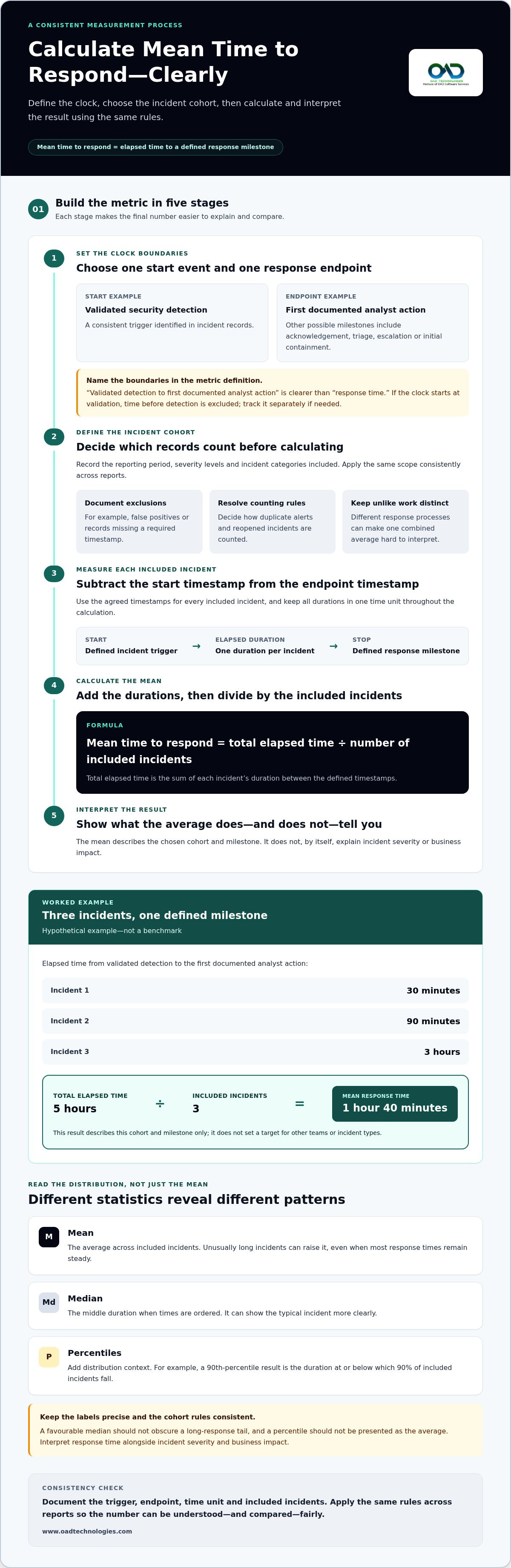
In cybersecurity, mean time to respond is the average elapsed time between a defined incident trigger, such as a validated security detection, and a defined response milestone, such as an analyst’s first documented action. It measures how quickly an organisation acts after the chosen starting event. The result is meaningful only when both clock boundaries are explicit.
Response time is the interval from a specified incident trigger to a specified response action; incident-resolution time continues until the underlying issue is resolved. The response endpoint might be analyst acknowledgement, triage, escalation or an initial containment action. These milestones are not interchangeable. A response can begin while investigation continues, and the threat may remain active after an initial action.
MTTR has several expansions, including mean time to respond, repair, recover and resolve. The Mean Time to Recovery (MTTR) reference illustrates how the acronym is used in different operational contexts. For MTTR reporting, spell out “mean time to respond” and name the metric’s endpoint. Don’t assume readers will infer what the acronym means.
Where does the response-time clock start and stop?
Choose a start event that can be identified consistently in incident records. It might be a validated detection, when an alert is confirmed as credible, or a formal incident declaration. Then define the endpoint, such as an assigned human response or a documented initial action. If the clock starts at validation, the metric excludes the time between the event occurring and its detection. Track that interval separately if you need to understand the full incident timeline.
Record these boundaries in the metric definition, not just in an analyst’s working notes. For example, “validated detection to first documented analyst action” is more informative than “response time”. Without agreed boundaries, two teams may calculate figures that appear comparable but cover different parts of an incident.
Why do MTTR reports use different meanings?
IT operations often use MTTR for repair, recovery or resolution, with the clock ending when a service or system returns to an agreed state. Cybersecurity teams may use response to mean acknowledgement, investigation or an initial action against a threat. These intervals answer different questions: swift acknowledgement does not prove the threat was contained, and containment does not necessarily mean systems have been restored.
Use the full metric name in dashboards, incident reviews and executive reports, then add a plain-language boundary label. “Mean time to respond, validated detection to initial action” makes the measure clear; “mean time to repair, outage to service restoration” describes a different interval. Consistent labels help leaders compare like with like and avoid mistaking one team’s response figure for another team’s recovery result.
For a reliable definition, document the trigger, endpoint, time unit and incidents included in the calculation. Apply those rules consistently across reports. This gives security teams a shared measurement and helps executives understand what the number can, and cannot, say about incident handling.
How to Calculate Mean Time to Respond MTTR Consistently
Mean time to respond = total elapsed time from the defined start event to the response endpoint for all included incidents ÷ the number of included incidents. “Total elapsed time” is the sum of each incident’s duration between those timestamps; “included incidents” are the records that meet the agreed scope for the reporting period. Use a single time unit, such as minutes or hours, throughout the calculation.
Hypothetical example, not a benchmark: Three incidents take 30 minutes, 90 minutes and 3 hours from validated detection to the first documented analyst action. Together, those intervals total 5 hours. Divide 5 hours by 3 incidents to get a mean response time of 1 hour and 40 minutes. The result describes this cohort and milestone only; it does not establish a target for other teams or incident types.
Which incidents belong in the calculation?
Set the incident population before calculating. Record the reporting period, severity levels and incident categories included, then apply those rules consistently. Document exclusions, such as false positives or records missing a required timestamp, rather than removing cases without explanation. Decide in advance how to count duplicate alerts and reopened incidents: several alerts may belong to one incident, while a reopened case may represent a continuation or a new response cycle.
Keep categories separate when their response processes differ materially. For example, combining routine endpoint alerts with complex identity incidents can make the overall average difficult to interpret. A clear cohort definition shows which events shaped the result and supports fair comparisons between reporting periods.
Should teams report the mean, median or percentiles?
The mean is sensitive to unusually long incidents. One delayed case can raise the average even if response times for most incidents remain steady. The median, the middle value when durations are ordered, can show the typical incident more clearly. Percentiles add distribution context: a 90th-percentile result, for instance, indicates the duration at or below which 90% of included incidents fall.
Report these statistics with precise labels and the same cohort rules. Don’t use a favourable median to obscure a long-response tail or present a percentile as the average. Together, the mean and distribution measures show different aspects of performance; none explains incident severity or business impact on its own.
Timestamp quality is essential. A missing start time, delayed analyst entry or edited incident record can shift the calculated interval. Duplicate alerts may inflate the incident count, while inconsistent handling of reopened cases can shorten or lengthen durations. Preserve timestamp definitions, document corrections and review outliers before publishing results. These controls make MTTR reporting more repeatable and auditable.
Keep operational targets distinct from external requirements. The CISA Binding Operational Directive 22-01 illustrates that remediation requirements have a defined scope and purpose; it is not a general cybersecurity response-time benchmark. For organisations refining security measurement within broader Managed Technology Services, consistent incident records provide a stronger basis for analysis.
MTTR vs MTTA, MTTD and Time to Contain: What Each Metric Tells You
Security response involves connected milestones, but each interval answers a different operational question. Mean time to detect (MTTD) measures discovery; mean time to acknowledge (MTTA) measures alert recognition; response time tracks a separately defined action; containment and recovery measure later outcomes. Keep their clock boundaries distinct, even when one incident record supplies timestamps for all of them.
| Metric | Clock boundaries | Question it answers |
|---|---|---|
| MTTD, mean time to detect | From the incident or activity’s defined start to detection | How long did it take to identify a potential incident? |
| MTTA, mean time to acknowledge | From alert generation to recorded acknowledgement | How long did it take someone to recognise the alert? |
| Mean time to respond | From the selected trigger, such as validated detection, to the defined response action | How long until the specified response began? |
| MTTC, mean time to contain | From a defined detection or confirmation point to verified containment | How long until the threat was stopped from causing further harm? |
| Mean time to recover | From a defined incident milestone, often containment, to service or system restoration | How long until affected operations were restored? |
Organisations may set different boundaries for some metrics, particularly MTTD and MTTC. Document the trigger and endpoint in the metric name or its supporting definition. The NIST Cybersecurity Framework provides a broader structure for considering security outcomes across Detect, Respond and Recover. Time metrics can help teams examine those activities without replacing the wider risk picture.
How do MTTD and MTTA differ from response time?
Detection means identifying activity as a potential incident. Acknowledgement means recognising or accepting an alert for attention; on its own, it does not show that investigation or action has begun. Response time measures a separate, pre-agreed action after its chosen start event. A team might define that action as an analyst beginning triage or taking a documented first step.
Consider a hypothetical timeline: suspicious activity occurs, monitoring identifies it, an analyst acknowledges the alert, and a response action follows. Each timestamp can support a different interval. This illustrates possible milestones, not a universal workflow; processes may combine steps or record them differently.
Is containment or recovery part of MTTR?
Containment and recovery are separate milestones unless an organisation explicitly defines its response metric to end at one of them. If “respond” ends at the initial analyst action, measuring through containment or system restoration answers a different question. Combining these intervals can hide whether delay occurred in acknowledgement, investigation, containment or restoration.
Label dashboards precisely, for example, “mean time to respond, validated detection to first action” or “mean time to contain, confirmed incident to verified containment”. A single MTTR figure cannot describe the full incident-response lifecycle. Read response-time metrics alongside linked milestones to see where time accumulates while preserving the meaning of each measure.
How to Interpret MTTR Without Hiding Risk or Gaming the Metric
A lower mean time to respond can signal faster action, but it does not automatically mean risk has fallen. The average may improve because a reporting period included more straightforward incidents, severe cases were classified differently, or the response clock stopped before containment. Interpret the number alongside the incidents behind it, the response outcome and the business context.
Build a baseline using stable definitions, then examine trends across comparable periods, severity levels and incident types. Avoid treating a universal target as proof of effective response. Set any internal objective transparently, explain its rationale and review it as the threat environment, business priorities or operating model changes. The goal is meaningful improvement, not a lower figure at any cost.
What makes MTTR comparisons fair?
Before comparing teams or time periods, align the clock boundaries, incident scope, severity categories and reporting window. Disclose changes to detection technology, classification rules or response processes that may alter which incidents enter the dataset. A new source of telemetry, for example, might surface more lower-severity cases and shift the average even if response performance has not changed.
External benchmarks need the same scrutiny. Unless their definitions, incident mix and operating context are comparable, use them as background rather than a pass-or-fail standard. A carefully documented internal trend may offer more useful insight than a headline figure drawn from a different environment.
How can leaders use MTTR in governance reviews?
Review the trend with security, technology and business stakeholders rather than ranking teams by one number. Ask what the slowest cases reveal: did detection take longer, was escalation delayed, did a decision require coordination, or did containment depend on a complex technical step? The pattern can help leaders focus on a bottleneck instead of pressing teams to shorten every interval indiscriminately.
Pair response time with containment, recurrence and business-impact information where reliable data exists. A quick initial action followed by prolonged exposure tells a different story from prompt containment followed by a longer restoration period. Record the metric definition, cohort and limitations alongside executive reporting so decision-makers can see what the data supports and where interpretation requires care.
Also examine outliers and classification quality. If teams exclude difficult cases without a documented rule, or stop the clock at an early milestone while describing the result as full response, the average can look healthier without reflecting lower risk. Keep exclusions visible and review significant shifts in the incident population. These safeguards make MTTR reporting more useful for governance and operational learning.
For organisations connecting incident measurement with defined security responsibilities, OAD Technologies’ Managed Detection and Response services can support a structured discussion about reporting scope and milestones. Discuss your MTTR reporting requirements.
How Managed Security Operations Can Support Meaningful MTTR Reporting
Managed security services can contribute to clearer MTTR reporting when the organisation and service team agree on responsibilities, incident milestones and reporting scope. Those agreements make recorded intervals easier to interpret: which event starts the clock, which action ends it, and who records or validates each milestone. They also clarify where the service team’s role ends and where the organisation retains decision-making responsibility.
Managed Detection and Response (MDR) should fit into the organisation’s wider measurement and governance approach, rather than becoming a disconnected source of activity figures. Align its reporting definitions with internal incident categories and the metrics used in risk reviews. This makes it easier to understand how security operations contribute to response oversight without treating a service report as a complete measure of business risk.
What should a managed response reporting scope make clear?
Set out which incident categories and response milestones fall within the agreed scope, and which measures will appear in reports. For each milestone, document how it is recorded and whether the measure tracks acknowledgement, investigation, initial action or containment. Distinguish service responsibilities from decisions retained by the organisation, such as approving a disruptive action or assessing wider business impact.
A Fully Managed, Defined Scope arrangement should make those boundaries clear and tailored to the organisation’s needs. That clarity supports consistent expectations; it does not imply a particular response time or guarantee an outcome. Review the scope and definitions when the operating model, incident categories or reporting needs change.
How do SIEM and EDR relate to response measurement?
Security Information and Event Management (SIEM) can bring security events from different sources into a shared view and support correlation, helping teams examine an incident timeline. Endpoint Detection and Response (EDR) focuses on activity on endpoints, such as computers and servers, and can provide relevant detection and response information. SIEM and endpoint telemetry may help establish when events were observed or actions recorded, but their usefulness depends on available data, timestamps and agreed interpretation.
These technologies provide context, not a metric definition on their own. A recorded alert time, for instance, may not be the same as a validated detection or formal incident declaration. Establish which timestamp represents the chosen clock boundary and preserve that convention across reports. For wider context on security operations and event management, explore the managed detection and response strategic guide and the SIEM strategic guide.
Before evaluating a managed response arrangement, consider whether its scope makes responsibilities, incident categories, milestone definitions and reporting measures clear. Assess how the reporting aligns with internal governance and how telemetry informs the timeline, without assuming the data captures every relevant business factor. These foundations make response-time reporting more useful for shared oversight and ongoing review.
OAD Technologies provides Managed Technology Services for organisations shaping their security operations and measurement approach. Discuss your requirements to explore how a defined scope can support clearer MTTR reporting.
Turn response measurement into a stronger operating practice
Make incident metrics part of an ongoing governance conversation. Use them to identify where coordination, decision-making or visibility could improve, then agree how progress will be reviewed across security and business teams. This shifts the focus from pursuing a lower number to building a response model that reflects your organisation’s priorities.
Well-defined MTTR measures can support that work when they remain connected to meaningful outcomes and a clearly scoped operating model. OAD Technologies offers Managed Detection and Response, SIEM and endpoint security services that can be considered as part of an organisation’s measurement approach. No single figure should be treated as a guarantee of performance.
Take the next step with a conversation tailored to your requirements. Book a meeting or visit the OAD Technologies website to discuss how clearer measurement can support confident security decisions.
Frequently Asked Questions
Is MTTR a reliable measure of cybersecurity performance on its own?
No. MTTR is a useful operational indicator, but it cannot show whether incidents were contained effectively, returned after closure or caused serious business disruption. Read MTTR alongside evidence such as containment status, recurrence and affected business functions. For example, a faster average paired with repeated incidents may point to unresolved weaknesses rather than stronger security performance.
Can organisations compare MTTR across different security teams?
Yes, if the comparison considers more than the reported average. Check that teams use equivalent definitions and incident categories, then consider differences in alert volume, severity mix, staffing models and dependencies on other teams. A team handling complex incidents may have a longer average for sound operational reasons. Use comparisons to identify questions for review, not as a league table or standalone judgement of capability.
How should an organisation set an MTTR target?
Start with reliable historical data, then set objectives by incident severity and business risk rather than adopting a generic industry figure. Involve security, technology and business leaders so the target reflects operational capacity and the consequences of delay. Define what counts as meeting the target, how exceptions are treated and when it will be reviewed. Keep the objective distinct from regulatory or contractual obligations.
What happens if an incident has more than one response timestamp?
Preserve each timestamp and its meaning rather than replacing earlier records with a single “response” time. An alert might be acknowledged, escalated, investigated and acted on at different points. Select the event that matches the metric definition for the calculation, while retaining other milestones for analysis. If records conflict, document how the discrepancy was resolved so the measurement remains traceable during later reviews.
Does a lower MTTR always mean a better security outcome?
No. A shorter interval can reflect quicker action, but speed alone does not establish that the action was appropriate or effective. For instance, closing an alert promptly without confirming whether related activity persists could make a metric look better while leaving risk unaddressed. Assess the result alongside containment, incident recurrence and operational impact, and review outliers before treating a downward trend as progress.
Should MTTR include the time needed to contain and recover from an incident?
Not by default. Whether containment or recovery belongs in MTTR depends on the metric’s stated endpoint and the question leaders need answered. If you want to understand the full operational journey, track those stages as separate intervals as well as any deliberately defined end-to-end measure. This helps reveal whether delays arise during initial action, threat containment or restoration, without blurring distinct responsibilities and outcomes.
Disclaimer
Content by OAD Technologies is for general informational purposes only and does not constitute professional or cybersecurity advice. No warranties are made regarding accuracy or completeness; reliance is at your own risk. OAD Technologies shall not be liable for any direct or indirect losses arising from use of this content.