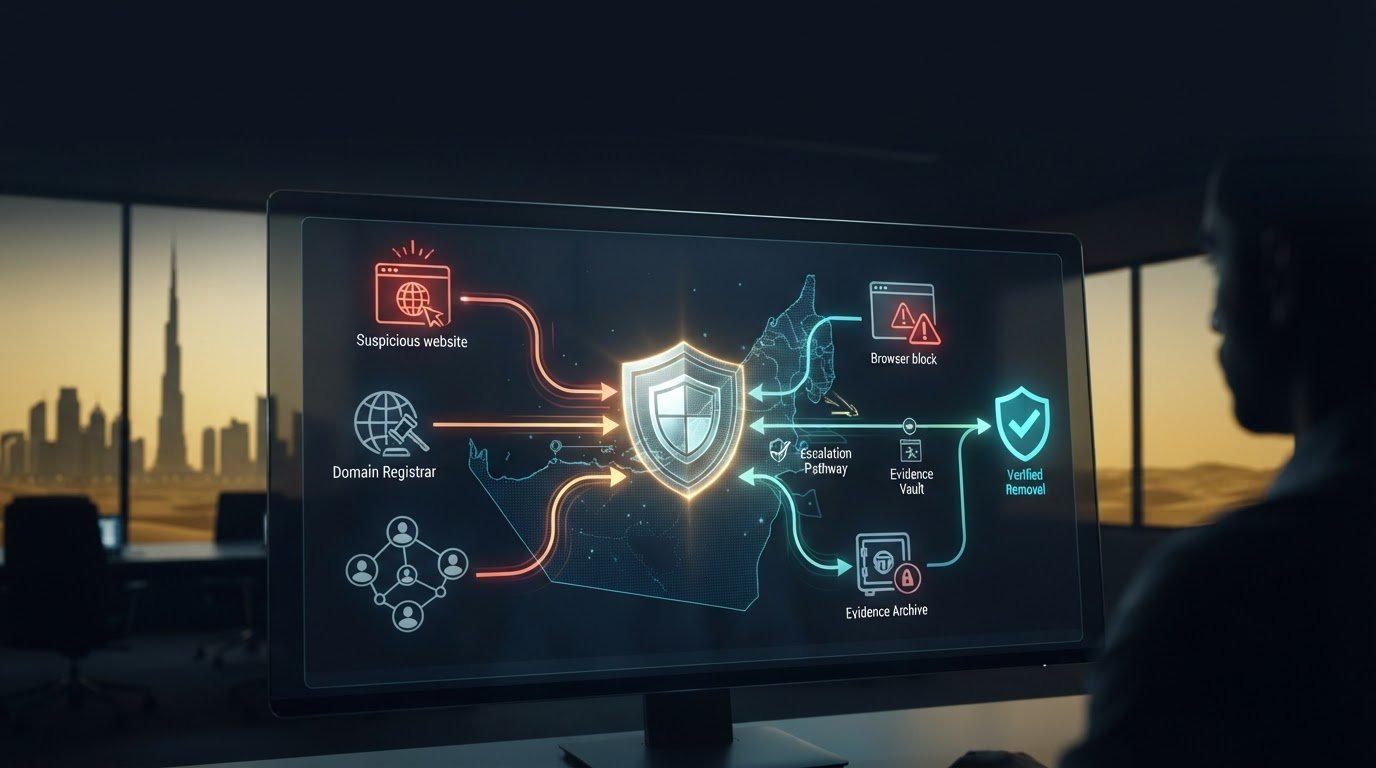
Security tools alone don’t give a business a coordinated response when suspicious activity appears. Managed network security services in the UAE bring monitoring, threat detection and incident response into a continuous operation, with managed security services able to provide round-the-clock coverage. They matter because teams need clear visibility across their networks and a practical way to act on emerging threats.
Security controls should support business operations, not obstruct them. For example, a UAE business with staff working across office and cloud systems needs access controls that protect sensitive resources while allowing authorised employees to do their jobs.
This guide explains how managed security operations bring together SOC monitoring, MDR, SIEM, incident response and reporting. It also covers access controls, network segmentation, onboarding and the way UAE requirements can shape security priorities. Use these points to assess your organisation’s needs and decide where external expertise could help.
Key Takeaways
- Understand how SOC monitoring, MDR, SIEM and incident response connect to turn security alerts into coordinated action.
- Recognise how ransomware, CEO fraud, cloud exposure and insider threats can affect business operations, and where layered controls help.
- Map the provider’s operational process, from asset discovery and system integrations to tuning and security reporting.
- Assess when outsourced or co-managed security can complement internal expertise, and how clear roles support effective collaboration.
- Use reporting, access controls and network segmentation to improve oversight and limit the potential spread of an attack.
MSSP services, including SOC, MDR/MXDR, SIEM/SOAR, and incident response
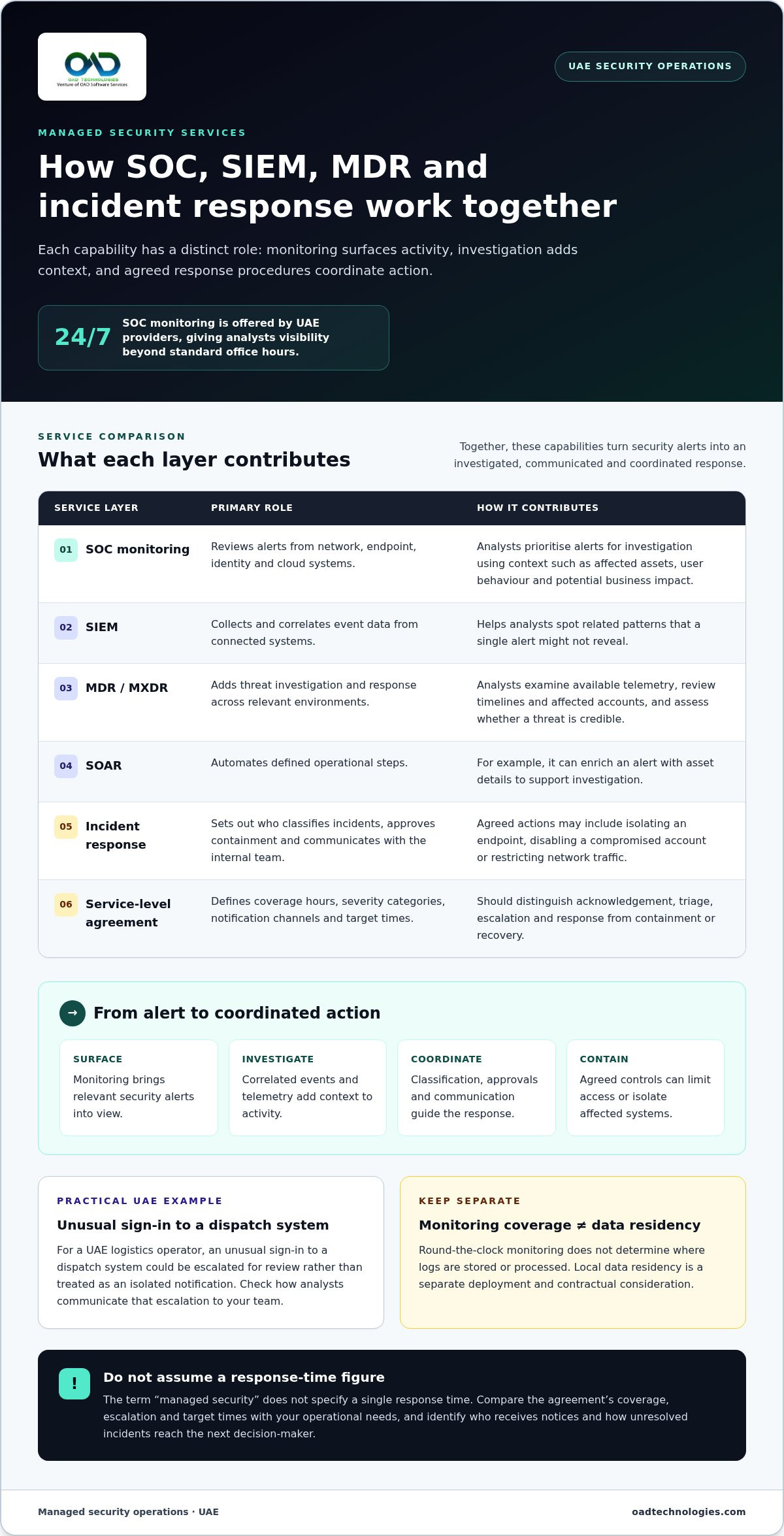
A managed security provider can combine SOC monitoring, threat investigation, and incident response in one operational service. UAE providers offer 24 X 7 SOC monitoring. Local data residency is a separate deployment and contractual consideration, because monitoring coverage alone doesn’t determine where logs are stored or processed.
SOC Monitoring and Alert Triage
A Security Operations Centre (SOC) reviews alerts from network, endpoint, identity, and cloud systems, then prioritises them for investigation. Continuous monitoring can operate around the clock, giving analysts visibility beyond standard office hours. Alert triage separates routine activity from events needing action, using context such as affected assets, user behaviour, and potential business impact. For a UAE logistics operator, an unusual sign-in to a dispatch system could be escalated for review rather than treated as an isolated notification. Check how analysts communicate that escalation to your team.
Threat Detection and Investigation
SIEM tools collect and correlate event data from connected systems, helping analysts identify patterns that a single alert might not reveal. MDR and MXDR services add investigation and response across relevant environments, while SOAR can automate defined steps, such as enriching an alert with asset details. Analysts examine the timeline, affected accounts, and related activity to assess whether a threat is credible. Review how findings are documented and how the provider distinguishes confirmed incidents from alerts requiring further investigation. This process helps teams understand what happened and which assets need attention.
Incident Response and Containment
A documented incident response procedure turns detection into coordinated action. It should identify who classifies an incident, who can approve containment and how the provider communicates with your internal team. Depending on the evidence and business impact, containment may involve isolating an affected endpoint, disabling a compromised account or restricting network traffic. For example, access by a suspicious account to a finance application could be restricted while analysts investigate related logins and preserve relevant records. Clear approval paths help prevent delays and unintended disruption to essential work.
Service Levels and Response Times
There is no single response-time figure to assume from the term “managed security”. The service-level agreement should define coverage hours, severity categories, notification channels, and target times for acknowledgement, triage, escalation, and response. It should distinguish an analyst’s initial response from containment or recovery, which may depend on access, approvals, and incident scope. UAE providers offer 24 X 7 SOC monitoring, but local data residency remains a separate deployment and contractual consideration. Compare commitments against your operational needs, including who receives escalation notices and how unresolved incidents reach the next decision-maker. These terms make performance measurable without confusing monitoring coverage with a guaranteed resolution time.
Why Managed Security Services Are Essential for Your Business?
Ransomware, CEO fraud, cloud exposure and insider activity create different risks for UAE organisations. Managed security operations connect monitoring and investigation, helping teams assess suspicious activity across systems rather than treating every alert in isolation.
Continuous Monitoring and Detection
24 X 7 monitoring gives analysts visibility into security events outside normal office hours. Continuous threat detection can surface unusual logins, unexpected cloud permission changes, or activity that differs from established patterns. Review which systems feed monitoring, how alerts are prioritised, and how findings reach your team. Those details show whether detection reflects your actual business environment.
For example, a retailer operating across the UAE may rely on cloud services for inventory and online orders. Monitoring identity events alongside cloud configuration changes can help analysts connect an unusual sign-in with a sudden permission change. This context makes an investigation more useful than handling each notification separately and helps teams understand how events relate to business-critical systems.
Threat Hunting and SIEM Integration
Threat hunting looks for suspicious patterns that automated alerts may not flag. SIEM integration brings logs from selected systems into a shared view, allowing analysts to search for related activity across accounts, endpoints and cloud services. Define which data sources matter most, then align hunting questions with business risks, such as unauthorised access to finance records or unusual administrative actions.
Managed Detection and Response (MDR) connects threat detection with investigation and response. Analysts use SIEM events and other available telemetry to examine activity, identify affected assets and recommend or initiate agreed actions. Ask how hunting findings inform detection rules, how false positives are reduced and how the team records its reasoning. These practices help focus monitoring over time.
Different threats call for different investigations. Ransomware indicators may prompt checks for unusual file activity and affected devices. CEO fraud often involves messages that imitate an executive and request an urgent payment or sensitive information. Cloud exposure may involve overly broad permissions or publicly accessible data, while insider threats require careful review of legitimate accounts behaving unexpectedly. A defined process helps analysts assess context before escalating an event.
For a UAE business handling customer information, an alert involving an employee account could prompt a review of sign-in history, accessed resources and recent permission changes. The response team can share evidence with appropriate internal decision-makers and coordinate containment. Clear ownership matters: security staff investigate, business leaders weigh operational impact, and system owners implement approved changes. This division helps protect critical work while teams address the threat.
Managed security service provider operations
An MSSP operation combines people, technologies, and agreed procedures to manage security events. Evaluate how the provider connects its security operations to your systems, responsibilities, and business priorities. In the UAE, NIST-aligned practices, ISO certification and compliance support, and SIRA-related security implementations can inform provider evaluation. Compare evidence of operational capability, not just a catalogue of technologies.
How Operations Are Set Up
Onboarding typically covers asset discovery, integrations, tuning, SOC monitoring and reporting. Asset discovery identifies the systems in scope, such as cloud workloads, endpoints and network devices. Integrations then route relevant telemetry into monitoring tools. During tuning, the provider adjusts detection rules to reduce irrelevant alerts and focus on meaningful activity. Agree which systems are included and how new assets enter scope as your environment changes.
Next, establish ownership of operational tasks. Your internal team may approve disruptive changes, while the provider analyses events and recommends actions. Define escalation contacts, reporting recipients and access permissions before monitoring begins. This operating model makes hand-offs visible to both sides and helps prevent delays caused by unclear responsibilities.
Provider Selection and Evaluation
Compare providers against the same operational criteria. Assess monitoring coverage, incident escalation, investigation capability, reporting detail, and the technologies they can integrate. Ask how the provider maps controls to relevant requirements, such as UAE Information Assurance (NESA), Dubai ISR, or ADHICS where applicable to your organisation. NIST-aligned practices can also help structure the evaluation.
- Coverage: Compare 8×5 and 24×7 SOC coverage against your operating needs.
- Methods: Review how detection rules are tuned and how investigations are documented.
- Governance: Examine access controls, escalation ownership, and compliance support.
- Reporting: Check whether reports show incidents, trends, actions, and outstanding risks.
Use a consistent scorecard to compare providers rather than relying on rankings alone. A ranking rarely reflects your specific architecture, regulatory context or internal capabilities. For example, a business with complex cloud operations may value cloud integrations and clear ownership more than a broad but generic service catalogue.
Proof of Concept and Contract
UAE providers may offer a 2-6 week proof of concept for MDR or cloud security. A separate guide recommends a 60 to 90-day proof of concept before signing a long-term MSSP contract. Use an evaluation period to test integrations, alert quality, reporting, and communication against agreed scenarios. MSSP contracts commonly run for 12-36 months, so document scope, service levels, escalation routes, and review processes before committing.
Managed security services and outsourced cybersecurity operations
Outsourcing can extend cybersecurity capability when an internal team lacks specialist staff or operational coverage. Relevant UAE requirements depend on the organisation’s sector, location, and data: examples include UAE IA/NESA, DESC, ADHICS, and the PDPL.
Outsourcing Benefits and Risks
For an organisation with limited in-house resources, a service provider can supply technical expertise and monitoring without requiring a full internal SOC. This can allow staff to focus on business initiatives while security specialists manage defined operational tasks. The organisation still needs internal ownership of risk decisions, approvals and business continuity.
Outsourcing also creates dependencies. Incomplete asset inventories, unclear escalation routes, or excessive provider access can weaken controls. Define which systems the provider monitors, what evidence it can access, and who approves disruptive actions. For example, a UAE SME could assign an internal IT lead to coordinate provider investigations and approve changes to business-critical systems.
- Set scope: Document covered users, networks, cloud services, and exclusions.
- Define authority: Separate investigation, approval, and implementation responsibilities.
- Protect access: Grant the provider only the permissions needed for agreed tasks.
- Review performance: Use reports to track incidents, open actions, and control gaps.
These steps preserve accountability while adding external capacity. They also make it easier to identify service gaps when the organisation adds systems, changes suppliers or expands its operations.
Always-On Protection and Regulations
Managed security services can provide monitoring and specialist cybersecurity expertise without requiring a business to build a full in-house SOC. Agree the monitoring scope, escalation contacts, assets in scope and response responsibilities. Confirm how the provider coordinates with internal staff when an incident affects business operations.
UAE requirements vary by context. UAE IA/NESA applies to government and critical infrastructure, including energy and finance; DESC applies to Dubai government entities and suppliers; ADHICS applies to healthcare providers in Abu Dhabi. The PDPL is relevant to organisations handling personal data. These requirements can inform security priorities and evidence needs.
A UAE organisation handling personal data can map relevant systems, control owners, and reporting evidence to its security priorities. A healthcare provider subject to ADHICS can use applicable requirements to guide which systems receive monitoring attention. This turns regulatory considerations into operational tasks rather than a disconnected checklist.
Ransomware, CEO fraud, cloud exposure and insider activity can affect organisations across sectors. Outsourced cybersecurity can add technical expertise, but it does not transfer business accountability. Keep internal decision-makers involved in risk acceptance, access approvals and recovery priorities. This shared operating model combines provider expertise with knowledge of the organisation’s systems, customers and essential services.
Co-managed security, reporting and access controls
Co-managed security combines provider expertise with internal knowledge of business systems. Clear reporting and access rules turn shared visibility into accountable action across your infrastructure.
Security Reporting and Log Management
Security reports should connect incidents, log evidence, and recommended actions. Agree which systems generate logs, who reviews them, and how the provider records investigation outcomes. A SIEM can correlate endpoint, identity, and network events, helping teams trace activity across infrastructure. Reports should distinguish confirmed incidents from unresolved alerts, identify control gaps, and assign actions to named owners. Log access and retention should follow organisational policy and relevant regulatory requirements.
Security Visibility and Access Controls
Co-managed visibility depends on both parties seeing relevant security events without receiving unnecessary privileges. Use role-based access to separate investigation, approval and implementation duties. Limit provider permissions to agreed systems and tasks, then review access when responsibilities change. Network segmentation can restrict movement between systems, while controlled endpoint access can help limit the spread of an attack. Document who can authorise containment and who communicates its business impact.
Threat intelligence is useful when teams connect it to their own assets and risks. For example, analysts can compare an alert with known indicators, then identify affected accounts, endpoints or network segments. A report should explain the evidence, potential business impact and next action. This gives internal teams a basis for prioritising work instead of treating every alert as equally urgent.
For an organisation supplying government entities, reporting can map security actions to applicable requirements and control evidence. Teams can record which systems are in scope, which control owners are responsible and what evidence supports each action. This creates a traceable view for internal governance and supplier discussions, without treating a security report as proof of compliance by itself.
Set a regular review process that brings the provider and internal system owners together. Use each review to examine recurring alert patterns, infrastructure changes, unresolved remediation tasks and access permissions. If a new endpoint or cloud service enters production, update monitoring scope and ownership. This change-control step keeps reports aligned with the organisation’s actual environment.
Co-managed operations work best when an incident has a clear route from detection to decision. Define who receives escalations, who approves business-impacting action and how the provider records the outcome. A shared decision log can help teams understand why access was restricted or a network segment isolated. It also gives later reviews a practical record of actions and outstanding work.
OAD Technologies: Data Loss Prevention (DLP)
OAD Technologies provides Data Loss Prevention (DLP) for organisations seeking greater control over sensitive business information. DLP helps identify and manage how data moves across systems, supporting efforts to reduce accidental exposure and strengthen information-handling practices. It may be relevant when teams share confidential files across departments, use cloud platforms or need clearer oversight of data access.
Where broader security visibility is also a concern, OAD Technologies provides Managed Detection and Response (MDR), Security Information and Event Management (SIEM), and Vulnerability Assessment and Penetration Testing (VAPT). These services address different needs: DLP focuses on data protection, MDR and SIEM support security monitoring and investigation, and VAPT assesses vulnerabilities.
Discuss your requirements with OAD Technologies to explore how DLP can support your organisation’s security priorities.
Build Your Next Security Priorities into a Clear Plan
The next step is to translate security priorities into decisions your team can own. Identify which business systems need the clearest protection, who approves changes, and what evidence leadership needs to assess progress. This gives discussions about managed network security services in the UAE a practical starting point, grounded in operational needs rather than a generic checklist.
OAD Technologies provides Data Loss Prevention (DLP), Vulnerability Assessment and Penetration Testing (VAPT), and Managed Detection and Response (MDR). These services address distinct needs: protecting sensitive information, assessing vulnerabilities, and supporting threat detection and response. Their relevance depends on the challenges your organisation wants to address first.
Bring your current priorities and operational requirements into the conversation. A focused discussion can help clarify which security work deserves attention and how it can align with your wider business objectives.
Sound decisions can help security operations evolve alongside your business.
Frequently Asked Questions
MSSP vs MDR vs SOC vs MSP: What’s the Difference?
An MSSP manages cybersecurity operations, while MDR focuses on detecting, investigating and responding to threats. A SOC is the team or operational function that monitors and handles security events. An MSP generally manages broader IT services, such as infrastructure and user support. For example, an organisation might use an MSP for technology operations and an MSSP for security oversight, with MDR supporting threat response.
Which MSSP Is Right for Your Organisation?
The right MSSP fits your systems, risk priorities and internal responsibilities. Map the business applications and endpoints that need protection, then assess which provider can monitor those environments and integrate with existing tools. Compare escalation routes, reporting, access permissions and service scope. For a company with several business units, confirm how responsibilities and reporting stay consistent across teams, while risk decisions remain with accountable internal leaders.
Why Is Cloud and Network Security Crucial for UAE Businesses?
Cloud and network security help protect connected services, sensitive information and business operations from unauthorised access or disruption. UAE organisations should consider applicable cybersecurity requirements when setting controls. For example, a business using cloud-hosted finance systems can review account permissions, network access and configuration changes together. This helps security teams understand how a weakness in one area could affect connected services and which business systems need closer attention.
What managed network security services are available in the UAE?
Managed network security services in the UAE can include SOC monitoring, MDR, SIEM, endpoint protection, access management, cloud security posture management, network controls and email security. Related services include Data Loss Prevention (DLP), Vulnerability Assessment and Penetration Testing (VAPT), and Governance, Risk, and Compliance support. The right combination depends on the systems needing oversight and whether the organisation needs detection, assessment, data protection or compliance support.
Which UAE providers offer managed network security services?
OAD Technologies provides UAE organisations with Managed Detection and Response (MDR), Security Information and Event Management (SIEM), Network Security Solutions and Managed SOC. Its wider cybersecurity offering includes Data Loss Prevention (DLP) and Vulnerability Assessment and Penetration Testing (VAPT). These services address different requirements, so discussions can focus on the operational or security gaps the organisation wants to address rather than treating every service as interchangeable.
What services are included in a managed network security package?
There is no single definition of a managed network security package. Scope may cover security monitoring, event analysis, incident escalation, endpoint or network visibility and management reporting. Some arrangements also include SIEM, MDR, identity controls or cloud security capabilities. For example, an organisation with limited visibility into branch network activity could prioritise network telemetry and escalation procedures. The agreement should identify included systems, provider responsibilities, internal approvals and how changes to scope are handled.
How do UAE managed security providers compare by coverage, certifications, and support?
Compare providers using the same criteria: monitoring coverage, technologies supported, escalation arrangements, reporting, and how services fit your regulatory context. Distinguish stated coverage hours from incident handling commitments. Check certifications against the work they relate to, rather than assuming a certification covers every service. OAD Technologies lists ISO 9001, ISO 14001, ISO 45001, and ISO 27001 certifications. A consistent comparison makes operational differences easier to assess.
How do organisations choose and onboard a managed network security provider in the UAE?
Start by documenting key systems, data flows, internal owners, and security priorities. Then define the service scope, access permissions, communication routes, and reporting expectations before onboarding begins. During setup, teams can inventory assets, connect relevant data sources, tune monitoring, and agree how operational changes are approved. For a UAE organisation with separate finance and operations teams, naming an owner in each function helps route findings to people who can act on them.
Disclaimer
Content by OAD Technologies is for general informational purposes only and does not constitute professional or cybersecurity advice. No warranties are made regarding accuracy or completeness; reliance is at your own risk. OAD Technologies shall not be liable for any direct or indirect losses arising from use of this content.