A compliance programme that wakes up only before an audit is already working too late. For UAE organisations, maintaining GRC compliance year-round means coordinating governance, risk management and compliance through ongoing monitoring, clear policies, regular risk assessments and named owners. These practices keep requirements connected to everyday decisions instead of leaving them for a last-minute review.
It’s easy to treat compliance as a set of policies and audit evidence, but documents alone don’t show whether controls still match the organisation’s risks. This article explains what GRC means and how ongoing oversight, practical policy management, risk assessment and clear accountability support consistent compliance. It also explores how these elements work together in the UAE business context, so you can see what an ongoing GRC programme involves and where to focus.
Key Takeaways
- Understand how governance, risk management and compliance work together to guide decisions and keep responsibilities clear.
- Use regular monitoring and reporting to spot changes that may require updated controls or policies.
- Make policies practical through clear communication, staff training and integration into everyday work.
- Apply ISO 31000 guidance to assess risk exposure and shape appropriate mitigation strategies.
- Assign a named owner to each risk-register activity so actions have clear accountability and follow-through.
What is GRC (Governance, Risk and Compliance)?
GRC brings governance, risk management and compliance together so decisions, controls and regulatory requirements work in concert. Maintaining GRC compliance year-round depends on clear policy ownership, evidence tracking and attention to changing organisational risks.
Policy Management and Organizational Accountability
GRC policy management sets out how an organisation creates, approves, communicates and reviews rules, and assigns people responsibility for applying them. A risk assessment may prompt a new policy or an update when existing guidance no longer addresses a relevant exposure. This connection matters: employees need current instructions, and managers need to know who maintains them.
For example, a UAE organisation can assign a policy owner, an approver and teams responsible for following its controls. Keeping current policies separate from archived versions helps staff find the right guidance and preserves retired documents for reference.
Senior Management Oversight
Senior management oversight means leaders approve the organisation’s approach to governance and review whether risk and compliance activities support business objectives. Clear reporting helps decision-makers understand material risks, control gaps and overdue actions, rather than leaving compliance solely to specialists.
For UAE regulated entities, compliance officers or Money Laundering Reporting Officers should have clearly defined duties and reporting responsibilities. Senior leaders can use their reports to focus attention on issues requiring decisions, while keeping accountability connected to operational teams.
Audit Evidence and Readiness
Audit evidence management organises records that show how a control operated, who performed it and when. A GRC tool can centralise evidence, audit trails and reporting, making compliance history easier to track against a requirement such as ISO 27001. Current records help teams respond to audit requests without rebuilding the history from scattered files.
Evidence alone doesn’t prove that a control works as intended. A saved access review, for instance, shows that a review took place; follow-up testing assesses whether it identified and addressed inappropriate access.
Vendor and Third-Party Risk
Vendor risk management assesses how suppliers could affect an organisation’s data, services or regulatory obligations. A consistent process records the supplier relationship, relevant risks, controls and an internal owner. This is particularly important when a business relies on an external provider for a critical system or sensitive information.
For example, a UAE company using a cloud provider can document which business service depends on it, the associated risks and who monitors them. Reviewing that record when the service or risk changes keeps third-party oversight connected to the wider GRC programme.
Regular monitoring, reporting, and framework adjustments
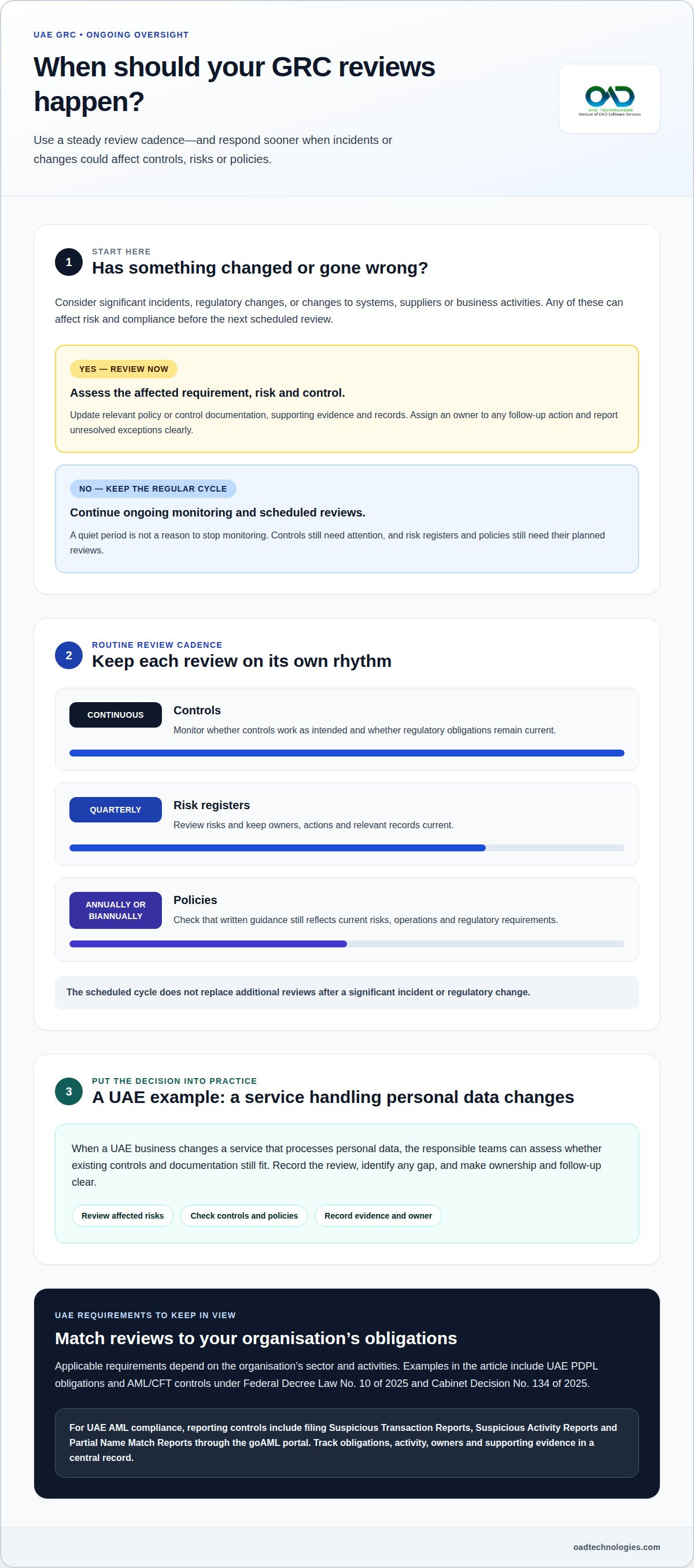
Applicable UAE requirements depend on the organisation’s sector and activities; examples include UAE PDPL obligations and AML/CFT controls under Federal Decree Law No. 10 of 2025 and Cabinet Decision No. 134 of 2025. Review controls continuously, risk registers quarterly, and policies annually or biannually, with additional reviews after significant incidents or regulatory changes.
Ongoing Monitoring and Regulatory Reporting
Ongoing monitoring tracks whether controls work as intended and whether regulatory obligations remain current. Changes to systems, suppliers or business activities can affect risk and compliance before the next scheduled review.
In UAE AML compliance, reporting controls include filing Suspicious Transaction Reports, Suspicious Activity Reports and Partial Name Match Reports through the goAML portal. A central record of obligations, reporting activity, owners and supporting evidence helps teams coordinate these tasks and identify gaps. Monitoring tools can track compliance status, regulatory updates and reporting workflows, while staff remain responsible for reviewing exceptions and acting on them.
Compliance and Audit Readiness
Audit readiness means keeping current records that link each regulatory requirement to its controls, evidence and accountable owner. This makes it easier to explain how the organisation monitors compliance, instead of assembling a response from disconnected files after an audit request arrives.
A practical tracking record can show the applicable requirement, the control addressing it, its latest review and the location of its evidence. If a control changes, update its documentation and related evidence, not just its status in a report. Reporting exceptions with clear owners and follow-up actions helps management see what remains unresolved.
Policy Review and Maintenance
Policy maintenance is the planned review and revision of written requirements as risks, operations or regulations change. Reviewing policies annually or biannually helps prevent outdated procedures from guiding current work, while event-triggered reviews address changes between scheduled cycles.
Use a policy register to record each document’s owner, approval status, review point and linked controls. When a regulatory update affects a requirement, identify impacted policies and procedures, assess the gap, then record the revision and communicate it. Archive retired versions for reference and formally announce their retirement so teams don’t keep using superseded guidance.
Siloed data can undermine this cycle: legal teams may track regulatory changes separately from operational controls, while risk teams keep their own records. A central view links each requirement to the relevant policy, risk, control, evidence and reporting owner. For instance, if a UAE business changes a service that processes personal data, the responsible teams can assess whether existing controls and documentation still fit the activity.
A GRC framework should adapt when monitoring identifies a control failure, a significant incident or a regulatory change. Record the trigger, assess its effect, assign corrective actions and track completion. This creates a feedback loop: findings inform policy updates, control changes and the next risk review, keeping compliance work connected to current business conditions.
Policy implementation, communication, and training
A GRC programme becomes operational when people can apply its policies to routine decisions. Implementation connects documented requirements with internal responsibilities, communication and training.
Implementing and Communicating Policies
Policy implementation turns approved requirements into assigned tasks, while communication clarifies who must act and how. A policy cannot guide an operational decision if employees don’t understand what it requires.
For each policy, define its owner, audience, approval route and related procedures. Communicate the current version through channels employees use at work, and provide role-based training. For example, a UAE organisation handling personal data can explain its internal data-handling policy through scenarios relevant to teams that collect or use that information. Training records and staff attestations can help demonstrate participation and understanding.
Policy changes also need a clear communication path. When a procedure is revised, explain what changed, which roles are affected and when teams should follow the new direction. When a policy is retired, formally communicate the change across the organisation and retain the archived copy for reference. This helps prevent reliance on outdated instructions and connects implementation with accountability.
Common Implementation Mistakes
Common GRC implementation mistakes include trying to launch too broadly, leaving responsibilities unclear and treating training as a one-off event. Policies may look complete while staff remain unsure how to apply them to real decisions.
Another mistake is choosing technology before identifying the risk or compliance problem it should address. A tool can organise workflows, but it can’t determine which business risks matter or make a control effective by itself. Define the intended outcome first, then map requirements, internal processes and ownership before configuring supporting systems.
A phased approach helps contain complexity. Start with a minimum viable product focused on one risk domain or compliance area, such as access management or data handling. Identify the relevant obligations, policies, controls and teams, then test whether employees can follow the process and managers can track completion. Use the findings to refine responsibilities before extending the integrated programme to other areas.
Training should support the work people actually do. A first-line team could complete new attestations every quarter, while role-specific sessions explain how procedures apply to its tasks. For example, a UAE organisation can use a policy scenario to show staff how to escalate a suspected data-handling issue internally. Feedback and completion records help programme owners identify where further communication or clarification is needed.
Embedding compliance in day-to-day operations gives teams a practical reference when making decisions, rather than leaving policies in a document repository. Connect each requirement to a process owner, accessible guidance and a way to record completion. This integrated approach helps leaders see whether implementation is working and where to focus the next improvement.
Enterprise risk assessments and control monitoring
Enterprise risk assessment connects business objectives, exposure, controls and remediation, giving teams an ongoing view of changing priorities.
Enterprise Risk Assessment and Review
A risk assessment identifies scenarios, evaluates their likelihood and impact, and determines how controls should reduce exposure. External specialists such as FaultLine Cyber & Security Ltd can support this process by conducting exposure assessments that uncover hidden cyber, physical, and operational risks. The International Organization for Standardization says ISO 31000 provides guidelines for assessing company risk exposure and developing mitigation strategies.
Review the risk register quarterly, then reassess after a significant incident or regulatory change. For each risk, record its owner, existing controls, residual exposure and next action. For example, a UAE organisation introducing a customer-facing digital service can assess risks to service availability and information handling before launch, then revisit them if the service or its dependencies change.
Continuous risk assessment follows a practical cycle: identify a scenario, evaluate its impact and likelihood, select controls, assign remediation, then track residual risk against risk appetite. Record the decision and its rationale so leaders can understand why a treatment was chosen and whether it remains suitable.
Continuous Compliance and Control Monitoring
Continuous compliance monitoring checks whether controls and evidence remain aligned with applicable requirements as operations change. Continuous controls monitoring can capture evidence and flag control failures in real time, helping teams investigate exceptions sooner.
A GRC platform can centralise control status, evidence and remediation tracking, but automation doesn’t establish that a control is effective. An access control report, for example, may show that a review took place; testing must still establish whether the review identified inappropriate access and led to action. A calendar should map each control to its owner, evidence source and monitoring frequency, with extra checks triggered by incidents or material changes.
GRC software can automate monitoring, evidence collection and reporting; the right platform depends on requirements, existing systems and desired workflows. Prices depend on the case and are provided after a quote request, with scope, integration needs and selected capabilities shaping the cost.
Metrics and Continuous Improvement
Metrics turn monitoring results into signals that support decisions and improvement. Track measures such as overdue remediation, recurring control failures and evidence collection status, then review them with the relevant owners.
Each metric needs a clear definition and an action threshold set by the organisation. If recurring exceptions increase, investigate the cause, adjust the control or process, and document the change. This makes issues visible to operational teams and leaders, helping them distinguish isolated errors from a pattern that needs broader attention.
Internal Audits and Compliance Testing
Internal audits and compliance testing independently assess whether controls are suitably designed and operate as intended. They support ongoing compliance by identifying gaps that routine monitoring may miss and testing whether corrective actions address root causes.
Include audit and testing activities in the annual compliance calendar, alongside control reviews, evidence collection and risk-register updates. Assign each activity an owner, scope and reporting route. When testing finds a failure, record the finding, responsible owner, corrective action and closure evidence, then use the result to refine the next assessment and monitoring plan.
Risk-register ownership and accountability
A risk register supports enterprise accountability when every recorded exposure has a named owner, a decision path and follow-up. Without these links, operational teams may record risks but leave responsibility for action unclear.
Separate the risk owner from the people who operate individual controls. The risk owner assesses exposure, recommends treatment and reports changes; control owners carry out specific safeguards and retain evidence. For example, a service owner may own a supplier-related risk, while technology and procurement teams operate separate controls. This makes accountability visible without placing every task on one person.
A RACI matrix can clarify how risk-register activities are assigned. Give each activity one accountable person, then identify who performs the work, who advises and who receives updates. Apply this structure to risk identification, impact assessment, treatment approval and closure. If multiple teams share a control, name one accountable owner to coordinate their contributions and report unresolved issues.
Link register entries to governance policies and operational decisions. Each record should explain the risk scenario, affected objective, existing controls, residual exposure, treatment decision and next review trigger. Policy owners can then see which requirements need attention, while senior leaders can identify enterprise risks requiring direction or resources. Record the rationale for accepting or treating a risk so later reviewers can follow the decision.
Accountability also depends on escalation routes. Define who is notified when a control fails, a risk increases or a treatment action becomes overdue. For instance, an operational team can report a failed safeguard to its control owner, who updates the risk owner and escalates material concerns through established governance channels. Set clear status labels, such as open, under treatment or accepted, and record the evidence supporting each change.
Compliance culture grows when employees can raise concerns and see how the organisation responds. Connect policy responsibilities to role-based training, accessible reporting routes and documented follow-up. Managers should discuss relevant risks during operational reviews, rather than leaving the register solely with a compliance function. This reinforces shared accountability while keeping ownership of each action clear.
Reviewing ownership after organisational changes keeps the register useful. A new business process, supplier relationship or team structure can shift who controls a risk. Update affected owners and escalation paths, then communicate the changes to relevant teams. This disciplined maintenance strengthens governance and keeps risk decisions connected to those responsible for carrying them out.
OAD Technologies: Governance, Risk, and Compliance (GRC)
OAD Technologies provides Governance, Risk, and Compliance (GRC) support for organisations seeking to connect risk assessment, policies, controls and accountability. This service is relevant when compliance responsibilities are difficult to coordinate, risk records need clearer ownership or ongoing monitoring needs a more structured approach.
Where technical testing can inform risk decisions, Vulnerability Assessment and Penetration Testing (VAPT) can help identify security weaknesses. Security Information and Event Management (SIEM), Managed Detection and Response (MDR) and Data Loss Prevention (DLP) address related monitoring and information-protection needs. The right combination depends on the organisation’s risks and operational requirements.
For UAE organisations working to make GRC practices part of routine operations, OAD Technologies can help shape an approach suited to their needs. Contact OAD Technologies to discuss your GRC requirements.
Make Your GRC Approach Part of Everyday Decisions
Maintaining GRC compliance year-round is an ongoing management responsibility, not a task reserved for audit preparation. Connect compliance priorities with the decisions teams already make so emerging risks can inform policy, controls and operational planning.
Start by identifying where ownership or evidence is fragmented, then decide which improvement would make the greatest practical difference. OAD Technologies’ GRC support can help organisations develop a more coordinated approach. Where security risks also need technical attention, Data Loss Prevention (DLP), Vulnerability Assessment and Penetration Testing (VAPT), and Managed Detection and Response (MDR) address related information-protection, testing and detection needs.
For example, a UAE organisation reviewing access to sensitive customer information can bring the relevant risk, policy responsibilities and security controls into the same discussion. This clarifies the next action and helps teams connect compliance goals with business operations.
With clear priorities and accountable ownership, your organisation can continue improving its GRC practices as risks and operations evolve.
Frequently Asked Questions
Why is GRC Important?
GRC helps an organisation connect business decisions with risk controls and compliance obligations. This reduces the chance of teams relying on conflicting policies or overlooking an important responsibility. Before launching a new service, for example, leaders can consider its business purpose, relevant risks, control requirements and accountable owner together. This joined-up view supports informed decisions and clarifies how the organisation manages its obligations.
How Can AI Support GRC?
AI can help GRC teams organise large volumes of information, surface patterns and flag items for review. For example, it might identify policies potentially affected by a regulatory update or highlight recurring control exceptions in reports. People must validate the output, assess its relevance and make decisions. Assigning a human owner helps ensure automated suggestions aren’t mistaken for approved compliance actions.
How Can Your Company Develop an Effective GRC Framework?
Start by defining business objectives, decision rights, stakeholder expectations and the risks the organisation needs to manage. Map applicable requirements to existing policies and controls, identify gaps, and assign owners for decisions and follow-up. A UAE organisation expanding into a new service area could first assess the risks tied to that activity, then involve relevant teams and review whether current procedures still fit its operations.
How Does GRC Work in Practice?
GRC works by linking a requirement or business objective to a risk, a control, an owner and evidence of action. For example, a UAE organisation handling customer information might connect its internal data-handling procedures with staff responsibilities and relevant security controls. If a control produces an exception, the assigned owner reviews the cause, records the response and escalates decisions through the organisation’s governance process.
What Is GRC?
GRC means governance, risk management and compliance. Governance establishes how decisions and responsibilities are directed; risk management identifies and addresses uncertainty that could affect objectives; compliance aligns organisational activity with applicable obligations. These disciplines work together, not in isolation. For instance, before introducing a new business process, an organisation can assess its risks, approval responsibilities and relevant requirements.
What Is a GRC System?
A GRC system is a set of processes and, sometimes, software used to coordinate governance, risk and compliance work. Software may centralise records, track changes and organise evidence, but regulations don’t require a dedicated GRC platform. Organisations can also use existing tools and defined procedures. What matters is whether owners can connect obligations, controls, decisions and records in a usable way.
What does year-round GRC compliance involve?
Year-round GRC compliance means keeping responsibilities, controls and evidence active between formal audit periods. It involves reviewing risk changes, following up on control exceptions, communicating policy updates and maintaining records as work happens. When an organisation changes a supplier or business process, for example, teams can assess the resulting risks and update affected procedures instead of waiting for the next audit cycle to reveal gaps.
How to maintain evidence and documentation for recurring compliance audits?
Maintain audit evidence by linking each record to the relevant requirement, control, owner and review period. Use consistent file names, version control and access permissions so teams can find current records and distinguish them from archived documents. For a control test, retain the result alongside any corrective-action record. Review evidence periodically for completeness, but assess control performance separately: documentation alone doesn’t establish effectiveness.
Disclaimer
Content by OAD Technologies is for general informational purposes only and does not constitute professional or cybersecurity advice. No warranties are made regarding accuracy or completeness; reliance is at your own risk. OAD Technologies shall not be liable for any direct or indirect losses arising from use of this content.