
Privileged access can give an account authority to change systems, data and security settings, so it needs controls beyond a standard login. PAM solutions in the UAE help organisations control privileged accounts, while Privileged Identity Management (PIM) focuses on managing privileged identities and activating administrative roles when needed. The UAE PDPL requires appropriate security measures for personal data.
It is reasonable to expect these controls to work with the systems your teams already use. PAM can integrate with Microsoft Active Directory and cloud platforms, helping organisations manage privileged access across on-premises and cloud environments rather than treating them as separate.
This article explains how PAM and PIM differ, how they protect accounts and sessions, and what to consider when integrating them with Active Directory, cloud platforms and business systems. It also covers a practical UAE scenario and key implementation factors, helping you assess how privileged access controls fit your organisation’s security and compliance needs.
Key Takeaways
- Map privileged accounts across Active Directory, cloud platforms and business systems to identify where access controls need to connect.
- Plan how identity, single sign-on, IT service management and security monitoring tools will share access and activity data.
- Use PAM and PIM to limit elevated permissions, manage temporary access and improve visibility into privileged activity.
- Assess providers against your existing identity environment, integration needs, compliance priorities and third-party access requirements.
- Compare solutions by how well their controls and integrations fit your operating model, not by feature count alone.
Can PAM work with Microsoft Active Directory or any cloud platform?
Yes. PAM can connect privileged accounts across directory services, cloud platforms and enterprise systems. Common integrations include Microsoft Active Directory, Microsoft Entra ID, AWS, Google Cloud, VMware, Linux and Windows servers, databases and business applications. The specific connection depends on the platforms in use and how they manage identities, credentials and permissions.
With Active Directory, a PAM platform can discover directory-linked privileged accounts and control administrator credentials. Integration with Entra ID can connect cloud identity workflows with privileged role management. For cloud infrastructure, integrations can bring privileged access under central policies across environments such as AWS and Google Cloud. This helps teams manage access without treating each platform as a separate security boundary.
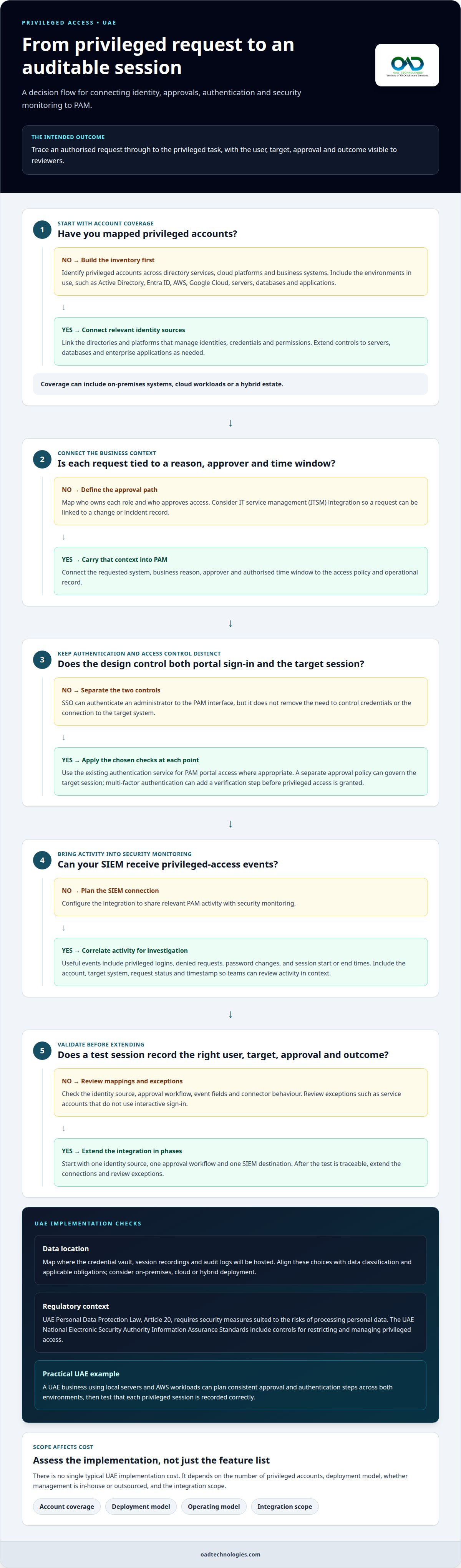
Deployment can cover on-premises systems, cloud workloads or a hybrid estate. A practical sequence is to identify privileged accounts, connect the relevant directories, then extend controls to servers, databases and enterprise applications. For example, a UAE business using local servers and AWS workloads could apply consistent approval and authentication steps across both environments. Integrations can also include VPN access and security monitoring platforms.
UAE requirements depend on the organisation and its sector. The UAE National Electronic Security Authority’s Information Assurance Standards include controls for restricting and managing privileged access; the Dubai Electronic Security Center’s cybersecurity framework is also relevant to access governance. These requirements inform control design, but they do not make every deployment identical.
Data residency requires deliberate planning. Map where the credential vault, session recordings and audit logs will be hosted, then align those choices with the organisation’s data classification and applicable obligations. A UAE-based enterprise can use this review to decide whether its PAM components belong on-premises, in cloud hosting or across a hybrid environment. Hosting location alone does not replace access control or risk-based security measures.
There is no single typical UAE implementation cost. It depends on the number of privileged accounts, deployment model, whether management is handled in-house or outsourced, and the integration scope. For organisations considering a managed approach, OAD Technologies provides managed SOC, SIEM and MDR services with a sub-15-minute response target. The right scope depends on the organisation’s platforms, sector and operating model.
To assess how a PAM design fits directory, cloud and application environments, review privileged access management capabilities alongside the existing identity architecture.
PAM integration with SIEM, SSO, ITSM, and identity platforms
Integration connects privileged access management with systems that approve, authenticate and monitor elevated work. For organisations assessing PAM solutions in the UAE, the goal is to link identity records with access requests and security events. This creates traceability from an authorised request through to task completion. The workflow depends on the platforms already in use, their connectors and the organisation’s permissions model.
A SIEM can receive events such as privileged logins, denied requests, password changes and session start or end times. Security teams can correlate these records with endpoint alerts, such as those from CrowdStrike Falcon EDR, or network alerts, then investigate activity using a shared timeline. Useful event fields include the account, target system, request status and timestamp. Linking SIEM security monitoring with PAM brings privileged activity into broader detection workflows.
Single sign-on (SSO) can simplify access to the PAM interface by using an existing authentication service. It does not remove the need to control credentials or the target session. For example, SSO may authenticate an administrator to the PAM portal, while a separate approval policy governs a database connection. Multi-factor authentication can add another verification step before privileged access is granted.
IT service management (ITSM) integration can link an access request to a change or incident record. A typical workflow connects the requested system, business reason, approver and authorised time window. After approval, PAM applies the corresponding access policy, while the ITSM record retains operational context. This helps reviewers distinguish planned maintenance from unexpected privileged activity.
Identity platforms provide the user and role information PAM uses to assign permissions. Integration can support account lifecycle tasks, such as granting access after an approved role change and removing it when no longer needed. Before implementation, map authoritative identity sources, role ownership and approval paths. Automation can reduce manual hand-offs while retaining human approval where policy requires it.
For a phased rollout, connect one identity source, one approval workflow and one SIEM destination first. Test whether a privileged session is recorded with the correct user, target, approval and outcome. Then extend the integration and review exceptions, such as service accounts that do not use interactive sign-in. A UAE enterprise can use this sequence to align security operations with IT change records without connecting every application at once.
Integration quality depends on more than connector availability. Teams need to define which system owns identity data, which events matter to analysts and how access changes are reviewed. Documenting these decisions helps establish an operating model across PAM, SSO, ITSM and identity platforms. It also gives security teams a clearer basis for investigating privileged sessions.
PAM/PIM benefits for UAE organisations
Privileged accounts can change configurations, access sensitive data and administer critical systems. PAM limits those permissions to approved tasks, while PIM manages privileged identities and role activation. Together, they help organisations apply least privilege, reduce standing administrator access and make access decisions more traceable. For example, a database administrator can receive elevated access for authorised maintenance rather than retaining broad permissions indefinitely.
Controls can include multi-factor authentication, approval workflows, credential rotation and session monitoring. A recorded privileged session gives reviewers context about who accessed a system, which account they used and when the activity occurred. Audit logs can help security teams investigate unusual actions and correlate them with other alerts. These records support incident response, but only when teams review them and connect them to clear procedures.
PAM addresses risks from stolen or reused administrator credentials, excessive permissions and lingering access after a role change. Limiting access and recording privileged activity can also reduce opportunities for misuse. PAM does not prevent every attack: unprotected accounts, compromised endpoints, weak approvals and vulnerabilities in critical systems can still expose an organisation. Deployment therefore needs account discovery, policy design, staff awareness and ongoing review.
For UAE organisations, these controls can also support risk-based data protection. The Central Bank of the UAE’s Retail Payment Services and Card Schemes Regulation requires payment service providers to control privileged and emergency ID use and access, including limiting privileged users and logging and monitoring their activity. PAM can help operationalise controls, but it does not by itself establish regulatory compliance.
Consider a UAE payment service provider whose operations team maintains a transaction platform. PIM can make an administrator role available through an approval process for a defined task. PAM can control the resulting privileged session and retain an activity record. Separating approval, execution and review can support segregation of duties while reducing unnecessary access to transaction systems and customer information.
Benefits also depend on coverage. An inventory should include administrator accounts, service accounts and machine identities, not only named employees. Teams can then prioritise accounts that access sensitive data or critical systems, set role-based permissions and remove access when duties change. Regular reviews help identify exceptions, such as emergency accounts or automation credentials, that need distinct controls.
To sustain protection, organisations need to review access policies, session records and account inventories as systems evolve. Integrating PAM events with security monitoring can help teams spot unusual activity across the wider environment. Ongoing governance makes access control a repeatable operational process rather than a one-time deployment.
Which privileged access management providers serve businesses in the UAE?
UAE businesses can engage a PAM software provider, an implementation partner or a managed security provider. These roles may sit with one organisation or several, depending on the deployment model. The software provider supplies the platform; an implementation partner connects it to directories, cloud accounts and business systems. A managed security provider can support ongoing monitoring and administration where required.
Rather than treating these categories as interchangeable, map each role to a delivery responsibility. For example, a UAE enterprise might use a PAM platform for credential control, an integration specialist for Microsoft Active Directory and cloud connections, and its internal security team for approvals. A managed service arrangement changes who performs routine administration, but the organisation still needs clear ownership of access policy, account approval and risk acceptance.
Assess providers against the environment they must support. An organisation using Active Directory, Microsoft Entra ID, AWS and on-premises servers needs integrations that cover those systems and its identity lifecycle. Ask how the proposed design handles privileged accounts, service accounts, emergency access and third-party sessions. The implementation plan should explain how credentials are protected, sessions recorded and access removed when duties change.
Support matters after deployment. Define who handles platform configuration, integration changes, access-policy updates and operational incidents. For a UAE business with a lean IT team, a managed operating model may shift routine PAM administration to a provider. A larger enterprise may retain administration internally while using specialist support for architecture or complex integrations. The right arrangement depends on internal skills, system complexity and control requirements. For businesses also reviewing their broader technology support model, managed service providers such as itworks.co.nz provide an example of how organisations coordinate day-to-day IT management and strategic digital solutions.
Regulated organisations should connect provider evaluation to their applicable obligations. A UAE financial-services business, for example, can assess whether proposed controls support its privileged-access governance and audit needs. Healthcare, government and critical-infrastructure organisations may have different control and hosting considerations. Documentation should make the provider’s role clear, including how access approvals, logs and responsibilities fit the organisation’s security processes.
Use a practical evaluation sequence: map privileged accounts and target systems; document required integrations; define who operates each control; then test a representative workflow before expanding deployment. A UAE retailer could pilot access to a high-impact business application, checking that approval, authentication, session records and access removal work together. This can reveal integration and operational gaps before the design reaches more systems.
Provider fit is less about a label and more about accountable delivery across software, integration and ongoing operations. Compare the proposed scope with your identity environment, hosting requirements, internal capabilities and audit priorities. A clear division of responsibilities helps procurement teams understand what the engagement covers and helps technical teams plan a maintainable PAM service.
How do leading PAM solutions compare on features and integrations?
Compare platforms against your actual access estate, not feature lists alone. For PAM solutions in the UAE, begin by mapping identity sources, privileged account types, target systems and remote access routes. An organisation using Microsoft Active Directory, cloud workloads and on-premises servers needs broad integration coverage. A business with a smaller environment may prioritise simpler administration. The right comparison reflects operational needs, not a universal ranking.
Credential management is one useful comparison point. Assess how each platform protects privileged passwords, SSH keys and certificates, and applies access policies. Consider multi-factor authentication, approval processes and temporary access together. For example, an administrator connecting to a production database should follow a defined approval and authentication process. Compare how each option records that decision and applies the permitted access.
Session oversight also varies in practical value. Assess whether teams can monitor and record privileged sessions, then review the audit logs. Check whether records identify the user, target system, access time and relevant activity. If a contractor maintains a business application remotely, these details help reviewers connect the session to its authorised purpose. Consider how security teams can retrieve records during an investigation.
Integration depth shapes daily operations. Evaluate connections to Microsoft Active Directory or Microsoft Entra ID, cloud environments, VPNs and SIEM systems. Identify how identity changes, approvals and security events move between platforms. PAM solutions in the UAE should fit the organisation’s current architecture and planned growth. Effective integration preserves useful context, such as which identity requested access and which system received it.
Remote administration deserves a focused review. Consider whether the solution fits the organisation’s mobile device management and remote access arrangements. For example, a UAE organisation with administrators working across locations may prioritise consistent authentication and session visibility. Reliable underlying connectivity is equally vital for distributed teams, and organisations assessing field and branch network options can review performance insights from solaas.it. Compare how each option handles external users, service accounts and machine identities, as their access patterns may differ from employee accounts.
Use the same assessment criteria for each candidate: account volume, identity infrastructure, compliance needs, third-party access, scalability, integrations and support. These factors make product comparisons relevant. A financial organisation with external maintenance access may place greater weight on session records and approvals; a cloud-focused enterprise may prioritise identity connections and coverage across environments. Include ongoing administration, since policies and system connections need continuing ownership.
Finally, test a representative workflow before making a decision. Trace a request from identity verification through approval, authentication, session oversight and event logging. Record which steps are supported directly and which depend on additional integration or operating procedures. This practical exercise reveals gaps more clearly than a feature count and helps teams choose capabilities that fit their environment, governance priorities and daily operations.
OAD Technologies
OAD Technologies helps UAE organisations assess how privileged access fits into their wider cybersecurity operations. If you are planning a PAM programme, its Vulnerability Assessment & Penetration Testing (VAPT) service can assess security weaknesses across your environment, while Managed SIEM and Security Analytics and Managed Detection & Response (MDR) can support security monitoring and incident investigation. Data loss prevention can complement access controls by helping protect sensitive information. These services address connected security needs; they do not replace decisions about PAM design, identity policies or privileged-account ownership.
This support can be useful when your team is assessing administrator-access risks, reviewing security events or strengthening protection for sensitive data. Discuss your organisation’s cybersecurity requirements and the related controls you are considering with OAD Technologies.
Turn PAM planning into a practical next step
Effective access governance depends on clear ownership. Decide who approves privileged access, who reviews exceptions and how teams will assess whether controls work as intended. These decisions connect technical implementation to daily operations and give security and IT teams a shared basis for progress.
For organisations assessing PAM solutions in the UAE, the next step is to define a practical scope and delivery plan. Consider which business processes rely on privileged access, who will own operational decisions and what evidence leadership needs to assess progress. A focused plan gives teams a starting point while leaving room to adapt as systems and requirements evolve.
OAD Technologies can discuss how your cybersecurity priorities relate to privileged access and the wider environment. Use that conversation to consider suitable next steps in context, rather than treating PAM as a standalone technology decision.
With clear ownership and a considered path forward, your organisation can strengthen access governance with confidence.
Frequently Asked Questions
Can PAM be added to an existing IT setup without major disruption?
Yes. To protect service continuity, maintain the current access route until the replacement process has passed acceptance testing. Test routine administration, failed authentication and emergency recovery with system owners before changing production procedures. A documented rollback path gives operators a way to restore the previous workflow if a critical application behaves unexpectedly. User guidance also helps administrators understand the revised access process before it becomes routine.
What are PAM solutions and how do they work?
PAM solutions provide controls for elevated accounts, including a central place to protect privileged credentials. Depending on the design, an authorised user may retrieve or use a credential through a controlled process instead of handling it directly. Organisations should define how credentials are changed after exposure, who can access emergency accounts and how exceptions are reviewed. These operating rules help make the technology usable in day-to-day administration.
How do UAE organisations choose a PAM solution for cloud and on-premises systems?
Compare how each option handles your required account types, system connections and evidence needs. For UAE organisations, include data handling and hosting requirements in the assessment, alongside the ability to retain and export usable audit records. A procurement team can also assess how the solution supports internal review and external audit preparation. These checks help distinguish technical fit from fit with the organisation’s governance needs.
What are the steps to implement PAM in a UAE organisation?
Start by assigning an accountable business owner for privileged access and identifying who approves exceptions. Create an approval matrix that distinguishes routine administration, urgent maintenance and emergency access. Then document the decisions, communicate them to administrators and review whether teams follow the process. Include service-account owners in governance discussions, since automated identities need accountable business contacts even when no individual uses them to sign in.
How long does a typical PAM deployment take, and what resources are required?
There is no universal deployment duration: the schedule depends on inventory quality, legacy-system complexity, approval decisions and access to application owners for testing. Resource planning should include an executive sponsor, identity and infrastructure specialists, system owners, security governance and change communications. Their availability affects decision-making as much as technical configuration. Organisations can plan more reliably by agreeing on scope and stakeholder responsibilities before scheduling implementation activity.
Disclaimer
Content by OAD Technologies is for general informational purposes only and does not constitute professional or cybersecurity advice. No warranties are made regarding accuracy or completeness; reliance is at your own risk. OAD Technologies shall not be liable for any direct or indirect losses arising from use of this content.