
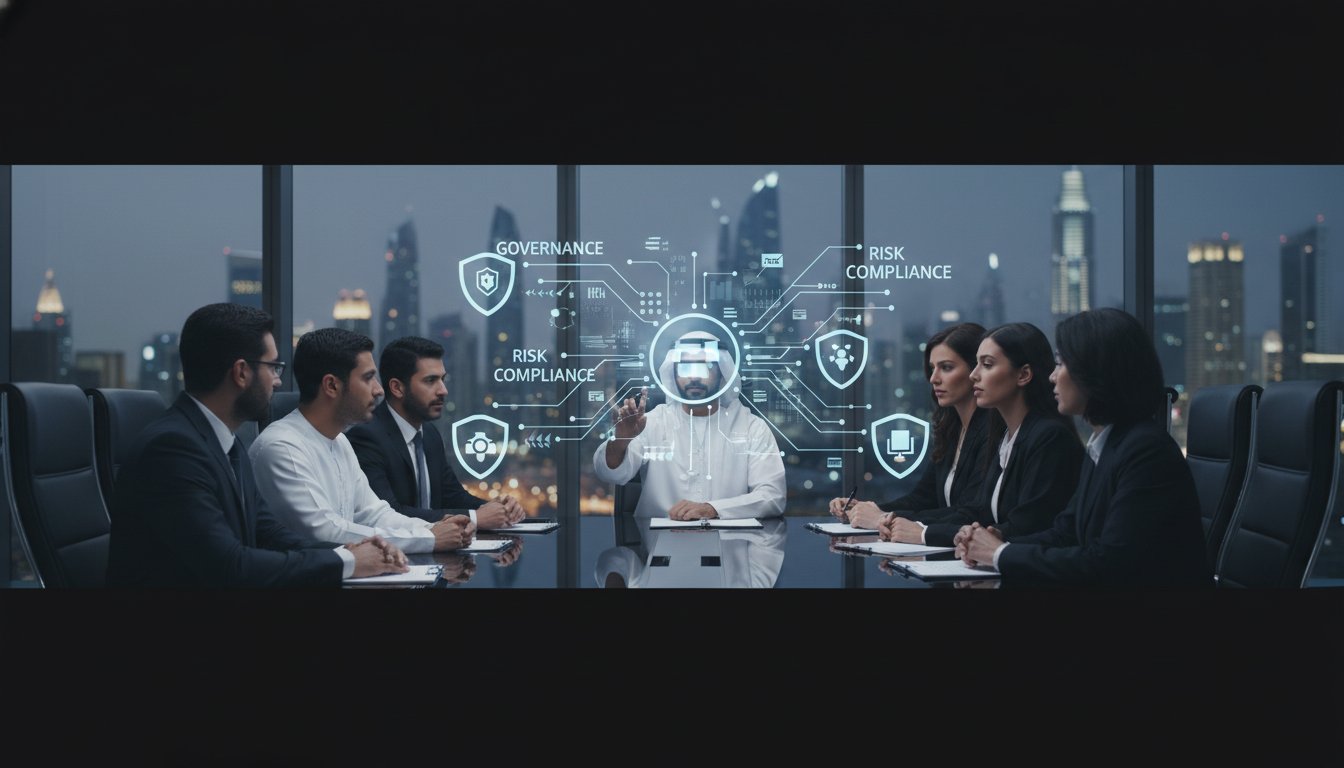
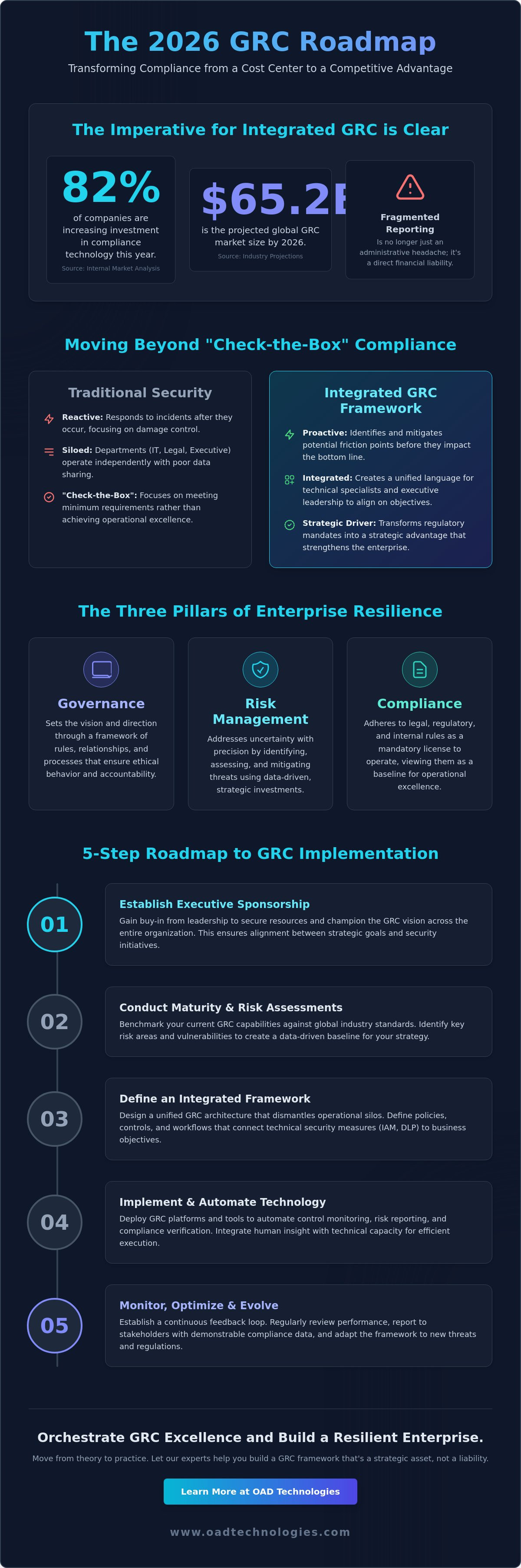
82% of companies are increasing their investment in compliance technology this year because they've realized that fragmented reporting is no longer just an administrative headache; it's a financial liability. If you're asking what is governance risk and compliance in 2026, you aren't just looking for a dictionary definition. You're looking for a way to stop the rising costs of non-compliance from eroding your margins while navigating a landscape of shifting global mandates.
We understand the difficulty of aligning technical security measures, such as Identity and Access Management (IAM) or Data Loss Prevention (DLP), with your broader business objectives. It's frustrating when regulatory demands feel like a barrier to innovation rather than a catalyst for growth. This guide changes that perspective. You'll discover how an integrated GRC framework transforms your regulatory obligations into a strategic advantage that strengthens your enterprise.
We've designed this roadmap to provide a clear path for GRC implementation. We'll explore how to reduce operational risk while ensuring demonstrable compliance with national and international standards, including the UAE PDPL and the Digital Operational Resilience Act (DORA). By the end, you'll have the tools to build a resilient system that syncs technical precision with business integrity.
Key Takeaways
- Transition from siloed operations to an integrated system that transforms regulatory mandates into strategic business drivers.
- Discover exactly what is governance risk and compliance in 2026 and how it creates a unified language for both technical specialists and executive leadership.
- Move beyond reactive, check-the-box security by implementing a proactive framework that prioritizes long-term resilience over temporary fixes.
- Follow a structured five-step roadmap to establish executive sponsorship and conduct comprehensive maturity assessments against global industry benchmarks.
- Understand the value of highly customized GRC strategies that integrate human insight with technical capacity for sustainable digital relevance.
Defining GRC: The Strategic Operating System for Modern Enterprise
At its core, Governance, risk management, and compliance (GRC) is an integrated collection of capabilities that enable an organization to achieve its objectives reliably, address uncertainty, and act with integrity. Understanding what is governance risk and compliance begins with viewing it as a unified architecture rather than three separate departments. The acronym was originally created to dismantle the siloed management styles that once plagued digital enterprises, where legal, IT, and executive teams rarely shared data. In 2026, with the global GRC market projected to reach $65.2 billion, this integration has evolved into a strategic necessity for survival.
Modern GRC acts as the foundation for enterprise resilience. It shifts the organizational mindset from reactive firefighting to proactive governance. Instead of waiting for a breach or a regulatory audit to expose weaknesses, a robust framework identifies potential friction points before they impact the bottom line. This structured approach ensures that every technological investment, from Cloud Security Posture Management (CSPM) to Identity and Access Management (IAM), aligns directly with the company’s mission and risk appetite.
Governance: Setting the Vision and Direction
Governance serves as the framework of rules, relationships, and processes through which an organization is directed and controlled. It's the mechanism that translates a board’s vision into ethical corporate behavior and accountability. Effective governance isn't just about oversight; it's about setting the standards that ensure long-term business sustainability. When leadership establishes clear direction, it empowers teams to make decisions that honor the company's values while pursuing aggressive growth targets in a volatile digital economy.
Risk Management: Addressing Uncertainty with Precision
Risk management is the disciplined process of identifying, assessing, and mitigating threats that could hinder an organization’s goals. In 2026, the distinction between financial, strategic, and cybersecurity risks has blurred. A vulnerability in a third-party API is now a strategic risk as much as a technical one. By using precise risk data, executives can make informed decisions about where to allocate resources. This data-driven approach ensures that security measures like Vulnerability Assessment and Penetration Testing (VAPT) aren't just technical exercises but strategic investments in business continuity.
Compliance: Adhering to the Rules of Engagement
Compliance involves meeting the legal, regulatory, and internal requirements that govern your industry. In today's digital markets, compliance has transitioned from an optional "best practice" to a mandatory license to operate. Regulations like the EU AI Act or India’s DPDP Act carry penalties that go far beyond financial fines; they can result in a total loss of market access and permanent brand damage. Achieving demonstrable compliance requires a shift in perspective, viewing these rules as the baseline for operational excellence rather than a bureaucratic hurdle.
Why GRC is Essential for Cybersecurity Resilience in 2026
The digital threat landscape of 2026 is defined by its volatility. As cyber-attacks become more sophisticated and automated, the focus has shifted from basic perimeter defense to total organizational resilience. Understanding what is governance risk and compliance is no longer just a requirement for auditors; it's a lifeline for the CISO. GRC acts as a critical translation layer, converting technical vulnerabilities into business risks that executive leadership can understand and prioritize. This authoritative overview of GRC highlights how successful organizations use these frameworks to create a unified front against digital disruption.
Beyond technical defense, GRC is the primary driver of brand reputation and stakeholder trust. In an era where data breaches can lead to immediate market devaluation, stakeholders demand transparency. A mature GRC framework demonstrates that your organization isn't just reacting to threats but is proactively managing its digital integrity. This resilience is built on the synergy between human insight and automated tools. While software can flag a deviation in your Cloud Security Posture Management (CSPM), it takes human expertise to understand the strategic implications of that risk within your specific market context.
Aligning Technical Security with Business Objectives
Security teams often struggle when they operate in a vacuum, focusing on technical metrics that don't always resonate with the boardroom. GRC solves this by fostering "Principled Performance," which is the ability to achieve business objectives while reliably managing uncertainty and acting with integrity. It ensures that technical controls, such as Endpoint Detection and Response (EDR) or Network Security Solutions, are deployed where they provide the most value to the enterprise. The ROI of GRC is measured by the capital saved through the systematic avoidance of catastrophic operational failures and regulatory fines.
Navigating the UAE Regulatory Landscape
In the Middle East, the regulatory environment is tightening with unprecedented speed. The UAE Personal Data Protection Law (PDPL) has set a high bar for how companies handle sensitive information, while national standards like NESA and ISR demand rigorous protection of critical infrastructure. A unified GRC approach simplifies these complexities by allowing you to map a single security control to multiple regulatory requirements. This reduces the burden of fragmented reporting and ensures that your compliance posture remains constant across different jurisdictions. Aligning these complex technical requirements with your broader business goals is where OAD Technologies provides strategic value through tailored GRC consulting that respects the unique needs of the UAE market.
GRC vs. Traditional Security: Moving Beyond Check-the-Box Compliance
Legacy security often functions as a series of reactive firewalls. It waits for an event to happen then scrambles to contain it. In contrast, an integrated approach to what is governance risk and compliance builds a proactive shield. Many organizations fall into the trap of "Check-the-Box" compliance, where the goal is merely to satisfy an auditor's list. This creates a dangerous illusion of safety. You might have your certificates on the wall, but your actual operational risk remains unmanaged because the technical controls aren't talking to the business strategy.
The cost of this fragmentation is high. When risk data is scattered across different tools, leadership lacks a clear view of the enterprise's health. You might have technical solutions like Managed Detection and Response (MDR) flagging threats, but if those alerts aren't mapped to your governance framework, they remain isolated technical incidents. Integrated GRC provides the single source of truth needed to bridge this gap. It ensures that every stakeholder, from the IT administrator to the CEO, looks at the same risk profile.
The Pitfalls of Reactive Risk Management
Siloed departments are the primary cause of redundant controls and ballooning operational costs. When IT, legal, and HR manage risks independently, they often duplicate efforts or leave massive gaps. This leads to "Compliance Fatigue," where employees see security as a series of bureaucratic hurdles rather than a strategic asset. These gaps between departments are exactly what sophisticated attackers exploit. They look for the seams where one team's responsibility ends and another's begins. Without a unified view, these vulnerabilities remain hidden until they're exploited.
The Integrated GRC Advantage
Centralized visibility is the cornerstone of modern resilience. An integrated framework allows for automated reporting that pulls data from technical systems like SIEM or Data Loss Prevention (DLP) directly into executive dashboards. This synchronization dramatically improves response times during a security incident because the impact on business objectives is immediately visible. For a deeper dive into these methodologies, explore our Governance Risk and Compliance (GRC): The 2026 Enterprise Strategy Guide. This proactive stance ensures that compliance is a byproduct of good security, not the primary goal. As the originators at OCEG state in their foundational definition of GRC, the objective is to achieve goals reliably while addressing uncertainty.
Implementing a Robust GRC Framework: A 5-Step Roadmap
Transitioning from a conceptual understanding to a functional reality requires a structured, multi-phase approach. Building a robust system isn't just about software; it's about people and processes. You must first establish a cross-functional GRC committee that includes legal, IT, and finance leaders, all backed by active executive sponsorship. This committee oversees a comprehensive maturity assessment to benchmark your current state against global standards like the NIST Cybersecurity Framework 2.0. From here, you'll document a unified policy framework and select tools that integrate with your security stack. Understanding what is governance risk and compliance involves recognizing that this framework must be continuously audited and optimized to stay ahead of evolving threats.
Execution is where many organizations falter. They often treat implementation as a one-time project rather than an ongoing operational cycle. By 2026, the complexity of global data laws makes it impossible to manage these requirements manually. A successful roadmap ensures that every policy you write is enforceable and every risk you identify is tracked. This systematic approach transforms GRC from a cost center into a strategic operating system that supports growth and innovation.
Assessing Maturity and Defining Scope
To identify gaps in your existing infrastructure, you should utilize GRC Capability Models. These models help you move past surface-level security and look at how deeply integrated your risk management truly is. During this phase, you must prioritize risks based on their potential business impact and likelihood of occurrence. A risk-first mentality ensures you aren't wasting capital on low-impact vulnerabilities while leaving critical assets exposed. This phase defines the boundaries of your framework, ensuring that your compliance efforts are focused where they matter most.
Integrating GRC with Technical Controls
The true power of GRC is realized when it dictates the configuration of your technical security tools. For example, your governance policies should directly inform Data Loss Prevention (DLP) rules to ensure that sensitive data handling aligns with legal mandates. Similarly, Identity and Access Management (IAM) provides the technical enforcement for your access policies, ensuring only authorized personnel reach critical assets. Automated reporting bridges the gap between technical logs and executive dashboards, turning raw data into actionable intelligence for the boardroom. If you're ready to move beyond fragmented reporting, OAD Technologies can help you design a custom GRC roadmap that syncs your technical precision with business integrity.
Orchestrating GRC Excellence with OAD Technologies
Understanding what is governance risk and compliance is the starting point for any resilient enterprise, but the real value comes from expert orchestration. OAD Technologies serves as a strategic partner, acting as a master designer of systems that bridge the gap between high-level innovation and practical business results. We don't just position GRC as a standalone function. Instead, we integrate it directly with our Managed Detection and Response (MDR) and Security Information and Event Management (SIEM) solutions. This creates a continuous feedback loop where technical logs and incident data inform governance policies in real time, ensuring your risk profile is always current.
Our philosophy centers on the synergy between human insight and technical capacity. We reject the notion that standardized software alone can solve complex governance challenges. While tools like Cloud Security Posture Management (CSPM) or Endpoint Detection and Response (EDR) provide essential data, it takes experienced specialists to interpret that data within your specific business context. This collaborative mindset makes us an extension of your own team rather than a distant vendor, focusing on long-term viability over temporary patches. By choosing tailored consulting over rigid, out-of-the-box software, you ensure your framework reflects the unique operational realities of your organization.
Tailored Consulting for the UAE Regulatory Environment
Navigating the Middle East's digital evolution requires a partner who understands the local landscape. We maintain deep expertise in UAE-specific regulations, including the Personal Data Protection Law (PDPL) and the Information Assurance Standards (ISR). Our consultants help local businesses achieve regulatory alignment without the operational friction that typically slows down system growth. By grounding technical requirements in a business context, we ensure you meet national infrastructure standards while maintaining the momentum of your digital transformation. We act as a guardian of your long-term digital relevance in an increasingly scrutinized market.
The Future of GRC: Proactive Resilience
The role of GRC is shifting from a defensive cost center to a proactive driver of performance. Organizations that embrace this shift gain a competitive edge by building trust with stakeholders and making faster, data-backed decisions. We invite leadership teams to move beyond the cycle of quick fixes and invest in a visionary security architecture. This approach doesn't just protect your current assets; it shapes the future of your enterprise. It's time to transform your compliance burden into a strategic asset. Partner with OAD Technologies for your GRC transformation and build a foundation for sustainable digital growth.
Building Strategic Resilience for the Digital Future
Transitioning from a reactive security posture to a proactive governance framework is no longer a choice; it's a strategic imperative. We've explored how integrating governance, risk management, and compliance into a single operating system dismantles silos and aligns technical precision with executive vision. By synchronizing your security stack with business objectives, you transform regulatory hurdles into a competitive advantage. Understanding what is governance risk and compliance provides the essential foundation for this enterprise-wide transformation.
OAD Technologies brings specialized UAE market expertise to this journey, ensuring your organization meets local standards like PDPL and ISR without compromising operational momentum. Our integrated approach bridges technical security assessments with Managed Detection and Response (MDR), creating a resilient ecosystem that adapts to the shifting threat landscape of 2026. We act as a strategic partner, helping you design a roadmap that prioritizes long-term viability over temporary fixes.
It's time to elevate your security architecture and secure your digital legacy. Secure your enterprise with OAD Technologies’ GRC Consulting and take the first step toward a more resilient, compliant, and successful future.
Frequently Asked Questions
What is the difference between GRC and traditional risk management?
Traditional risk management often operates as a standalone silo focused on threat mitigation. In contrast, understanding what is governance risk and compliance involves integrating these efforts with corporate governance and regulatory requirements. This unified framework connects technical security findings directly to strategic objectives. It ensures that risk isn't just managed but is governed by the organization's overarching vision, allowing leaders to achieve their objectives reliably while addressing uncertainty.
How does GRC help with the UAE Personal Data Protection Law (PDPL)?
GRC provides the structured methodology required to map data processing activities against specific PDPL requirements. It ensures that technical controls, like Data Loss Prevention (DLP), are configured to protect sensitive information according to national standards. By centralizing documentation and audit trails, an integrated GRC approach allows businesses to demonstrate accountability and transparency to UAE regulators. This systematic visibility minimizes the risk of significant financial penalties and protects your brand reputation.
Can GRC software replace a security team?
No, GRC software is a tool that empowers people rather than replacing them. While automation streamlines data collection and reporting, human insight is essential for interpreting risk in a specific business context. A successful strategy relies on the synergy between advanced technical capacity and the expertise of security professionals. These specialists understand how to apply tools to solve complex organizational challenges and maintain the long-term viability of the enterprise.
What are the main drivers for GRC implementation in 2026?
The primary drivers include increasing regulatory complexity, such as the EU AI Act, and a heightened focus on cybersecurity resilience. When organizations ask what is governance risk and compliance in 2026, they're looking for ways to manage the rising costs of non-compliance. GRC has transitioned from a bureaucratic hurdle to a strategic imperative that protects brand reputation and ensures long-term digital relevance in a market defined by rapid technological evolution.
How long does it take to implement an effective GRC framework?
Implementation timelines vary based on organizational complexity, but an initial framework typically takes three to nine months to establish. This period involves conducting maturity assessments, defining policy frameworks, and integrating technical controls like SIEM or EDR. It's a structured lifecycle that moves from identifying pain points to deploying sophisticated solutions. This steady and deliberate pace is necessary to ensure long-term stability and success for the enterprise without overwhelming internal teams.
What is the role of the CISO in a GRC strategy?
The CISO acts as the bridge between technical security precision and executive leadership. In a GRC context, they're responsible for ensuring that technical defenses, such as Vulnerability Assessment and Penetration Testing (VAPT), support the organization's broader risk appetite. They translate complex data into a common language that the board understands. This role transforms cybersecurity from a back-office function into a core component of the corporate governance and strategic vision.
Is GRC only for large enterprises or can SMEs benefit too?
SMEs benefit significantly from GRC by establishing a foundation for scalable growth and investor trust. While the scope may be smaller, the need to manage uncertainty and meet regulations like the UAE PDPL is just as critical. Managed service providers like Mytech Partners specialize in helping small and mid-sized businesses implement tailored GRC frameworks to avoid the high costs of reactive fixes. This positions them as reliable partners in the global supply chain, ensuring their ongoing digital viability and competitive advantage.
How does GRC integrate with Data Loss Prevention (DLP)?
GRC provides the policy-driven logic that dictates how Data Loss Prevention (DLP) tools are configured. It defines what data is sensitive and who should have access, while the DLP software enforces these rules at the technical level. This integration ensures that your technical controls aren't just running in a vacuum. Instead, they're actively upholding the governance standards and compliance obligations of your entire organization to prevent unauthorized data exposure.
Disclaimer
Content by OAD Technologies is for general informational purposes only and does not constitute professional or cybersecurity advice. No warranties are made regarding accuracy or completeness; reliance is at your own risk. OAD Technologies shall not be liable for any direct or indirect losses arising from use of this content.


