

UAE organisations operate across interconnected networks, cloud services and business applications, making clear vulnerability-management priorities essential. Automated reports can flag large numbers of potential weaknesses without showing which ones create material business risk. Distinguishing routine vulnerability assessment from higher-depth penetration testing helps organisations choose an assessment that fits their systems, risk questions and applicable requirements.
The objective is not simply to complete a checklist. It is to understand technical exposure, connect findings to important services and plan proportionate remediation. This guide explains the distinction between automated assessment and human-led testing, providing a practical framework for selecting and scoping security testing. VAPT can support risk management and compliance readiness, but no single assessment establishes compliance or guarantees security.
Key Takeaways
- Distinguish between the wide-lens automation of Vulnerability Assessments and the targeted, human-led exploitation of Penetration Testing to optimise your security investments.
- Use assessment evidence to support alignment with applicable UAE, emirate-level and sector-specific security and data-protection requirements.
- Learn how professional network penetration testing in Dubai eliminates the noise of false positives by validating real-world attack paths that automated tools cannot see.
- Transition from managing an endless backlog of scan results to executing a prioritised remediation roadmap based on actual risk to your business operations.
- Understand why a hybrid VAPT approach provides the essential strategic foundation for more advanced Data Loss Prevention and Identity Management initiatives.
Understanding the Fundamental Divide: Vulnerability Assessment vs. Penetration Testing
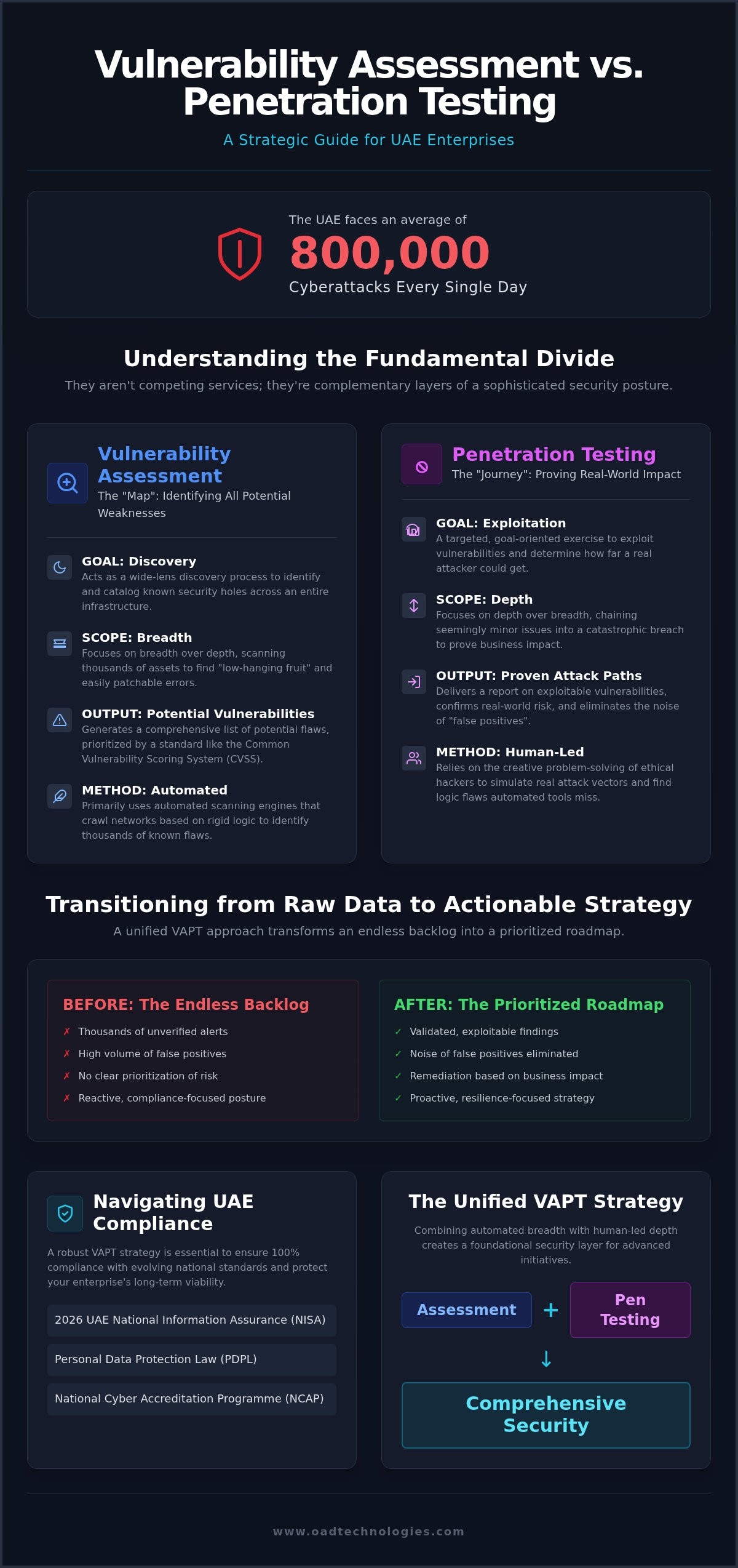
Many IT leaders in the UAE treat the terms vulnerability assessment and penetration testing as interchangeable. This confusion often leads to misallocated budgets and significant security gaps. To build a resilient defence, you have to recognize that these two processes serve entirely different strategic functions. A Vulnerability Assessment acts as a wide lens discovery process. It identifies and catalogues security holes across your entire infrastructure. In contrast, penetration testing is a targeted, human-led exercise designed to exploit those holes to see how far an attacker could actually get.
Think of it as the difference between a map and a journey. The assessment provides the map, highlighting every unlocked window or weak fence on your perimeter. The penetration test is the actual attempt to break in, proving whether those weaknesses can be chained together to reach your crown jewels. For enterprises investing in penetration-testing services in Dubai, understanding this distinction is the first step toward moving beyond basic compliance and achieving true operational resilience. These aren't competing services; they're complementary layers of a sophisticated security posture.
The Scope of Vulnerability Assessments
A vulnerability assessment focuses on breadth. It uses automated scanning engines to crawl through your network, identifying thousands of known security flaws. These results are typically prioritised using the Common Vulnerability Scoring System (CVSS), which provides a baseline for technical hygiene. By identifying these gaps early, you create the essential first step in a successful Vulnerability Assessment and Penetration Testing (VAPT) lifecycle. It's about finding the "low hanging fruit" before a malicious actor does, ensuring your team isn't blindsided by easily patchable errors.
The Depth of Ethical Penetration Testing
While assessments find the gaps, Dubai network penetration testing proves their impact. This process involves creative problem solving by ethical hackers who simulate real-world attack vectors. They don't just find a weak password; they use it to move laterally through your systems, bypass defensive controls, and attempt to exfiltrate data. This manual analysis can identify logic flaws and context-dependent weaknesses that automated tools may miss. Moreover, a high-quality test provides a rigorous way to validate the effectiveness of your Managed Detection and Response (MDR) protocols, helping assess how selected activity is detected and escalated within the agreed test scenario.
Relying solely on automated scans leaves you vulnerable to complex, multi stage attacks. UAE enterprises must utilize both to satisfy the rigorous demands of national standards like NISA. By combining the automated breadth of an assessment with the human-led depth of a penetration test, you transform raw data into a strategic roadmap for long-term viability.
Technical Methodology: Comparing Frequency, Toolsets, and Human Insight
Automation provides speed, but it lacks the nuance required to secure a complex enterprise network. While vulnerability scanning engines can process thousands of assets in minutes, they operate on rigid logic. Strategic hackers, however, rely on creative problem solving to chain seemingly minor issues into a catastrophic breach. This is why penetration testing for Dubai organisations remains a critical investment for firms that have moved beyond basic compliance. You don't just need to know that a port is open; you need to know if an adversary can use it to compromise your entire database.
One of the most significant technical hurdles in vulnerability management is the "false positive" problem. Automated tools often flag services that aren't actually vulnerable or misidentify software versions. Manual penetration testing can reduce this noise by validating selected findings within the agreed scope. If a finding cannot be reproduced under the agreed test conditions, teams can reassess its priority while documenting the scope and limitations. This rigorous validation follows the technical testing framework outlined in NIST SP 800-115, helping remediation teams focus on findings supported by test evidence. This balance between breadth and depth ensures your security posture is both wide enough to cover all assets and deep enough to protect critical ones.
Continuous Monitoring vs. Point-in-Time Validation
Vulnerability assessments should be continuous. In 2026, new CVEs (Common Vulnerabilities and Exposures) are released daily, and an annual scan is no longer sufficient to maintain a secure posture. Penetration testing, however, serves as a point-in-time deep dive. It's best utilized during major infrastructure changes, new product launches, or as part of a scheduled quarterly review. By integrating SIEM logs with your testing schedule, you can observe how your defensive layers react to simulated attacks in real time.
Skillsets and Resource Allocation
There's a vast difference between running a commercial scanner and interpreting a complex attack chain. An expert tester possesses a "hacker mindset," looking for non-obvious vulnerabilities like business logic flaws or insecure direct object references that scanners simply can't see. Manual validation significantly reduces remediation fatigue for IT teams by ensuring every ticket in the queue represents a genuine, proven risk to the organisation. This precision allows your internal resources to focus on high impact fixes rather than chasing automated errors. If you're ready to move beyond generic scans, exploring specialised security partnerships can provide the technical depth your infrastructure requires.
By shifting the focus from simple discovery to active validation, network penetration testing in the UAE provides a level of certainty that automated tools alone cannot match. It transforms a list of potential problems into a verified action plan for your technical specialists; to further develop these skills or explore advanced assessment frameworks, visit Exploit Labs.
Strategic Use Cases: Navigating UAE National Cybersecurity Standards
UAE organisations may need to consider federal, emirate-level and sector-specific cybersecurity requirements. The applicable obligations depend on the organisation, its activities and the systems or data in scope. Penetration-testing evidence can help risk owners evaluate selected controls and support compliance-readiness discussions, but testing does not by itself demonstrate that every legal or regulatory requirement has been met.
The UAE Personal Data Protection Law requires relevant organisations to implement appropriate technical and organisational measures for protecting personal data. VAPT may provide useful evidence about selected systems and controls, but its conclusions apply only to the agreed scope and point in time. Guidance such as NIST's technical guide to security testing can help structure assessment planning; organisations must still determine which UAE and sector-specific obligations apply to them.
Aligning with National Regulatory Frameworks
A practical Governance Risk and Compliance (GRC) programme can use security-testing evidence to inform risk decisions and control reviews. Government, critical-infrastructure and regulated organisations should determine the authoritative requirements that apply to their sector and scope. Documented testing, remediation decisions and retesting results may support assurance activities, but they should not be presented as certification or proof of compliance.
Risk-Based Decision Making
Choosing between a vulnerability assessment and a penetration test depends on the risk profile, intended decision and systems in scope. Automated assessments may support routine vulnerability-management activities, while penetration testing may be appropriate before important launches, after material changes or when a defined risk question requires deeper validation. Testing frequency and scope should reflect business criticality, threat exposure and any applicable requirements rather than an unsupported universal rule.
From Raw Data to Remediation: Interpreting VAPT Results
A stack of reports is not a security strategy; it's a backlog. To move from discovery to defence, UAE enterprises must translate technical findings into operational priorities. The anatomy of a Vulnerability Assessment report is essentially an inventory of flaws. It catalogues every missing patch and misconfiguration across your network, often resulting in hundreds of pages that can overwhelm IT teams. While this data is necessary for maintaining baseline hygiene, it lacks the context of how these vulnerabilities interact in a real-world scenario. Without a clear path forward, these reports often gather digital dust while the risks remain active.
In contrast, a high-quality penetration-testing report can describe tested attack paths and explain how selected weaknesses could affect important assets. It should connect technical evidence to business context rather than relying solely on CVSS scores. A medium-severity issue affecting a critical service may require different treatment from a higher-scored issue on an isolated asset. Where retesting forms part of the agreed scope, it can provide evidence about whether selected remediation actions addressed the original finding. To turn findings into a risk-based roadmap, consult with our strategic advisers.
Prioritizing Findings in the UAE Enterprise
Effective prioritisation requires distinguishing between what's "Critical" in theory and what's "Exploitable" in your specific environment. This distinction allows you to focus limited resources on the threats that pose the highest risk to your long-term viability. These results should directly inform your Data Loss Prevention (DLP) strategies, helping you refine rules based on verified access paths. When you communicate these risks to executive leadership, focus on the potential for operational downtime and regulatory fines under the UAE PDPL rather than technical jargon.
Measuring Security Maturity Over Time
Tracking security outcomes can help stakeholders assess whether remediation and testing activities are producing useful evidence. Measures such as remediation time can help teams monitor how selected findings progress from identification to closure. By integrating VAPT findings into a Cloud Security Posture Management (CSPM) framework, you gain a unified view of your risk across hybrid environments. Using historical data from professional penetration testing allows you to demonstrate a clear trend of increasing maturity, reassuring stakeholders that your defence is keeping pace with the evolving threat landscape.
Building a Unified VAPT Strategy with OAD Technologies
A coordinated security-testing strategy should examine vulnerabilities in the context of business services, dependencies and continuity priorities. OAD Technologies combines vulnerability assessment with scoped, human-led penetration testing according to the organisation's requirements. The resulting evidence can inform remediation and wider defensive planning, while remaining subject to the boundaries and assumptions agreed for the engagement.
Human-led validation can add context to automated findings and help technical and business stakeholders decide what to address first. OAD Technologies can align a defined VAPT engagement with the organisation's wider Governance, Risk and Compliance framework. The service supports risk management and compliance readiness without promising that testing alone fulfils every requirement.
Customized Security Assessments
Standardized, "off-the-shelf" penetration tests often fail to account for the unique architectural nuances of a Dubai-based enterprise. We reject the "one-size-fits-all" model in favor of assessments designed around your specific risk profile and operational requirements. During the testing phase, we leverage insights from Identity and Access Management (IAM) to identify how compromised credentials could lead to lateral movement within your network. This level of customisation allows us to bridge the gap between technical discovery and actual business outcomes, ensuring that our findings are relevant to both your C-suite and your technical specialists.
Your Partner in Digital Resilience
OAD Technologies can work alongside internal security and technology teams to define assessment objectives, interpret findings and plan remediation priorities. VAPT engagements are delivered on a Fully Managed, Defined Scope basis, with testing boundaries, responsibilities and outputs documented in advance. This helps organisations move from isolated findings towards a repeatable, risk-led testing cycle.
Securing Your Digital Future in the Emirates
The transition from automated vulnerability scans to true security resilience requires a sophisticated balance of speed and human intuition. You've seen how identifying technical gaps is only the beginning. The real value lies in proving exploitability and aligning those findings with your strategic business goals. By prioritizing remediation based on proven risk, you ensure your team protects the assets that matter most to your long-term viability.
As UAE and sector-specific requirements evolve, well-scoped security testing can provide evidence for risk and assurance discussions. OAD Technologies offers expert-led penetration testing with manual validation for organisations across the UAE. The work can support compliance readiness and resilience planning, but it does not establish full regulatory alignment on its own.
Secure your enterprise with OAD Technologies’ Strategic VAPT Services and take the next step toward a resilient digital legacy. We're ready to help you master the complexities of the modern threat landscape.
Frequently Asked Questions
Is a vulnerability assessment the same as a penetration test?
No, they are distinct processes that serve different strategic purposes. A vulnerability assessment provides a wide lens, automated scan of your network to identify and catalog known security flaws. In contrast, UAE penetration-testing engagements is a targeted, manual exercise where ethical hackers attempt to exploit those flaws to prove their real-world impact and reach. Both are necessary to build a complete picture of your security posture.
How often should my organisation conduct a penetration test in the UAE?
There is no universal testing interval for every UAE organisation. Frequency should reflect the importance and exposure of the systems, material technology changes, threat intelligence, previous findings and any authoritative sector-specific requirements. Organisations may also consider testing before important launches or after significant changes, with scope and timing agreed according to operational risk.
Can a vulnerability assessment replace a penetration test for compliance?
No single assessment should be treated as proof of regulatory compliance. A vulnerability assessment and a penetration test provide different types of evidence, and the appropriate combination depends on the organisation's risk questions and applicable requirements. Confirm any mandated testing method or frequency against the current authoritative framework for the relevant sector.
What are the different types of penetration testing available?
Penetration testing is generally categorized by the amount of information provided to the tester: black box, white box, and grey box assessments. Within these categories, UAE enterprises focus on specific environments such as external and internal networks, web applications, and cloud infrastructure. In 2026, API security testing and mobile application assessments have become essential for firms managing integrated digital platforms and biometric authentication services.
Will a penetration test disrupt my business operations?
A professionally managed test should be planned to minimise operational risk, but disruption cannot be ruled out entirely. Clear rules of engagement, authorised targets, escalation contacts, test windows and stop conditions help reduce risk. Where suitable, selected activities may be performed in a representative staging environment; testing decisions should reflect the objective and limitations of that environment.
How much does a VAPT service typically cost for a UAE enterprise?
The investment required for VAPT services depends entirely on the scope of your infrastructure, the number of applications, and the depth of the testing required. Rather than a flat fee, costs are determined by the complexity of the environment and the specialised expertise needed to test your specific architecture. Treating penetration-testing reports as a strategic investment helps you avoid the significantly higher costs associated with a data breach or regulatory non-compliance.
What is the role of automated tools in a manual penetration test?
Automated tools act as a force multiplier by handling the initial, repetitive phases of reconnaissance and vulnerability scanning. However, they cannot replicate the creative problem solving and logic of a human tester. The manual phase of the test is where ethical hackers find business logic flaws and chain multiple minor vulnerabilities together to achieve a high impact compromise that automated tools would consistently miss.
How do VAPT results impact my GRC strategy?
VAPT results can provide technical evidence for Governance, Risk and Compliance discussions and help organisations prioritise remediation according to validated findings and business context. The evidence applies to the agreed scope and point in time; it should not be presented as proof that every control is effective or that the organisation complies with the UAE Personal Data Protection Law.
Disclaimer
Content by OAD Technologies is for general informational purposes only and does not constitute professional or cybersecurity advice. No warranties are made regarding accuracy or completeness; reliance is at your own risk. OAD Technologies shall not be liable for any direct or indirect losses arising from use of this content.