

Your SIEM shouldn't be an expensive digital graveyard for logs that nobody ever reads. Most security teams are currently drowning in telemetry while starving for actual visibility, a paradox that leads to analyst burnout and ballooning ingestion costs. Mastering siem implementation best practices in 2026 requires a shift from simple data collection to a design-first architecture that prioritizes strategic intelligence. We know the challenge of balancing high-performance detection with the need to meet strict UAE federal regulations like ISR and PDPL.
You're likely looking for a way to build a system that actually detects threats instead of just storing them. This article provides a strategic framework to transform raw logs into actionable security insights that empower your team. We'll explore how to create a streamlined, automated SOC that significantly reduces your Mean Time to Detect (MTTD) and Respond (MTTR). By aligning your deployment with the NIST CSF 2.0 "Govern" function, you'll ensure your security posture supports long-term business resilience and measurable operational success.
Key Takeaways
- Shift your focus from ingestion volume to strategic visibility by mapping specific data sources to high-impact threat scenarios like ransomware and insider threats.
- Discover how modern siem implementation best practices transform expensive log storage into a high-performance engine for actionable security intelligence.
- Integrate human-centric logic with automated response frameworks to significantly reduce alert noise and prevent analyst burnout.
- Ensure full alignment with UAE federal regulations, including PDPL and ISR, through a structured, GRC-first deployment roadmap.
- Optimize your SOC operations to achieve measurable reductions in Mean Time to Detect (MTTD) and Respond (MTTR) through a phased architectural design.
The SIEM Paradox: Moving Beyond the Log Graveyard
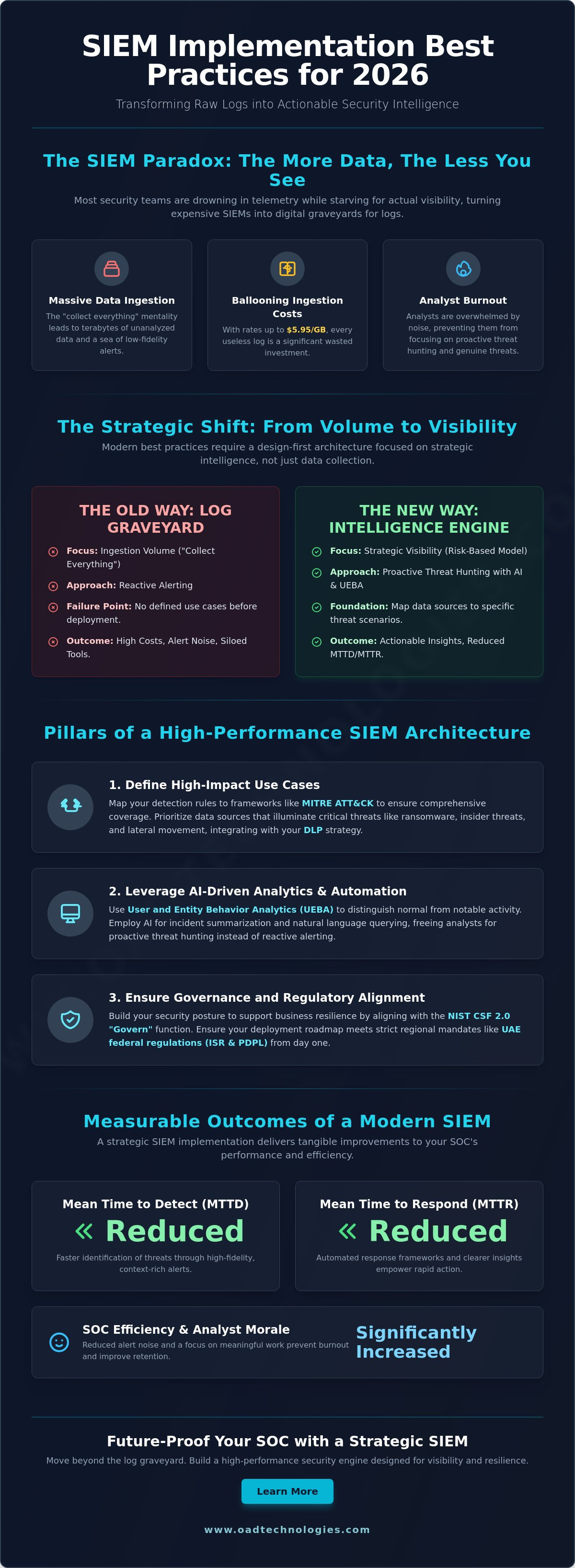
For many organizations, the SIEM is the most expensive piece of software they never truly use. It sits in the corner of the SOC, silently ingesting terabytes of data while analysts ignore the thousands of low-fidelity alerts it generates. This is the SIEM Paradox: the more data you collect, the less you actually see. Successful Security Information and Event Management (SIEM) deployment isn't a "set it and forget it" technical task. It's a strategic orchestration of data, people, and processes designed to provide clarity, not just storage. When you treat your SIEM as a strategic asset, you move beyond the "log graveyard" and toward an environment of actionable intelligence.
In 2026, the "collect everything" mentality is a fast track to financial exhaustion. With ingestion rates for cloud-native platforms like CrowdStrike Falcon Next-Gen SIEM reaching $5.95/GB for third-party data as of April 2026, every useless log represents a wasted investment. Adopting siem implementation best practices means shifting toward a risk-based visibility model. You need to identify which data points actually illuminate your specific business risks and prioritize those over the "noise" of routine system heartbeats. This nuanced approach is vital as data becomes more decentralized across hybrid cloud environments and multi-cloud architectures.
Why Traditional SIEM Implementations Fail
Most failures start long before the software is installed. Organizations often rush into technical deployment without defining specific use cases first. If you don't know what threats you're looking for, you won't find them. Additionally, many leaders underestimate the human capital required for success. A SIEM isn't a self-driving car; it requires continuous tuning by skilled analysts to stay relevant. Finally, the integration gap between siloed security tools creates blind spots. Without a unified data strategy, your SIEM becomes just another isolated island of information.
The Shift to Next-Gen SIEM and AI-Driven Analytics
Modern siem implementation best practices now leverage User and Entity Behavior Analytics (UEBA) to change the scope of detection. Instead of just looking for static signatures, these systems use machine learning to distinguish "normal" activity from "notable" events. This shift allows your team to move away from reactive alerting. By using AI-powered incident summarization and natural language querying, analysts can focus on proactive threat hunting. This transition ensures your SOC stays ahead of sophisticated adversaries rather than just documenting their footprints after a breach occurs.
Strategic Architecture: Designing for Visibility, Not Volume
Effective SIEM architecture begins with a cold assessment of risk, not a list of available logs. Many organizations fall into the trap of treating their SIEM as a standalone silo, but it's actually the central nervous system of a broader security ecosystem. To avoid the high costs of ingestion without clear value, you must prioritize high-fidelity data sources that directly illuminate your most critical business risks. Mapping data sources to specific threat scenarios like lateral movement or ransomware encryption is one of the core siem implementation best practices that separates high-performing SOCs from those drowning in noise. This design-first approach ensures that every byte ingested serves a purpose, keeping you within cost-effective commitment tiers rather than falling into expensive pay-as-you-go rates that can exceed $5.00/GB in some regions.
Scalability must be baked into the foundation of your architecture. As your digital estate expands across hybrid environments, your SIEM needs to grow without requiring a total redesign. By focusing on visibility rather than sheer volume, you create a sustainable model that remains effective as your data footprint evolves. Designing a customized security architecture that bridges the gap between high-level risk and technical visibility is essential for long-term viability.
Defining High-Impact Use Cases
Your detection strategy should never be a guessing game. Develop a library of detection rules mapped specifically to the MITRE ATT&CK framework to ensure comprehensive coverage across the attack lifecycle. Integrating SIEM goals with your Data Loss Prevention (DLP) objectives allows you to monitor not just system health, but the movement of your most sensitive assets. To make this data actionable, create custom dashboards tailored to different stakeholders. While the SOC needs deep technical telemetry, executive leadership requires high-level visualizations of risk reduction and compliance posture.
Data Ingestion and Normalization Strategies
Data is only useful if it's comparable. Establishing a common schema, such as the Open Cybersecurity Schema Framework (OCSF), ensures that data from disparate tools can be correlated effectively. According to ACSC's SIEM Implementation Guidance, a successful rollout requires a clear understanding of the digital environment before procurement begins. Implementing data deduplication and filtering at the edge can significantly reduce the burden on your central engine. This balance between on-premises collection and cloud-native telemetry allows for a unified view of your security posture without the overhead of redundant data processing.
The Human-Tech Synergy: Tuning and Automation Frameworks
Technology alone can't secure an enterprise. While AI-driven analytics are transformative, a SIEM is ultimately a force multiplier for human intuition, not a replacement for it. High-performing security teams treat automation as the execution of human-defined logic. One of the most vital siem implementation best practices involves establishing a rigorous tuning cadence that ensures your technology evolves alongside the threat landscape. Without this synergy, even the most advanced platform will eventually succumb to alert fatigue and technical debt.
Context is the bridge between a raw log and a decisive response. Integrating Identity and Access Management (IAM) data directly into your SIEM provides the "who" behind the "what." When telemetry is enriched with user roles, permissions, and access levels, analysts can instantly distinguish between a developer's authorized late-night deployment and a credential harvesting attempt. This level of enrichment allows for aggressive alert pruning. If a detection doesn't lead to a tangible security action, it shouldn't exist. By removing low-value noise, you maintain a high signal-to-noise ratio that keeps your team focused on genuine threats.
Building the Feedback Loop for Continuous Tuning
A static SIEM is a failing SIEM. You need a structured feedback loop where analysts and the system engine learn from each other. Consider these operational habits:
- Conduct weekly reviews of false positives to refine detection logic and reduce future noise.
- Empower senior analysts to create temporary, high-sensitivity rules in response to emerging global zero-day threats.
- Integrate external threat intelligence feeds to automatically contextualize internal alerts with known malicious indicators.
Leveraging SOAR for Intelligent Response
Security Orchestration, Automation, and Response (SOAR) is where your siem implementation best practices move from detection to containment. By defining automated playbooks for low-level alerts, such as verifying a suspicious login or isolating a non-critical endpoint, you free up your specialists for high-stakes investigations. However, strategic maturity requires knowing when to keep a human-in-the-loop. Decisions involving critical infrastructure or high-availability databases should always require a manual sign-off to prevent automated processes from causing unintended operational downtime. This balance ensures your SOC remains both agile and resilient.
A Step-by-Step SIEM Implementation Roadmap for 2026
Launching a SIEM without a clear roadmap is like building a skyscraper without blueprints. In 2026, siem implementation best practices dictate a phased approach that balances technical agility with regulatory rigor. A successful deployment moves through five distinct stages to ensure the final system is both functional and resilient. It starts with Phase 1: Discovery and GRC Alignment. Here, you map your environment to UAE PDPL and ISR requirements, ensuring your data strategy aligns with the NIST Cybersecurity Framework 2.0, which officially introduced the "Govern" function on February 26, 2024. This foundational step prevents costly architectural shifts later in the project.
Phase 2 focuses on Architectural Design. You must decide between cloud-native, on-premises, or hybrid models based on your data residency needs and performance requirements. Once the skeleton is in place, Phase 3: Integration and Ingestion begins. This involves connecting your EDR, firewalls, and cloud applications to create a unified telemetry stream. Phase 4: Content Development is where the magic happens; your team builds custom parsers and detection rules that reflect your specific threat landscape. Finally, Phase 5: Operational Handover ensures the SOC is trained and equipped with automated response playbooks to handle the new influx of intelligence.
Compliance-First Planning
Regulations aren't just hurdles; they're design requirements. Your data retention policies must strictly adhere to Governance, Risk, and Compliance (GRC) standards to avoid heavy penalties. By automating compliance reporting within the SIEM, you reduce the manual burden of audits and provide real-time proof of adherence to national information standards. This proactive stance ensures that sensitive national data remains secure and localized where necessary.
Testing and Validation (VAPT Integration)
A SIEM is only as good as what it catches. Integrating Vulnerability Assessment and Penetration Testing (VAPT) into your validation phase is essential. By simulating red team attacks, you can verify that your detection rules fire correctly and that alerts reach the right analysts. During these exercises, measure your Mean Time to Detect (MTTD) to establish a performance baseline. This rigorous testing ensures your defenses aren't just theoretical. If you're ready to move beyond generic setups, it's time to develop a customized SIEM implementation strategy that fits your specific operational goals.
Future-Proofing Your SOC with OAD Technologies
Deploying a SIEM isn't a one-time transaction; it's the start of a long-term evolution. While many providers treat security as a product purchase, OAD Technologies positions itself as the master designer of bespoke security ecosystems. We reject standardized, "one-size-fits-all" approaches that fail to account for the unique risks of your specific industry. One of the most critical siem implementation best practices we champion is the creation of individualized business resilience. This means designing a system that doesn't just meet a checklist but actively protects your specific digital assets and operational continuity.
Our approach centers on the powerful synergy between Managed Detection and Response (MDR) and SIEM management. While the SIEM provides the visibility and data foundation, our MDR experts provide the proactive oversight and rapid response capabilities that turn data into defense. This partnership ensures that your security posture isn't just a collection of tools, but a unified force capable of staying ahead of sophisticated adversaries. We bridge the gap between high-level innovation and practical business results, ensuring your investment delivers measurable value from day one.
The OAD Advantage: Beyond System Integration
We don't just connect data sources; we build long-term viability. Our team acts as an extension of your own, bringing a proactive, solution-oriented mindset to every challenge. By combining rigorous engineering standards with a deep sense of curiosity, we ensure your SOC remains relevant in an ever-changing market. We focus on empowering your people through technology, creating a collaborative environment where human insight and automated capacity work in perfect harmony. This commitment to craftsmanship ensures that your security infrastructure is built to last, not just to pass an immediate audit.
Next Steps: Your Roadmap to Resilience
Securing your digital future requires a clear understanding of where you stand today. We invite leadership teams to a specialized security assessment to evaluate SIEM readiness and identify potential visibility gaps in your current architecture. Our consultants provide expert guidance on the synergy between Endpoint Detection and Response (EDR), SIEM, and Data Loss Prevention (DLP), ensuring every component of your stack works toward a common goal. Don't leave your enterprise's safety to chance or standardized software defaults. Reach out to OAD Technologies today to begin your journey toward a more resilient, strategically designed digital future.
Securing Your Digital Future with Strategic Intelligence
Transforming your SOC from a data warehouse into a proactive intelligence engine requires more than just software. It demands a fundamental shift toward risk-based visibility where every log ingested serves a documented threat scenario. By following modern siem implementation best practices, you ensure that your security architecture remains both cost-effective and compliant with the latest UAE federal regulations. Success lies in the synergy between advanced automation and the human expertise required to tune detection logic against an evolving threat landscape.
OAD Technologies acts as your strategic partner in this journey. We offer specialized UAE GRC expertise and red team validated detections to ensure your system isn't just functional but truly battle-ready. Our bespoke MDR-SIEM integration bridges the gap between technical complexity and long-term business resilience. Design your strategic SIEM framework with OAD Technologies to secure your digital legacy. Your roadmap to a more resilient future starts today.
Frequently Asked Questions
What is the most common mistake in SIEM implementation?
The most common mistake is treating the platform as a technical log dump rather than a strategic business tool. Organizations often adopt a "collect everything" mentality without defining specific use cases first. This leads to excessive ingestion costs and alert fatigue for analysts. Effective siem implementation best practices prioritize mapping data sources to high-risk threat scenarios like lateral movement or ransomware before the first log is ever ingested.
How long does a typical SIEM implementation take for an enterprise?
A typical enterprise implementation usually takes between three and nine months to reach full operational maturity. While initial log ingestion might happen within weeks, the critical work of tuning detection rules and building response playbooks requires a phased approach. This timeline ensures your team can integrate complex data sources and establish a reliable feedback loop without overwhelming the SOC during the transition phase.
Should we choose a cloud-native SIEM or an on-premises solution?
Choosing between cloud-native and on-premises depends on your specific scalability needs and data residency requirements. Cloud-native platforms like Splunk 8.5.2 or Microsoft Sentinel offer rapid deployment and lower infrastructure overhead. However, organizations with strict UAE data residency requirements or localized sensitive data might require a hybrid model. Modern platforms like the upcoming IBM QRadar 7.6.x now provide more flexibility across these different deployment architectures.
How do we reduce SIEM licensing costs without sacrificing visibility?
Reducing licensing costs requires aggressive data filtering and deduplication at the edge before ingestion. You should prioritize high-fidelity data sources that provide clear security value while excluding routine system heartbeats or low-risk logs. Implementing siem implementation best practices like tiered storage or commitment tiers can also offer significant savings. These models allow you to scale your visibility while managing the overall investment more effectively through predictable billing.
Can SIEM replace our existing EDR or DLP tools?
No, a SIEM doesn't replace Endpoint Detection and Response (EDR) or Data Loss Prevention (DLP) tools. Instead, it acts as a central orchestrator that aggregates telemetry from these specialized solutions. While EDR protects endpoints and DLP secures data movement, the SIEM provides the "big picture" by correlating events across your entire ecosystem. This integration is essential for identifying complex attack chains that individual tools might miss in isolation.
What are the essential data sources for a first-phase SIEM deployment?
Focus on high-impact telemetry for your initial phase, specifically Identity and Access Management (IAM) logs, firewalls, and EDR alerts. These sources provide the most immediate visibility into credential abuse and network perimeters. You should also include logs from your primary cloud providers and email security solutions. This targeted approach ensures that your first phase delivers immediate security value without overwhelming your analysts with unnecessary noise from secondary systems.
How does SIEM help with UAE Personal Data Protection Law (PDPL) compliance?
SIEM supports UAE Personal Data Protection Law (PDPL) compliance by providing the necessary log retention and auditing capabilities for personal data access. It allows you to monitor who is accessing sensitive information and generates the reports required for regulatory audits. By aligning your SIEM with NIST CSF 2.0 "Govern" functions, you can automate the evidence-gathering process, ensuring you meet national standards for data sovereignty and protection.
What is the difference between SIEM and SOC-as-a-Service?
A SIEM is the technological platform used to collect and analyze security data, while SOC-as-a-Service provides the human expertise to manage it. You can own the SIEM tool internally, but many enterprises partner with providers for Managed Detection and Response (MDR) to gain access to specialized analysts. This partnership ensures that the technology is continuously tuned and that alerts are investigated by experts who understand your specific business context.
Disclaimer
Content by OAD Technologies is for general informational purposes only and does not constitute professional or cybersecurity advice. No warranties are made regarding accuracy or completeness; reliance is at your own risk. OAD Technologies shall not be liable for any direct or indirect losses arising from use of this content.


