

The fastest way to waste a cybersecurity budget is to start by shopping for tools. If you’re asking how to start a cybersecurity program from scratch, begin with the business risks you need to manage, not a product list. Without a clear view of important assets, access and weaknesses, it’s difficult to decide which controls deserve attention first.
That uncertainty is common, particularly when security responsibilities are spread across teams or investment feels daunting. You don’t need to solve everything at once. Start by assigning ownership, identifying what matters most to the organisation and deciding where to reduce risk. Consider the regulations and sector-specific obligations that apply to your organisation, and confirm them with authoritative sources and qualified advisers.
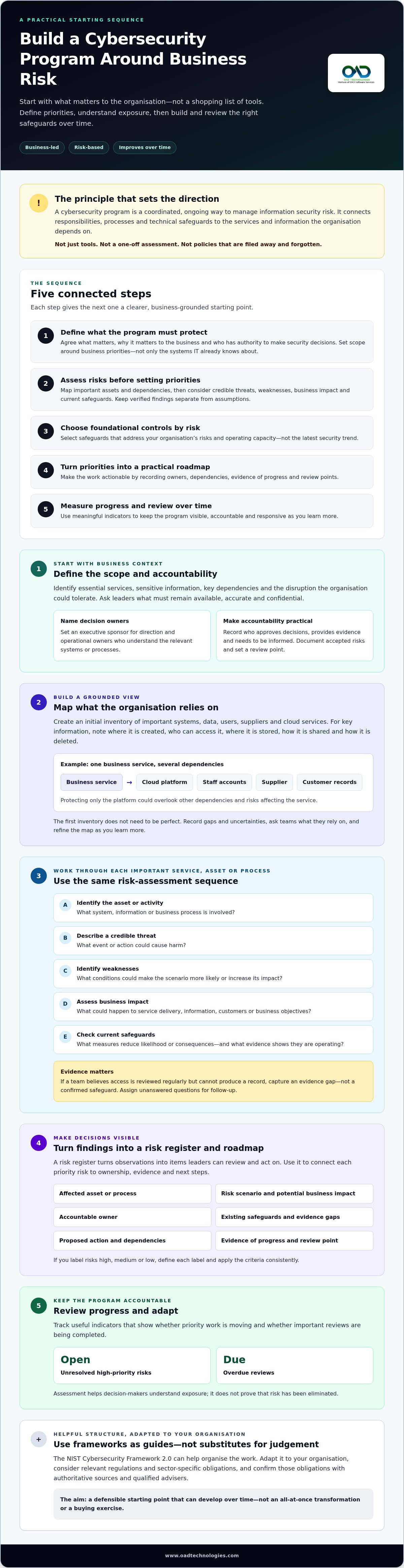
This guide sets out a practical sequence: define priorities, assess risks, select foundational controls, put them into practice and review progress. Frameworks such as NIST Cybersecurity Framework 2.0 can help organise the work, but should be adapted to your organisation. The aim is a defensible starting point that can develop over time, not an all-at-once transformation or a buying exercise.
Key Takeaways
- Define what the cybersecurity programme must protect, why it matters to the business and who owns decisions.
- Assess assets, threats, weaknesses, business impact and existing safeguards before setting priorities.
- Choose controls that address your organisation’s risks and operating capacity, not the latest security trend.
- Turn priority risks into a roadmap with named owners, dependencies, evidence of progress and review points.
- Track useful indicators, such as unresolved high-priority risks and overdue reviews, to keep the programme accountable.
How to start a cybersecurity programme: define what it must protect
Start by agreeing what the programme protects, why those things matter and who has authority to make security decisions. This defines the work before you assess risks or select controls. Set the scope around business priorities, rather than limiting it to systems the IT team already knows about.
A cybersecurity programme is a coordinated, ongoing approach to managing information security risk. It connects responsibilities, processes and technical safeguards to the services and information an organisation depends on. It is not just a collection of tools, a one-off assessment or policies filed away and forgotten. As the overview of Information security management explains, structured management brings security practices together rather than treating them as isolated tasks.
To work out how to start a cybersecurity program from scratch, define the scope in business terms. Consider essential services, sensitive information, key dependencies and the disruption the organisation could tolerate. For example, a business service may rely on a cloud platform, staff accounts, a supplier and customer records. Protecting only the platform would overlook other dependencies and risks affecting the service.
Set business objectives and assign accountability
Ask leaders which services, information and activities must remain available, accurate and confidential. Name an executive sponsor who can set direction, along with operational owners who understand the relevant systems or processes. These roles can fit the existing structure; they don’t require a new department. Agree how owners will raise security decisions, request exceptions and escalate risks for formal acceptance.
Make accountability practical. Record who approves decisions, who provides evidence and who needs to be informed. If a business owner accepts a risk, document the decision and set a review point. This creates a clear route from a technical concern to people who understand its business consequences.
Map the starting environment before choosing controls
Build an initial inventory of important systems, data, users, suppliers and cloud services. For each key information type, note where it is created, who can access it, where it is stored, how it is shared and how it is deleted. Include dependencies that could affect essential services, such as external platforms or supplier-provided technology.
The first inventory won’t be perfect, and it doesn’t need to be. Ask teams what they rely on and who maintains it, then record gaps and uncertainties for follow-up. Refine the map as you learn more. This gives the risk assessment a business-grounded starting point instead of an assumed picture of the organisation.
Assess cybersecurity risks before setting your first priorities
With an initial picture of the environment, assess where security failures could affect business objectives. Risk is the possibility of harm and the consequences if it occurs. A compromised staff account, for example, could expose sensitive information or interrupt a service, depending on its access and the organisation’s reliance on that service.
Use the same sequence for each important service, asset or process:
- Identify the asset or activity: What system, information or business process is involved?
- Describe a credible threat: What event or action could cause harm?
- Identify weaknesses: What conditions could make that scenario more likely or increase its impact?
- Assess business impact: What could happen to service delivery, information, customers or business objectives?
- Check current safeguards: What measures reduce the likelihood or consequences, and what evidence shows they’re operating?
Separate verified findings from assumptions. If a team believes access is reviewed regularly but can’t produce a record, note an evidence gap rather than treating the safeguard as confirmed. Record unanswered questions and assign someone to investigate them. Assessment findings help decision-makers understand exposure; they don’t prove that risk has been eliminated.
Use a risk register to make decisions visible
A risk register turns observations into items leaders can review and act on. For each entry, capture the affected asset or process, risk scenario, potential business impact, accountable owner, existing safeguards, evidence gaps, proposed action and review point. If you use labels such as high, medium or low, define each one and apply the criteria consistently. Without shared criteria, a label can obscure rather than clarify priorities.
Keep the register useful, not exhaustive for its own sake. For example, an entry could describe how losing access to a critical service might interrupt operations, name the service owner and note that recovery arrangements need verification. This gives the organisation a decision to make and a question to resolve.
Consider recognised frameworks without treating them as shortcuts
NIST Cybersecurity Framework 2.0 can help organise desired cybersecurity outcomes across Govern, Identify, Protect, Detect, Respond and Recover. ISO/IEC 27001 provides requirements for an information security management system; using the standard doesn’t automatically establish that risks are controlled or obligations are met. Apply either framework in the context of your organisation.
For UAE organisations, confirm applicable national and sector requirements with qualified advisers and authoritative sources. Frameworks can structure the discussion, but they don’t determine which rules apply to every organisation. The SANS Institute’s cybersecurity skills roadmap can help teams consider the skills and roles needed to carry out security work. If specialist input would help interpret findings and shape next steps, discuss your cybersecurity requirements with OAD Technologies.
Choose foundational cybersecurity controls by risk, not by trend
Use the risk assessment to decide which controls belong in the first phase. Compare each option with the risk scenario it addresses, the business service or information it protects, who will own it and whether the organisation can operate it effectively. A popular tool adds little value if it doesn’t address a priority risk or no one is responsible for reviewing its output.
Buying technology alone doesn’t create a functioning programme. A control needs an owner, an operating process and a way to check whether it’s working. For example, access technology won’t resolve excessive permissions unless someone decides who should have access and reviews changes. The right sequence depends on assessed exposure, existing safeguards and your organisation’s capacity to operate the controls.
Prioritise identity, data and endpoint protection where findings justify them
If assessment identifies unmanaged or excessive access, consider identity and access management practices such as access governance and least privilege. Where sensitive information could be exposed or shared inappropriately, Data Loss Prevention (DLP) may be relevant. If device threats or gaps in investigation and response are priorities, assess endpoint protection and detection capabilities, including Endpoint Detection and Response (EDR) or Managed Detection and Response (MDR). These are options to evaluate, not automatic requirements for every organisation.
Match technical controls to visibility and response needs
Security Information and Event Management (SIEM) technology collects and analyses security-relevant event data to support visibility and investigation. Vulnerability Assessment and Penetration Testing (VAPT) can help identify and validate technical weaknesses within an agreed scope. Before selecting either, decide what the findings should help you do, who will act on them and how they will be reviewed.
The examples below show how to connect a risk to a control and evidence. Assign owners according to your organisation’s responsibilities, and tailor the evidence to the control rather than treating these examples as a checklist.
| Risk scenario | Control area to consider | Responsible owner | Example evidence |
|---|---|---|---|
| Unmanaged access to business systems | Identity and access management | Relevant system or process owner | Access records and review history |
| Sensitive information shared inappropriately | Data Loss Prevention | Information owner with relevant technical support | Documented rules and reviewed alerts |
| Limited visibility of suspicious activity | SIEM or detection capabilities | Security or technology owner | Defined log sources and investigation records |
| Unverified technical weaknesses | Vulnerability Assessment and Penetration Testing | Technology owner | Scoped findings and tracked remediation |
For each selected control, document the risk it addresses, its accountable owner, the operating process and how it will be reviewed. This is the practical core of how to start a cybersecurity program from scratch: make deliberate choices that fit your risks and capacity, then check that they work in day-to-day operations.
Turn cybersecurity priorities into a practical implementation roadmap
A risk register explains what needs attention. A roadmap turns those findings into work people can own and complete. Convert each priority into an initiative with a decision-maker, delivery owner, dependencies, intended evidence and a review point. This makes progress visible without assuming every action can start at once or promising a fixed completion date.
Organise initiatives into manageable workstreams, such as governance, people, information, technology, suppliers and incident readiness. Sequence actions according to risk and capacity. For instance, improving access reviews may depend on knowing which systems are in scope and who owns access decisions. A technical change may also require an approved change process. Record these dependencies so teams can resolve prerequisites before work stalls.
Separate policy and process work from technical delivery
Technology changes are only part of implementation. Policies and processes define how staff handle information, manage access, report concerns and make decisions. Give document work and technical work clear owners. Assign an internal decision-maker to approve the intended outcome and a delivery owner to coordinate practical work. One person may hold both roles in a smaller organisation, but the responsibilities should still be explicit.
Prioritise policies that address actual risks and operating requirements. Make them concise, approved, accessible to the people who need them and subject to review. Staff should know how to report a suspected incident and where the report goes next. Define who assesses it, who can escalate it and which decision-makers need to be involved. Check that these routes are workable, not just written down.
Use a roadmap format that supports decisions
A simple roadmap can capture the initiative, owner, dependency, evidence and review point. The examples below are prompts, not a prescribed sequence or a claim about results:
- Governance: clarify risk approval and escalation routes; decision-maker: designated leadership sponsor; evidence: approved responsibilities; review when governance arrangements change.
- People and access: establish access ownership for priority systems; dependency: a usable system inventory; evidence: named owners and review records; review as systems or responsibilities change.
- Incident readiness: document and communicate reporting steps; dependency: agreed escalation contacts; evidence: approved, accessible guidance; review after a relevant process or organisational change.
- Technology: plan a control for an assessed exposure; dependency: scope, ownership and change approval; evidence: implementation and review records; review against the original risk.
Keep the roadmap proportionate to available people, skills and decision-making capacity. If your team needs help translating priorities into defined work, discuss your cybersecurity roadmap with OAD Technologies. A disciplined approach to how to start a cybersecurity program from scratch connects business decisions to practical delivery and leaves room to adapt as the organisation learns more.
Measure progress and sustain the cybersecurity programme over time
A programme stays useful when leaders can see whether agreed actions are moving forward and whether risks have changed. Track each priority action’s owner, evidence, review date and status. Use measures that prompt decisions, not just activity counts. For example, monitor unresolved high-priority risks, overdue reviews and actions blocked by dependencies. Give each indicator an owner who can explain what needs attention and recommend a next step.
Keep measures proportionate to the organisation. A concise view of open risks and overdue actions may be more useful than a large dashboard no one reviews. Evidence should show whether a control or process is operating as intended, not merely that it was purchased or introduced. If evidence is missing, record the gap and decide whether to investigate, improve the process or accept the risk through the appropriate governance route.
Create a proportionate review and incident-learning cycle
Set a review cadence that reflects your risk exposure and decision-making needs. At each review, consider changes to business services, systems, suppliers and applicable obligations. Revisit priorities when changes affect what the organisation depends on or how it handles information. Check relevant UAE and sector requirements with qualified advisers and authoritative sources as they evolve.
Use incidents, exercises and audit findings to improve the programme. Ask what happened, which safeguards worked, where response or decision-making slowed and what action should follow. Record decisions, owners and review points. Update risk ownership, controls or roadmap actions when circumstances change. This turns lessons into accountable work rather than a report that sits on a shelf.
Where Managed Technology Services can support the programme
Internal leaders should retain accountability for risk decisions, even when specialist support contributes technical capacity or expertise. The support required depends on assessed needs: VAPT may help examine technical weaknesses within an agreed scope; SIEM may support security-event visibility; and Data Loss Prevention may be relevant where sensitive information risks warrant it. Define responsibilities, evidence expectations and review arrangements before work begins.
Where external delivery is appropriate, clarify the service boundaries and how the work fits internal governance. A Fully Managed, Defined Scope arrangement may suit a requirement when its scope, responsibilities and intended outputs have been agreed. It should complement, not replace, accountable leadership, and it doesn’t by itself establish compliance or guarantee an outcome.
Learning how to start a cybersecurity program from scratch is only the beginning; sustained review keeps priorities connected to business change. If you’re assessing where specialist support could fit, discuss your requirements with OAD Technologies.
Build a cybersecurity programme that can grow with your organisation
A sustainable cybersecurity programme starts with clear business priorities, named accountability and an honest view of risk. From there, choose controls that address assessed exposure, turn them into owned initiatives and review progress through evidence, review dates and open actions. The key to how to start a cybersecurity program from scratch is not to do everything at once, but to create an approach your organisation can maintain and adapt.
Specialist support can add capability where your team needs it, while internal leaders retain responsibility for decisions and risk ownership. OAD Technologies provides Managed cybersecurity and SOC services, VAPT, SIEM and Data Loss Prevention, alongside endpoint protection, identity governance, privileged access and Zero Trust. The right support depends on your requirements and the defined scope.
If you’re ready to discuss how these priorities could fit your organisation, book a meeting or discuss your requirements with OAD Technologies. Start with a clear next step, then build steadily from there.
Frequently Asked Questions
How do I start a cybersecurity programme from scratch?
Start by identifying the business services, information and systems that matter most, then assign an accountable owner. Build an initial asset and risk picture before selecting controls. Use the findings to prioritise practical actions, document responsibilities and review progress. Approach how to start a cybersecurity program from scratch iteratively: refine the programme as you learn, rather than assuming that buying tools replaces governance, clear ownership or risk-based decisions.
What should a cybersecurity programme include?
A cybersecurity programme commonly connects governance, risk assessment, asset and data awareness, access management, security controls, staff responsibilities, incident readiness and ongoing review. Its scope should reflect the organisation’s services, information, dependencies and applicable obligations. Treat these as related workstreams, not a checklist that guarantees security. Assign owners to priority activities and retain evidence of decisions and progress, so leaders can see what is managed, what remains unresolved and where further action is needed.
Can a small organisation start a cybersecurity programme without a dedicated security team?
Yes. A small organisation can begin with executive sponsorship, named internal responsibilities and a focused view of its essential services, information and risks. Prioritise actions the organisation can operate and maintain, and seek specialist advice when a need exceeds internal expertise or capacity. For businesses lacking in-house technical teams, partnering with an IT support and infrastructure provider like Networking2000 can help maintain essential systems and foundational safeguards. External support can contribute to defined work, but internal leaders should retain accountability for decisions and risk acceptance. A tool purchase alone won’t provide the ownership or governance a programme needs.
How do we decide which cybersecurity risks to address first?
Prioritise risks by considering the importance of the affected service or information, plausible threat scenarios, existing safeguards and the consequences of disruption or misuse. Record the evidence behind your assessment, along with assumptions and unanswered questions. Agree on criteria for qualitative priority levels and apply them consistently, but don’t let a score replace accountable judgement. Revisit priorities when business needs, systems or suppliers change, since those changes can alter the organisation’s exposure.
Does a cybersecurity framework guarantee compliance?
No. A framework can help organise security outcomes and support structured risk management, but it doesn’t automatically establish compliance with every legal or sector obligation. Requirements depend on the organisation’s activities and the rules that apply to it. Confirm relevant obligations using authoritative sources and qualified legal or compliance advisers. Treat frameworks and security services as tools that can support compliance efforts, not as guarantees of compliant status, certification or a particular security outcome.
When should an organisation use a cybersecurity service provider?
Consider specialist support when internal expertise or capacity doesn’t match an identified need, such as technical testing, security monitoring or protection for sensitive information. First define the objective, scope, responsibilities, evidence expectations and decision rights. Then assess potential providers against those requirements. Managed IT and security partners such as AA Network Technologies can help implement and maintain necessary controls, but teams must keep internal ownership of governance and risk acceptance, even when a provider delivers defined work. A managed service can contribute capability, but it doesn’t replace executive accountability for the organisation’s security decisions.
How can we measure whether our cybersecurity programme is progressing?
Track whether priority risks have owners, agreed actions have evidence and reviews happen as planned. Choose indicators that help leaders decide what to do, such as unresolved high-priority risks, overdue reviews or findings awaiting action. Consider incident lessons and changes in business exposure alongside status reports. Measures should reflect the programme’s objectives and prompt follow-up where needed. Progress indicators show how work is managed; they don’t prove that incidents cannot occur.
Disclaimer
Content by OAD Technologies is for general informational purposes only and does not constitute professional or cybersecurity advice. No warranties are made regarding accuracy or completeness; reliance is at your own risk. OAD Technologies shall not be liable for any direct or indirect losses arising from use of this content.