

What if an effective data loss prevention programme blocked less but gave teams better visibility? Sensitive information moves between endpoints, email, cloud services and AI-enabled workflows, while broad restrictions can disrupt legitimate work. The most useful enterprise dlp best practices start by identifying where priority data travels, then applying controls that match the risk.
DLP should help reduce exposure without making everyday work harder. Achieving that balance takes more than technology: teams need clear data classifications, named owners for decisions and a practical way to review exceptions. For UAE organisations, DLP can support wider data protection and governance efforts, but it does not guarantee compliance on its own.
This guide explains how to identify important data, map how it moves through business systems and set proportionate controls for common workflows, including generative AI use. It also covers policy ownership, exception handling and ongoing review, helping security, technology and business teams improve oversight while enabling productive work.
Key Takeaways
- Start with your highest-priority data. Identify the systems, processes and workflows it touches before setting controls.
- Use enterprise dlp best practices to match policy responses to data sensitivity, destination, user role and business purpose.
- Choose whether to monitor, warn, request justification or block based on risk, rather than applying the strictest control everywhere.
- Assign clear responsibilities for alert review, exception decisions and policy updates across security, IT, legal, privacy and business teams.
- Connect DLP decisions to wider governance and evidence processes, while treating controls as support for compliance, not a guarantee of it.
Enterprise DLP best practices start with understanding your data risk
Enterprise DLP combines data discovery, policies, technical controls and accountable oversight to help organisations identify and manage the movement of sensitive information. The aim is not to block every transfer. It is to understand which data needs protection, where it goes and what response fits the circumstances. Data loss prevention (DLP) refers to technology for identifying and controlling data across environments such as endpoints, networks and cloud services.
Exposure can happen during legitimate work, without an attacker or deliberate misuse. An employee might email a client document to the wrong recipient, create a file-sharing link with overly broad access or paste internal material into an AI tool for summarisation. These actions may serve a business purpose, yet still create risk if information reaches an unsuitable destination or is handled outside approved processes.
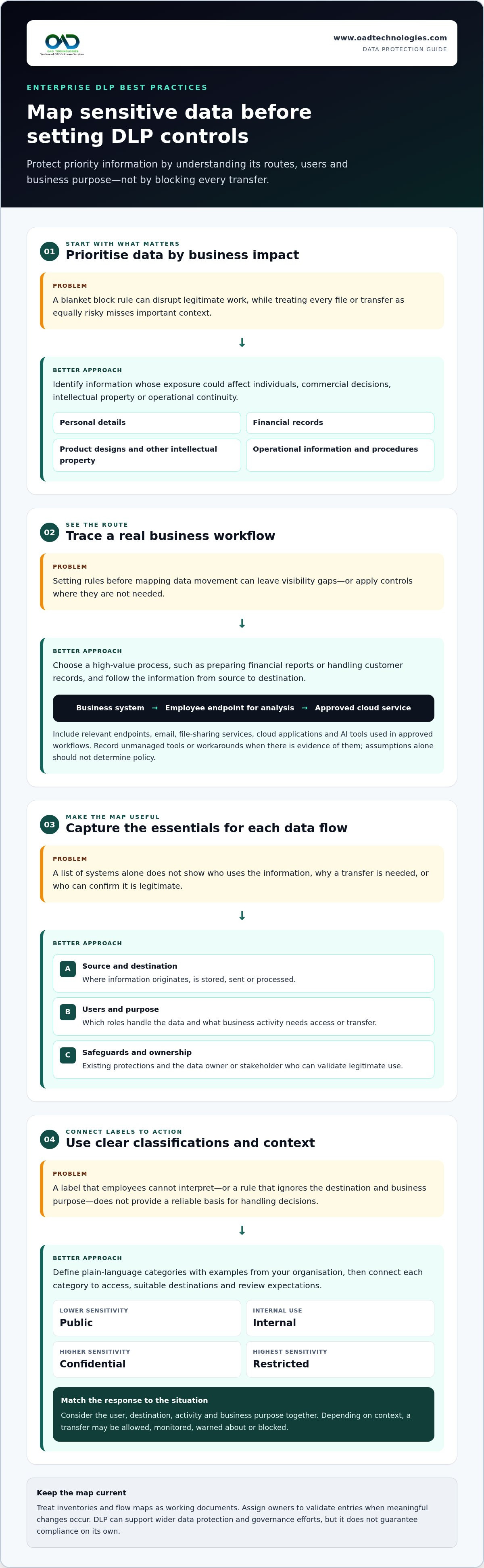
That is why enterprise DLP best practices begin with a risk baseline, not a blanket block rule. Consider the information and workflows that matter across endpoints, email, cloud services and approved business tools. Then assess potential impact: could disclosure affect individuals, commercial decisions, intellectual property or operational continuity? These questions give teams a practical basis for prioritising controls.
What should enterprise DLP protect?
Classify information by its business impact, rather than relying only on technical labels or file types. Relevant categories may include personal details, financial records, intellectual property such as product designs, and operational information such as internal procedures. The organisation’s classification scheme should reflect its actual data, business needs and applicable obligations. A label is useful only when people understand what it means and how it affects handling.
Why does data context matter to DLP?
The same file can be appropriate in one situation and risky in another. A finance employee may share a report with an authorised colleague through an approved cloud service, while sending it to a personal account could create unnecessary exposure. Assess the user, destination, activity and business purpose together. This context helps determine whether to allow, monitor, warn or block, rather than treating every transfer as equally risky.
As a starting point, ask:
- Which information would have the greatest impact if exposed or misused?
- Where is it stored, and which routine workflows move it?
- Who is authorised to use or share it, and for what purpose?
Clear answers help security and business teams focus discovery and policy design on material risks. They also provide a useful foundation for mapping how priority data moves through the organisation.
Map data flows before applying enterprise DLP controls
Once priority information is identified, trace how it moves through the organisation before choosing rules or enforcement settings. A useful map connects data repositories and systems to the business processes that use them. This helps teams see where safeguards already exist, where visibility is limited and which flows need closer review, without trying to catalogue every asset at once.
How can teams discover where sensitive data moves?
Start with a high-value process, such as preparing financial reports or handling customer records, and follow the information from its source to its destinations. Include endpoints, email, file-sharing services, cloud applications and AI tools used in approved workflows. Record unmanaged tools or workarounds when there is evidence of them; assumptions alone should not determine policy.
For each flow, capture the essentials:
- Source and destination: where the data originates and where it is stored, sent or processed.
- Users and purpose: which roles handle it and what business activity requires access or transfer.
- Safeguards and ownership: existing protections and the data owner or stakeholder who can validate legitimate use.
For example, a reporting process may draw information from a business system, move it to an employee’s endpoint for analysis, then share a finished file through an approved cloud service. Mapping each step gives security and business teams a clearer basis for deciding where controls should apply and who needs to validate the workflow.
How should data classification guide DLP?
Use plain-language categories that employees and data owners can apply consistently, such as public, internal, confidential and restricted. Define each category with examples drawn from the organisation’s information. Then connect each label to handling expectations: who may access the data, which destinations are appropriate and when a transfer should trigger review. Classification should guide decisions, not add labels users cannot interpret.
Keep the inventory and flow map as working documents. Business processes, applications and approved workflows change, so assign owners to validate entries when meaningful changes occur. A structured approach to classification, visibility and governance is explored in this enterprise DLP strategic framework.
When documenting safeguards, teams can compare them with relevant guidance such as NIST security and privacy controls, then determine what fits their own environment and obligations. This is not a substitute for local requirements, but it can help organise control discussions. OAD Technologies provides data loss prevention as part of its enterprise cybersecurity services. Learn about OAD Technologies’ DLP services.
Set proportionate enterprise DLP policies without obstructing work
A DLP policy should reflect the sensitivity of the information, its destination, the user’s role and the business purpose of the activity. The same document may be suitable for an authorised colleague in an approved cloud workspace but inappropriate for an external personal account. Strong enterprise dlp best practices do not equate stricter blocking with better protection. A control that repeatedly interrupts valid work can erode trust and encourage workarounds.
When should a DLP policy warn, monitor, or block?
Choose the response according to the evidence and potential impact. Monitoring helps teams understand activity before changing workflows. Warnings and justification prompts can encourage users to pause and explain a transfer. Blocking may fit clearly defined, high-risk scenarios, provided the affected business process and decision owners have been considered in advance.
| Response | Suitable context | Operational trade-off |
|---|---|---|
| Monitor | Early assessment of a data flow or policy in a representative workflow. | Builds insight without interrupting work, but does not stop a transfer. |
| Warn | A potentially risky action where a prompt could prevent accidental disclosure. | Supports user judgement, though repeated or unclear warnings may be ignored. |
| Require justification | A transfer that may be legitimate but needs a business reason recorded. | Adds useful context for review while introducing friction for the user. |
| Block | A clearly prohibited destination or transfer with a well-understood risk. | Prevents the defined action, but can disrupt work if the policy scope is too broad. |
Before expanding enforcement, test policies against representative workflows, including routine approved sharing and edge cases. Microsoft’s practical guide to DLP provides further context on how controls can apply across modern work environments. Use test findings to adjust policy scope, then increase enforcement deliberately rather than switching every rule to block at once.
How can DLP reduce false positives and workflow disruption?
Review alerts with data owners and affected teams to establish whether an activity was expected, who needed the information and which destination the work required. Record the evidence behind each policy change. If a rule flags an approved process, refine its scope or response rather than assuming the user acted improperly. This feedback helps distinguish genuine risk from routine activity.
For UAE organisations, DLP policies should fit broader privacy and governance responsibilities. The UAE Personal Data Protection Law guide provides relevant background; policy decisions still need to reflect each organisation’s circumstances. OAD Technologies provides DLP services to support organisations developing controls around their workflows. Explore OAD Technologies’ DLP services.
Operationalise enterprise DLP with ownership, exceptions, and review
DLP policies need ongoing decisions, not just technical administration. Clear ownership helps teams distinguish a system alert from a confirmed policy issue, approve legitimate workflows and make changes that reflect business risk. A practical operating cycle is to assign decision-makers, review alerts, assess exception requests, document outcomes and reassess policies as data use changes. These enterprise dlp best practices make accountability part of day-to-day operations.
Who should own enterprise DLP decisions?
Separate the technical work of configuring and maintaining policies from business decisions about acceptable data use. Security oversees risk and policy intent; IT supports implementation across relevant systems; business data owners validate sensitivity and legitimate workflows. For broader alignment across cybersecurity, AI governance, and corporate strategy, leadership teams often collaborate with executive advisory firms like TechAxis Advisors to connect technical execution with business goals. Legal and privacy teams advise on relevant obligations and handling expectations. Define how each role escalates decisions so unresolved questions reach an accountable owner rather than sitting in a queue without context.
How should DLP exceptions and alerts be reviewed?
An exception should explain why the activity is needed, which users or workflow it covers, who approved it and what conditions would prompt review. Avoid vague, open-ended exemptions. For example, an approved process for sharing a restricted report with a defined recipient group should be documented with its business rationale and responsible data owner.
Review alerts with relevant stakeholders before treating flagged activity as a violation. A user may have a valid reason to move information, or a policy may be matching an approved process too broadly. Record the decision and any adjustment so teams can distinguish recurring legitimate activity from patterns that need further assessment.
A workable review sequence is:
- Assign: Name the policy administrator and the business owner for each priority data area.
- Assess: Review alert context and exception requests with the people who understand the workflow.
- Document: Record decisions, rationale, approval and any conditions for revisiting an exception.
- Reassess: Use review findings to refine policies and clarify ownership where responsibilities remain unresolved.
Track whether alerts lead to useful decisions, where policies create friction, which patterns recur and which data areas lack a clear owner. These measures help identify whether a policy needs tuning, user guidance or a business decision. They also connect DLP operations to broader governance practices. For more context on aligning risk decisions and accountability, read the GRC enterprise strategy guide.
OAD Technologies provides data loss prevention as part of its wider security and governance services. Read about OAD Technologies’ DLP services.
Connect enterprise DLP with governance and continuous improvement
DLP is most useful when it forms part of a wider governance process. It can support data-handling controls and provide records of policy activity, but a DLP deployment alone does not establish compliance with a law or framework. Organisations must determine which requirements apply to their operations, then assess whether their policies, responsibilities and evidence address them. UAE businesses should consider the relevant legal and regulatory context rather than treating a security tool as a compliance shortcut.
How does DLP support compliance efforts?
Governance connects data owners, risk decisions, control reviews and evidence. A data owner can validate how information should be used; security teams can translate those expectations into DLP policies; and legal, privacy and compliance stakeholders can help assess obligations and review records. Alerts, exception approvals and policy changes may help demonstrate how controls are managed, but they do not prove that every requirement has been met. Keep evidence tied to the specific process and obligation it supports.
DLP also works alongside other security disciplines, each with a distinct role. Identity and access management governs who can access systems and information. Security Information and Event Management (SIEM) brings security events together for analysis, while Cloud Security Posture Management (CSPM) helps identify cloud configuration risks. DLP focuses on identifying and managing sensitive data as it is handled or transferred. Coordinating these perspectives can give risk owners a fuller view without confusing one control’s purpose with another’s. For organizations managing comprehensive technology and cybersecurity needs alongside data safeguards, resources like terapixels.net offer commercial technology solutions including remote monitoring and security management.
How can organisations improve DLP over time?
Set a defined governance cycle to revisit data flows, policy outcomes, exception records and changes to business processes or systems. Use alert reviews to identify recurring legitimate activity, gaps in ownership and workflows where employees need clearer guidance. If access rights contribute to unnecessary exposure, review them alongside data-handling controls. The identity and access management framework offers further context on connecting access governance with broader security decisions.
Assess whether policies generate actionable alerts, whether approved work experiences avoidable friction and whether exception decisions remain justified. Share findings with relevant data owners and governance stakeholders, then use them to refine priorities and employee guidance. This review loop keeps enterprise dlp best practices connected to how the organisation operates, rather than leaving policies unchanged as systems and workflows evolve.
OAD Technologies provides data loss prevention as part of its enterprise cybersecurity services and can discuss requirements in the context of wider security and governance needs. Book a meeting or learn more about OAD Technologies.
Build DLP that protects data and enables work
Effective enterprise dlp best practices begin with knowing which information matters and how it moves through the organisation. From there, teams can set controls that reflect data sensitivity, user roles and business purpose, rather than blocking every transfer by default. Clear ownership for alerts, exceptions and policy review helps keep those controls relevant as workflows change.
DLP works best as part of a wider security and governance approach. It can support data protection efforts, but it does not guarantee compliance on its own. Regular review helps organisations assess whether policies remain useful, where legitimate work encounters friction and which decisions need clearer accountability.
OAD Technologies provides data loss prevention as part of its enterprise cybersecurity services. For organisations assessing their data flows, controls or governance responsibilities, OAD Technologies can discuss DLP requirements as part of a wider security approach.
With clear priorities and shared ownership, organisations can strengthen oversight while giving employees room to do their work confidently.
Frequently Asked Questions
What are the most important enterprise DLP best practices?
Start by identifying priority data and mapping how it moves through business systems. Assign data owners, use clear classifications employees can apply and match controls to the sensitivity of information and the context of each activity. Test policies against legitimate workflows before expanding enforcement. Define who reviews alerts and approves exceptions, document those decisions and revisit outcomes regularly. DLP supports wider governance, but it cannot guarantee that data loss or non-compliance will not occur.
How can an enterprise DLP programme avoid disrupting employees?
Begin with visibility and policy testing rather than broad blocking rules. Involve business teams and data owners to distinguish legitimate activity from avoidable exposure. Monitoring can help teams understand a workflow; warnings or justification prompts may support safer decisions without stopping work. Reserve blocking for clearly defined cases. Review alerts and exceptions for unnecessary friction, then adjust controls using evidence and documented business requirements rather than assumptions about employee behaviour.
What data should an enterprise DLP programme protect first?
Prioritise information according to its sensitivity, business value, exposure risk and relevant handling obligations. Depending on the organisation, this may include personal information, financial records, intellectual property or operational data. Identify where priority information is stored and how it moves before setting controls. Ask data owners and business stakeholders to validate classifications and typical uses. This helps ensure policies reflect real workflows, not labels or assumptions that do not fit the business.
How should enterprise DLP policies handle exceptions?
Give every exception a documented business reason, a defined scope and an accountable approver. Record the workflow it covers, the users or destinations involved and the conditions that should trigger review. Avoid treating exceptions as permanent, informal permissions. When an alert occurs, security teams should consider the activity’s context and involve the relevant data owner before deciding whether it represents a policy issue or an approved business need.
Does enterprise DLP ensure compliance with data protection laws?
No. DLP can support data-handling controls, monitoring and governance, but deploying it does not automatically demonstrate compliance with a law or framework. Applicable obligations depend on the organisation’s activities and the rules that apply to them. Verify legal interpretations against current, authoritative sources and involve appropriate compliance expertise. Treat DLP as one component of a broader assessment and governance programme, with evidence and responsibilities connected to specific processes.
How does DLP work with identity governance and SIEM?
DLP focuses on identifying and managing risky handling or movement of sensitive information. Identity governance helps determine who should have access, while Security Information and Event Management (SIEM) brings security events together to support investigation and oversight. These capabilities can complement each other, but they have different roles. Define how relevant alerts and responsibilities connect across your environment, based on your architecture and business requirements, rather than treating the tools as interchangeable.
How often should enterprise DLP policies be reviewed?
Set a regular review cycle that suits your organisation, and revisit policies when data flows, systems, business processes or relevant obligations change. Use alert patterns, exception records and feedback from affected teams to identify rules that need adjustment. There is no universal review interval that fits every enterprise. The goal is to keep controls aligned with current data use and business risk, while addressing unclear ownership or recurring disruption as it appears.
Book a meeting or discuss your requirements.
Disclaimer
Content by OAD Technologies is for general informational purposes only and does not constitute professional or cybersecurity advice. No warranties are made regarding accuracy or completeness; reliance is at your own risk. OAD Technologies shall not be liable for any direct or indirect losses arising from use of this content.