
What if your GRC team spent their time mitigating strategic risks instead of hunting for data across disconnected spreadsheets to meet the June 2026 FATCA deadline? For many UAE enterprises, manual data collection takes weeks for every audit, often resulting in human error that leads to significant non-compliance risks. It's a frustrating cycle where your experts are buried in administrative tasks rather than focusing on high-level security architecture. You likely feel the pressure of tracking real-time adherence to UAE PDPL and NESA standards while the regulatory environment becomes increasingly complex.
We believe you shouldn't have to choose between rigorous standards and operational speed. You can transform regulatory reporting from a manual burden into a streamlined, automated strategic advantage for your organization. By implementing compliance reporting automation, you'll gain the ability to generate audit-ready reports at the click of a button and maintain real-time dashboards that reflect your true security posture. This article outlines a strategic framework for 2026, exploring how to leverage customized integrations and technical telemetry to reduce GRC costs and ensure long-term digital relevance in a changing market.
Key Takeaways
- Understand the transition from reactive, point-in-time audits to continuous compliance monitoring as necessitated by the UAE's 2026 digital landscape.
- Discover the three-pillar technical architecture required to implement compliance reporting automation by integrating data ingestion with existing security telemetry.
- Learn how to calculate the strategic ROI of automation by reducing the operational "compliance tax" and eliminating human bias in reporting.
- Follow a structured five-step roadmap to effectively map your organization's technical controls to national mandates such as NESA and the UAE PDPL.
- Explore how customized GRC frameworks create a synergy between human insight and technological capacity to maintain long-term digital relevance.
The Evolution of Compliance Reporting in the UAE National Landscape
By 2026, the UAE's digital economy has matured into a sophisticated ecosystem where data is the primary currency. In this environment, regulatory compliance has evolved from a periodic administrative hurdle into a continuous operational requirement. Compliance reporting automation is the programmatic orchestration of security data, transforming raw technical telemetry into real-time documentation that meets rigorous national standards. Enterprises are rapidly shifting from reactive, point-in-time audits to continuous monitoring models. This transition ensures your organization isn't just compliant on the day of an assessment, but remains so every second your systems are operational.
The UAE Personal Data Protection Law (PDPL) and the National Electronic Security Authority (NESA) have redefined the baseline for corporate accountability. Manual reporting is no longer viable. It lacks the speed required to report data breaches within mandated windows or demonstrate ongoing adherence to Information Assurance (IA) standards. Without automation, the gap between a security event and a compliance report becomes a significant liability.
The Rising Cost of Manual Compliance
Relying on manual data collection creates a "compliance tax" that drains resources from your core business objectives. When your IT and legal teams spend weeks aggregating data for a single audit, you lose hundreds of man-hours that should be used for strategic innovation. This fragmentation often leads to compliance blind spots. Outdated information in a spreadsheet fails to reflect a critical vulnerability in your production environment. In the UAE market, these gaps don't just lead to operational friction; they invite heavy regulatory fines and lasting reputational damage that can derail strategic expansion.
National Regulatory Drivers for Automation
The UAE PDPL mandates strict data tracking and reporting, requiring enterprises to maintain granular visibility over how personal information moves through their systems. To achieve this, many organizations integrate their reporting tools with Data Loss Prevention (DLP) solutions to automate movement reports. Similarly, IA standards require real-time visibility into security controls, making manual updates obsolete. The UAE Information Security Regulation (ISR) serves as a critical pillar for government and critical infrastructure entities, mandating automated reporting of security incidents and control effectiveness to ensure national digital resilience in 2026.
By bridging the gap between technical VAPT findings and high-level GRC dashboards, enterprises can move toward a proactive posture. This synergy between technology and human insight defines the modern, resilient enterprise. It's about building a system that protects your digital relevance while satisfying the most stringent national mandates.
How Compliance Reporting Automation Works: The Technical Architecture
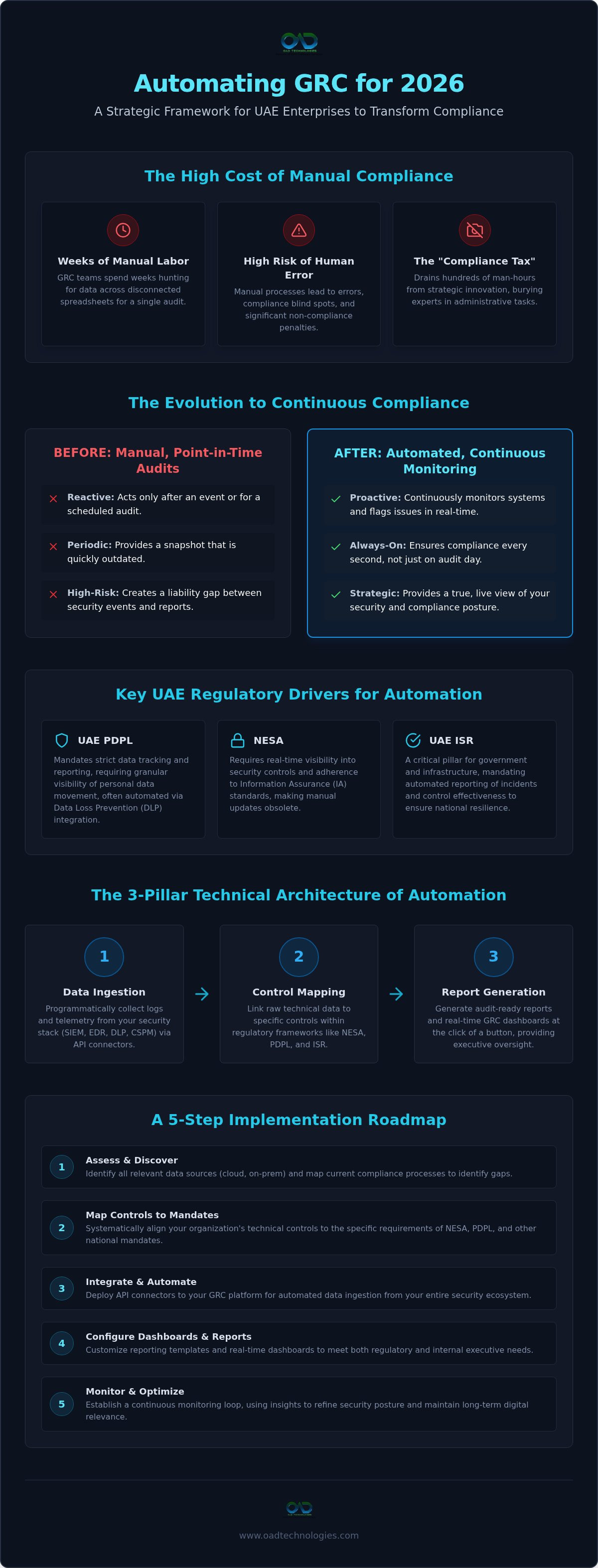
Effective compliance reporting automation isn't just about software; it's about a structured technical architecture that bridges the gap between raw data and executive oversight. This framework rests on three critical pillars: data ingestion, control mapping, and report generation. The process begins with the ingestion of logs and telemetry from across your security stack. By integrating directly with Data Loss Prevention (DLP), the system can automatically document sensitive data movement, satisfying PDPL requirements without the need for manual data entry.
The architecture further leverages SIEM and EDR telemetry to automate incident response reporting. Rather than manually reconstructing a timeline after a security event, the system pulls real-time data to generate a comprehensive narrative for regulators. API connectors act as the essential bridge, linking GRC platforms with cloud environments through Cloud Security Posture Management (CSPM). This ensures your reporting reflects the dynamic nature of modern infrastructure rather than a static, outdated list of assets.
Continuous Monitoring vs. Annual Audits
Traditional audits provide a snapshot that is often obsolete by the time the report is published. Automated tools shift this paradigm by polling system configurations in real-time. This creates a persistent compliance posture where deviations are flagged and recorded immediately. Using SIEM as a single source of truth ensures that every automated log is verified and immutable, providing a reliable audit trail for national mandates.
Mapping Controls to Multiple Frameworks
Modern GRC operates on a "Collect Once, Report Many" philosophy. A single technical control, such as a specific encryption standard, often satisfies requirements for ISO 27001, NESA, and ISR simultaneously. Automation software cross-references these technical controls with various regulatory mandates instantly. This reduces redundant testing cycles and allows your team to focus on proactive problem-solving. As a master designer of these systems, OAD Technologies helps you design customized integration roadmaps that turn complex telemetry into clear, actionable business results.
Manual vs. Automated Reporting: Calculating the Strategic ROI
For UAE enterprises, the transition to compliance reporting automation is often viewed as a technical upgrade, but its true value lies in its strategic return on investment. The traditional "compliance tax"—the immense drain on IT and legal resources required to manually gather evidence—stifles innovation. By automating these workflows, organizations can reduce the audit lifecycle from several months of frantic data gathering to just a few days of review. This velocity doesn't just save time; it provides executive leadership and the Board with real-time risk dashboards, allowing for data-driven decisions based on current security posture rather than historical snapshots.
The financial implications are clear. Direct cost savings manifest through the reduction of billable hours spent on administrative tasks. However, the indirect benefits are often more impactful. Automation eliminates the human bias and selective reporting that can mask underlying risks. It creates a transparent environment where compliance is a byproduct of secure operations, not a separate, labor-intensive event. This transparency is essential for maintaining digital relevance in a market where regulatory scrutiny is rapidly increasing.
Accuracy and the Reduction of Human Error
Manual data entry remains the primary cause of audit failures. When teams are forced to copy-paste telemetry into spreadsheets under tight deadlines, errors are inevitable. These mistakes lead to non-compliance findings that can trigger fines or damage your brand's reputation. Automated systems ensure data integrity by creating tamper-proof audit trails that record every system change and control execution. In the dynamic environments of 2026, automated reporting eliminates data drift by ensuring that compliance evidence is captured at the precise moment a control is triggered, rather than weeks later when the state may have changed.
Strategic Resource Allocation
One of the most significant advantages of an automated framework is the ability to repurpose your most expensive talent. Security specialists should focus on proactive threat hunting and system architecture, not filling out paperwork. When your Managed Detection and Response (MDR) telemetry feeds directly into your reporting engine, the GRC team transitions from being report gatherers to strategic advisors. They can spend their time analyzing the synergy between human insight and technological capacity, identifying gaps before they become liabilities. This shift ensures your organization isn't just checking boxes, but is actively shaping its future through rigorous engineering standards and visionary risk management.
Implementing an Automated Framework: A 5-Step Roadmap
Transitioning to an automated model requires a deliberate, engineered approach. It's not a "set and forget" solution but a living architecture that evolves with your business. For UAE enterprises, compliance reporting automation follows a logical progression from discovery to continuous refinement, ensuring your organization remains resilient in a shifting regulatory environment.
- Step 1: Regulatory Discovery – Catalog every national mandate, including the UAE PDPL and NESA, to define the precise scope of your automated reporting engine.
- Step 2: Control Baselining – Map your existing technical controls to these requirements to identify gaps and determine which processes are ready for immediate automation.
- Step 3: Integration and Ingestion – Establish secure API connections between GRC platforms and your security stack, specifically DLP, IAM, and SIEM, to feed the engine with real-time, verified telemetry.
- Step 4: Dashboard Configuration – Translate raw technical data into business-centric KPIs and executive reporting formats that provide at-a-glance risk visibility for the Board.
- Step 5: Continuous Refinement – Regularly update the logic of your automation framework as UAE laws, such as new tax reporting requirements or e-invoicing mandates, continue to evolve.
Overcoming Common Implementation Hurdles
Legacy systems often pose the biggest technical challenge. Ensuring that older infrastructure can communicate with modern GRC APIs is essential for eliminating data silos that lead to reporting gaps. You must also address data privacy concerns early in the process to maintain internal and external trust. Success depends on cross-departmental buy-in. Legal, IT, and Finance must all recognize the project's long-term viability. When these stakeholders align, the system becomes a strategic asset rather than just an IT expense.
Selecting the Right Automation Partners
A platform is only as effective as the expertise behind it. When evaluating partners, prioritize those with deep, localized knowledge of UAE regulatory nuances. A standardized approach fails to account for the specific reporting mandates of 2026, such as the mandatory registration for FATCA and CRS by June 30. You need a strategic architect who understands the synergy between human insight and technological capacity. If you're ready to modernize your GRC framework, you can consult with our GRC specialists to design a customized roadmap tailored to your specific operational needs.
Navigating the Future of GRC with OAD Technologies
As the UAE's regulatory environment reaches new levels of complexity in 2026, enterprises need more than just software; they require a strategic architect. OAD Technologies positions itself as a master designer of systems, bridging the critical gap between high-level innovation and practical business results. While compliance reporting automation provides the engine for efficiency, our expertise ensures that this engine is tuned to the specific technical and legal nuances of the national landscape. We don't just implement tools. We build resilient frameworks that safeguard your organization's digital relevance.
A significant part of this resilience comes from our ability to translate technical security telemetry into executive-level insights. We integrate findings from rigorous VAPT assessments directly into your GRC workflows. This ensures that a vulnerability discovered at the network layer is immediately reflected in your compliance posture. By connecting technical assessments with reporting engines, we provide a unified view of risk that manual processes simply can't match. This synergy between human insight and technological capacity is what defines a truly mature security organization.
A Tailored Approach to UAE Compliance
We firmly reject standardized, one-size-fits-all solutions. A generic GRC platform often misses the specific reporting requirements mandated by the UAE PDPL or the intricate Information Assurance standards defined by NESA. OAD Technologies takes a customized approach, integrating your existing security layers—such as DLP and SIEM—into a cohesive GRC vision. A common concern is that automation might overlook the "human" context of risk. We address this by using compliance reporting automation to handle the heavy lifting of data aggregation, which frees our consultants to focus on qualitative risk analysis. This ensures that every report reflects not just raw data, but strategic business context.
Next Steps for Your Organization
The path to a streamlined GRC function starts with understanding where you stand today. Jumping into automation without a clear baseline often leads to "paving the cow path"—simply making inefficient manual processes faster. We recommend a specialized GRC maturity assessment to identify which controls are ready for automation and which require manual refinement first. This proactive mindset, backed by rigorous engineering standards, ensures your transition to an automated framework is both stable and scalable. If you're ready to transform your regulatory obligations into a strategic advantage, you should schedule a GRC strategy consultation with OAD Technologies to begin your roadmap for 2026 and beyond.
Securing Your Strategic Position in the 2026 Regulatory Landscape
The shift toward a digital-first UAE economy requires a fundamental change in how enterprises manage risk. Relying on manual spreadsheets in an era of real-time regulatory scrutiny is no longer a viable strategy. By building a technical architecture that connects security telemetry with executive oversight, you turn a mandatory burden into a competitive advantage. This evolution ensures your organization doesn't just survive audits but thrives through enhanced operational visibility and precision.
Implementing compliance reporting automation is the most effective way to safeguard your digital relevance while meeting the strict mandates of the UAE PDPL and NESA. At OAD Technologies, we provide the specialized UAE national GRC expertise and proactive risk management focus needed to navigate these complexities. We act as your strategic cybersecurity partner, helping you bridge the gap between technical innovation and practical results. It's time to move beyond point-in-time audits and embrace a future of continuous, automated compliance. Partner with OAD Technologies for Strategic GRC Automation and secure your organization’s long-term success.
Frequently Asked Questions
What is compliance reporting automation and how does it benefit UAE firms?
Compliance reporting automation is the systematic orchestration of security telemetry into real-time documentation that meets national regulatory standards. For UAE firms, it transforms a labor-intensive manual process into a streamlined strategic asset. This approach reduces the "compliance tax" on internal teams while providing executive leadership with accurate, data-driven risk dashboards. By automating evidence collection, organizations ensure they remain audit-ready at all times, significantly reducing the risk of non-compliance fines.
Does automation replace the need for a GRC team or compliance officer?
No, automation doesn't replace human expertise; instead, it empowers your GRC team to focus on high-value strategic advisory. By handling the repetitive task of data aggregation, compliance reporting automation allows officers to analyze risks and design more resilient security frameworks. This synergy between human insight and technological capacity ensures that your organization doesn't just check boxes but actively manages its security posture. The tool provides the data, while the team provides the critical business context.
How does automated reporting handle the UAE Personal Data Protection Law (PDPL)?
Automated reporting provides the granular visibility required to track personal data movement as mandated by the UAE PDPL. It continuously monitors data flows and records access events, ensuring that your organization can demonstrate adherence to privacy standards during any audit. If a potential breach occurs, the system generates the necessary documentation within the required regulatory window. This persistent monitoring eliminates the errors often found in manual tracking, providing a reliable audit trail for national regulators.
Can automation integrate with existing SIEM and DLP solutions?
Yes, integration with SIEM and DLP solutions is a core component of a modern automated framework. These tools serve as the primary sources of security telemetry, feeding real-time logs into your GRC reporting engine. By using API connectors, the platform bridges technical security layers with compliance mandates, ensuring that every vulnerability or data event is reflected in your reports. This integrated approach creates a single source of truth, reducing the friction between your technical operations and regulatory documentation.
What are the main challenges when moving from manual to automated reporting?
The primary challenges include integrating legacy systems that lack modern APIs and breaking down data silos between departments. Ensuring that data remains private and secure during the ingestion process is also a critical hurdle. Success requires strong stakeholder buy-in across Legal, IT, and Finance to ensure the system is viewed as a long-term strategic investment. Overcoming these obstacles typically involves a structured, five-step roadmap that begins with a thorough assessment of your current compliance maturity.
How often should automated compliance reports be generated?
While the system performs continuous monitoring in the background, formal reports can be generated as often as your internal stakeholders require. Most UAE enterprises schedule executive dashboards for weekly review while maintaining the capability to produce audit-ready reports on-demand. This flexibility ensures that you aren't waiting for an annual audit to identify gaps. Instead, you maintain a persistent compliance posture that allows for immediate course correction whenever a control deviation is detected by the automated engine.
Is automated compliance reporting secure enough for government-regulated sectors?
Yes, automated systems are specifically designed to meet the rigorous security requirements of government-regulated sectors. They provide tamper-proof audit trails and use encrypted data ingestion to ensure that your compliance evidence remains immutable and protected. By reducing the number of human touchpoints, you actually decrease the risk of internal data leaks or unauthorized modifications. These systems are essential for maintaining the high standards required by NESA and the Information Security Regulation (ISR) in 2026.
Disclaimer
Content by OAD Technologies is for general informational purposes only and does not constitute professional or cybersecurity advice. No warranties are made regarding accuracy or completeness; reliance is at your own risk. OAD Technologies shall not be liable for any direct or indirect losses arising from use of this content.