

AI-driven breaches in the UAE surged by 340% in the first half of 2026, signaling a sophisticated new era of digital deception. For local enterprises, the fear of a single fraudulent wire transfer draining millions of AED from the balance sheet is no longer a distant threat but a daily operational reality. You've likely seen phishing attempts become indistinguishable from legitimate executive correspondence, making business email compromise prevention uae a critical priority for your security team. Balancing these rigorous protections with employee productivity remains a significant challenge as attackers leverage deepfake technology to bypass traditional defenses.
This strategic guide empowers you to master the multi-layered technical controls and strategic frameworks needed to safeguard your organization against these evolving social engineering attacks. We'll explore a comprehensive roadmap that integrates Managed Detection and Response (MDR) and advanced Identity and Access Management (IAM). By the end of this guide, you'll have the technical clarity to achieve compliance with NESA IAS v2 and DESC ISR v3 standards while significantly reducing your risk of financial and reputational damage.
Key Takeaways
- Analyze how AI-driven spear-phishing and look-alike domains bypass traditional filters to target high-value UAE organizations.
- Implement foundational email authentication protocols like SPF, DKIM, and DMARC to secure your infrastructure against unauthorized impersonation.
- Discover why identity and access management (IAM) is the cornerstone of effective business email compromise prevention uae in a landscape of compromised vendor accounts.
- Learn to execute a multi-phase defense strategy, starting with VAPT entry-point discovery and moving to 24 X 7 visibility through Managed Detection and Response (MDR).
- Align your cybersecurity posture with the latest UAE national regulations, including NESA and DESC ISR v3, to avoid significant financial penalties.
Defining Business Email Compromise (BEC) in the UAE Context
Business Email Compromise (BEC) isn't a simple technical failure; it's a highly calculated psychological operation designed to exploit human trust. In the UAE, where high-value financial transactions and rapid digital trade are standard, BEC has evolved into a strategic exploit. Unlike generic phishing that relies on volume and luck, BEC involves deep reconnaissance into your organization's hierarchy and vendor ecosystem. Attackers use impersonation and social engineering to manipulate employees into authorizing fraudulent wire transfers or leaking confidential information. This level of precision makes business email compromise prevention uae a fundamental requirement for any enterprise operating in the region's 2026 digital landscape.
The UAE's status as a global hub for investment and innovation makes its enterprises high-value targets for sophisticated international threat actors. With a multinational workforce and a culture of rapid decision-making, the risk of a misinterpreted "urgent" request from a superior is high. Financially motivated attacks now account for 52% of all cyber incidents in the UAE. The shift from voluntary guidelines to mandatory compliance means the stakes have changed. Non-compliance with the UAE National Cyber Security Strategy can result in penalties up to AED 3,000,000 and potential criminal liability for senior management. You aren't just protecting a balance sheet; you're protecting the organization's legal standing and reputation.
Common BEC Variants Targeting UAE Businesses
- CEO Fraud: Attackers impersonate high-level executives, often using AI to mimic their specific linguistic patterns. They typically request "urgent" or "confidential" payments that must bypass standard verification protocols.
- Invoice Manipulation: By intercepting vendor communications, attackers swap legitimate bank details with their own. This often happens within existing email threads, making it nearly impossible to detect without technical authentication.
- Account Takeover (ATO): This involves compromising legitimate credentials to launch attacks from within. Since the email comes from a verified internal address, it bypasses most basic security filters and exploits the inherent trust between colleagues.
The Role of BEC in Data Exfiltration
While the primary motive of BEC is often direct financial gain, it's frequently used as a gateway for much larger breaches. Once an attacker gains access to an executive inbox, they can scrape sensitive intellectual property or resident data, triggering violations of the UAE Personal Data Protection Law (PDPL). Effective business email compromise prevention uae requires a synergy between email security and data loss prevention (DLP). This ensures that even if an account is compromised, the actual data remains shielded from unauthorized movement. BEC is a strategic threat to UAE organizational integrity.
The Anatomy of Modern BEC Attacks: 2026 Threat Landscape
The landscape of digital deception in the UAE has undergone a radical transformation. As of 2026, AI-driven breaches have surged by 340%, rendering traditional security filters increasingly obsolete. Attackers no longer rely on suspicious links or glaring grammatical errors. Instead, they use generative AI to craft machine-perfect spear-phishing messages that bypass legacy Natural Language Processing (NLP) systems. This evolution forces a shift in how we approach business email compromise prevention uae, moving beyond simple blocklists toward sophisticated behavioral analysis and identity-centric defense.
Modern campaigns often utilize a "Low and Slow" strategy combined with look-alike domains. Threat actors don't strike the moment they gain access. They dwell within the environment for weeks or months, silently observing communication patterns, identifying key decision-makers, and learning the nuances of the organization's billing cycles. They might register a domain that differs from yours by a single, nearly invisible character. By the time they execute a fraudulent transaction, they have enough context to make the request appear entirely routine. This level of preparation is why reactive filtering is no longer sufficient for high-value UAE enterprises.
AI and Deepfake Evolution in Email Threats
The most alarming development in 2026 is the integration of synthetic media into email-based attacks. Attackers now use AI to clone the specific writing style, vocabulary, and professional tone of UAE-based executives. These machine-perfect emails are often supplemented by deepfake audio or video clips sent via secondary channels to "confirm" the request. This multi-channel approach exploits the psychological triggers of urgency and authority, making it difficult for even the most vigilant employees to distinguish reality from a highly engineered fabrication. Detecting these threats requires a system that understands the context of a request, not just the technical headers of the message.
Expliting Trust: The Vendor Email Compromise (VEC)
Supply chain compromise represents the most challenging frontier in email security. In a Vendor Email Compromise (VEC) scenario, the attacker doesn't spoof your domain; they compromise a legitimate third-party vendor you already trust. By hijacking existing email threads, they can insert fraudulent payment instructions into a conversation that has been ongoing for months. Because the email originates from a verified partner's infrastructure, it often bypasses standard authentication checks. Protecting your enterprise requires a shift toward comprehensive brand protection and external risk monitoring to identify compromised partners before they become a liability for your own balance sheet.
Technical Controls: Strengthening the UAE Email Infrastructure
Securing the enterprise perimeter in 2026 requires a transition from basic filtering to a robust, authenticated infrastructure. Foundational protocols like SPF (Sender Policy Framework), DKIM (DomainKeys Identified Mail), and DMARC (Domain-based Message Authentication, Reporting, and Conformance) are no longer optional. They form the bedrock of business email compromise prevention uae by verifying that every message originating from your domain is legitimate. Without these, your brand is vulnerable to simple spoofing attacks that can bypass even the most expensive AI filters.
Identity is the new perimeter. Integrating identity and access management (IAM) into your email security stack is essential to mitigate account takeover risks. By centralizing control over user credentials, you can enforce rigorous verification processes that prevent attackers from using stolen passwords to launch internal attacks. This architectural shift ensures that access is granted based on verified identity rather than just a set of credentials. When paired with Advanced Threat Protection (ATP) and sandbox analysis, your system can safely detonate suspicious attachments in a controlled environment before they reach the endpoint.
Early detection relies on granular visibility. Integrating your email logs with a Security Information and Event Management (SIEM) system allows for real-time correlation of anomalies. This means identifying a suspicious login attempt from an unusual geography and immediately linking it to a sudden change in mail forwarding rules. This level of technical oversight is what separates resilient organizations from those that discover a breach only after the financial damage is done.
Implementing Zero Trust for Email Access
Moving beyond standard Multi-Factor Authentication (MFA) is critical in an era of sophisticated adversary-in-the-middle attacks. Organizations must adopt phishing-resistant hardware security keys to ensure that only authorized personnel can access sensitive inboxes. Conditional access policies should be strictly enforced, evaluating factors like device health and behavioral patterns before granting entry. There is also a powerful synergy between Endpoint Detection and Response (EDR) and email security; when an endpoint is flagged for compromise, access to the email environment can be automatically revoked to prevent lateral movement.
Email Authentication Protocol Best Practices
Setting your DMARC policy to 'reject' is the only way to ensure full protection in 2026. A 'quarantine' policy often leaves too much room for human error, allowing malicious emails to linger in junk folders where they can still be opened. DMARC acts as a definitive instruction to receiving servers, ensuring that any email failing authentication is blocked before it reaches the recipient's inbox, effectively preventing domain spoofing for UAE brands. Additionally, implementing BIMI (Brand Indicators for Message Identification) adds a layer of visual trust by displaying your verified logo in the recipient's inbox, signaling the authenticity of your communications to partners and clients alike.
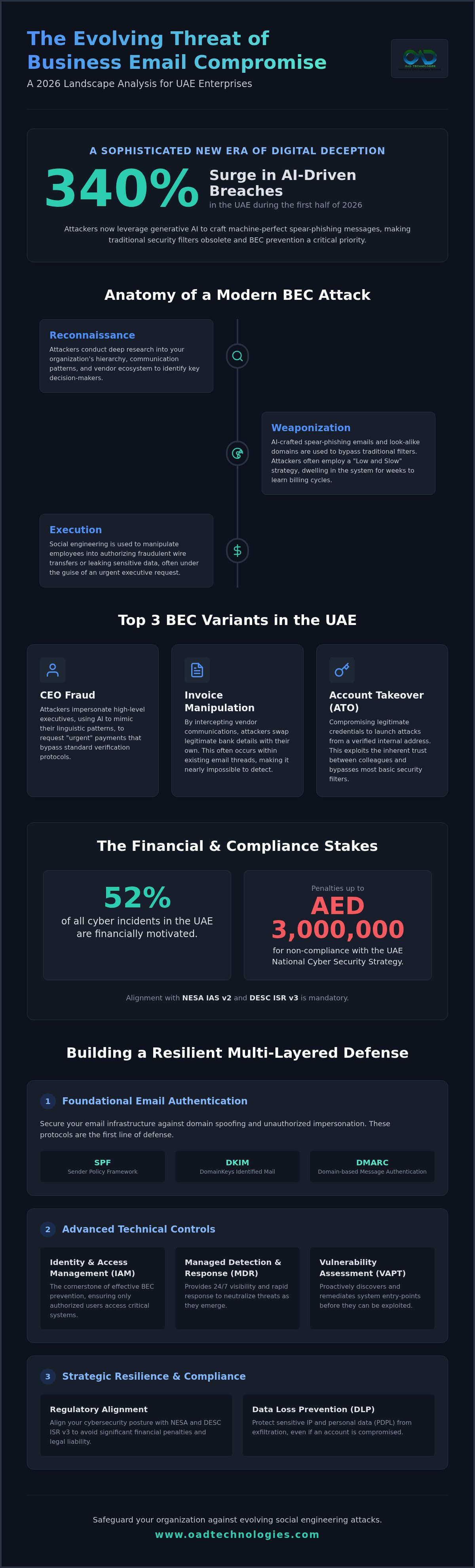
A Multi-Layered BEC Prevention Framework for UAE Enterprises
Effective business email compromise prevention uae requires a structured, multi-phase methodology that integrates technical precision with strategic governance. Phase 1 begins with a rigorous VAPT to identify specific entry points and misconfigurations in your mail flow. This isn't a surface-level scan; it's a deep dive into the vulnerabilities that AI-driven spear-phishing campaigns exploit. Once entry points are mapped, Phase 2 focuses on the technical hardening of the email gateway and identity provider, ensuring that authentication protocols are strictly enforced and legacy vulnerabilities are closed. This creates a resilient baseline that stops the majority of automated threats before they reach a user's inbox.
Resilience is maintained through Phase 3, which involves continuous monitoring using managed detection and response (MDR). This provides 24 X 7 visibility into account anomalies, such as sudden changes in mail forwarding rules or logins from unauthorized geographies. Phase 4 aligns these technical efforts with Governance, Risk, and Compliance (GRC) standards to ensure your architecture meets national mandates. Finally, Phase 5 establishes an incident response plan specifically tailored to financial fraud scenarios. This plan defines clear protocols for freezing compromised accounts and coordinating with UAE financial institutions to stop fraudulent transfers before they're finalized. You can schedule a comprehensive security audit to begin mapping this framework to your organization's specific needs.
Aligning with UAE National Cybersecurity Standards
Navigating the 2026 regulatory landscape is essential for any enterprise. BEC prevention is now a core requirement of NESA IAS v2 and DESC ISR v3 compliance. These standards mandate regular technical security assessments to prove that your organization is actively defending against sophisticated social engineering. Furthermore, the UAE Personal Data Protection Law (PDPL) introduces strict rules for email monitoring; you must balance security oversight with resident data privacy. Implementing a compliant framework ensures you avoid the heavy penalties for non-compliance, which can reach up to AED 3,000,000 for significant breaches.
The Human Element: Advanced Awareness Training
Technology alone can't stop a well-crafted social engineering attack. Organizations must move away from annual slide-based training toward continuous, high-fidelity phishing simulations that mimic real-world 2026 threats. These simulations help employees recognize the subtle psychological triggers used in AI-generated emails. Beyond training, establishing 'out-of-band' verification procedures is non-negotiable. Every financial transaction, regardless of the perceived urgency, should require a secondary confirmation via a trusted, non-email channel. Empowering your team with automated reporting tools ensures that suspicious activity is flagged to the SOC within seconds, turning your workforce into a proactive layer of defense.
Strategic Resilience: OAD Technologies’ Approach to Email Security
OAD Technologies views business email compromise prevention uae as a component of a unified, resilient architecture rather than a standalone filter. We move away from the fragmented approach that leaves gaps for AI-driven attackers to exploit. By synchronizing SIEM, EDR, and IAM, we provide total visibility into your digital environment. This integration ensures that an anomaly in an email header is immediately correlated with endpoint behavior and identity verification logs. Our UAE-based SOC experts provide the contextual analysis necessary to distinguish legitimate executive requests from highly engineered deepfakes.
Our GRC consulting ensures your prevention strategy isn't just technically sound but also audit-ready. We align your infrastructure with NESA and DESC requirements, protecting your organization from the legal and financial repercussions of non-compliance. We act as your strategic partner, focusing on the long-term viability of your security posture. This commitment to precision and high-quality craftsmanship ensures that your investment in security translates into measurable operational performance.
Managed Detection and Response (MDR) for BEC
Real-time detection is the core of our MDR service. Our system identifies anomalous login patterns and flags sudden mailbox rule changes that often signal an active compromise. We don't wait for alerts to trigger; our proactive threat hunting teams search for dormant attackers who might be in the reconnaissance phase. Once we detect a compromise, we execute rapid containment strategies to freeze accounts and isolate affected systems. This speed is critical to preventing the massive financial loss associated with fraudulent wire transfers.
Building a Future-Proof Email Defense
OAD Technologies rejects standardized, one-size-fits-all security models. We design customized architectures tailored to the specific operational workflows of your UAE enterprise. Our SOC thrives on the synergy between human insight and advanced technological capacity. While AI handles the high-volume data processing, our experts provide the strategic oversight needed to manage complex supply chain risks. This localized expertise is vital for understanding the nuances of the regional threat landscape. Secure your enterprise today with OAD Technologies' Email Security Solutions.
Future-Proofing Your Digital Communications
The 2026 threat landscape demands a transition from legacy filtering to an identity-centric defense architecture. By integrating technical protocols like DMARC with advanced IAM and continuous monitoring, you create a resilient environment that stops AI-driven social engineering before it results in financial loss. Effective business email compromise prevention uae isn't just about blocking malicious messages; it's about building a system that understands the context of every interaction. This strategic approach ensures long-term viability and protects your organization's reputation in an increasingly complex market.
Aligning with national standards like NESA and DESC ISR v3 is no longer optional for UAE enterprises. We provide the specialized infrastructure and expertise needed to bridge the gap between innovation and practical business results. Our UAE-based SOC and MDR capabilities offer 24 X 7 visibility into account anomalies, while our GRC consulting ensures your strategy meets the highest regulatory standards. Through advanced DLP and IAM integration, we help you maintain operational momentum without compromising on security.
Secure your UAE enterprise with OAD Technologies' advanced BEC prevention strategies to safeguard your organization's future. You now have the roadmap to stay ahead of sophisticated threats and ensure your digital relevance.
Frequently Asked Questions
What is the primary cause of Business Email Compromise in the UAE?
The primary cause is the exploitation of human trust through sophisticated social engineering and AI-driven phishing. In 2026, attackers use generative AI to create machine-perfect messages that mimic specific executive tones and linguistic patterns. These tactics often lead to credential theft, providing a gateway for account takeover. Successful business email compromise prevention uae requires addressing these human vulnerabilities while implementing technical safeguards that detect behavioral anomalies before a fraudulent transaction occurs.
How can I distinguish a legitimate executive email from a BEC attempt?
Distinguishing legitimate correspondence from a BEC attempt requires a combination of technical verification and behavioral analysis. You should check for look-alike domains where a single character differs from your official address. Be wary of unusual requests for urgent wire transfers or changes to bank details, especially those that bypass standard protocols. Implementing out-of-band verification, such as a phone call to a known number, remains the most effective way to confirm high-value requests.
Is MFA enough to prevent Business Email Compromise?
Standard Multi-Factor Authentication (MFA) is no longer a complete defense against modern BEC attacks. Sophisticated threat actors use adversary-in-the-middle (AiTM) techniques to intercept session tokens and bypass one-time passwords. To ensure robust business email compromise prevention uae, organizations must transition to phishing-resistant hardware security keys. These tools provide a higher level of assurance by ensuring that the authentication process is tied to a physical device that attackers cannot easily replicate or intercept remotely.
What are the legal reporting requirements for BEC in the UAE?
UAE enterprises must report significant cyber incidents to the UAE Cyber Security Council or relevant sectoral regulators like DESC. If the compromise leads to a personal data breach, the UAE Personal Data Protection Law (PDPL) requires notifying the UAE Data Office within 72 hours. Organizations should also coordinate with their financial institutions immediately to attempt to freeze any fraudulent transactions. Failure to comply with these reporting mandates can result in significant legal and financial penalties.
How does DMARC help in preventing email spoofing?
DMARC prevents unauthorized parties from using your domain to send fraudulent emails. It works by providing instructions to receiving servers on how to handle messages that fail SPF or DKIM authentication. By setting a reject policy, you ensure that spoofed emails are blocked before they reach the recipient's inbox. This protocol is essential for protecting your brand reputation and ensuring that partners can trust the communications originating from your official corporate infrastructure and mail servers.
What should I do immediately if I suspect my business email is compromised?
You must immediately isolate the affected account and change all associated credentials to prevent further unauthorized access. Notify your Security Operations Center (SOC) or Managed Detection and Response (MDR) provider to begin an investigation into lateral movement. Simultaneously, contact your bank and any relevant financial partners to halt pending transfers. A rapid response plan is critical to minimizing the financial and reputational damage caused by a successful business email compromise within your organization.
How often should a UAE enterprise conduct VAPT for email systems?
UAE enterprises should conduct Vulnerability Assessment and Penetration Testing (VAPT) for their email systems at least once a year. However, high-risk organizations or those undergoing significant infrastructure changes should perform these assessments more frequently. Regular VAPT helps identify misconfigured gateways, weak authentication protocols, and potential entry points that attackers exploit. This proactive approach ensures your defenses remain resilient against the rapidly evolving tactics used by international threat actors in the 2026 digital landscape.
Does UAE Personal Data Protection Law (PDPL) affect email security monitoring?
The UAE Personal Data Protection Law (PDPL) significantly impacts how organizations monitor their email environments. Security teams must ensure that email archiving and monitoring activities comply with resident data privacy requirements and data residency mandates. While monitoring is necessary for threat detection, it must be balanced with the rights of the data subjects. Organizations should consult with GRC experts to align their email security policies with the executive rules of the PDPL to avoid non-compliance.
Disclaimer
Content by OAD Technologies is for general informational purposes only and does not constitute professional or cybersecurity advice. No warranties are made regarding accuracy or completeness; reliance is at your own risk. OAD Technologies shall not be liable for any direct or indirect losses arising from use of this content.