

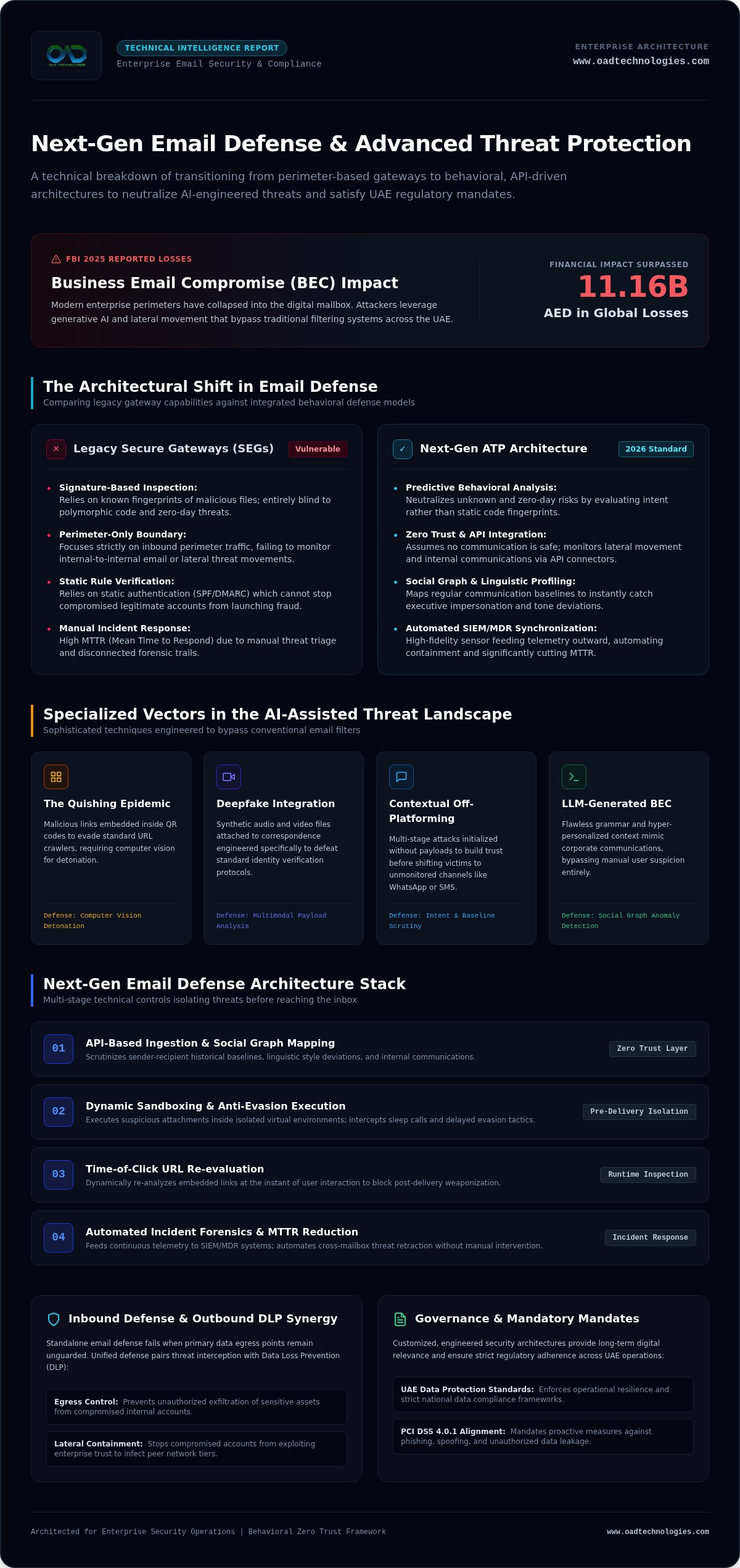
The FBI reported that Business Email Compromise losses surpassed 11.16 billion AED in 2025. This staggering figure highlights a harsh reality for enterprises operating in the UAE. Your perimeter is no longer a physical line; it's a digital mailbox. You likely feel the mounting pressure of managing complex security stacks while defending against a rising volume of AI-driven phishing. Traditional gateways often fail to detect internal threats or sophisticated lateral movements that bypass standard filters.
Mastering advanced threat protection for email requires shifting from legacy gateways to integrated, API-based architectures. This guide provides a technical roadmap to help you bridge the gap between high-level innovation and practical business results. We'll explore the mechanics of next-generation defense and the strategic integration of Data Loss Prevention (DLP) to safeguard sensitive assets. You'll gain a clear understanding of how to maintain operational resilience while ensuring strict alignment with UAE data protection regulations and PCI DSS 4.0.1 mandates.
Key Takeaways
- Identify why shifting from signature-based detection to predictive, behavioral analysis is essential for neutralizing zero-day threats in 2026.
- Understand how advanced threat protection for email utilizes dynamic sandboxing and time-of-click re-evaluation to intercept sophisticated phishing attempts in real-time.
- Explore the critical synergy between inbound defense and outbound data loss prevention to secure your organization’s primary data egress points.
- Develop a roadmap for aligning your email security framework with UAE national compliance standards and mandatory PCI DSS 4.0.1 requirements.
- Learn how a customized, engineered security architecture provides greater long-term digital relevance than standardized, one-size-fits-all software solutions.
Defining Advanced Threat Protection (ATP) for Modern Email Infrastructure
The traditional perimeter has dissolved. In 2026, the primary entry point for sophisticated cyberattacks remains the inbox, yet the methods have evolved far beyond simple spam or known malware. Legacy Secure Email Gateways (SEGs) that rely on signature-based detection are increasingly blind to modern threats. These older systems look for known "fingerprints" of malicious files; however, attackers now use polymorphic code and unique, AI-generated content that has no existing signature. Advanced threat protection for email represents a fundamental shift from reacting to known threats to predicting and neutralizing unknown risks through deep technical analysis.
Modern ATP functions as a critical pillar within a Zero Trust architecture. It assumes that no communication is inherently safe, regardless of the sender's identity or historical relationship. By acting as a high-fidelity sensor, ATP feeds real-time intelligence into your broader security stack, including SIEM and MDR systems. This integration ensures that an isolated email threat doesn't escalate into a cross-platform breach. It monitors not just what is entering the network, but also lateral movement and internal-to-internal communications that traditional gateways often ignore.
From Static Filters to Behavioral Intelligence
Effective defense now requires analyzing the intent of a communication rather than just its technical composition. While foundational email authentication protocols like DMARC and SPF prevent basic domain spoofing, they cannot stop a legitimate but compromised account from sending a malicious request. ATP utilizes social graph mapping to understand typical communication patterns between employees and external partners. If a "C-suite executive" suddenly requests an urgent wire transfer to a new vendor in a style that deviates from their historical linguistic baseline, the system flags the anomaly. Advanced threat protection for email is a dynamic, self-evolving ecosystem rather than a static security tool.
The 2026 Threat Landscape: AI-Assisted Attacks
Cybercriminals now leverage Large Language Models (LLMs) to eliminate the typographical errors and awkward phrasing that once made phishing easy to spot. These hyper-personalized attacks are often part of larger Business Email Compromise (BEC) campaigns that are difficult to distinguish from routine corporate correspondence. Modern ATP must also contend with specialized vectors such as:
- Deepfake Integration: Identifying synthetic audio or video attachments designed to bypass standard identity verification.
- The Quishing Epidemic: Using computer vision to detonate malicious links hidden inside QR codes, a tactic that bypasses traditional URL scanners.
- Contextual Social Engineering: Detecting multi-stage attacks where the initial email contains no payload but aims to move the conversation to a less secure platform like SMS or WhatsApp.
For enterprises in the UAE, these threats are not theoretical. They represent a direct risk to operational continuity and regulatory standing. Implementing a robust ATP framework is the only way to maintain digital relevance and protect the integrity of the corporate mission.
The Technical Architecture of Next-Gen Email Defense
Next-generation email defense moves beyond the gateway. It builds a multi-layered architectural stack that scrutinizes every byte of data and every user interaction. This shift is critical because modern attackers don't just send malicious files; they exploit trust. Advanced threat protection for email provides the technical scaffolding needed to detect these nuanced shifts in behavior, ensuring that the initial access phase of a cyberattack is neutralized before it can escalate.
By integrating automated incident response and forensics, these architectures significantly reduce the Mean Time to Respond (MTTR). Instead of manual triage, the system automatically isolates suspicious messages and provides security teams with a clear forensic trail. This proactive stance is essential for maintaining operational continuity in high-stakes environments where even a few minutes of exposure can lead to a significant breach.
Advanced Sandboxing and Link Detonation
Dynamic sandboxing involves executing suspicious attachments in a secure, isolated virtual environment to observe their behavior before they reach the user's inbox. Attackers often try to bypass these environments using sandbox evasion techniques, such as delayed execution or detecting virtual machine signatures. Modern architectures counter this by simulating human interactions, such as mouse movements or keystrokes, to force the malware to reveal its intent.
When a user interacts with a link, time-of-click protection re-evaluates the destination URL in real-time. This prevents "sleeping" malicious sites from activating after the initial scan. Integrating these detonation results into your broader SIEM strategy allows for cross-stack correlation and faster threat hunting. This technical rigor aligns with CISA and NSA phishing prevention guidance, which emphasizes stopping the attack cycle at the point of initial access.
Identity-Centric Email Security
A resilient architecture must verify the "who" as much as the "what." A robust framework integrates directly with Identity and Access Management (IAM) to ensure that every sender is authorized and authenticated. While DMARC, SPF, and DKIM provide a baseline for external verification, they don't solve the problem of internal account takeovers. Advanced threat protection for email monitors internal mail flow to detect lateral movement, which is often the precursor to data exfiltration.
If a compromised internal account starts sending unusual requests to colleagues, the system uses Natural Language Understanding (NLU) to identify the shift in tone and intent. This allows for the immediate isolation of the affected account without disrupting the entire communication flow. If you're looking to refine your technical stack, OAD Technologies can help design a resilient framework tailored to your specific infrastructure.
Why Standalone Email Security Fails: The Critical DLP Connection
Organizations often treat email defense as a one-way filter. They focus heavily on stopping phishing and malware from entering the network but leave the back door wide open. In reality, email is the primary egress point for sensitive corporate data. Without a unified strategy, intellectual property, financial records, and proprietary code can slip through legitimate mail routes undetected. Relying on a standalone filter creates a dangerous gap in your security posture where inbound threats are blocked, but outbound exfiltration remains unmonitored.
Integrating your Data Loss Prevention (DLP) framework with advanced threat protection for email creates a bidirectional shield. This combination allows for deep content inspection of every message leaving the network. The system doesn't just look for viruses; it identifies sensitive data patterns. If an employee attempts to send a spreadsheet containing thousands of customer records or a sensitive contract to a personal address, the system intervenes in real-time. This synergy ensures that your inbound threat detection and outbound policy enforcement work as a single, cohesive unit.
Outbound Security and Data Exfiltration
Modern attackers don't always use loud, massive transfers to steal data. They prefer "slow and low" leaks that mimic routine traffic, making them nearly impossible for traditional gateways to spot. Advanced threat protection for email monitors these subtle patterns, identifying when an account starts forwarding sensitive attachments to external addresses at unusual intervals. Automated encryption plays a vital role here, ensuring that even if a message is sent, the data remains unreadable to unauthorized parties. The intersection of ATP and DLP acts as the dual-gate of digital sovereignty.
Strategic Visibility Across the Enterprise
Standalone tools create operational silos that slow down response times. Consolidating your email alerts into a unified Managed Detection and Response (MDR) workflow provides the high-level context needed to stop complex breaches. Email telemetry isn't just for mail; it improves your Cloud Security Posture Management (CSPM) by highlighting where sensitive data is being shared across SaaS platforms. For UAE enterprises, this data is invaluable for informing GRC risk assessments and ensuring strict compliance with the UAE Personal Data Protection Law (PDPL). This integrated approach transforms email security from a simple filter into a strategic guardian of your long-term digital relevance.
Implementing a Resilient Email Security Framework
Building resilience requires more than a software license. It demands a structured methodology that bridges the gap between high-level innovation and practical business results. Enterprises must begin with a comprehensive technical security assessment to identify architectural gaps that traditional filters might overlook. This process ensures that your advanced threat protection for email is not a standalone silo but a calibrated component of your wider defense stack. Continuous monitoring and iterative policy refinement are essential to keep pace with evolving threats that target the specific vulnerabilities of your unique infrastructure.
We view the human element not as a liability but as a sophisticated sensor. When combined with automated defense, Security Awareness Training (SAT) functions as a dynamic technical control. It empowers your team to recognize the subtle nuances of AI-generated social engineering that algorithms might still be learning to identify. This synergy between human insight and technological capacity creates a proactive, solution-oriented mindset that is backed by rigorous engineering standards.
Compliance and Regulatory Alignment
In the UAE, security is inseparable from digital sovereignty. Mapping your email controls to the UAE Personal Data Protection Law (PDPL) is a mandatory step for any enterprise handling sensitive information. This involves establishing rigorous protocols for email archiving and e-discovery, ensuring that data is not only protected but also retrievable for regulatory audits. Regulated industries must maintain high-quality craftsmanship in their data handling to meet these local standards. Integrating these governance standards into your broader GRC framework provides the assurance needed to operate without fearing the operational or financial impact of non-compliance.
The Roadmap to Deployment
A successful deployment follows a steady, deliberate rhythm. We recommend a three-phase approach to ensure long-term viability and minimize disruption to your business operations:
- Phase 1: Establish a baseline through a technical audit and VAPT testing to uncover existing vulnerabilities in your current mail flow and routing.
- Phase 2: Execute pilot testing with high-risk departments like Finance and HR, where the impact of Business Email Compromise (BEC) is most severe and data sensitivity is highest.
- Phase 3: Proceed with a full enterprise rollout, ensuring seamless integration with your Security Operations Center (SOC) for 24 X 7 managed detection and response.
This phased approach allows for the customization of security policies to fit specific department needs rather than relying on a standardized, one-size-fits-all approach. If you are ready to modernize your defense, contact OAD Technologies to begin your technical security assessment today.
Navigating the Future of Secure Communications with OAD Technologies
Standardized security plans often leave critical gaps in an enterprise's defense. At OAD Technologies, we reject the "one-size-fits-all" model in favor of highly customized architectures. Our approach to advanced threat protection for email focuses on bridging high-level innovation with practical business results. We don't just sell software; we design resilient ecosystems that empower your people and protect your digital assets. This proactive, solution-oriented mindset ensures that your security stack evolves alongside the global threat landscape, protecting the integrity of your corporate mission.
Our role is that of a master designer of systems. We act as an extension of your own team, ensuring that every technological investment translates into operational performance and strategic expansion. By focusing on the synergy between human insight and technological capacity, we help organizations move beyond simple compliance toward true operational resilience. This commitment to precision and high-quality craftsmanship is what allows our clients to maintain their digital relevance in a market defined by rapid change.
Custom-Engineered Security Stacks
We prioritize system synergy over the performance of individual tools. A single high-performing filter is ineffective if it doesn't communicate seamlessly with your wider MDR or SIEM infrastructure. As a UAE-based strategic partner, we understand the nuances of national strategic alignment and the specific requirements of the local regulatory environment. We design for resilience, moving your organization from a state of being merely "secure" to being "survivable." This architectural philosophy means that even if a sophisticated attack occurs, your system is built to contain the threat and maintain business continuity without incurring massive financial or reputational losses.
Strategic Partnership and Ongoing Growth
Our engagement goes far beyond the initial implementation phase. We provide continuous technical security assessments to ensure your advanced threat protection for email remains effective as cybercriminals refine their tactics. This ongoing growth is supported by executive-level GRC consulting, where we align your security investments with your long-term strategic goals. We don't aim to replace your internal teams; we aim to empower them with the tools and intelligence needed to defend your enterprise. By choosing a visionary guardian for your digital evolution, you ensure your organization remains protected and competitive in an ever-changing global market.
Securing Your Digital Sovereignty in a Predictive Era
The transition from legacy gateways to integrated cloud architectures is no longer optional for UAE enterprises. We've explored how advanced threat protection for email acts as a critical sensor within your broader security stack, bridging the gap between inbound defense and outbound data integrity. By rejecting standardized approaches in favor of custom-engineered resilience, your organization can survive the most sophisticated AI-driven threats of 2026. This technical maturity ensures that your communication channels remain a source of strength rather than a point of vulnerability.
OAD Technologies brings proven strategic expertise to your defense, ensuring every security control aligns strictly with UAE national standards and PDPL requirements. Our integrated DLP and MDR capabilities empower your internal teams, turning security into a catalyst for operational growth rather than a bottleneck. We act as a master designer of systems, focusing on the synergy between human insight and technological capacity to guard your long-term digital relevance. Your digital evolution deserves a guardian that values precision, high-quality craftsmanship, and visionary partnership.
Secure your digital evolution with OAD Technologies' advanced email security solutions. It's time to build a future where your enterprise is not just secure, but truly survivable.
Frequently Asked Questions
How does Advanced Threat Protection differ from a standard spam filter?
Advanced threat protection for email differs from standard filters by focusing on intent rather than just volume or known signatures. Standard filters block mass-market junk, but ATP neutralizes zero-day malware and sophisticated social engineering. It uses dynamic sandboxing to detonate attachments and time-of-click analysis to inspect URLs. This shift from static lists to predictive intelligence ensures that hyper-personalized attacks, which lack a recognizable spam signature, are blocked before they reach the inbox.
Is ATP for email mandatory under the UAE Personal Data Protection Law (PDPL)?
The UAE Personal Data Protection Law (PDPL) mandates that organizations implement appropriate technical measures to protect personal data from unauthorized access or leakage. While the law doesn't name "ATP" specifically, it requires high standards of data security that traditional filters cannot meet. Implementing advanced threat protection for email is a critical step in demonstrating compliance. It provides the necessary encryption, archiving, and exfiltration controls to safeguard sensitive PII and avoid significant regulatory penalties.
Can ATP prevent Business Email Compromise (BEC) and invoice fraud?
Yes, ATP is specifically designed to stop Business Email Compromise (BEC) by analyzing communication patterns and linguistic styles. Unlike standard filters, it identifies when a legitimate account has been compromised or when an attacker is impersonating an executive to request fraudulent wire transfers. By mapping your organization’s social graph, the system flags anomalies in sender behavior or tone. This proactive detection prevents invoice fraud by intercepting deceptive requests that contain no malicious links or attachments.
What is the role of AI and Machine Learning in 2026 email security?
AI and Machine Learning serve as the primary engine for predictive defense against Large Language Model (LLM) generated phishing. In 2026, these technologies baseline "normal" communication to detect synthetic deepfakes and automated social engineering. Machine learning models analyze thousands of metadata points in milliseconds to identify subtle deviations that human eyes miss. This technological capacity allows security stacks to evolve autonomously, identifying new attack vectors like "quishing" without requiring manual updates or prior threat signatures.
How do I integrate email security with my existing SIEM or MDR provider?
Integration is achieved through cloud-native APIs that feed high-fidelity telemetry directly into your SIEM or MDR workflow. This connection allows your Security Operations Center (SOC) to correlate email alerts with endpoint and network data for a unified view of the threat landscape. OAD Technologies specializes in these customized integrations, ensuring that email security acts as a primary sensor for your broader defense. This synergy reduces the time spent on manual triage and accelerates your overall incident response lifecycle.
Does ATP impact email delivery speed or user experience?
Modern API-based ATP solutions have a negligible impact on delivery speed compared to legacy inline gateways. While deep inspection and sandboxing take a few seconds, most systems deliver the email body immediately while scanning attachments in the background. This ensures a seamless user experience without sacrificing security. Users only notice the system when a malicious link is blocked at the time of click, providing a reassuring layer of protection that doesn't disrupt the daily business rhythm.
Should I use the built-in security features of my cloud email provider or a third-party solution?
Built-in features provide a foundational baseline, but a specialized third-party solution offers the depth required for complex enterprise risk profiles. Third-party ATP providers often possess superior behavioral engines and more robust Data Loss Prevention (DLP) capabilities. Relying solely on a single vendor creates a monoculture where a single exploit can bypass all defenses. A layered approach, engineered by a strategic partner like OAD Technologies, ensures that your defense remains resilient against attacks specifically designed to bypass standard cloud filters.
Disclaimer
Content by OAD Technologies is for general informational purposes only and does not constitute professional or cybersecurity advice. No warranties are made regarding accuracy or completeness; reliance is at your own risk. OAD Technologies shall not be liable for any direct or indirect losses arising from use of this content.