

If your brand's digital twin is currently defrauding customers across the UAE, how many hours would it take for your security team to notice? Most leadership teams recognize that social media is no longer just a marketing channel. It's a highly visible, vulnerable extension of the corporate perimeter. You're likely already dealing with a relentless volume of low-quality bots and sophisticated AI-generated deepfakes that can erode trust and cause financial damage before platform support even acknowledges your report. Effectively detecting brand impersonation on social media in 2026 requires moving beyond reactive manual reporting toward a structured, engineering-led approach.
This strategic guide provides the technical frameworks and proactive strategies needed to identify and neutralize fraudulent profiles before they impact your corporate reputation. We'll show you how to treat social platforms as a critical component of your Data Loss Prevention (DLP) and Managed Detection and Response (MDR) strategies. You'll learn how to build a scalable detection workflow, integrate brand protection into your existing security stack, and significantly reduce time-to-takedown. By the end of this article, you'll have a clear roadmap to maintain your digital relevance and protect your organization's long-term viability in an increasingly complex threat landscape.
Key Takeaways
- Understand the 2026 threat landscape, where AI-driven deepfakes and executive impersonation have replaced basic logo-copying as the primary risk to UAE corporate reputations.
- Implement a structured 5-step framework for detecting brand impersonation on social media by mapping core digital assets and deploying broad-spectrum monitoring.
- Align your brand protection efforts with Data Loss Prevention (DLP) and Identity and Access Management (IAM) to identify leaked assets and prevent unauthorized account access.
- Master the technical takedown process and leverage UAE-specific Governance, Risk, and Compliance (GRC) frameworks to enforce your brand's legal rights across social platforms.
- Adopt a "Digital Twin" surveillance model that treats social media as an extension of your network perimeter, ensuring proactive neutralization of fraudulent profiles.
The Evolution of Social Media Brand Impersonation in 2026
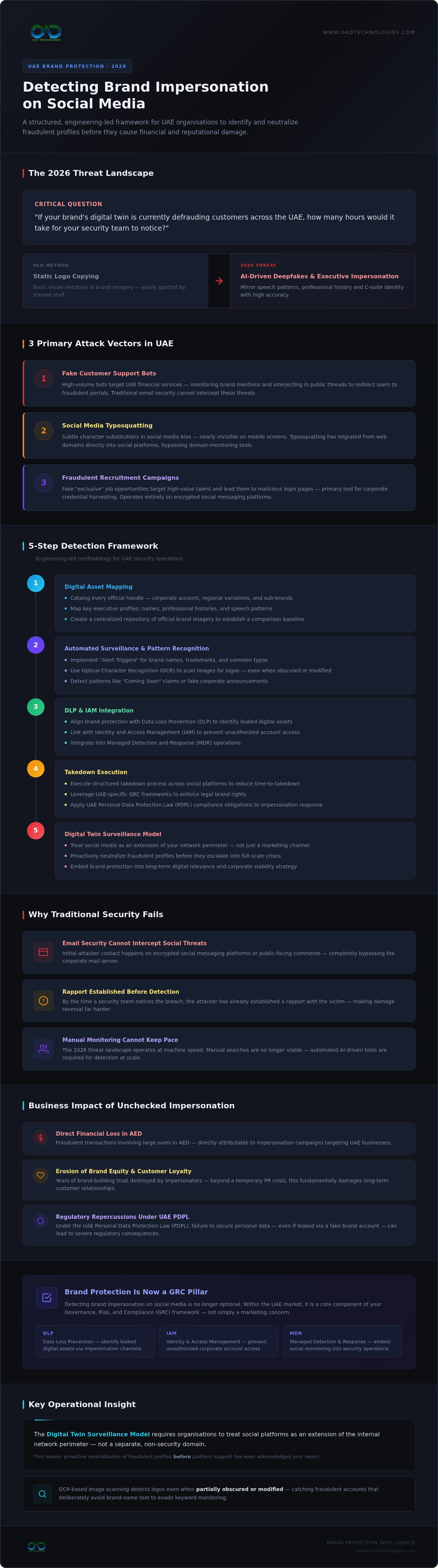
By 2026, the methodology behind digital fraud has undergone a radical transformation. Attackers have moved beyond static logo-copying, favoring high-fidelity deepfakes and AI-driven social engineering. This shift makes detecting brand impersonation on social media a complex technical challenge rather than a simple visual check. Modern adversaries now construct "Executive Impersonation" profiles that mirror the speech patterns and professional history of C-suite leaders with unsettling accuracy. These profiles don't just look like your leadership; they sound like them, too.
Traditional email security solutions often fail to catch these threats. The initial contact happens on encrypted social messaging platforms or through public-facing comments, completely bypassing the corporate mail server. By the time a security team notices the breach, the attacker has already established a rapport with the victim. This bypass of the traditional perimeter demands a new surveillance model that treats social platforms as an extension of your internal network.
Beyond Phishing: The New Face of Digital Scams
Digital scams now leverage sophisticated technical tricks to deceive even savvy users. We see a high volume of fake customer support accounts targeting UAE financial services. These bots monitor brand mentions and interject in public threads, redirecting users to fraudulent portals. Typosquatting has also migrated from web domains to social media bios, using subtle character substitutions that are nearly invisible on mobile screens. Additionally, fraudulent recruitment campaigns have become a primary tool for credential harvesting. They target high-value talent with "exclusive" opportunities, leading them to malicious login pages designed to capture corporate credentials.
The Business Impact of Unchecked Impersonation
The fallout from these sophisticated campaigns extends far beyond a temporary PR crisis. Unchecked impersonation leads to direct financial loss through fraudulent transactions, often involving large sums in AED. It erodes brand equity and destroys the customer loyalty you've spent years building. Within the national UAE market, the stakes are even higher due to regulatory requirements. Under the UAE Personal Data Protection Law (PDPL), failure to secure personal data, even if leaked via a fake brand account, can lead to severe regulatory repercussions. Effectively detecting brand impersonation on social media is no longer optional; it's a pillar of your Governance, Risk, and Compliance (GRC) framework.
A 5-Step Framework for Detecting Brand Impersonation
A reactive approach to brand protection is no longer viable. To secure your corporate reputation, you need a repeatable, engineering-led methodology. This 5-step framework moves beyond manual searches, integrating detecting brand impersonation on social media into your core security operations. By treating social platforms as an extension of your network, you can identify threats before they escalate into full-scale crises.
Step 1: Digital Asset Mapping
Before you can detect a fake, you must define the real. Start by cataloging every official handle across all social platforms. This isn't just about the main corporate account; it includes regional variations and sub-brands. Next, map the profiles of key executives. High-profile leaders are frequent targets for VIP impersonation, so their names, professional histories, and even common speech patterns should be documented. Finally, create a centralized repository of official brand imagery and marketing assets. By documenting these assets, you create a baseline for comparison that automated tools can use to spot deviations.
Step 2: Automated Surveillance and Pattern Recognition
Manual monitoring can't keep pace with the 2026 threat landscape. You must implement automated "Alert Triggers" for high-risk keywords, including brand names, trademarks, and common typos. Use Optical Character Recognition (OCR) to scan images for your logo, even when it's partially obscured or modified. This helps identify fraudulent accounts that avoid using your brand name in text to evade detection. Look for patterns like "Coming Soon" or fake corporate announcements that signal a coordinated scam. Integrating these tools with specialized brand protection services ensures that your team receives actionable alerts rather than a flood of noise.
Advanced Detection and Verification
The final three steps of the framework focus on validation and structural defense. Utilize AI-based sentiment and behavioral analysis to distinguish between a disgruntled customer and a malicious actor. A fake profile often exhibits different posting frequencies or engagement patterns than an authentic one. Cross-reference any suspicious external profile with your internal identity registries. If an account claims to represent an employee who isn't in your HR system, it's an immediate red flag. Finally, establish a "Verified Registry" for all official accounts. This public-facing list serves as the single source of truth for your customers and partners, making detecting brand impersonation on social media significantly easier for both your team and your audience.
Integrating Brand Protection with DLP and IAM
Effective security in 2026 requires breaking down the silos between external threat intelligence and internal defense mechanisms. Many organizations treat brand protection as a marketing or legal concern, yet the most damaging attacks often begin with a breach of internal data or identity. By integrating your strategy for detecting brand impersonation on social media with your existing security stack, you create a defensive loop that identifies leaked assets before they're weaponized against your reputation. This unified posture ensures that your security team isn't just reacting to fake profiles but proactively hardening the assets that make those fakes possible.
DLP as a Feeder for Brand Intelligence
Your Data Loss Prevention (DLP) framework serves as a critical early warning system. Sophisticated impersonators don't just copy a logo; they repurpose internal documents, high-resolution brand assets, and even leaked executive schedules to build credibility. DLP acts as the internal radar that identifies the unauthorized movement of digital assets before they can be weaponized in external fraud campaigns. By monitoring for the export of sensitive marketing kits or C-suite communication patterns to unauthorized users, you can predict where the next impersonation attempt might occur. This allows your team to alert social platforms to potential fraud before the first fake post goes live.
IAM: The First Line of Defense Against Account Takeover
While external monitoring is vital, the most convincing impersonation is the takeover of a legitimate corporate account. Robust Identity and Access Management (IAM) protocols are essential to prevent these "inside-out" attacks. In the UAE's high-stakes enterprise environment, enforcing multi-factor authentication (MFA) and hardware security keys for all social media managers is a non-negotiable standard. Your IAM system should also monitor for credential leaks on the dark web, flagging any compromised corporate emails associated with social handles. Implementing the Principle of Least Privilege ensures that only necessary personnel have administrative access to your brand's digital voice, minimizing the blast radius of a potential credential breach.
The ultimate goal is to correlate these external threats with internal Managed Detection and Response (MDR) telemetry. When your surveillance tools identify a suspicious profile, your MDR team can immediately check if any internal systems show signs of unauthorized access or data exfiltration. This synergy transforms detecting brand impersonation on social media from a manual search task into a sophisticated, automated component of your wider security operations center (SOC). It moves your organization from a state of constant firefighting to one of strategic, engineering-led resilience.
Executing Effective Takedowns and Countermeasures
Identification is only the first half of the battle. Once your surveillance tools succeed in detecting brand impersonation on social media, you must move into a decisive enforcement phase. In 2026, the speed of your response determines whether a fraudulent profile is a minor nuisance or a reputation-shattering event. This requires a blend of automated legal actions, pre-established platform partnerships, and a clear communication strategy for your stakeholders. Precision in the takedown process ensures that you neutralize threats without impacting legitimate user engagement.
Platform-Specific Takedown Workflows
Major social platforms now offer "Trusted Reporter" status to organizations with a proven track record of accurate reporting. This status often bypasses standard moderation queues, ensuring your claims are reviewed within hours rather than days. To maintain this standing, you must provide standardized documentation, including trademark registrations and notarized identity proof for your leadership team. For high-impact executive impersonation, utilize the dedicated escalation paths that platforms provide for enterprise security partners. Having these workflows mapped out before an incident occurs is essential for rapid response.
Strategic Response: Beyond the Takedown
A successful takedown shouldn't be the end of your response. Transparency is your best defense during an active campaign. Issue public-facing advisories that explain how to identify your official channels and provide "How to Identify Us" guides for your customers. If users have already been targeted by a scam, provide clear instructions on how they can protect their accounts and report fraudulent AED transactions. We also recommend coordinating with national UAE cybersecurity authorities to track the source of persistent campaigns.
Once the immediate threat is neutralized, your team should conduct a Vulnerability Assessment (VAPT) to determine if the impersonators used technical exploits or data leaks to gather the intelligence used in their scam. This post-incident analysis helps close the gaps that allowed the impersonation to feel authentic in the first place. By treating every incident as a learning opportunity, you strengthen your overall security posture against future evolution in attacker tactics.
To build a more resilient brand that can withstand sophisticated digital fraud, partner with OAD Technologies to integrate these countermeasures into your wider security architecture.
Securing Your Digital Footprint with OAD Technologies
In the high-stakes digital economy of 2026, detecting brand impersonation on social media requires more than just vigilance. It demands a specialized engineering partner who views brand safety as an integral part of your network's defensive layer. OAD Technologies employs a proactive "Digital Twin" surveillance model. This approach creates a comprehensive digital map of your corporate identity, allowing our systems to treat social media as an extension of your traditional network perimeter. By mirroring your authentic presence, we can instantly identify anomalies that signal the birth of a fraudulent profile before it gains traction with your audience.
Our methodology relies on the deep synergy between our Brand Protection services and our core Managed Detection and Response (MDR) and SIEM solutions. We don't just alert you to a fake account; we correlate that threat with your internal telemetry to ensure no data leaks or credential compromises fueled the attack. This holistic view bridges the gap between passive detection and decisive action, ensuring your response is both rapid and technically precise. Our strategies align strictly with UAE national security and GRC standards, providing a framework for resilience that respects the specific regulatory environment of the Emirates.
The OAD Advantage: Technical Precision
We reject standardized, one-size-fits-all security packages. Every OAD engagement involves a highly customized integration with your existing security stack, ensuring that our brand protection tools empower your people rather than adding to their operational burden. Our expert analysts possess a granular understanding of the UAE threat landscape, from local social engineering tactics to regional financial fraud patterns. This localized expertise allows us to act as an extension of your own team, focusing on long-term digital resilience rather than quick, temporary fixes. We believe the synergy between human insight and technological capacity is the only way to stay ahead of AI-driven adversaries.
Next Steps for Enterprise Resilience
Protecting your corporate reputation is a continuous journey of adaptation and improvement. We invite you to request a comprehensive digital risk assessment to uncover hidden vulnerabilities in your current social media footprint. Our team also provides expert consulting on Governance Risk and Compliance (GRC) to ensure your brand safety protocols meet the highest national standards. To secure your organization's ongoing digital relevance and protect your customers from sophisticated scams, contact OAD Technologies for a tailored security strategy today. We're ready to help you master the complexities of detecting brand impersonation on social media and safeguard your future growth.
Mastering Your Digital Perimeter in 2026
Protecting your corporate identity in 2026 requires a fundamental shift from reactive monitoring to proactive, engineering-led resilience. We've explored how a structured 5-step framework and the integration of internal security telemetry can transform your approach to detecting brand impersonation on social media. By aligning your digital footprint with robust DLP and IAM protocols, you don't just identify threats; you neutralize the vulnerabilities that make fraud possible. Within the UAE's specific regulatory landscape, this technical precision is essential for maintaining both customer trust and legal compliance under the PDPL.
OAD Technologies acts as your strategic partner in this evolution. Our UAE-based security operations center provides expert GRC alignment and integrated MDR solutions designed for the unique challenges of the national market. We bridge the gap between complex technical detection and decisive, automated action. Secure your brand with OAD Technologies specialized Brand Protection services to ensure your organization remains a trusted leader in an increasingly complex digital world. You have the tools and the roadmap; now it's time to build a more resilient future.
Frequently Asked Questions
How can I distinguish a legitimate fan account from a brand impersonator?
Distinguishing between the two requires analyzing intent and link destination. A fan account typically identifies itself as unofficial and engages in community discussion without commercial solicitation. In contrast, an impersonator often uses phishing links or directs users toward fraudulent payment portals to capture credentials or AED transactions. We recommend checking for verified badges and cross-referencing the account's creation date against your official brand history to confirm authenticity before engaging.
What are the legal options for brand impersonation in the UAE?
The UAE provides a robust legal framework through the Federal Decree-Law on Combatting Rumours and Cybercrimes. Organizations can file formal complaints with the Telecommunications and Digital Government Regulatory Authority (TDRA) or national law enforcement portals. Aligning your response with GRC standards ensures that your evidence collection meets the requirements for potential prosecution. We help clients navigate these regulations to ensure their brand enforcement remains legally sound and effective across the Emirates.
How does AI help in detecting social media brand impersonation?
AI is essential for detecting brand impersonation on social media at scale in 2026. Machine learning models analyze millions of profiles to identify image-hash matches and linguistic patterns that mirror your corporate voice. These systems can spot "Executive Impersonation" by detecting subtle deviations in posting behavior that human moderators might miss. By automating the initial discovery phase, your security team can focus on high-impact mitigation rather than manual searching.
Can OAD Technologies automate the takedown process for us?
We provide automated workflows that accelerate the reporting process through our established "Trusted Reporter" status with major social platforms. While the final removal depends on the platform provider, our system streamlines the submission of required documentation and technical evidence. This reduces the administrative burden on your team and ensures that takedown requests are prioritized. Our approach integrates these countermeasures directly into your wider security operations for maximum efficiency and speed.
Does brand impersonation detection cover the dark web as well?
Our brand protection services extend into the dark web to identify leaked corporate assets or credentials before they're used in impersonation scams. We monitor underground forums for mentions of your brand and the sale of high-resolution logos or executive data. This proactive intelligence allows us to anticipate fraud campaigns before they reach public social platforms. It's a critical component of a comprehensive Data Loss Prevention (DLP) strategy for UAE enterprises.
How long does it typically take to remove a fraudulent account in 2026?
In 2026, the median takedown time for major social platforms has improved significantly for organizations with verified reporting status. While standard user reports can still take several days to process, our specialized workflows often result in account suspension within 4 to 12 hours. This rapid response is vital to minimize the window of exposure and prevent financial loss in AED for your customers. Consistent monitoring ensures we catch these profiles at the point of creation.
Is executive protection included in standard brand protection services?
Executive protection is a core pillar of our brand protection offering. We create specific digital twins for your C-suite leadership to monitor for deepfakes and fraudulent professional profiles. Attackers frequently target high-value individuals to bypass traditional email security and gain trust through social engineering. Our system provides dedicated surveillance for these VIP assets, ensuring that your leadership's reputation remains secure across all digital touchpoints, protecting both the individual and the organization.
What is the role of SIEM in monitoring social media threats?
A SIEM platform plays a vital role in detecting brand impersonation on social media by correlating external threat intelligence with internal security logs. If a fake account is identified, the SIEM can check for corresponding spikes in failed login attempts or unauthorized data access within your network. This integration provides a holistic view of the threat landscape, allowing your security operations center (SOC) to respond to coordinated attacks across multiple vectors simultaneously and effectively.
Disclaimer
Content by OAD Technologies is for general informational purposes only and does not constitute professional or cybersecurity advice. No warranties are made regarding accuracy or completeness; reliance is at your own risk. OAD Technologies shall not be liable for any direct or indirect losses arising from use of this content.