

What if your most valuable corporate asset isn't your physical infrastructure, but the digital trust your customers place in your identity? Many executives realize that a single sophisticated phishing campaign or an uncontrolled data leak on the dark web can erode years of brand equity in just a few hours. It's a high-stakes environment where protecting brand reputation online has evolved from a communications challenge into a critical technical requirement. You likely feel the pressure of rising domain spoofing and the need for faster incident response to maintain your competitive edge in the UAE market.
This article provides a strategic roadmap for 2026, shifting the focus from reactive damage control to proactive technical defense. You'll learn how to safeguard your corporate identity by integrating sophisticated measures like Data Loss Prevention (DLP) and Managed Detection and Response (MDR) directly into your brand protection strategy. We'll explore how these tools create a resilient framework that aligns with the UAE Personal Data Protection Law (PDPL). By bridging the gap between high-level innovation and practical business results, you can ensure your organization remains a trusted leader in an evolving digital market.
Key Takeaways
- Redefine brand reputation as a technical asset to shift your strategy from reactive public relations to proactive infrastructure defense.
- Identify the mechanics of modern "Brandjacking" and domain spoofing to neutralize threats before they impact your corporate identity.
- Integrate Data Loss Prevention (DLP) and Managed Detection and Response (MDR) as core components for protecting brand reputation online.
- Execute a high-impact digital footprint audit supported by rigorous vulnerability assessments to secure leaked assets on the dark web.
- Ensure your brand protection framework meets UAE national data standards, including the Personal Data Protection Law (PDPL), for long-term strategic resilience.
The Evolution of Online Brand Reputation as a Strategic Security Asset
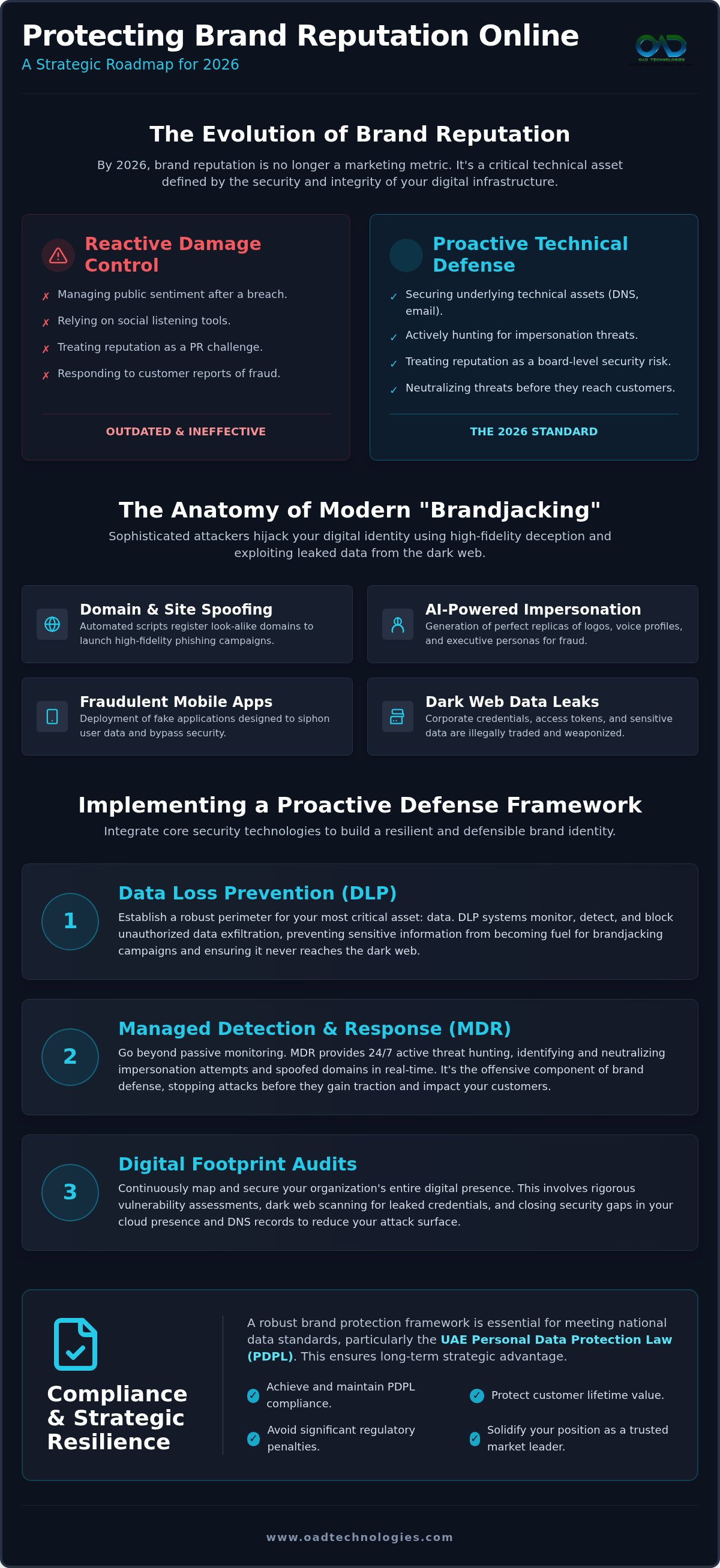
By 2026, the concept of brand reputation has moved far beyond the boundaries of marketing departments. It's now a technical composite of digital trust and infrastructure integrity. When customers interact with your brand, they aren't just engaging with your logo; they're trusting that your digital touchpoints are secure and authentic. Protecting brand reputation online now requires a fundamental shift in perspective. It's no longer enough to manage sentiment. You must secure the underlying assets that prove your brand is who it says it is.
Executive leadership must recognize that brand integrity is a board-level security risk. A single instance of site spoofing or a high-profile data breach creates an immediate trust deficit. This deficit isn't just a PR hurdle; it's a fundamental breakdown in the technical relationship between a business and its stakeholders. When infrastructure fails, the brand fails. Security failures don't just leak data; they broadcast a message of negligence that can take years to correct.
Beyond Social Listening: Brand Identity as Infrastructure
Traditional social listening tools track what people say, but they don't stop an attacker from weaponizing your brand. Enterprise-level protection requires moving toward digital asset protection. Your brand identity is now distributed across your DNS records, email authentication protocols, and cloud presence. These are the front lines of your reputation. If these technical pillars are weak, your brand is vulnerable to takeover.
Proactive threat hunting for brand impersonation is the new standard. Instead of waiting for a customer to report a fake app, security teams must actively monitor the dark web and rogue domain registrations. You're not just monitoring mentions; you're defending the technical pillars of your corporate identity. This proactive stance ensures that impersonation attempts are neutralized before they reach your audience.
The Escalating Cost of Reputational Breaches
The financial impact of a reputational breach is often far more severe than the immediate recovery costs. Trust erosion directly diminishes customer lifetime value. In a competitive market, users won't hesitate to switch to a competitor if they feel their data is at risk. This loss of loyalty has a compounding negative effect on long-term revenue and market position.
Beyond customer loss, regulatory penalties under the UAE Personal Data Protection Law (PDPL) add another layer of financial risk. A brand-damaging data leak can trigger significant fines and mandatory disclosure requirements that further amplify the damage. This makes protecting brand reputation online a matter of legal compliance as much as market trust. Reputational risk is the vulnerability of a company's standing due to technical failures that lead to unauthorized digital impersonation or data exposure. Addressing this risk requires a rigorous, security-first approach to brand management.
Technical Threats Targeting Corporate Brand Integrity
The digital threat landscape of 2026 is defined by high-fidelity deception. Attackers no longer rely on obvious scams; they use artificial intelligence to generate perfect replicas of corporate logos, voice profiles, and executive personas. This evolution has birthed "Brandjacking," a process where malicious actors hijack a company's digital identity to defraud customers or manipulate market perception. These threats manifest through domain spoofing, executive impersonation, and the deployment of fake mobile applications that siphon user data. In a decentralized digital economy, these fraudulent assets can spread across platforms in minutes, making protecting brand reputation online a race against automated scripts.
The dark web serves as the primary engine for these operations. It functions as an illicit marketplace where corporate credentials, internal access tokens, and sensitive employee data are traded like commodities. When these assets fall into the wrong hands, they provide the foundation for sophisticated attacks that bypass traditional perimeter defenses. Your corporate identity is only as secure as the credentials used to manage it. If an attacker gains access to your administrative consoles, they don't just steal data; they can dismantle your brand's authority from the inside out.
Domain Impersonation and Phishing Infrastructure
Typosquatting has reached new levels of technical sophistication. Attackers now use automated scripts to register dozens of look-alike domains that mimic your primary web presence with subtle character substitutions. These domains aren't just used for static landing pages; they form the backbone of Business Email Compromise (BEC) campaigns. By exploiting the deep trust your brand has built with stakeholders, attackers trick employees and partners into authorizing fraudulent transactions or sharing trade secrets.
Technical defenses are your primary line of resistance. Implementing and strictly enforcing DMARC, SPF, and DKIM protocols isn't just a technical exercise; it's a critical brand protection measure. These tools verify that your outgoing emails are authentic, preventing attackers from using your domain to launch phishing strikes. Organizations that neglect these gateways often find their legitimate communications flagged as spam, which erodes digital trust and disrupts operational performance.
Data Leaks and Intellectual Property Exposure
The weaponization of leaked internal documents poses a direct threat to corporate standing. When sensitive intellectual property or private communications are exposed, the resulting loss of market confidence can be catastrophic. These leaks often originate from uncontrolled data exposure, where internal assets are inadvertently pushed to public repositories or sold on dark web marketplaces. Once this data is public, the narrative is no longer under your control.
National enterprises must adopt proactive dark web monitoring to stay ahead of these threats. Identifying a leak before it becomes a public scandal allows for rapid mitigation and controlled response. This level of vigilance is a core component of specialized brand protection, ensuring that your strategic assets remain confidential. By moving beyond reactive PR, organizations can maintain the integrity of their vision and ensure long-term viability in an increasingly volatile digital market.
Integrating Security and Governance for Brand Resilience
Brand protection is not a peripheral activity managed by a communications team; it is the direct byproduct of a mature security stack. Relying on basic monitoring tools or keyword alerts leaves significant gaps that attackers exploit with ease. True resilience comes from a "Total Brand Defense" model, where your technical infrastructure and governance policies work in unison. By embedding security protocols into the very fabric of your digital presence, you ensure that protecting brand reputation online becomes an automated, high-fidelity operation rather than a series of reactive fire drills.
This integrated approach moves the focus from damage control to prevention. When your security tools are aware of your brand's digital footprint, they can identify anomalies that a human analyst might miss. This creates a feedback loop where technical intelligence informs your overall brand strategy. Aligning your security investments with your reputational goals ensures that every dirham spent on infrastructure also serves as an investment in corporate trust.
The Role of DLP in Reputation Management
Strategic leaks and unauthorized data exposure can dismantle market confidence overnight. Implementing data loss prevention (DLP) allows your organization to identify and secure sensitive assets before they cross your network perimeter. This technology prevents the public exposure of corporate strategies, board-level communications, and client data that, if leaked, would provide ammunition for competitors or extortionists. It's a critical layer of defense that keeps your internal narrative from becoming a public scandal.
Automation plays a critical role here. Modern DLP systems enforce granular policies that ensure digital assets remain within authorized environments. You don't have to rely on manual oversight to catch every potential slip; instead, the system recognizes sensitive patterns and blocks unauthorized transfers in real-time. Data loss prevention acts as a silent guardian for brand trust, ensuring that your most valuable intellectual property never becomes a public liability.
MDR: Real-Time Mitigation of Brand Abuse
While DLP secures the internal perimeter, managed detection and response (MDR) provides the external vigilance required to shut down impersonation attempts. Attackers move with incredible speed, often deploying fraudulent websites or rogue social media profiles during off-hours to maximize impact. Waiting for a manual report is a losing strategy. You need 24 X 7 monitoring that scans the global digital environment for assets that mimic your corporate identity, ensuring that protecting brand reputation online is a constant, unblinking process.
Effective brand defense relies on rapid takedown procedures. Once a fraudulent asset is detected, your MDR partner should initiate immediate mitigation steps to neutralize the threat. This process benefits from the synergy between high-speed automated detection and human intelligence. While AI can spot a look-alike domain in milliseconds, human experts provide the strategic oversight needed to navigate complex takedown legalities and ensure alignment with UAE national data protection standards. This integrated approach transforms your security posture into a formidable barrier against reputational threats.
Implementing a Proactive Brand Protection Strategy
Moving from theory to execution requires a structured roadmap. Protecting brand reputation online isn't a one-time project; it's a continuous lifecycle of assessment and refinement. You can't defend what you haven't mapped. The first step is always a comprehensive digital footprint audit. This identifies every domain, IP address, and social profile associated with your organization, including those abandoned by past marketing campaigns. Identifying these forgotten assets is critical to closing the gaps attackers love to exploit.
Once mapped, you must stress-test these assets. Implementing vulnerability assessment and penetration testing (VAPT) allows you to find leaked assets and security holes before they are weaponized. This technical rigor must be followed by automated monitoring for brand impersonation and a clear alignment with your governance risk and compliance (GRC) frameworks. Finally, establish a formal incident response plan. Speed is the only currency that matters during a reputational crisis.
Vulnerability Assessments: Identifying Reputational Weak Points
Shadow IT poses a significant threat to your brand. Forgotten marketing microsites or unsecured staging environments often serve as the entry point for attackers looking to host phishing pages. By using VAPT as a core component of your brand audit, you test the resilience of your external-facing applications against targeted strikes. This ensures that every digital touchpoint reflects your commitment to security and high-quality craftsmanship. It moves your defense from a generic perimeter check to a deep, asset-specific validation of your brand's integrity.
Governance and Compliance for Digital Assets
Your brand protection efforts must align with national regulations, specifically the UAE Personal Data Protection Law (PDPL). GRC frameworks provide the structure needed to maintain an authoritative digital presence while ensuring strict data privacy. This involves more than just software; it requires developing internal policies for executive digital hygiene. Securing personal social media profiles and professional accounts of leadership is essential, as these are frequent targets for impersonation. A well-designed governance strategy ensures that your organization meets its legal obligations while safeguarding its long-term vision.
Ready to secure your corporate identity against evolving threats? Partner with OAD Technologies to design a customized brand protection roadmap that bridges the gap between high-level innovation and practical business results.
Securing Your Vision: OAD Technologies’ Brand Protection Services
OAD Technologies acts as a master designer of systems, serving as the guardian of national corporate identity for enterprises that cannot afford a lapse in trust. We move beyond the traditional public relations model, treating brand integrity as a technical challenge that requires rigorous engineering. Our "Security-First" philosophy ensures that your organization doesn't just react to scandals but builds an infrastructure resilient enough to prevent them. By bridging the gap between high-level innovation and practical business results, we position your brand for long-term viability in a volatile digital market.
Choosing a local strategic partner provides a distinct advantage in understanding the national threat landscape. We ground our solutions in the specific regulatory requirements of the UAE, ensuring full alignment with the Personal Data Protection Law (PDPL). This local expertise allows us to identify and neutralize regional attack vectors that global, standardized software might overlook. Our approach emphasizes a deep collaboration, acting as an extension of your own team to ensure that protecting brand reputation online is woven into your core operational strategy.
Real-Time Threat Intelligence and Response
OAD leverages advanced Managed Detection and Response (MDR) capabilities to detect and dismantle brand threats before they reach your stakeholders. We don't rely on generic alerts. Instead, we provide customized threat feeds focused on national brand impersonation trends, identifying rogue assets with surgical precision. Our methodology relies on the synergy between human insight and technological capacity. While our automated systems scan the global digital environment 24 X 7, our specialized analysts provide the strategic context needed for rapid mitigation.
Proactive monitoring has saved national enterprises from major reputational fallout by identifying fraudulent infrastructure in its staging phase. When an attacker registers a look-alike domain or develops a fake app, our systems trigger an immediate response. This speed prevents the "Trust Deficit" discussed earlier, ensuring your digital presence remains authoritative and untarnished. We prioritize momentum and direct accountability, providing you with a clear roadmap for every incident we neutralize.
Customized Strategies for National Enterprise Resilience
We reject the industry's trend toward standardized, "one-size-fits-all" software. Your corporate identity is unique, and your defense architecture should reflect that. OAD designs bespoke security frameworks that integrate seamlessly with your existing Identity and Access Management (IAM) and Security Information and Event Management (SIEM) systems. This creates a unified security posture where brand protection isn't a siloed activity but a fundamental component of your digital evolution.
Our commitment to precision and high-quality craftsmanship ensures that your security stack supports your business goals rather than hindering them. We focus on investment returns and operational performance, grounding every technical choice in its ability to protect your strategic expansion. It's time to move beyond reactive PR and secure your vision with a partner that values your ongoing digital relevance. Protect your brand with OAD Technologies and ensure your corporate identity remains a trusted asset in 2026 and beyond.
Securing Your Corporate Legacy in a Decentralized Economy
The transition to 2026 requires a fundamental shift in how you view your digital presence. Brand integrity is no longer a marketing concern; it's a technical asset that demands a robust security stack. By moving from reactive PR to a model that integrates MDR and DLP, you create a resilient barrier against domain spoofing and AI-driven impersonation. Protecting brand reputation online is the foundation of long-term viability for any national enterprise.
OAD Technologies acts as your strategic partner, providing a specialized MSSP approach to national enterprise security. We bridge the gap between high-level innovation and practical results through sophisticated MDR and brand protection synergy. Our expertise in GRC ensures your organization maintains strict PDPL compliance while scaling its digital footprint. It's time to move beyond quick fixes and invest in a framework designed for the future.
Secure your corporate identity with OAD Technologies today. Your digital trust is your most valuable asset, and we're here to help you defend it with precision and craftsmanship.
Frequently Asked Questions
What is the difference between brand monitoring and brand protection?
Brand monitoring focuses on tracking mentions and sentiment across digital platforms, while brand protection involves the technical defense of your infrastructure. Monitoring is often a reactive communications task, but protection is a proactive cybersecurity discipline. It uses tools like Managed Detection and Response (MDR) to neutralize domain spoofing and fraudulent assets before they reach your audience. True protection ensures the technical pillars of your corporate identity remain uncompromised.
How does a data breach affect online brand reputation in the long term?
A data breach triggers a long term trust deficit that erodes customer loyalty and market confidence. Beyond immediate recovery costs, trust erosion directly diminishes customer lifetime value as users switch to more secure competitors. In the UAE, the resulting mandatory disclosures under the Personal Data Protection Law (PDPL) can amplify public fallout. Organizations often find that repairing a damaged reputation takes significantly longer than fixing the underlying technical vulnerability.
Can Data Loss Prevention (DLP) really prevent reputational damage?
Data Loss Prevention (DLP) prevents reputational damage by securing sensitive assets before they leave your network perimeter. By identifying and blocking the unauthorized transfer of corporate strategies or client data, DLP ensures your internal information doesn't become a public scandal. It acts as a silent guardian for brand trust, automating policy enforcement so that human error doesn't lead to high profile leaks that compromise your organization's standing.
What are the first steps to take if my brand is being impersonated online?
If you discover digital impersonation, the first step is to identify the scope of the fraudulent assets through a digital footprint audit. You should immediately initiate takedown procedures through your MDR partner to neutralize rogue domains or fake social profiles. Simultaneously, notify your legal and communications teams to manage stakeholder expectations. Proactively protecting brand reputation online requires a rapid technical response to minimize the window of opportunity for attackers.
How does national data protection law impact brand reputation management?
National data protection laws, such as the UAE Personal Data Protection Law (PDPL), mandate strict security standards for handling sensitive information. Non compliance doesn't just result in financial penalties; it leads to public disclosure requirements that can severely damage your corporate standing. Effective brand management now requires a GRC framework that ensures your security posture meets these legal obligations. This alignment demonstrates your commitment to data integrity and builds long term stakeholder trust.
Is brand protection a marketing or a cybersecurity responsibility?
Brand protection is primarily a cybersecurity responsibility because it depends on the integrity of your technical infrastructure. While marketing manages the brand's voice, security teams defend the DNS records, email protocols, and cloud assets that prove authenticity. Infrastructure failures, like site spoofing, are technical vulnerabilities that require technical solutions. A collaborative approach is best, but the board must view brand integrity as a core component of the organization's security posture.
What role does the dark web play in brand reputation threats?
The dark web serves as an illicit marketplace where attackers trade corporate credentials and leaked internal data. These stolen assets are used to build high fidelity impersonation campaigns and bypass traditional security perimeters. By monitoring these hidden forums, organizations can identify compromised data before it's weaponized against their reputation. Proactive dark web intelligence is a standard requirement for national enterprises aiming to maintain a secure and authoritative digital presence.
How often should an enterprise conduct a brand security audit?
Enterprises should conduct a deep brand security audit at least annually, or whenever there are significant changes to their digital infrastructure. However, the evolving threat landscape of 2026 makes continuous automated monitoring essential for real time defense. Regular Vulnerability Assessment and Penetration Testing (VAPT) helps identify shadow IT and forgotten digital assets that could be exploited. Maintaining a consistent audit cycle ensures your brand protection strategy evolves alongside emerging cyber threats.
Disclaimer
Content by OAD Technologies is for general informational purposes only and does not constitute professional or cybersecurity advice. No warranties are made regarding accuracy or completeness; reliance is at your own risk. OAD Technologies shall not be liable for any direct or indirect losses arising from use of this content.