

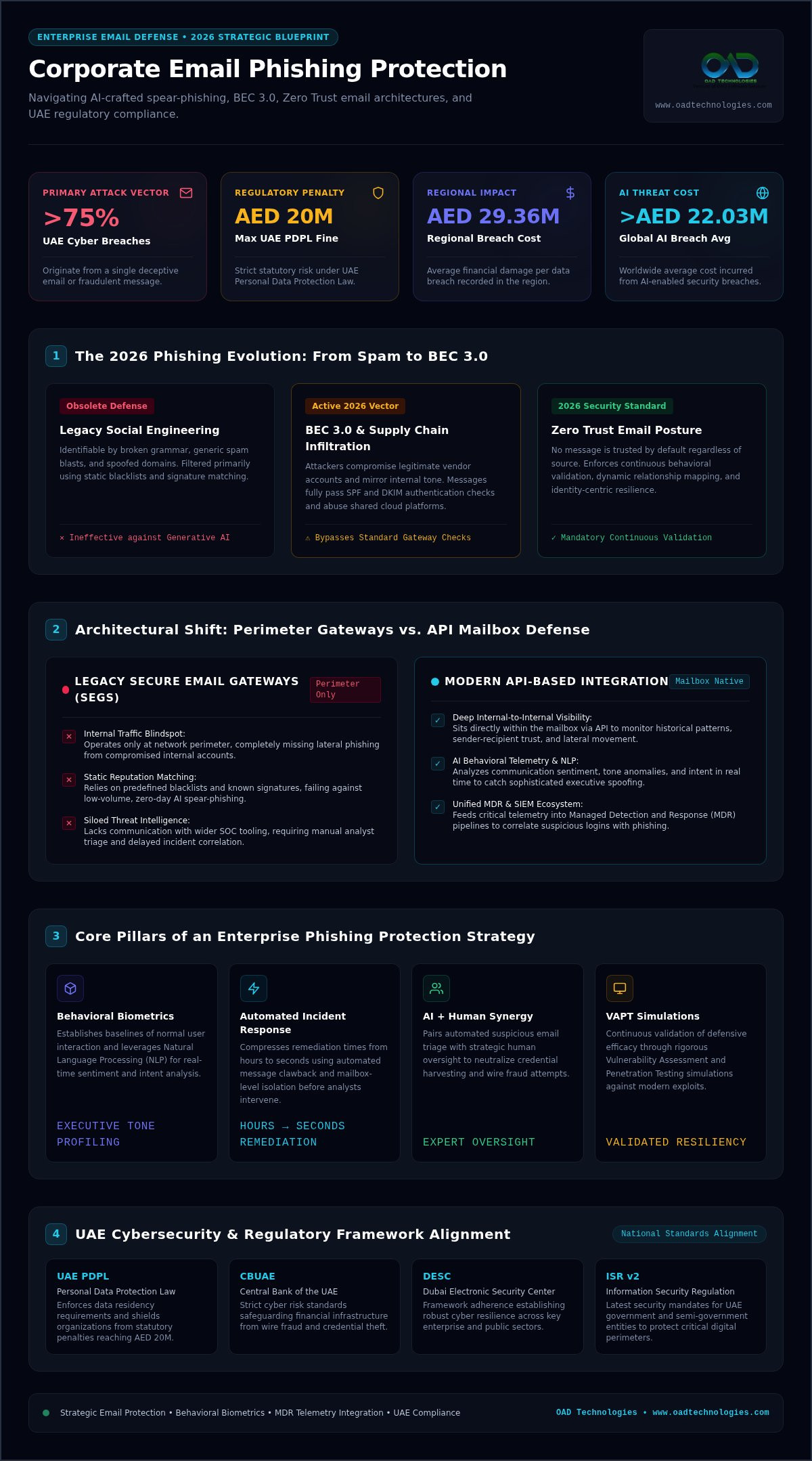
Over 75% of all cyber breaches across the UAE now originate from a single, deceptive email or fraudulent message. You've likely seen your inbox defenses struggle as AI-generated spear-phishing becomes indistinguishable from legitimate business correspondence. It's frustrating when siloed security tools fail to communicate, leaving your team to piece together a fragmented threat landscape. This makes selecting the right corporate email phishing protection more than a technical choice; it's a critical compliance move, especially when facing potential penalties of up to AED 20 million under the UAE Personal Data Protection Law (PDPL).
This guide will help you move beyond basic filters to implement a strategy that balances AI-driven telemetry with strategic human oversight. We'll examine the technical criteria for 2026, from mandatory DMARC enforcement to the integration of email feeds into your wider Managed Detection and Response (MDR) architecture. By the end, you'll have a clear roadmap for selecting a solution that doesn't just block spam, but actively secures your organization's digital future while aligning with national cybersecurity standards like those from the CBUAE and DESC.
Key Takeaways
- Learn how to evolve your defense from legacy pattern matching to behavioral biometrics to counter the surge of hyper-realistic, AI-crafted spear-phishing attacks.
- Evaluate corporate email phishing protection as a strategic integration point that feeds critical telemetry into your broader MDR and SIEM ecosystems for a unified threat view.
- Ensure your email security architecture aligns with UAE-specific regulations, including PDPL data residency requirements and the latest ISR v2 standards for government and semi-government entities.
- Discover how to compress remediation times from hours to seconds by implementing automated incident response and validating your defensive efficacy through VAPT simulations.
- Understand the long-term value of a customized security framework that synergizes high-speed AI detection with expert human oversight to eliminate credential harvesting risks.
The 2026 Phishing Landscape: Beyond Legacy Filtering
The era of identifying a malicious email by its broken grammar or suspicious sender address has ended. In 2026, generative AI has perfected the art of the "perfectly legitimate" email, allowing attackers to mirror the specific tone and context of your internal communications with terrifying accuracy. These aren't just bulk spam campaigns. They're low-volume, high-precision strikes designed to bypass standard reputation checks. Modern corporate email phishing protection must evolve into a multi-layered behavioral analysis system that looks beyond the digital envelope to understand the true intent of every interaction.
The Evolution of Social Engineering
We've entered the stage of BEC 3.0. Attackers no longer rely solely on spoofed domains; they compromise legitimate accounts within your supply chain to launch attacks from trusted sources. These compromised accounts pass SPF and DKIM checks perfectly, making them invisible to native cloud security filters. By studying various phishing attack techniques, we see a clear shift toward exploiting trusted third-party cloud services like shared document platforms to host malicious payloads. Zero Trust Email is the 2026 standard, defined as a security posture where no message is trusted by default, regardless of its source, requiring continuous validation of identity and behavioral intent.
Why Legacy Secure Email Gateways (SEGs) Are Failing
Legacy SEGs were built for a world of static blacklists and signature-based detection. They operate at the perimeter, which creates a massive blind spot for internal-to-internal email traffic. If an employee's account is compromised, a legacy gateway won't see the lateral movement as the attacker phishes other departments from within the "trusted" network. Modern solutions utilize API-based integration to sit directly inside the mailbox environment. This provides deep visibility into historical communication patterns and allows for real-time post-delivery remediation that legacy systems simply can't match.
Instead of relying on a rigid perimeter, UAE enterprises are shifting toward identity-centric resilience. This approach recognizes that the user's identity is the new boundary. By integrating email telemetry with Managed Detection and Response (MDR), organizations can correlate a suspicious login with a subsequent spear-phishing attempt. This synergy is essential for maintaining compliance with UAE Personal Data Protection Law (PDPL) and protecting against the AED 29.36 million average cost of a regional data breach. It's about building a system that doesn't just block emails, but understands the relationship between every sender and recipient.
Core Pillars of an Enterprise-Grade Phishing Protection Strategy
Effective corporate email phishing protection in 2026 requires a shift from static filters to a dynamic, intelligence-led architecture. We no longer define security by what we block, but by how accurately we analyze behavior. High-performance systems now utilize behavioral biometrics to establish a baseline of "normal" communication for every user. This allows the system to detect subtle anomalies that traditional tools miss, such as a sudden shift in an executive's phrasing or an unusual request for a wire transfer from a long-term vendor.
Speed defines resilience. Automated incident response has become a non-negotiable pillar, reducing the "Time to Remediate" from hours to mere seconds. When an AI-enabled breach occurs, which now costs organizations an average of over AED 22.03 million globally, automated clawback and mailbox-level isolation prevent lateral movement before a human analyst even sees the alert. This proactive stance is essential for maintaining operational continuity across the UAE's high-stakes financial and technology sectors.
AI-Driven Behavioral Telemetry
Modern engines leverage Natural Language Processing (NLP) to perform real-time sentiment and intent analysis. They don't just scan for malicious links; they evaluate the tone of executive communications to identify sophisticated impersonation attempts. This AI-driven telemetry automates the classification of reported suspicious emails, freeing your SOC team to focus on high-level strategic defense rather than manual triage. By analyzing communication patterns, these tools can flag "unusual" requests even when they originate from known, authenticated contacts.
Authentication and Brand Protection
Foundational protocols remain essential. Following the NIST trustworthy email guidelines ensures that SPF, DKIM, and DMARC are properly enforced across your domain. However, 2026 leaders go further by implementing BIMI (Brand Indicators for Message Identification) to build instant visual trust in the inbox. This works alongside automated monitoring for look-alike domains to stop brand impersonation before it reaches your clients, protecting your reputation in a competitive market.
Strategic integration ties these pillars together. By connecting email telemetry with Identity and Access Management (IAM), organizations can generate continuous user risk scores. If an account shows signs of compromise, the system can automatically trigger stepped-up authentication. Similarly, aligning email security with Data Loss Prevention (DLP) policies ensures that sensitive UAE data never leaves your perimeter through unauthorized channels. If you're looking to modernize your stack, you can consult with our integration specialists to design a customized defense.
Integrated vs. Siloed Security: The Strategic Advantage
Security sprawl has become a significant liability for the modern enterprise. When organizations deploy disconnected tools that don't share telemetry, they create blind spots that attackers are eager to exploit. In 2026, corporate email phishing protection cannot exist as a standalone silo. It must function as a core intelligence feed that enriches your entire security ecosystem, providing the cross-vector visibility needed to correlate a suspicious email with unusual endpoint activity or cloud access requests.
By integrating email data into your SIEM, you empower your SOC to detect lateral movement more effectively. This centralized approach aligns with the CISA phishing defense guidance, which emphasizes disrupting the attack cycle at its earliest phase. When your email security platform communicates directly with your endpoint and cloud sensors, you gain a unified view of the threat landscape that reduces the risk of a successful credential harvesting incident.
Email as a Primary Signal for MDR
Statistics consistently show that roughly 90% of cyberattacks begin with a single email. This makes your email security platform the most critical sensor in your Managed Detection and Response (MDR) architecture. While AI handles high-volume threats, expert human analysts are essential for filtering out AI-generated false positives that can overwhelm automated systems. A proactive 24 X 7 threat hunting model uses email indicators to identify emerging patterns, allowing for rapid intervention before a breach escalates into a multi-million dirham disaster.
Closing the Loop with VAPT
A sophisticated defense requires constant validation. We recommend using Vulnerability Assessment and Penetration Testing (VAPT) to simulate advanced phishing campaigns. This process identifies technical misconfigurations, such as weak DMARC policies or improperly tuned filters, that allow spoofed messages to reach the inbox. By measuring your "Mean Time to Detect" (MTTD) during these simulations, you can refine your stack to ensure it meets the rigorous standards required by the UAE Cyber Security Council and national data protection regulations.
Buying Framework: Selecting the Right Solution for UAE Enterprises
Selecting corporate email phishing protection in 2026 requires a shift from evaluating isolated features to assessing total ecosystem compatibility. UAE enterprises must prioritize infrastructure that offers deep visibility without compromising performance. While legacy gateway-based models still exist, cloud-native API-based deployment has become the preferred standard for organizations using Microsoft 365 or Google Workspace. These models allow for the inspection of internal-to-internal communications, which is critical for identifying compromised accounts that have already bypassed the perimeter.
Total Cost of Ownership (TCO) extends far beyond the initial license fee. You must factor in the management overhead required to tune filters and the time your team spends on incident response. With the average cost of a data breach in the Middle East reaching AED 29.36 million in 2026, a solution that reduces remediation time from hours to seconds provides a clear return on investment. Choosing a national strategic partner ensures that your defense is supported by local expertise that understands the specific threat patterns targeting the region's financial and energy sectors.
Compliance and GRC Integration
Email security is no longer just an IT function; it's a core component of your Governance Risk and Compliance (GRC) strategy. To meet the requirements of the UAE Personal Data Protection Law (PDPL), your solution must ensure that sensitive payload data resides within national borders. Stringent logging and reporting are also mandatory for entities governed by the Dubai Electronic Security Centre (DESC) and its Information Security Regulation (ISR). High-performance platforms automate these reporting requirements, providing the audit trails necessary to prove compliance during national security reviews.
Evaluation Checklist for CISOs
When drafting your requirements, focus on operational agility. A modern solution must provide retrospective clawback, allowing you to pull malicious emails from all user mailboxes even after delivery. Operationally, the tool should integrate seamlessly with your existing EDR and SIEM platforms to provide a unified telemetry feed. Every 2026 RFP must prioritize 'human-in-the-loop' capabilities to ensure that automated AI responses are validated by expert threat hunters who understand the local context. If you are ready to evaluate your current posture against these standards, consult with our UAE-based security architects to design a resilient architecture.
Fortifying the Human and Digital Perimeter with OAD Technologies
OAD Technologies rejects the standardized, "one-size-fits-all" security model. We believe your defense should reflect your specific operational reality; not a generic template. Our approach to corporate email phishing protection centers on building highly customized architectures that integrate directly into our national MDR and SIEM operations. By positioning email as a primary intelligence feed, we ensure that every suspicious interaction is correlated with broader network telemetry, providing the unified visibility necessary for 2026 threat landscapes.
We focus on the essential synergy between high-speed AI capacity and expert human insight. While our automated engines process millions of data points to identify malicious QR codes or AiTM proxies, our analysts provide the strategic oversight required to neutralize sophisticated social engineering. This proactive mindset transforms your security posture from a reactive filter into a solution-oriented management system. We act as guardians of your digital relevance, ensuring your organization remains resilient as phishing tactics evolve.
Customized Integration Services
Every industry faces a unique risk profile. A financial institution in the UAE deals with different impersonation threats than a government entity or a healthcare provider. We design an email security stack tailored to these specific pressures, ensuring full alignment with national GRC requirements. Our team manages the seamless migration from legacy SEGs to modern, API-driven architectures, eliminating the blind spots associated with older gateway models. This ongoing strategic partnership ensures your defenses stay ahead of attackers who use generative AI to craft hyper-personalized deception.
Taking the Next Step in Enterprise Resilience
Hardening your email perimeter starts with a rigorous technical assessment. This process identifies existing gaps in your authentication protocols and evaluates how well your current tools communicate with each other. OAD Technologies acts as a true extension of your internal security team, providing the engineering standards and problem-solving passion needed for long-term success. We don't just provide a service; we build a roadmap for your ongoing digital viability. To begin your journey toward a unified defense, you should consult with OAD Technologies for a strategic email security assessment.
Securing Your Organization's Digital Future
The 2026 threat landscape demands more than just a reactive filter; it requires a unified architecture that bridges technical innovation and human expertise. Modern corporate email phishing protection has evolved into a proactive sensor that feeds your entire security ecosystem. By prioritizing behavioral biometrics and automated remediation, your organization can effectively neutralize AI-enabled attacks while maintaining strict alignment with UAE PDPL and national ISR standards. This integration isn't just a technical upgrade; it's a strategic necessity for regional resilience.
OAD Technologies stands as a specialized system integrator, ready to transform your email security from a siloed tool into a critical strategic asset. Our proactive 24 X 7 Managed Detection and Response (MDR) ensures that your perimeter is guarded by experts who understand the specific nuances of the regional market. We don't just provide software; we deliver a roadmap for long-term viability and operational excellence. We act as an extension of your own team to ensure your digital assets remain protected against even the most sophisticated social engineering.
It's time to move beyond standardized approaches and build a defense that grows with your business. Secure your enterprise perimeter with OAD Technologies' Email Security Solutions and gain the confidence to innovate in an increasingly complex digital world. Your journey toward a hardened, compliant, and integrated future starts today.
Frequently Asked Questions
Is native security in Microsoft 365 or Google Workspace enough for phishing protection in 2026?
Native security provides a foundational layer but often fails against highly targeted, AI-driven attacks that bypass standard filters. In 2026, attackers use compromised legitimate accounts to circumvent reputation-based checks. Specialized corporate email phishing protection adds a behavioral layer that analyzes the intent behind communications. This integration is essential for UAE enterprises to close the gaps left by standard cloud providers and ensure resilience against sophisticated social engineering.
How does AI-driven phishing protection differ from traditional email filtering?
Traditional filtering relies on static blacklists and known malicious signatures. AI-driven protection uses behavioral biometrics and Natural Language Processing (NLP) to establish communication baselines for every user. It detects anomalies in tone, phrasing, and request types that indicate a potential threat. This shift from pattern matching to intent analysis allows organizations to stop zero-day attacks and hyper-personalized phishing that don't contain traditional red flag indicators.
What are the specific UAE compliance requirements for corporate email security?
UAE enterprises must align with the Personal Data Protection Law (PDPL), which emphasizes data residency and sovereignty for sensitive communications. Additionally, entities governed by the Dubai Electronic Security Centre must adhere to Information Security Regulation (ISR) v2 standards for logging and auditability. Financial institutions also face mandates from the CBUAE to conduct digital impersonation risk assessments, requiring technical controls that prevent brand spoofing and unauthorized data exfiltration.
Can a phishing protection solution prevent Business Email Compromise (BEC)?
Modern solutions significantly reduce the risk of Business Email Compromise (BEC) by analyzing the metadata and context of every message. By establishing identity-centric baselines, the system flags unusual requests for wire transfers or sensitive data, even if the email originates from a trusted contact's account. Integrating email security with Identity and Access Management (IAM) further hardens your perimeter by requiring stepped-up authentication when behavioral anomalies are detected.
How does email security integrate with a Managed Detection and Response (MDR) service?
Email security acts as a critical sensor for a Managed Detection and Response (MDR) service. Telemetry from blocked phishing attempts and suspicious mailbox behavior feeds directly into the SOC. This allows expert human analysts to correlate email alerts with endpoint and network data to identify broader attack campaigns. This synergy ensures that a single phishing click doesn't escalate into a full-scale breach, providing a unified view of the threat landscape.
What is the role of DMARC and SPF in modern phishing defense?
SPF and DMARC are foundational authentication protocols that verify a sender's authorization to use a specific domain. In 2026, strict DMARC enforcement at the reject level is a prerequisite for email deliverability and brand protection. These protocols prevent direct domain spoofing, ensuring that your corporate identity isn't used to launch attacks against your partners or clients. They form the first line of defense in a multi-layered security architecture.
How often should we conduct phishing simulations and VAPT for our email systems?
We recommend conducting automated phishing simulations continuously to maintain high user awareness levels. For the underlying infrastructure, Vulnerability Assessment and Penetration Testing (VAPT) should occur at least bi-annually or after any major system configuration. This ensures that your technical controls are effectively blocking sophisticated payloads and that your Mean Time to Detect remains within acceptable thresholds for UAE national security standards and compliance requirements.
What happens to our data privacy when an email security tool scans our communications?
Modern security tools prioritize privacy by utilizing metadata analysis and sandboxing rather than storing full message contents. For UAE organizations, it's vital to ensure your provider complies with PDPL by keeping data within local cloud zones. Encryption and role-based access controls ensure that only authorized security personnel can review flagged communications. This approach protects your intellectual property while providing the deep inspection needed to stop credential harvesting and data loss.
Disclaimer
Content by OAD Technologies is for general informational purposes only and does not constitute professional or cybersecurity advice. No warranties are made regarding accuracy or completeness; reliance is at your own risk. OAD Technologies shall not be liable for any direct or indirect losses arising from use of this content.