

Building an internal security operations center has become an expensive operational distraction rather than a hallmark of enterprise resilience. Covering a single monitoring seat around the clock mathematically demands at least five full-time analysts. When paired with relentless alert fatigue and steep recruitment overhead, maintaining an internal desk quickly drains critical engineering bandwidth. For enterprise leaders evaluating viable alternatives to building an in-house soc, the primary objective isn't merely curbing expenditure; it's establishing decisive, continuous threat containment.
You already know how demanding it is to balance round-the-clock monitoring and analyst retention against rigorous national compliance mandates and protracted tool deployments. Retaining specialized talent while managing complex telemetry shouldn't stall your broader digital initiatives or leave critical assets vulnerable to sophisticated intrusions.
This strategic guide examines the most effective operational models designed to replace or augment an internal security facility without compromising regulatory standing or response velocity. We analyze turnkey Managed Detection and Response (MDR), SOC-as-a-Service, and collaborative co-managed architectures to help you deploy the optimal defensive posture for 2026.
Key Takeaways
- Explore strategic alternatives to building an in-house soc that eliminate multi-tier staffing overhead while delivering active containment.
- Compare operational capabilities across Managed Detection and Response (MDR), SOC-as-a-Service, and co-managed architectures to identify your optimal fit.
- Apply a structured evaluation matrix to align telemetry ingestion across cloud, endpoint, and identity layers with national compliance standards.
- Overcome organizational context barriers through collaborative runbooks and mutual escalation rules that preserve governance and internal control.
- Implement a phased five-stage migration plan that systematically shifts asset discovery and continuous monitoring without operational downtime.
The True Cost and Operational Limits of Building an In-House SOC
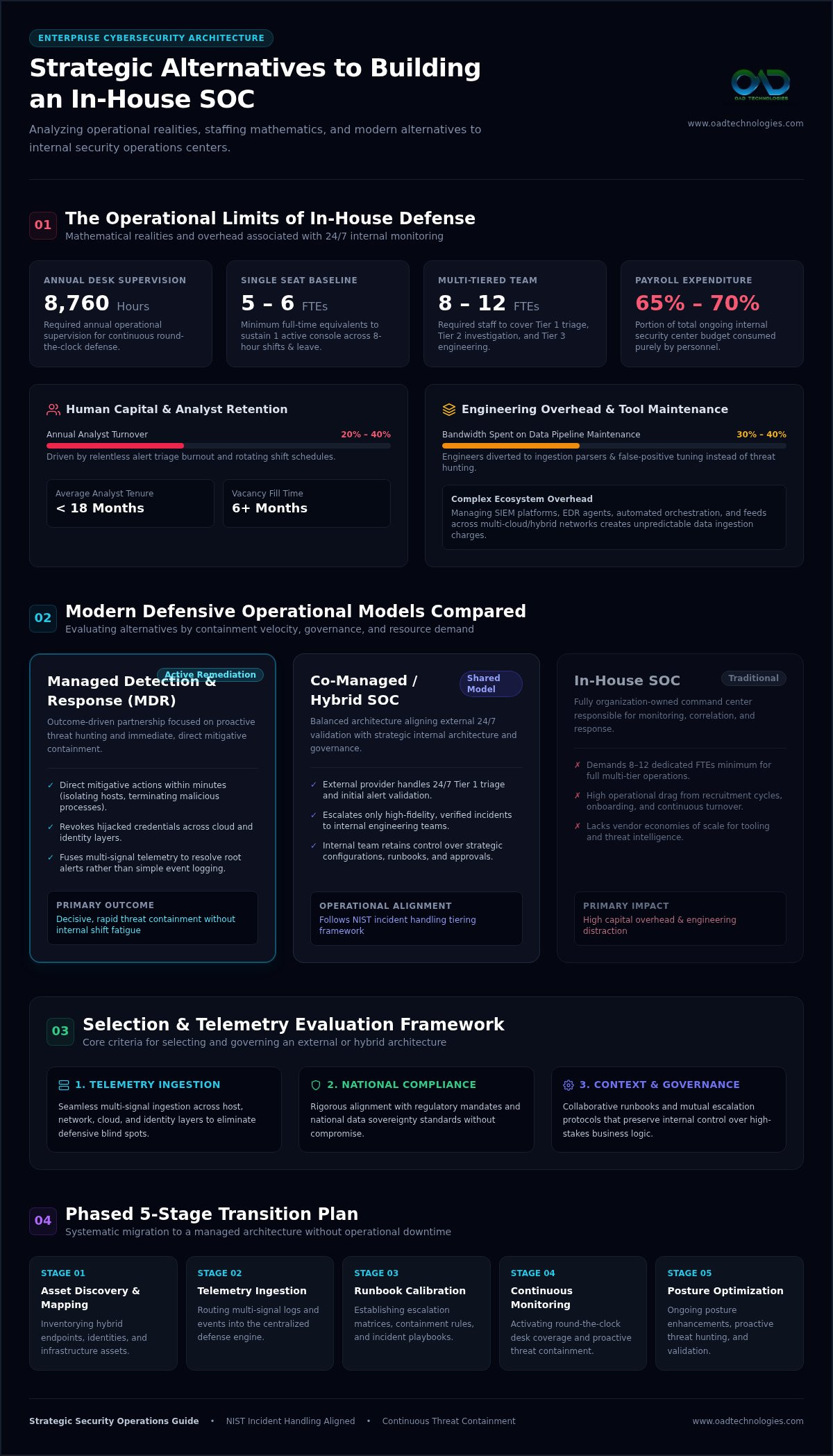
An in-house Security Operations Center (SOC) functions as an organization-owned, centralized facility responsible for 24 X 7 threat monitoring, correlation, and response across the enterprise perimeter. While direct architectural control is appealing, the operational friction of staffing an internal command center often proves overwhelming. Maintaining continuous coverage requires 8,760 hours of annual desk supervision. Once you account for rotating eight-hour shifts, training, and statutory leave, sustaining a single active console requires five to six full-time equivalents (FTEs). Expanding that foundation to support multi-tiered operations, spanning Tier 1 triage, Tier 2 investigation, and Tier 3 engineering, elevates the mathematical minimum to 8 to 12 dedicated personnel. This heavy baseline drives many organizations to evaluate structured alternatives to building an in-house soc.
Human Capital, Analyst Burnout, and the 24 X 7 Staffing Trap
Personnel costs account for 65% to 70% of an internal security center's ongoing expenditure. Even with substantial payroll allocations, retention remains fragile. Repetitive alert triage and demanding shift cycles accelerate burnout, driving annual analyst turnover between 20% and 40%, with average tenures rarely surpassing 18 months. Because filling a mid-level security vacancy routinely takes upwards of six months, internal teams spend excessive cycles onboarding replacements rather than advancing detection posture.
The Technology Stack: Capital Outlays and Ongoing Optimization
Beyond payroll, modern defense requires an intricate software ecosystem combining SIEM platforms, EDR agents, automated orchestration, and specialized threat intelligence feeds. As corporate networks expand across multi-cloud and hybrid environments, data ingestion charges grow unpredictably. In-house engineers often dedicate 30% to 40% of their bandwidth solely to data pipeline maintenance, writing ingestion parsers, and suppressing false positives. Without the economies of scale offered by experienced managed security service providers, internal teams quickly become burdened by administrative tool maintenance rather than proactive threat hunting.
Core Alternatives to Building an In-House SOC: Models Compared
Selecting an effective operational model requires moving beyond binary build-versus-buy arguments. Today's cybersecurity landscape offers distinct operational frameworks tailored to varying levels of internal capacity and regulatory stringency. Rather than treating security operations as an all-or-nothing capital initiative, modern enterprises evaluate distinct alternatives to building an in-house soc based on containment velocity, visibility retention, and contractual service level agreements.
Managed Detection and Response (MDR)
Modern managed detection and response (MDR) delivers an outcome-driven partnership centered on proactive threat hunting and active remediation. Unlike legacy monitoring services that simply dispatch email notifications when thresholds trigger, MDR analysts take direct mitigative action. They isolate compromised endpoints, revoke hijacked credentials, and terminate malicious processes across cloud and host layers within minutes. By fusing multi-signal telemetry, an MDR model resolves alerts at their root rather than merely logging anomalous events.
Co-Managed SOC and Hybrid Operating Frameworks
Co-managed architectures provide an ideal path for organizations wanting to maintain internal oversight while eliminating the strain of continuous shift coverage. Under this shared security model, an external provider handles 24 X 7 Tier 1 triage and initial alert validation, escalating only high-fidelity, verified incidents to internal teams. This aligns cleanly with the operational tiering outlined in the NIST incident handling framework. Your internal team retains control over strategic architecture, proprietary configurations, and business-specific approvals without enduring the exhausting burden of off-hours shift rotations.
SOC-as-a-Service (SOCaaS) vs. Traditional MSSPs
Understanding the distinction between traditional MSSPs and cloud-native SOC-as-a-Service is critical when sizing operational models:
- Traditional MSSPs: Primarily manage perimeter firewalls, network appliances, and log forwarding. They tend to forward voluminous, contextual-thin tickets that shift the investigative workload back onto internal engineers.
- SOC-as-a-Service: Provides turnkey access to cloud-native SIEM analytics, custom detection engineering, and compliance reporting without the capital outlays of private infrastructure hosting.
While SOCaaS offers broad visibility across distributed networks, organizations seeking hands-on threat disruption often combine it with managed containment. Identifying the right model among these alternatives to building an in-house soc starts with matching internal technical capacity to required defense speed; exploring tailored enterprise cyber defense solutions ensures your operations achieve immediate resilience without overhead bloat.
Evaluating SOC Alternatives: Strategic Framework and Selection Matrix
Choosing between external delivery models requires an objective evaluation methodology. Rather than focusing solely on commercial terms, leadership teams must rigorously assess how well each provider integrates across multi-cloud footprints, hybrid infrastructure, and identity governance controls. A mature provider should ingest telemetry from diverse data sources, correlate discrete events across endpoints, and differentiate between routine administrative workflows and malicious activity. When assessing alternatives to building an in-house soc, the primary consideration should be whether the provider offers genuine investigative depth or merely passes raw alerts through automated ticketing scripts.
To structure this comparison, evaluate candidate partners against four foundational operational pillars:
- Telemetry Ingestion Depth: Native integration across cloud workloads, SaaS productivity suites, on-premises networks, and identity stores like Microsoft Entra ID.
- Containment Capabilities: Verified execution of active mitigative actions, such as network isolation and token invalidation, backed by pre-authorized protocols.
- Operational Resiliency: Proven shift distribution, robust analyst retention, and compliance with the CISA cybersecurity advisory for managed service providers regarding supply-chain hygiene.
- Architectural Sovereignty: Unrestricted access to raw event logs, custom parsing rules, and full export capabilities without vendor lock-in.
Threat Coverage and Incident Response SLAs
Service Level Agreements must prioritize active remediation speed over passive notification times. Contractual terms need to define explicit ceilings for Mean Time to Detect (MTTD) and Mean Time to Respond (MTTR), guaranteeing live containment within critical initial minutes. Clear rules of engagement (RoE) should delineate which systems permit automated isolation, such as remote workstations, versus critical production servers that require joint escalation. The partner should track emerging regional adversary groups actively, feeding current indicator feeds into custom detection engineering.
Data Sovereignty, Governance, and Regulatory Alignment
In highly regulated markets like the United Arab Emirates, external monitoring architectures must strictly comply with national data sovereignty regulations and sector-specific financial mandates. Ensure log retention pipelines store telemetry within approved jurisdictional borders and provide immutable evidentiary chains for compliance audits. Aligning operational monitoring with your broader governance, risk, and compliance (GRC) strategy guarantees that continuous threat hunting strengthens your regulatory standing rather than introducing unvetted data exposures.
Evaluating alternatives to building an in-house soc against these criteria ensures your organization secures a strategic engineering partner that expands capability without introducing governance friction.
Overcoming Operational Hesitations: Context, Control, and Transition
The most persistent reservation security leaders face when exploring external defense models centers on business context. Engineering executives often fear that external analysts won't understand internal operational workflows, mistaking legitimate developer activity for live adversary behavior. This fear is understandable, but modern service architectures eliminate the context deficit through systematic environmental mapping and codified operational governance. Adopting viable alternatives to building an in-house soc doesn't mean yielding control; it means establishing collaborative frameworks where external expertise operates with the exact precision of an internal team.
Bridging the Tribal Knowledge and Environmental Context Gap
Contextual alignment starts during onboarding through explicit discovery protocols. Rather than simply ingesting logs, engineering teams collaborate to document crown-jewel data stores, critical business applications, and privileged administrative workflows. Establishing tailored alert-tuning baselines ensures third-party detection rules account for proprietary software nuances. Regular joint operational cadence meetings between internal architects and partner leads bridge the gap between organizational change and threat monitoring, ensuring operational awareness stays current.
Maintaining Total Visibility Without Tool Overhead
Delegating monitoring never requires relinquishing architectural transparency. Enterprise-grade models maintain comprehensive operational visibility through dedicated oversight mechanisms:
- Real-Time Telemetry Portals: Internal engineers retain continuous, direct access to active dashboards, investigative queries, and raw log feeds.
- Granular Forensic Trails: Every triage assessment, isolation trigger, and credential reset is immutably documented for internal auditing.
- Synchronized Incident ChatOps: Bi-directional integrations with enterprise platforms like Microsoft Teams or Slack allow analysts to coordinate investigations alongside internal responders in real time.
True operational resilience also requires continuous validation. Coupling ongoing threat monitoring with regular vulnerability assessments and penetration testing (VAPT) proactively stresses detection thresholds against authentic adversary attack chains. Evaluating alternatives to building an in-house soc gives your organization access to elite telemetry correlation while preserving institutional sovereignty. To see how these operational safeguards reinforce your enterprise defense, consult with our cybersecurity specialists to construct a tailored operational roadmap.
Migrating to a Managed Security Architecture: Roadmap and Next Steps
Decommissioning manual monitoring in favor of external operational models requires disciplined execution. Organizations cannot simply toggle a switch; they need a structured transition that avoids detection gaps during cutover. By systematically mapping network perimeters, establishing granular authorization limits, and validating response velocity before going live, enterprises can operationalize alternatives to building an in-house soc without exposing day-to-day business operations to unnecessary risk.
The Phased Transition Lifecycle: From Assessment to Live Defense
A successful transition follows an orderly lifecycle across distinct engineering milestones:
- Phase 1: Discovery and Architecture Scoping. Audit current asset inventories, catalog existing log pipelines across hybrid infrastructure, and map out critical identity stores.
- Phase 2: Sensor Deployment and Telemetry Ingestion. Roll out modern endpoint sensors, establish secure API connectors to cloud workloads, and verify continuous ingestion into the centralized analytics engine.
- Phase 3: Playbook Engineering and Authority Matrix. Codify customized response playbooks, setting precise thresholds for delegated automated actions versus mandatory escalation procedures.
- Phase 4: Simulated Adversary Validation. Conduct controlled adversary emulations and tabletop scenarios to confirm communication pathways, telemetry fidelity, and real containment speed.
- Phase 5: Full Operational Handshake. Decommission legacy manual ticketing and establish continuous 24 X 7 co-managed or turnkey threat coverage.
Achieving Strategic Security Maturity with OAD Technologies
Building internal operations from scratch binds organizational bandwidth to constant hiring, training, and maintenance cycles. OAD Technologies delivers an outcome-driven alternative, uniting Managed Detection and Response (MDR), SIEM operational administration, Identity and Access Management (IAM) governance, and Cloud Security Posture Management (CSPM) into a unified defensive posture. This integrated methodology provides comprehensive threat visibility across your entire digital estate without administrative complexity.
Adopting strategic alternatives to building an in-house soc provides immediate access to seasoned threat analysts and modern detection engineering. Rather than sinking capital into facility buildouts and perpetual recruitment, your internal teams can refocus on strategic digital transformation, confident that your perimeter and critical workloads remain actively defended against sophisticated attacks.
Transforming Enterprise Cyber Defense for 2026 and Beyond
Establishing an internal security monitoring facility is no longer the sole benchmark of operational maturity. Sustaining round-the-clock shift coverage, absorbing analyst burnout, and maintaining sprawling detection pipelines drains critical organizational momentum. Shifting focus toward outcome-based alternatives to building an in-house soc allows security leaders to transform defensive operations from a costly capital burden into an agile, resilient operational asset.
Strategic operational models replace infrastructure maintenance with rapid, SLA-backed containment. Modern response architectures unite SIEM telemetry, EDR controls, Cloud Security Posture Management (CSPM), and GRC advisory into an integrated operational defense. This collaborative approach satisfies stringent national compliance mandates, protects crown-jewel assets, and preserves internal engineering bandwidth without sacrificing governance or architectural sovereignty.
You don't need to shoulder the exhausting cycle of recruiting, training, and retaining round-the-clock shifts on your own. Accelerate your enterprise defense with tailored Managed Detection and Response from OAD Technologies and secure long-term operational resilience today.
Frequently Asked Questions
What is the primary difference between an MSSP and an MDR provider?
The primary difference lies in active threat containment versus passive alert forwarding. A traditional MSSP manages security devices, aggregates logs, and forwards raw alert notifications to internal staff for manual triage. Conversely, Managed Detection and Response (MDR) pairs multi-signal telemetry analysis with direct mitigative intervention. MDR analysts actively isolate compromised endpoints, sever malicious network connections, and neutralize threats in real time rather than leaving incident remediation to your internal team.
Can an alternative to an in-house SOC satisfy strict national compliance regulations?
Yes, mature alternatives to building an in-house soc satisfy stringent national compliance mandates, provided the service aligns with local data sovereignty laws. Enterprise-grade providers ensure log storage and incident telemetry remain within national borders while maintaining immutable audit trails. Combining managed monitoring with integrated governance, risk, and compliance (GRC) consulting guarantees that your incident reporting windows, continuous vulnerability tracking, and security controls satisfy national regulatory standards without physical facility buildouts.
How do external SOC providers gain adequate context regarding our internal network?
Providers establish operational context through structured onboarding workflows and telemetry mapping. During initial deployment, engineering teams catalog critical business assets, map high-privilege identity accounts, and document normal administrative behavior. Detection engineers create customized tuning rules to eliminate noise stemming from internal software dependencies. Regular cadence reviews between internal architects and external threat leads ensure ongoing operational changes, new server deployments, and proprietary workflow updates remain fully contextualized.
Does outsourcing 24 X 7 security monitoring mean our internal team loses system control?
Not at all. Modern delivery frameworks operate under mutually approved Rules of Engagement and transparent delegation matrices. Internal leadership retains absolute administrative control over core directories, privileged configurations, and production servers. External analysts only execute pre-authorized actions, such as isolating non-critical endpoints or freezing suspicious user sessions during verified attacks. Your internal engineers maintain real-time access to raw telemetry feeds, incident investigation records, and comprehensive forensic audit trails.
What is a co-managed SOC model, and which organizations benefit most from it?
A co-managed SOC divides security responsibilities between an external partner and internal engineers. The partner manages continuous 24 X 7 Tier 1 alert triage, SIEM pipeline health, and preliminary threat analysis, while internal personnel handle context-sensitive remediation and strategic governance. This operational model benefits mid-market and enterprise organizations that already employ technical teams but lack the extensive headcount required to sustain round-the-clock shift rotations and off-hours coverage.
How fast can an enterprise transition from internal monitoring to an external MDR service?
Most organizations complete the transition within two to four weeks. Because modern cloud-native architectures utilize lightweight endpoint sensors and API integrations with identity providers and cloud infrastructure, initial telemetry ingestion begins almost immediately. The onboarding phase focuses on baseline activity profiling, refining custom containment rules, and conducting tabletop response simulations. This accelerated deployment stands in sharp contrast to internal facility buildouts, which typically require months of infrastructure deployment and staffing.
Will adopting a managed detection model require replacing our existing security software?
In most deployments, adopting managed alternatives to building an in-house soc does not require ripping and replacing your established technology. Leading providers integrate directly with existing enterprise EDR agents, identity providers, and network firewalls via open APIs and secure log forwarders. If capability gaps exist, providers integrate complementary solutions like specialized Cloud Security Posture Management (CSPM) or Data Loss Prevention (DLP) to establish a unified defensive architecture.
Disclaimer
Content by OAD Technologies is for general informational purposes only and does not constitute professional or cybersecurity advice. No warranties are made regarding accuracy or completeness; reliance is at your own risk. OAD Technologies shall not be liable for any direct or indirect losses arising from use of this content.