

Did you know that 97% of AI-related breaches in the past year were caused by implementations that lacked robust identity and network access controls? For many UAE organizations, the struggle isn't a lack of tools, but rather a fragmented security stack that fails to communicate while legacy perimeters succumb to lateral-movement threats. It's exhausting to maintain compliance with evolving national regulations like the UAE Personal Data Protection Law (PDPL) when your infrastructure wasn't built for the complexities of 2026. We agree that the traditional castle-and-moat model is no longer sufficient to protect your most valuable digital assets.
This guide empowers you to master the principles of secure network architecture design, transforming your infrastructure into a resilient, data-centric ecosystem. You'll learn the practical steps to balance high-level innovation with rigorous security standards, ensuring your growth doesn't come at the cost of vulnerability. We'll preview a roadmap for seamless DLP and IAM integration, providing the strategic clarity needed to maintain long-term digital relevance in an increasingly sophisticated threat landscape. By shifting the focus from perimeter defense to identity-centric boundaries, you can build a scalable network that supports modern cloud and AI workloads with total confidence.
Key Takeaways
- Transform your infrastructure from a collection of hardware into a holistic, decentralized framework that replaces legacy perimeters with modern, data-centric defenses.
- Implement Zero Trust and micro-segmentation as the core foundational elements required to halt lateral threat movement within your network.
- Discover how to leverage MDR and SIEM as the strategic connective tissue of your secure network architecture design to achieve unified visibility and proactive response.
- Follow a structured implementation roadmap focused on asset discovery and data flow mapping to ensure your architecture meets the rigorous standards of the UAE Personal Data Protection Law (PDPL).
- Adopt a customized, "master designer" approach to security that rejects standardized patches in favor of long-term digital resilience and strategic growth.
The Evolution of Secure Network Architecture Design in 2026
In 2026, secure network architecture design isn't a bill of materials for firewalls and switches. It's a holistic framework that integrates identity, data, and automated intelligence. The days when a static perimeter could safeguard an organization are over. We've moved from the legacy castle-and-moat era into a period of decentralized ecosystems where the network must be as fluid as the data it carries. This shift demands a high level of architectural craftsmanship. It's about designing systems that aren't just secure by default but are capable of autonomous adaptation. Modern requirements now include agentic AI and automated response capabilities to counter threats that move at machine speed. This isn't just about software; it's about a fundamental engineering philosophy that prioritizes resilience over mere prevention.
From Perimeter Defense to Data-Centric Resiliency
The traditional network boundary has dissolved. With hybrid work models now the standard for UAE enterprises, the inside of a network no longer exists in a physical sense. Designing for this reality requires a Zero Trust architecture mindset where every request is verified regardless of its origin. At the heart of this transition is data loss prevention. By treating DLP as a core architectural pillar, organizations ensure that protection follows the data itself, not the pipe it travels through. There's a vital synergy here; deep network visibility allows for more precise data controls, creating a feedback loop that strengthens the entire posture. This data-centric approach ensures that even if a segment is compromised, the crown jewels remain shielded by granular, context-aware policies.
The Business Impact of Strategic Design
Viewing security as a mere cost center is a legacy mindset that limits growth. Strategic design transforms security into a facilitator of digital evolution. When your architecture is resilient by design, it supports rapid strategic expansion and provides clear investment returns by reducing the friction of compliance and incident recovery. At OAD Technologies, we reject standardized, one-size-fits-all patches. We act as master designers, working in collaborative partnership to build customized integrations that align with your specific business context. This approach ensures long-term viability, positioning your infrastructure as a cornerstone of operational performance rather than a hurdle to be cleared. It's about creating a foundation that allows your team to innovate with speed, knowing the underlying system is built to withstand the pressures of a volatile digital market.
Core Pillars of a Resilient Enterprise Framework
Building a resilient framework requires moving beyond reactive patches and siloed tools. A modern secure network architecture design relies on four interconnected pillars that ensure data remains protected even when individual components fail. These pillars transform the network from a simple transport layer into an intelligent, self-defending ecosystem. By grounding your design in these principles, you create a foundation that supports both current operational needs and future strategic expansion.
Zero Trust: Never Trust, Always Verify
The transition from implicit trust to explicit, continuous authentication is the defining characteristic of 2026 security models. We no longer assume that a user or device is safe just because they've successfully logged into the internal network. Instead, every request for access must be verified based on real-time context, including device health, geographic location, and behavioral patterns. This approach aligns with the NIST SP 800-207 standards, which define the logical components and policy enforcement points necessary for a perimeterless environment. Central to this pillar is identity and access management (IAM). Modern IAM solutions act as the primary control plane, empowering your people to work from anywhere while ensuring that processes remain strictly governed by the principle of least privilege.
Micro-segmentation and Network Isolation
Lateral movement is the primary goal of any sophisticated threat actor once they gain an initial foothold. Micro-segmentation solves this by designing logical boundaries within the internal network, effectively isolating workloads and services from one another. This prevents a breach in a low-priority area from escalating into a compromise of your critical digital assets. In a hybrid cloud environment, the relationship between workload security and cloud posture is inseparable. You must ensure that security policies are consistent across on-premises servers and cloud-native containers. For example, segmenting your payment processing environment from your general corporate traffic isn't just a best practice; it's a structural necessity for regulatory compliance and risk mitigation. If you're looking to evaluate your current segmentation strategy, a professional technical security assessment can provide the baseline data needed for a more robust design.
Visibility serves as the final, critical pillar. You can't protect what you can't see. Integrating SIEM and EDR telemetry into your architecture provides the eyes and ears your security team needs to detect anomalies in real time. Organizations that utilize automated security and AI-driven containment have achieved an average breach lifecycle of 241 days, significantly lower than those relying on unsegmented perimeters and manual response. This telemetry doesn't just help in detection; it informs the continuous evolution of your architectural controls, ensuring they remain effective against emerging threats.
Integrating essential security controls isn't a post-implementation task. It's a core requirement of the initial design phase. In 2026, a truly secure network architecture design must treat every control as an interconnected sensor rather than a siloed tool. We see managed detection and response (MDR) as the connective tissue that binds these sensors together. It transforms passive logs into active defense. While many guides focus on hardware specs, we address a critical gap: the integration of Data Loss Prevention (DLP). By embedding DLP into the architectural design, you ensure that data movement aligns with UAE PDPL requirements, preventing leaks before they reach the egress point.
The CISA Zero Trust Maturity Model highlights that visibility and analytics are foundational to a mature posture. This is where SIEM proves its value. It provides a unified technological view across your entire estate, from on-premises data centers to remote endpoints. Distributed sensors like EDR and Email Security solutions feed this central intelligence, allowing your team to identify patterns that a single tool might miss. This isn't just about collecting data; it's about achieving technical authority through real-time threat mitigation.
The Synergy of SIEM and EDR
Endpoint telemetry is the lifeblood of modern security intelligence. When EDR data flows seamlessly into a centralized SIEM, you gain the ability to automate incident response through integrated playbooks. This synergy reduces the time to contain a breach from days to minutes. It's a proactive approach that empowers your security specialists to focus on high-level strategy rather than chasing false positives. This level of integration ensures that your architecture isn't just a static map but a living, breathing defense system.
Cloud-Native Security and CSPM
As UAE organizations expand into multi-cloud environments, the "shared responsibility" model becomes more complex. You can't rely on cloud providers alone to secure your workloads. Using cloud security posture management (CSPM) is essential to prevent the misconfigurations that lead to 97% of AI-related breaches. Strategic design for multi-cloud requires a consistent policy layer that spans all platforms. This ensures long-term digital relevance and protects your investment as your infrastructure evolves. By designing for visibility across public and private clouds, you maintain control over your data regardless of where it resides.
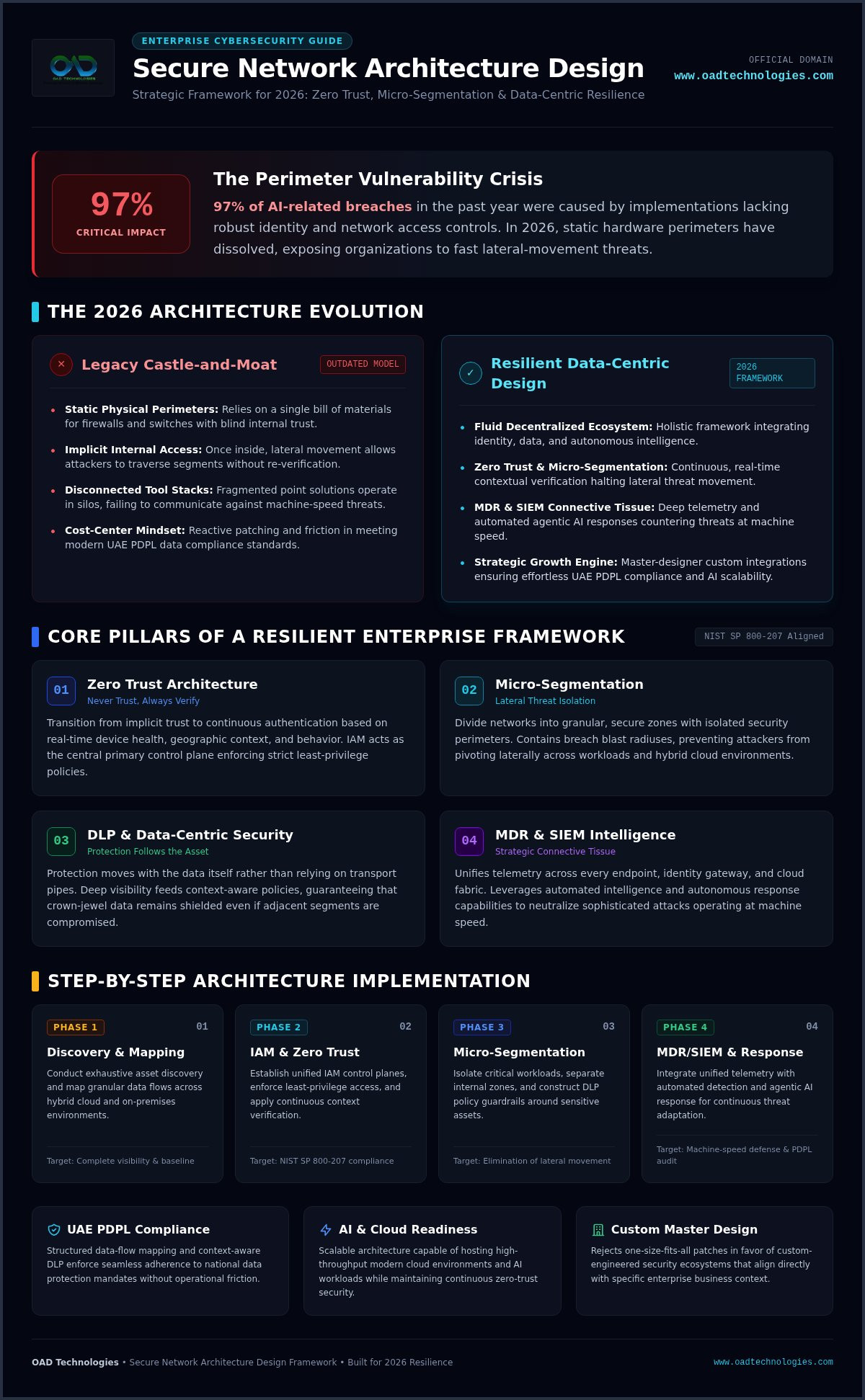
A Step-by-Step Guide to Secure Architecture Implementation
Execution requires a disciplined, methodical approach to transform conceptual models into operational reality. Implementing a secure network architecture design isn't a linear project; it's a continuous cycle of discovery, alignment, and refinement. We begin with a comprehensive inventory of assets. You can't defend what you haven't identified. This initial phase involves uncovering every endpoint, server, and cloud instance within your environment to establish a clear baseline for protection. Without this visibility, even the most advanced security tools remain ineffective.
Mapping Data Flows and Asset Criticality
Once you've cataloged your assets, the next step involves mapping how information moves between them. Understanding these communication paths is vital for meeting UAE regulatory standards, particularly the Personal Data Protection Law (PDPL). You must identify your "crown jewel" assets, those critical data sets whose loss would cause significant operational or financial damage. This mapping allows you to align your technical design with broader governance, risk, and compliance (GRC) objectives. Effective asset management provides the visibility required to prioritize risk mitigation across the entire enterprise framework.
Following data mapping, we move to risk assessment and control selection. In 2026, this means evaluating your design against the NIST CSF 2.0 framework and ensuring crypto-agility for post-quantum standards. You must place controls where they'll have the most impact, such as using automated Web Application Firewalls (WAF) for public-facing apps as mandated by PCI DSS 4.0. This strategic placement ensures that your investment returns are maximized by addressing the most likely attack vectors first. It's about building a system that is robust enough to handle modern threats while remaining flexible enough to support future growth.
The Role of Continuous Assessment
Most organizations treat testing as a final hurdle before launch. We view vulnerability assessment and penetration testing (VAPT) as a fundamental design requirement that provides a direct feedback loop for architectural iteration. If a red-team exercise identifies a path for lateral movement, that result shouldn't just lead to a software patch. It should trigger a re-evaluation of your micro-segmentation strategy. This iterative approach ensures that your architectural assumptions hold up against real-world attack vectors. Hardening security controls must never come at the expense of operational performance; instead, the two should evolve in tandem to support long-term viability. By using VAPT as a diagnostic tool for the architecture itself, you move beyond checklist compliance toward genuine technical authority.
Ready to validate your infrastructure against 2026 threat standards? Schedule a technical security assessment with our master designers to refine your defensive posture.
Strategic Partnership: Designing for the Future with OAD Technologies
In a digital environment where threats evolve at machine speed, your infrastructure requires more than just reactive patches. It demands the vision of a master designer. OAD Technologies positions itself as that strategic partner, acting as an extension of your own team to craft a secure network architecture design that is as unique as your business. We reject the "one-size-fits-all" approaches favored by global giants who prioritize scale over specificity. Instead, we focus on high-quality craftsmanship, ensuring that every control, from DLP to IAM, is integrated with precision to support your long-term operational performance.
Our philosophy centers on the synergy between human insight and technological capacity. While our advanced tools like MDR and SIEM provide the necessary telemetry, it's our engineering expertise that interprets this data to drive strategic expansion. We don't just replace processes; we empower your people. This collaborative mindset ensures that your architecture isn't a static burden but a dynamic facilitator of digital evolution. By choosing a partner that values long-term success over quick fixes, UAE enterprises can secure their digital relevance in an ever-changing market.
Beyond Standardized Integration
Standardized security often fails because it ignores the specific risk profile of the organization. We tailor every architectural element to align with your unique challenges and investment goals. This process involves deep collaboration to build enterprise resilience from the ground up. By adopting a proactive, solution-oriented mindset, we safeguard your digital assets against modern lateral-movement threats. This customized integration ensures that your security posture remains robust without introducing unnecessary friction into your daily operations. It's about building a system that works for your business, not the other way around.
Ensuring National Regulatory Alignment
Navigating the complexities of the UAE Personal Data Protection Law (PDPL) and other regional mandates requires more than just technical skill; it requires local context. As a UAE-based partner, we provide expert GRC consulting that bridges the gap between global engineering standards and national compliance requirements. We understand the specific market conditions that influence your risk landscape. This local expertise allows us to design architectures that are compliant by default, reducing the fiscal impact of regulatory penalties which can often exceed hundreds of thousands of dirhams for non-compliant enterprises. We're here to help you bridge the gap between high-level innovation and practical business results, ensuring your infrastructure is ready for the challenges of 2026 and beyond.
Building Resilience for the Decades Ahead
Resilience in 2026 demands a fundamental shift from legacy perimeters to identity-centric, decentralized frameworks. By integrating Zero Trust principles and micro-segmentation, you transform your infrastructure into a self-defending ecosystem that scales with your ambition. We've explored how continuous assessment through VAPT and the connective tissue of MDR services ensure your secure network architecture design remains effective against machine-speed threats. This strategic alignment doesn't just protect your most sensitive data; it facilitates digital evolution and ensures strict compliance with national regulations like the UAE Personal Data Protection Law (PDPL).
As master designers of customized digital protection, we're ready to bridge the gap between high-level innovation and practical business results. Our team combines advanced technical assessments with human-led insight to build systems that prioritize long-term viability over quick fixes. Partner with OAD Technologies to design your resilient enterprise architecture and safeguard your ongoing digital relevance. Let's work together to create a foundation that empowers your people while securing your processes for the future. Your journey toward a more robust and secure digital landscape starts with a single, strategic step.
Frequently Asked Questions
What are the key components of a secure network architecture?
A resilient secure network architecture design integrates identity control planes, encrypted transport layers, and dynamic policy enforcement points. It moves beyond physical hardware to include logic-based segmentation and automated telemetry. These components work together to ensure that security is baked into the structural DNA of the network. This approach allows for real-time adaptation to threats while maintaining high-level operational performance across the entire enterprise ecosystem.
How does Zero Trust impact network performance?
Modern Zero Trust implementations don't necessarily degrade performance. While continuous verification adds authentication steps, the use of edge processing and optimized SASE models minimizes latency. By eliminating unauthorized "noise" and unverified traffic, you often see a more streamlined flow of data. It's about replacing broad, clunky perimeter checks with surgical, context-aware verifications that happen at the speed of the modern cloud.
Why is micro-segmentation critical for modern cybersecurity?
Micro-segmentation is the most effective way to reduce the blast radius of a potential breach. It stops east-west lateral movement by isolating workloads and services within their own logical boundaries. In a hybrid environment where perimeters are porous, this granular control ensures that a compromise in one area doesn't lead to a total system failure. It's a structural necessity for protecting your organization's most critical digital assets.
How often should a network architecture be audited for security?
The standard has shifted from annual snapshots to continuous operational validation. In 2026, UAE enterprises should conduct quarterly VAPT cycles and maintain real-time telemetry monitoring. Regulatory bodies now favor active evidence of security over static compliance checklists. Regular audits ensure that your architectural assumptions still hold up against the latest threat vectors, allowing you to iterate on your design before vulnerabilities are exploited.
What is the role of IAM in secure network design?
Identity and Access Management acts as the primary gatekeeper in a perimeterless environment. It defines the "who" and "what" before the network ever allows a connection to proceed. By making IAM the central control plane, you ensure that every session is governed by the principle of least privilege. This synergy between identity and infrastructure is what allows people to work securely from any location without compromising the core network.
Can legacy networks be migrated to a secure modern architecture?
Legacy systems don't require a total rip-and-replace to achieve modern security standards. You can migrate through a phased overlay approach using software-defined perimeters and identity proxies. This allows you to bridge older hardware with modern Zero Trust principles. It's a strategic evolution that protects your existing investment while moving the organization toward a more resilient, data-centric future that supports long-term digital growth.
How does UAE regulation affect network security design?
UAE regulations like the PDPL 2026 mandate strict data sovereignty and localized inspection points. Your architecture must ensure that sensitive telemetry and personal data remain within jurisdictional boundaries. This requires a customized design that aligns with national governance standards while maintaining global engineering quality. A local partner helps navigate these requirements, ensuring that your infrastructure meets both legal mandates and high-level security performance goals without conflict.
What is the difference between network security and secure network architecture?
Network security refers to the specific tools you use, such as firewalls or antivirus software. In contrast, secure network architecture design is the overarching blueprint that dictates how those tools interact. Think of security as the individual locks on a door, while architecture is the design of the building itself. A well-designed building ensures that even if one lock fails, the structural integrity of the entire facility remains uncompromised.
Disclaimer
Content by OAD Technologies is for general informational purposes only and does not constitute professional or cybersecurity advice. No warranties are made regarding accuracy or completeness; reliance is at your own risk. OAD Technologies shall not be liable for any direct or indirect losses arising from use of this content.