
An overseas cloud region can support backup and disaster recovery in the UAE, but it is not suitable for every workload. Financial institutions must store customer and transaction data locally, and electronic health records must remain within UAE borders. The right design depends on the data involved and the rules that apply to your sector.
Keeping an off-site copy of data can improve resilience, but recovery also depends on how quickly systems can return, how much recent data the business can tolerate losing and whether restoration works in practice. This guide explains how to set recovery objectives, compare backups, replication, cloud recovery and standby infrastructure, and test plans for ransomware and outages. It also covers UAE considerations that affect data storage, helping you plan backup and disaster recovery in the UAE around business priorities and applicable requirements.
Key takeaways
- Set recovery time and data-loss limits by workload, then match backup frequency and recovery methods to those business priorities.
- Choose between backups, replication, cloud recovery and standby infrastructure based on how quickly each system must return and where its data may be stored.
- Test restores and recovery scenarios regularly; a completed backup job alone doesn’t prove that systems and data can be recovered.
- Plan for ransomware, equipment failure, power or connectivity outages, and other disruptions by defining recovery roles, dependencies and communications.
- Separate IT recovery from wider business continuity, and account for UAE requirements such as local data storage obligations for certain sectors.
Disaster recovery testing
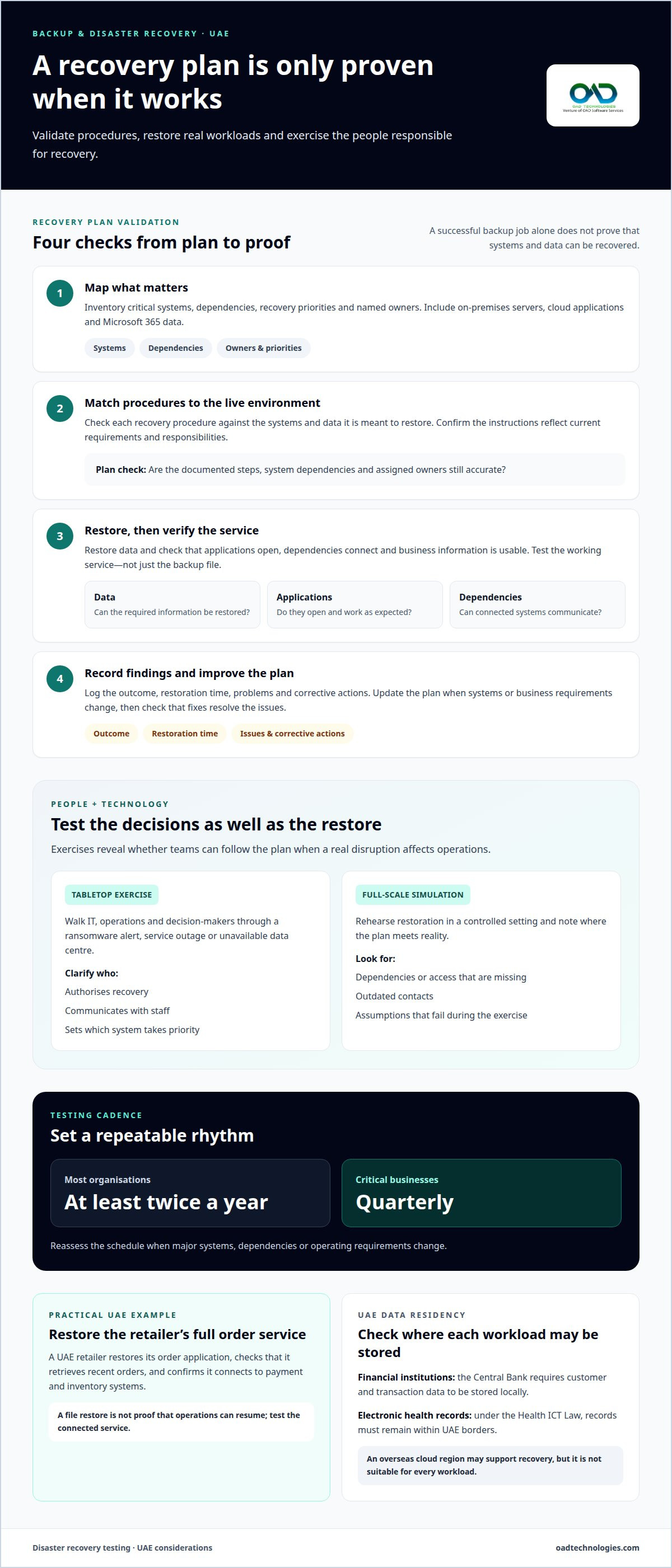
A disaster recovery plan needs practical testing, not just written procedures. Exercises reveal whether critical systems, data and assigned responsibilities support restoration when a real threat disrupts operations.
Recovery plan validation
Validation checks that recovery procedures match the current environment. Start with an inventory of critical systems, their dependencies, recovery priorities and named owners. Then compare each procedure with the systems and data it is meant to restore. The United Nations Office of Internal Oversight Services recommended documenting and testing disaster recovery procedures for all ICT applications and services.
Test backup integrity by restoring data and checking that applications open, dependencies connect and business information is usable. A successful backup job alone does not prove that recovery will work. Record the outcome, restoration time, problems and corrective actions, then update the plan when systems or business requirements change.
For example, a UAE retailer could restore its order application and check that it retrieves recent orders and connects to payment and inventory systems. This tests the full service, rather than treating a completed file restore as proof that operations can resume.
Recovery plan exercises
Exercises test whether people can follow the plan as well as whether technology can recover. A tabletop exercise can walk IT, operations and decision-makers through a ransomware alert, service outage or unavailable data centre. Participants identify who authorises recovery, who communicates with staff and which system takes priority.
Full-scale simulations go further by rehearsing restoration in a controlled setting. Record dependencies, outdated contacts, missing access and assumptions that fail during the exercise. Test regularly, and more often for critical systems. Use the findings to improve procedures and clarify responsibilities.
For business continuity and disaster recovery testing, combine written-plan reviews, restore checks and exercises. Record the scenario, participants, systems tested, issues found and remediation owner. A follow-up test can confirm that fixes work, rather than leaving weaknesses unresolved between review cycles.
Backup, replication, cloud recovery and standby infrastructure
An overseas cloud region can support recovery, but location rules depend on the data and sector. Choose protection according to the workload, recovery target and applicable UAE requirements.
Backup and replication
Backups preserve recoverable copies from set points in time; replication copies changes to another system or site. Replication can support faster failover, but it may also copy unwanted changes, including ransomware encryption. Keep separate backups and consider an immutable copy that cannot be modified, deleted or encrypted during its specified retention period.
Use a workload inventory covering on-premises servers, cloud applications and Microsoft 365 data. Map each workload to its backup location, retention needs and recovery dependencies. For a hypothetical Abu Dhabi retailer, that could mean protecting order records and inventory systems both locally and in cloud storage, then documenting which copy supports restoration if one site becomes unavailable.
Cloud failover and managed recovery
Cloud recovery can host replicated critical systems in a secondary location. Failover moves operations to that environment when the primary system cannot serve users. The plan should specify who authorises the switch, how application dependencies start and how teams validate access before normal work resumes.
Managed recovery arrangements should define responsibility for monitoring replication, initiating agreed procedures and coordinating restoration. For enterprises with multiple sites, map connections between identity services, databases and business applications. A cloud recovery design should also include a route back to the primary environment, so teams can return without losing changes made during failover.
Cloud regions and data residency
Compare cloud options by data location, security controls, recovery capabilities and cost factors, not region labels alone. An overseas region may provide geographic separation, but it can be unsuitable where sector rules require local storage. The Central Bank requires financial institutions to store customer and transaction data locally. Under the Health ICT Law, electronic health records must remain within UAE borders.
For Microsoft 365, cloud workloads and on-premises systems, document where data resides and how restoration works across sites. The 3-2-1-1 rule offers a useful design principle: three data copies, two media types, one off-site copy and one immutable copy. Tailor the locations to residency obligations rather than sending every copy to the same overseas region.
A defined backup and disaster recovery design can bring storage, replication and recovery procedures into one operational plan.
What is the difference between disaster recovery and business continuity?
Disaster recovery planning restores IT systems, applications and data after an incident. Business continuity planning covers the wider operation, including people, processes, facilities and suppliers. A Dubai office might restore its finance platform quickly, yet still struggle if staff cannot access records or approve payments. Both plans must connect technology restoration to the work the business needs to continue.
Begin with a business impact analysis. Identify critical processes, the systems and information they depend on, and the consequences of interruption. Set a recovery time objective (RTO) for how long each workload can remain unavailable. Set a recovery point objective (RPO) for the amount of data loss, measured in time, the business can accept. Different workloads need different targets; one company-wide objective can misdirect investment.
Use the analysis to build a disaster recovery plan with clear owners and operating steps:
- Rank critical processes and map their technology, supplier and staff dependencies.
- Assign recovery responsibilities, approval authority and escalation routes.
- Document restoration procedures, validation checks and staff communications.
- Connect each workload’s RTO and RPO to its recovery method and backup frequency.
- Exercise the plan, record weaknesses and revise procedures after changes.
These steps help create a plan teams can use under pressure, rather than a document detached from daily operations. The plan also needs workforce continuity: named personnel must be available to support critical services during and after disruption.
For an SME, disaster recovery planning can prioritise essential systems such as sales, payroll and customer records. With limited budgets, mapping dependencies helps direct resources towards processes most affected by interruption. An enterprise may have multiple locations, business units and suppliers. Its plan must coordinate owners across those dependencies and set application recovery priorities.
How do you create a backup and disaster recovery plan for a business in the UAE? Start with a business impact analysis, set workload-specific RTOs and RPOs, then document recovery priorities, responsibilities, dependencies, communications and validation steps. Include applicable UAE obligations: the UAE Personal Data Protection Law regulates personal-data processing concerning UAE residents, regardless of where an organisation is headquartered.
Which backup and disaster recovery providers serve businesses in Dubai and Abu Dhabi? Providers include managed IT and cloud recovery specialists, regional IT providers like ITSthe1 Solutions, as well as dedicated backup and disaster recovery firms. Compare their scope with your systems, recovery objectives, data-location requirements and ability to support plan testing.
Ransomware, data loss and infrastructure failure scenarios
Ransomware, accidental deletion, hardware failure and physical disruption can affect UAE operations in different ways. A useful plan connects data protection controls with recovery actions, communications and business continuity priorities.
Ransomware and data loss
For ransomware, plan for compromised systems and backups that may be affected by the same incident. Keep a protected recovery copy and define how teams identify a clean restoration point. Then document who isolates affected systems, approves restoration and validates recovered data before users regain access.
Accidental deletion and application errors need different recovery steps. A Dubai professional services firm, for example, might restore a deleted client record from backup, then confirm the record is complete and accessible to authorised staff. For personal data, the UAE Personal Data Protection Law (PDPL) regulates processing concerning UAE residents, regardless of where an organisation is headquartered. Article 9 requires a controller to notify the UAE Data Office once aware of a qualifying breach; it sets no fixed number of hours.
Data protection also depends on clear incident records. Document the affected applications, data categories, decisions, recovery actions and communications. This gives business continuity teams a consistent account of events and helps them coordinate restoration without confusing recovery copies with unaffected production data.
Infrastructure and data centre recovery
A data centre or network failure can make intact data inaccessible. Map the dependencies linking storage, identity services, network access and business applications. Recovery procedures should identify an alternate route or site, the order for restoring dependencies and the checks that confirm users can resume essential work.
Physical disruption can affect power, cooling, connectivity or access to a facility. For a logistics company operating between locations in the UAE, a local site outage could interrupt dispatch systems even when its data remains intact. The plan should explain how staff communicate, which operations can continue elsewhere and how systems return when the affected site becomes available.
Build recovery scenarios around distinct threats rather than one generic outage. A cyber incident may require isolating systems before restoration; equipment failure may call for switching to redundant infrastructure. For each scenario, assign an incident lead, recovery owner and business approver. Record dependencies and validation steps, then update procedures when applications, sites or suppliers change.
UAE organisations should account for applicable data protection and sector requirements when making recovery decisions. The UAE PDPL, Dubai Data Protection Law and Abu Dhabi Information Security Policy Framework are relevant planning considerations. Map the data and systems involved, identify applicable obligations, and ensure restoration procedures preserve required controls while supporting business continuity.
Natural disasters and other business disruptions in the UAE
UAE continuity plans need to account for weather, power, connectivity, equipment failure and cyberattacks. A business impact analysis helps rank which operations must recover first.
Severe weather in the UAE has shown how local disruption can affect transport, staff access, utilities and suppliers. Recovery planning should consider these dependencies, not only technology.
Use a business impact analysis to connect each critical process with its systems, people and external dependencies. Rank recovery priorities by the effect of downtime on customers, revenue, safety and obligations. For example, a UAE retailer may prioritise payment processing and order access over internal reporting. Assign owners to each priority, document alternate working arrangements, and set recovery objectives for the supporting systems.
Downtime impacts
Downtime can delay transactions, interrupt customer service and prevent staff from accessing essential records. Assess how a disruption affects your own revenue, contractual commitments and operational dependencies.
A useful assessment separates direct losses from knock-on effects. A payment outage, for example, can halt sales and create a backlog that persists after systems return. Record which services stop, what manual processes can continue and who authorises their use.
Disaster recovery restores IT systems; business continuity keeps wider operations moving. A complete disruption plan connects both: identify the incident, activate recovery priorities, communicate changes and resume normal processes after service validation. Include staff availability and supplier dependencies, since accessible backups cannot keep operations moving if key people or essential services are unavailable.
Business resilience benefits
Resilience comes from linking recovery procedures to business decisions. Clear priorities help teams direct resources towards essential services, while defined communication roles reduce confusion during an attack or outage. Documented alternatives can also help staff continue selected tasks when primary systems are inaccessible.
For a UAE organisation with offices in different emirates, a disruption at one location could affect staff access or supplier coordination elsewhere. A practical exercise can test how teams communicate, transfer priority work and record decisions. Use the findings to update responsibilities and recovery priorities as operations, technology and dependencies change.
Build the plan around the business impact of disruption, then connect each priority to a workable recovery action. This makes resilience an ongoing operational capability, not simply a set of stored copies.
OAD Technologies: Backup and disaster recovery
OAD Technologies helps UAE businesses plan recovery around critical workloads, data and acceptable downtime. Its Backup and Disaster Recovery service supports organisations designing protection for outages, data loss and ransomware scenarios.
Turn to OAD Technologies when recovery objectives, backup coverage or restoration procedures need closer alignment with business priorities. For related risks, Data Loss Prevention (DLP) helps protect sensitive information, while Vulnerability Assessment and Penetration Testing (VAPT) assesses security weaknesses. Managed Detection and Response (MDR) supports threat detection and response.
Share your key systems, operational priorities and recovery challenges with OAD Technologies to discuss a suitable next step.
Make recovery readiness part of business growth
Recovery planning should evolve with your business, not wait for the next incident. As applications, suppliers and data flows change, revisit how those changes affect recovery priorities and operational dependencies. This keeps resilience connected to real business needs rather than treating it as a one-off technology project.
For backup and disaster recovery in the UAE, map current recovery arrangements against operating priorities and applicable data obligations. OAD Technologies provides Backup and Disaster Recovery to support this work. Data Loss Prevention (DLP) helps address sensitive information risks, Vulnerability Assessment and Penetration Testing (VAPT) assesses security weaknesses, and Managed Detection and Response (MDR) supports threat detection and response.
Bring your recovery objectives and key operational dependencies to the discussion. A considered plan can help your teams make informed decisions as the business grows and its technology changes.
Frequently asked questions
Can UAE companies use an overseas cloud region for disaster recovery backups?
Yes, an overseas region can be an option when the workload’s legal, sector and contractual requirements allow it. It may provide geographic separation from a UAE primary site, but location alone does not establish that the design is suitable. Map each dataset to its applicable residency obligations before placing a recovery copy. Financial institutions and healthcare organisations have local-storage requirements for specific data.
What RTO and RPO should a typical business aim for?
Set RTO and RPO separately for each workload, based on the business impact of interruption and data loss. A customer-facing ordering system may need a shorter recovery window than an internal reporting tool. Identify the revenue, customer-service and operational consequences of each outage, then choose targets the recovery design can support. A business impact analysis helps decision-makers prioritise systems rather than applying one target across the organisation.
What backup and disaster recovery services are available in the UAE?
UAE businesses can choose backup storage, replication, cloud-based recovery, standby infrastructure and recovery testing. Some arrangements also include managed recovery, where agreed responsibilities cover activities such as monitoring copies and coordinating restoration. Microsoft 365 and other cloud applications may need separate protection planning from servers at a company site. The suitable mix depends on workloads, data location, acceptable downtime and how much recovery coordination internal teams can manage.
Which UAE data protection and cybersecurity regulations apply to backups and disaster recovery?
Relevant requirements depend on the organisation, sector, location and data involved. Consider the UAE Personal Data Protection Law, the Dubai Data Protection Law and the Abu Dhabi Information Security Policy Framework where applicable. Financial institutions must also account for Central Bank requirements, while healthcare organisations should consider the Health ICT Law. Map relevant obligations to each data set and recovery location; a backup design alone does not establish compliance.
What are the best practices for protecting backups from ransomware and cyberattacks?
Keep multiple copies across different media and locations, including an immutable copy that cannot be altered or deleted during its specified period. The 3-2-1-1 rule describes three copies, two media types, one off-site copy and one immutable copy. Restrict access to backup administration, separate backup credentials from everyday accounts, and test restoration. For example, restoring a sample application can reveal whether its data is usable, not merely stored.
How do UAE cloud backup providers compare on pricing, security, and data residency?
Pricing depends on data volume, retention, recovery targets and infrastructure, and is provided after a quote request. Compare security controls and data locations with workload needs and applicable data-residency requirements.
Disclaimer
Content by OAD Technologies is for general informational purposes only and does not constitute professional or cybersecurity advice. No warranties are made regarding accuracy or completeness; reliance is at your own risk. OAD Technologies shall not be liable for any direct or indirect losses arising from use of this content.