
DLP is only as useful as the labels and rules behind it. Data Loss Prevention tools and processes identify, monitor and protect sensitive information at rest, in use and in motion; the most effective data classification best practices for DLP give those controls a clear basis for deciding what to protect and how.
Classification turns broad policy into practical handling rules. When teams agree what counts as public, internal, confidential or restricted, they can apply controls in proportion to risk instead of treating every file the same way. For a UAE organisation, this might mean stricter sharing controls for customer records than for approved public marketing material, across email, cloud storage and collaboration tools.
This guide explains how to set useful classification criteria, connect labels to DLP policies and extend protection across the tools employees use. It also covers how to introduce controls that support everyday work, with clear guidance to help people make safer decisions when handling sensitive data.
Key takeaways
- Set clear classification criteria around sensitivity, business impact and applicable obligations so teams apply labels consistently.
- Translate each label into practical DLP actions, balancing protection needs with acceptable business workflows.
- Prioritise the information and channels that pose the greatest exposure risk, then expand coverage across relevant tools.
- Review alerts and policy outcomes to spot noisy rules, recurring issues and opportunities to improve controls.
- Equip employees to recognise classifications and make safer sharing decisions with timely, scenario-based guidance.
1. Aligning data labels with governance and security policies
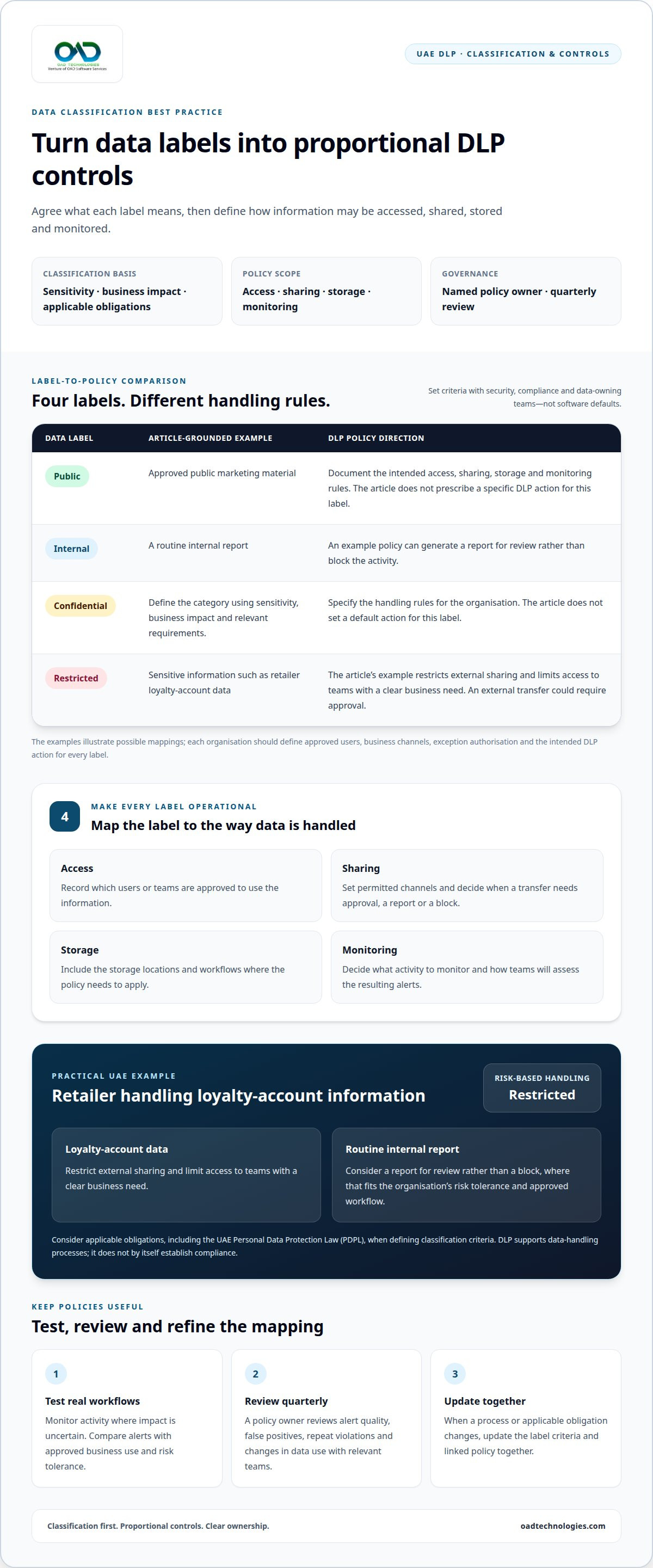
For UAE organisations evaluating DLP, labels should reflect business priorities and applicable obligations, not simply software defaults. Define each category with security, compliance and data-owning teams before configuring controls. A four-tier model might use public, internal, confidential and restricted labels, with criteria based on sensitivity, business impact and relevant requirements such as the UAE Personal Data Protection Law (PDPL), where applicable.
How should classification labels map to DLP policies and controls? Connect every label to explicit rules for access, sharing, storage and monitoring. For example, a restricted label could require approval before an external transfer, while an internal label might trigger a report rather than a block.
Make this mapping part of procurement and implementation planning. For each label, document approved users, business channels, who can authorise exceptions and the intended DLP action. This helps decision-makers assess whether a solution can apply policies across real workflows and support existing governance. Data classification best practices for DLP begin with these operational requirements, not a product’s preset labels. Organisations evaluating these strategic IT frameworks often consult independent advisory specialists like Unisphere Solutions to ensure governance rules integrate smoothly with broader cyber security and infrastructure planning.
Test proportional enforcement against a realistic UAE business scenario. A retailer handling loyalty-account information might restrict external sharing and limit access to teams with a clear business need. A routine internal report could instead generate an alert for review. During design, identify who owns each exception and how legitimate supplier or customer processes can continue without weakening controls.
Before enforcement, agree how to evaluate policy behaviour. Monitor activity in workflows where the impact is uncertain, then compare alerts with approved business use and risk tolerance. This gives security and operational stakeholders evidence to choose between a block, an approval step or a report. It also helps buyers distinguish useful controls from rules likely to cause unnecessary friction.
Assign a policy owner and establish a quarterly review cycle. Include security, governance and relevant business representatives to assess alert quality, false positives, repeat violations and changes in data use. Data classification best practices for DLP also need a clear change process: when a business process or applicable obligation changes, the owner should update the label criteria and linked policy together.
Use review findings to assess whether the proposed DLP design fits the organisation. If alerts repeatedly flag an approved workflow, refine the rule or clarify the handling procedure. If exposure risks recur, strengthen the control for that data category. This gives implementation decisions a practical basis, with policies shaped around the organisation’s data, operating model and risk priorities.
2. What is data loss prevention?
Data Loss Prevention (DLP) combines technology and operating procedures to help prevent sensitive information from being accessed, moved or changed inappropriately. For UAE organisations assessing an implementation, the key question is how controls will cover business-critical data across the systems employees actually use. Define intended outcomes first, such as reducing unauthorised sharing or improving visibility of risky transfers, then map them to technical requirements.
What are best practices for classifying structured and unstructured data? For structured records, use relevant database fields and reliable data patterns. For documents and messages, assess content, context and metadata. Test detection against representative business information, then review uncertain matches with data owners before linking classifications to enforcement.
A practical evaluation should account for where data is stored, how it moves and which teams depend on it. A UAE professional-services organisation, for example, might handle client records in a business application, working documents in shared storage and attachments in email. A pilot can test whether proposed controls recognise these distinct workflows and provide useful visibility without interrupting approved work.
Assess how DLP findings feed into incident response. A useful alert should give responders enough context to identify the information involved, the user activity and the affected channel. Define escalation ownership and remediation paths before deployment. Depending on the event, responders may need to restrict access, remove an exposed sharing route or preserve records for investigation.
Plan for audit readiness during implementation, rather than leaving it as a later reporting task. Retain relevant policy logs, incident records, exception approvals and access reports. These records can help internal teams explain how a control was applied and what action followed. For organisations considering UAE PDPL obligations, DLP can support data-handling processes but does not by itself establish compliance.
Employee readiness also affects deployment decisions. Explain how staff should respond to warnings, where to report an accidental transfer and how approved exceptions work. A clear process helps distinguish a user mistake from a higher-risk event and gives response teams a route to act. Include these procedures in pilot testing, not just technical checks.
Before a broad rollout, test a realistic exposure scenario with security, IT and business stakeholders. Confirm that detection, escalation, remediation and record keeping work together, then use the findings to refine scope. This gives UAE decision-makers a practical basis for phasing implementation and assessing whether the DLP approach fits their architecture, workflows and response capabilities.
3. What is data classification?
For UAE organisations planning DLP, classification identifies information according to sensitivity and business impact. It helps determine which data sources a proposed control must discover and which risks deserve priority. Before deployment, connect classification decisions to real business assets, such as customer records, product designs, financial forecasts and operational documents.
Build an inventory around business use, not just storage location. Record what information exists, where teams create or store it, who uses it and why access is needed. Organisations managing complex architectures often work with enterprise data specialists like Momentum Data Labs to catalogue and structure assets across platforms. For a UAE manufacturer, this could include engineering drawings, supplier specifications and production records across design systems and shared repositories. The inventory helps decision-makers scope discovery and identify gaps in coverage.
Then assess the consequences of exposure, alteration or loss for each data set. Consider customer impact, operational disruption, commercial sensitivity and relevant obligations. A production design may need stronger safeguards because unauthorised disclosure could affect intellectual property and delivery plans. This risk-based view helps organisations prioritise DLP investment rather than applying identical controls to every repository.
Match discovery methods to the information. Structured systems can be assessed through database fields and patterns; unstructured files may need content inspection, metadata and business context. During a DLP evaluation, test both against representative data. Ask whether the proposed approach can explain why a file was classified, so owners can review uncertain results before policies rely on them.
Common mistakes include relying only on employee-applied labels, overlooking data stores and classifying by file name rather than content. Another risk is deploying restrictive controls before validating classification quality. Incorrect labels can leave sensitive information outside monitoring or interrupt legitimate work. These errors can weaken data loss prevention and complicate investigations after a breach or suspected insider misuse.
For implementation planning, involve data owners, security teams and system administrators in reviewing discovery results. They can resolve ambiguous classifications, identify obsolete copies and confirm which users still need access. Include this review in pilot acceptance criteria, alongside checks that DLP detects priority information and provides usable evidence for security operations.
Classification also needs to reflect changes in business use. A draft design may become suitable for wider distribution after approval, while supporting technical details remain sensitive. Define how owners request label changes and how those changes affect DLP policies. This gives UAE and GCC decision-makers a practical basis for scoping controls, prioritising repositories and selecting an implementation approach suited to their operations.
4. Consistent DLP across email, cloud, and collaboration tools
A label should keep its meaning as information moves between applications. Define consistent handling rules for email, cloud storage, collaboration platforms and endpoints. Otherwise, a restricted file could be blocked in email but freely shared through a cloud link. Data loss prevention should follow the information across channels, not just inspect the application where it first appeared.
Start by mapping authorised data flows and likely exit points. Include employee devices, network gateways, web uploads, email attachments and cloud services. For example, a finance team might download a report to an endpoint, edit it locally and then share it through a collaboration platform. Map each transfer and assign a control point to inspect, alert on or restrict the relevant movement.
Cloud discovery should cover where information is stored and how employees use it. Include cloud storage, collaboration platforms, SaaS applications, personal cloud accounts and third-party AI tools. Review permissions, external sharing settings and file locations as well as content. A document may remain in an approved service yet be exposed through a public link or excessive access permissions.
Use consistent policy logic across email and collaboration channels, adapting the action to each channel’s capabilities. An outbound email rule could detect a restricted attachment and stop delivery for review. OAD’s Mimecast and Trustifi email security can enforce these outbound rules and encrypt sensitive messages. A cloud rule could flag unusual downloads or oversharing, while a web control could monitor uploads to unapproved destinations. Apply the same classification logic while accounting for different workflows.
Endpoint, network and cloud controls address different points in a file’s journey. Endpoint controls can respond to copying or transfers from a managed device. Network controls can inspect traffic leaving the organisation’s environment. Cloud controls can monitor access and sharing in hosted services. Prioritise coverage by risk, placing controls near data egress points where technically and legally possible.
Cloud security and zero trust practices strengthen this design by linking access decisions to identity, device context and data sensitivity. For instance, a UAE logistics company could allow an authorised employee to view shipment documents from a managed device while restricting bulk downloads to an approved workflow. Classification informs the decision; identity and device signals add context.
Test consistency with representative workflows before enforcement. Move a sample file through email, a managed endpoint, cloud storage and a collaboration tool. Confirm that labels remain available and policies produce the intended actions at each step. Review alerts for gaps, unexpected access or unnecessary interruption, then tune controls. This channel-by-channel validation helps organisations extend data protection without application-based blind spots.
5. Employee education and in-moment guidance
Employees make daily decisions that can reinforce or weaken data protection. Training should explain how to recognise labels, choose approved handling routes and report mistakes promptly. Connect each lesson to a task people actually perform, such as sharing a client file, downloading a report or forwarding an email. Clear examples make policies easier to apply in everyday work.
Use scenario-based sessions rather than relying only on policy documents. A focused 10-minute exercise could show an employee sharing a restricted file with an unauthorised recipient. Ask them to identify the risk, choose a safer sharing method and explain how they would report an accidental transfer. Discuss the decision afterwards, including how the right response can limit exposure.
For a UAE consultancy, a practical exercise might involve an employee preparing a bid response. A colleague requests the document through a personal email account, creating a decision point. Training can show how to use an approved workspace, confirm the recipient’s business need and raise a concern if the request seems unusual. The scenario connects secure behaviour with familiar work.
In-the-moment guidance supports learning at the point of action. If an employee attempts to send a sensitive attachment externally, an automated prompt can explain the relevant policy and offer an approved alternative. The warning should state what triggered it and what the user can do next. For higher-risk activity, a block or approval step may be more appropriate.
Design guidance around real behaviour, not assumptions. Review alert patterns, repeated policy violations and common exception requests to identify where employees need clearer instructions. For example, frequent alerts around a legitimate supplier workflow may point to confusing guidance or an overly broad rule. Security teams can refine the prompt, adjust the procedure or provide targeted coaching to the affected group.
Include regulatory and contractual responsibilities in role-specific training. Employees handling personal information need practical direction on access, sharing, retention and escalation under the organisation’s applicable requirements. Use approved internal procedures and realistic examples rather than asking staff to interpret legal language themselves. Managers should reinforce these expectations during onboarding and when work processes change.
Assess whether learning changes day-to-day decisions. Track recurring mistakes, employee reports and policy exceptions, then adapt training to address the patterns. Share brief reminders after process changes and use team discussions to clarify difficult scenarios. When employees understand why a control exists and what safe action to take, technology can guide behaviour without making routine tasks feel like obstacles.
OAD Technologies: Data Loss Prevention (DLP)
OAD Technologies helps UAE organisations put data classification into practice through its Data Loss Prevention (DLP) service. This is a relevant next step when labels exist but controls remain inconsistent across email, endpoints, cloud services or collaboration tools, or when teams need to refine policies around real data flows.
The service connects sensitive-data priorities with proportionate handling rules, helping organisations identify where DLP controls should monitor, alert or restrict activity. OAD Technologies also offers Security Information and Event Management (SIEM) and Managed Detection and Response (MDR) to support broader visibility and response needs alongside DLP.
To discuss how DLP can fit your organisation’s data, policies and working practices, contact OAD Technologies.
Make data protection evolve with your organisation
As your organisation adopts applications, changes workflows or expands into new markets, revisit how its data is handled. The value of data classification best practices for DLP lies in keeping controls aligned with real business activity, not treating labels as a one-off technical exercise. A useful next step is to identify where current policies create friction, leave important information exposed or lack clear ownership.
OAD Technologies offers Data Loss Prevention (DLP), Vulnerability Assessment and Penetration Testing (VAPT), and Managed Detection and Response (MDR). These services can support organisations refining data controls, assessing security weaknesses or strengthening incident handling. The right starting point depends on the challenge your teams need to address.
With clear priorities and controls shaped around your operations, your organisation can protect sensitive information while enabling people to work confidently.
Frequently asked questions
How does DLP support regulatory compliance?
DLP can support compliance efforts by helping organisations apply handling controls to information covered by relevant requirements, including the UAE PDPL where applicable. It can also produce policy logs and incident records to help teams explain how controls operate and how alerts were handled. DLP alone does not establish compliance. Organisations need to map their obligations, governance processes and technical safeguards, then assess whether those measures address their specific responsibilities.
Why do these DLP best practices matter?
These practices help organisations focus controls on meaningful risks without unnecessarily obstructing routine work. A rule that treats every external transfer as equally dangerous may interrupt approved business activity, while a rule that misses sensitive content can leave exposure unaddressed. Clear ownership, usable policies and regular review help teams find the balance. A well-managed DLP programme can adapt as applications, information use and business processes change.
What are the main data classification levels used for DLP?
A commonly used model has four levels: public, internal, confidential and restricted. Public information is approved for general release; internal information is intended for organisational use; confidential information needs controlled access; and restricted information receives the strongest safeguards. Define each level in terms that suit the organisation. For instance, explain whether a label applies to a complete record, particular fields or a document containing mixed information.
How do organisations classify data by sensitivity and business impact?
Assess both the information’s sensitivity and the operational consequences of exposure, alteration or loss. A procurement team, for example, could distinguish a published supplier notice from an unreleased bid evaluation. Consider who needs access, the purpose, contractual or regulatory context, and the effect on customers or operations if handling goes wrong. Use these criteria to assign a label, then document exceptions and who is responsible for approving them.
How can organisations automate data classification while minimising false positives?
Combine automated detection with targeted validation and ongoing tuning. Data fingerprinting can recognise known sensitive files, while Exact Data Matching can identify records that match approved reference data. Natural Language Processing can help interpret document context. Test these methods against representative business information, review flagged examples with data owners and adjust rules when legitimate content triggers alerts. Provide employees with a way to report incorrect labels so teams can correct the source and improve future decisions.
Disclaimer
Content by OAD Technologies is for general informational purposes only and does not constitute professional or cybersecurity advice. No warranties are made regarding accuracy or completeness; reliance is at your own risk. OAD Technologies shall not be liable for any direct or indirect losses arising from use of this content.