

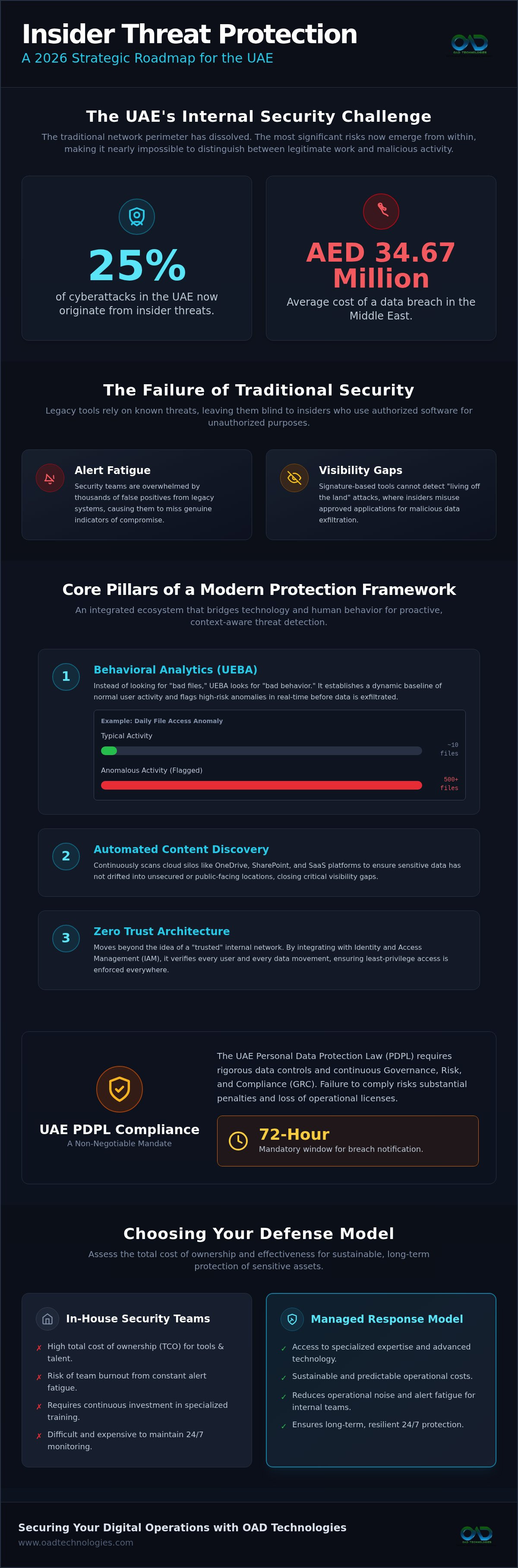
With 25% of cyberattacks in the UAE now originating from insider threats, the traditional network perimeter is no longer your most critical defense. It's often nearly impossible to tell the difference between a dedicated employee finishing a project and a malicious actor exfiltrating sensitive data. You've likely struggled with legacy monitoring tools that trigger endless false positives, creating more operational noise than actual security. Finding the right insider threat protection dubai requires a strategic shift from simple surveillance to a managed, human-centric resilience framework that empowers your team across your operations in the UAE rather than just watching them.
At OAD Technologies, we understand the pressure of maintaining high-performance operations while meeting the strict requirements of the UAE Personal Data Protection Law (PDPL). This guide provides a strategic roadmap for 2026, focusing on how behavioral analytics and Zero Trust identity architecture can secure your enterprise throughout the UAE. You'll learn how to gain full visibility of sensitive data movement across the national infrastructure and implement automated responses to high-risk anomalies. We'll examine the essential criteria for selecting a partner that aligns with national GRC frameworks, ensuring your digital operations remain both compliant and resilient in a complex threat landscape.
Key Takeaways
- Understand why the 2026 UAE PDPL landscape necessitates a move beyond traditional perimeter security toward an internal resilience model for hybrid workforces.
- Discover how the synergy between behavioral analytics and automated discovery forms the foundation of effective insider threat protection dubai for modern enterprises.
- Assess the total cost of ownership for in-house security versus managed response models to ensure sustainable, long-term protection of sensitive assets.
- Learn to implement Zero Trust principles by integrating Identity and Access Management (IAM) to verify every data movement across UAE national infrastructure.
- Explore how a collaborative, precision-engineered approach to policy design bridges the gap between high-level technical innovation and practical business outcomes.
The Evolution of Insider Threat Protection in the 2026 UAE Regulatory Landscape
The security perimeter has dissolved. In the UAE, where digital transformation moves at breakneck speed, the risk isn't just outside the gates. An insider threat can bypass the most expensive firewalls because they already have the keys. By 2026, the focus for enterprises has shifted from basic employee monitoring to a sophisticated model of data resilience. Effective insider threat protection dubai now requires a strategy that balances technical controls with the human element of risk. It's about empowering people while ensuring the integrity of the data they handle.
With Middle Eastern data breaches reaching an average cost of د.إ34,670,000, the stakes for national enterprises are higher than ever. It's not just about the immediate financial hit; it's about the erosion of trust within the national infrastructure. Organizations that fail to distinguish between legitimate work and malicious exfiltration face severe operational paralysis. The reputational damage in a market as interconnected as the UAE can be permanent, making advanced protection a business necessity rather than a technical luxury.
Navigating UAE PDPL and National Data Standards
The enforcement of the UAE Personal Data Protection Law (PDPL) has reached a critical stage in 2026. This federal mandate requires organizations to implement rigorous controls over sensitive personal data, with breach notifications mandatory within a 72-hour window. Achieving compliance isn't a one-time checkbox. It's a continuous process of Governance Risk and Compliance (GRC) that ensures data remains protected regardless of where it resides. Enterprises that ignore these standards risk substantial penalties and the loss of their license to operate within highly regulated sectors.
The Failure of Traditional Signature-Based Controls
Legacy security stacks often fall short because they rely on signatures of known malware. They don't recognize when a trusted user begins moving large volumes of data to a personal cloud storage account or an encrypted USB drive. This gap leads to two major problems:
- Alert Fatigue: Security teams are buried under thousands of false positives, causing them to miss actual indicators of compromise.
- Visibility Gaps: Signature-based tools can't see "living off the land" techniques where insiders use authorized software for unauthorized purposes.
Modern insider threat protection dubai solves this by moving toward context-aware behavioral analytics. Instead of looking for "bad files," these systems look for "bad behavior," identifying anomalies that suggest a departure from a user's standard work pattern. This proactive approach allows for automated intervention before data leaves the corporate ecosystem, ensuring that your most valuable assets remain secure without disrupting the flow of business.
Core Pillars of a Modern Insider Threat Protection Framework
A modern framework for insider threat protection dubai isn't just a collection of disconnected tools; it's an integrated ecosystem that bridges the gap between technical controls and human behavior. It relies on the deep synergy between User and Entity Behavior Analytics (UEBA) and traditional security layers. While legacy systems look for known signatures, UEBA builds a dynamic baseline of "normal" activity for every user and device within your network. When an employee who usually accesses ten files a day suddenly downloads five hundred from a sensitive directory, the system flags the anomaly in real-time. This proactive identification happens before any data leaves the network, providing a critical window for intervention.
Visibility must extend across the entire digital estate to be effective. Automated content discovery tools scan cloud silos like OneDrive, SharePoint, and specialized SaaS platforms to ensure sensitive data hasn't drifted into unsecured or public-facing folders. In the UAE's hybrid work environment, endpoint visibility serves as the final, essential layer. It ensures that even when users work remotely, their actions are logged and analyzed against established baselines. This comprehensive oversight allows enterprises to maintain a consistent security posture regardless of where their workforce is physically located.
Data Loss Prevention (DLP) as a Strategic Foundation
Effective Data Loss Prevention (DLP) manages risk across three critical states: data at rest, in motion, and in use. This ensures that whether information is stored in a local database, being transferred via email, or currently being edited, it remains under strict corporate control. We define "Data DNA" as the unique digital fingerprinting of sensitive UAE corporate assets that allows systems to recognize and protect intellectual property even if file names or formats are altered. Aligning these technical controls with global Insider Threat Mitigation frameworks ensures your resilience strategy meets the highest international standards.
Behavioral Analytics and Threat Detection
Machine learning plays a vital role in modern defense by drastically reducing the operational noise of false positives. By identifying "flight risk" indicators, such as a sudden surge in after-hours access or the installation of unauthorized shadow IT, the system can predict potential malicious intent. These behavioral signals shouldn't exist in isolation. Integrating them into a SIEM provides a unified view of your security posture, allowing your team to correlate insider activity with external threat intelligence. If you're looking to refine your internal defenses, OAD Technologies can help design a customized framework tailored to your specific operational needs.
Evaluating Solutions: Managed Services vs. In-House Security Teams
Decisions regarding insider threat protection dubai often come down to a choice between internal control and external expertise. While an in-house team offers direct oversight, the financial and operational reality in 2026 often favors a managed approach. Building a dedicated Security Operations Center (SOC) from scratch can cost an enterprise between د.إ4,400,000 and د.إ9,175,000 annually. This investment covers salaries for specialized analysts, high-end infrastructure, and around-the-clock coverage. In contrast, managed services provide comparable or superior resilience for a fraction of that cost. For larger or more regulated businesses in Dubai, a managed 24 X 7 SOC typically costs between د.إ240,000 and د.إ720,000 per year.
Visual communication is another effective way to reinforce these protocols; you can explore Safety Video production to make your internal safety training and risk management more impactful.
The Operational Burden of In-House Insider Risk Management
Finding analysts who understand the nuance of UAE PDPL and behavioral tuning is a significant challenge. In-house teams often spend a vast portion of their time triaging false-positive alerts, which leads to analyst burnout and missed threats. Without continuous optimization, security policies suffer from "policy drift," where the rules no longer align with evolving business processes. OAD Technologies rejects the standardized methodology. Instead, we act as a master designer, ensuring that your policies are as dynamic as the threats they aim to stop. This precision engineering prevents your security stack from becoming a bottleneck to productivity.
The Advantage of Managed Detection and Response (MDR)
A managed approach moves beyond the "alert-only" model that merely notifies you of a breach after the damage is done. Effective Managed Detection and Response (MDR) provides an active defense, where expert analysts intervene the moment a high-risk anomaly is detected. These providers leverage global threat intelligence, applying it specifically to the UAE's unique regulatory context. This creates a powerful synergy between DLP and active response. We position ourselves as a strategic extension of your CISO's team, bridging the gap between high-level innovation and practical business results. This partnership ensures that your insider threat protection dubai isn't just a software layer, but a long-term pillar of your digital relevance. It allows your internal staff to focus on growth while we handle the intricate details of data resilience.
Implementing Zero Trust Architecture for Data Resilience
Zero Trust has moved from a high-level concept to a regulatory necessity for enterprises. The core philosophy of "Never Trust, Always Verify" ensures that identity is never assumed, even for users physically present in a Dubai office. For organizations prioritizing insider threat protection dubai, this means every access request is validated against real-time context: time, location, device health, and historical behavior. By enforcing the principle of least privilege (PoLP), you ensure that employees only access the specific data required for their current tasks. Micro-segmentation then acts as a secondary barrier, containing potential breaches by preventing lateral movement across the UAE national infrastructure.
This architectural shift is essential because traditional security often grants too much trust once a user is authenticated. If an insider decides to move sensitive UAE corporate assets, a Zero Trust model requires them to re-verify their identity and intent at every stage of the data lifecycle. This continuous verification creates multiple friction points for malicious actors while remaining seamless for legitimate users. It transforms your security posture from a brittle shell into a resilient, multi-layered defense system that protects data at its most granular level.
Identity and Access Management (IAM): The First Line of Defense
Effective insider threat protection dubai relies on Identity and Access Management (IAM) as its primary engine. IAM provides the critical identity context that traditional data protection tools often lack. When an IAM system identifies a credential misuse pattern, such as a login from an unrecognized device during unusual hours, it can trigger an automated revocation of access rights. This synergy ensures that if an insider account is compromised, the path to exfiltration is blocked before damage occurs. To build a resilient Zero Trust architecture, partner with OAD Technologies for a customized security design that aligns with your specific operational workflow.
Securing the Multi-Cloud Ecosystem
Data sprawl across AWS, Azure, and local UAE cloud providers creates massive blind spots for security teams. Managing this complexity requires Cloud Security Posture Management (CSPM) to maintain unified policy enforcement across all environments. Visibility is the precursor to cloud data resilience. Without a clear view of where sensitive data lives in a multi-cloud ecosystem, protection is impossible. CSPM tools identify misconfigurations and unsecured data buckets that an insider might exploit, ensuring that your cloud presence remains as secure as your on-premises infrastructure. This unified approach prevents the accidental exposure of personal data, maintaining strict compliance with the UAE PDPL.
Securing the Future: The OAD Technologies Strategic Partnership
OAD Technologies operates as a strategic partner, not just a software vendor. We believe that effective insider threat protection dubai requires a departure from standardized, one-size-fits-all solutions that often create more friction than security. Our commitment to precision engineering ensures that every security control we implement is tailored to the specific operational realities of your business. We bridge the gap between high-level technological innovation and practical, measurable results. This collaborative approach allows us to act as an extension of your team, building a resilient framework that evolves alongside your organization's growth and the UAE's digital ambitions.
Our personality is defined by a proactive, solution-oriented mindset backed by rigorous engineering standards. We don't just install tools; we design systems that empower your workforce while safeguarding your most valuable assets. By anchoring our messaging in long-term viability, we position your enterprise to maintain its digital relevance in an ever-changing market. This strategy ensures that your security investments yield high returns in both operational performance and strategic expansion.
The OAD Methodology: Beyond Generic Templates
Generic security templates often fail because they don't account for the unique data flows and cultural nuances of a UAE enterprise. Our methodology prioritizes business-aligned data protection that empowers your people rather than restricting them. We utilize Vulnerability Assessment and Penetration Testing (VAPT) to rigorously validate your insider defenses from the perspective of a motivated actor. This technical validation ensures that your policies aren't just theoretical but practically effective against real-world exfiltration attempts. By combining human insight with advanced behavioral analytics, we create a synergy that identifies risks before they manifest as breaches.
A Roadmap to National Data Resilience
Securing your digital future requires a structured, multi-phase approach that avoids overwhelming your internal resources. We begin with an intensive discovery phase to identify your crown-jewel data and map its movement across your infrastructure. This allows us to design a phased implementation strategy that ensures zero business disruption while rapidly increasing your security posture. As UAE regulations continue to evolve throughout 2026, we provide continuous optimization services to keep your GRC framework perfectly aligned with federal mandates.
Our goal is to provide long-term viability for your digital operations. We invite you to collaborate with us on a comprehensive security roadmap that includes a detailed GRC audit and a customized insider threat protection dubai strategy. This proactive engagement ensures your enterprise remains a guardian of sensitive data within the UAE national infrastructure, maintaining both compliance and competitive advantage in an increasingly complex threat landscape.
Building Long-Term Digital Resilience in the UAE
The transition from basic surveillance to high-level data resilience is the defining security challenge for 2026. Successful enterprises in the UAE recognize that protecting sensitive data is no longer about restricting access, but about verifying intent at every digital touchpoint. By aligning Zero Trust principles with advanced behavioral analytics, you create a security posture that's both compliant and agile. Implementing insider threat protection dubai allows your organization to meet the rigorous demands of the PDPL while fostering a culture of accountability and innovation.
Our team serves as a strategic partner for national enterprise security, acting as specialized UAE PDPL compliance experts. We ensure seamless integration with MDR and SIEM ecosystems so your defenses remain unified and proactive. Secure your UAE digital assets with OAD Technologies’ Managed Resilience Framework. Your digital future depends on the synergy between human insight and technological precision; we're ready to help you shape it.
Frequently Asked Questions
What is the difference between insider threat protection and standard DLP?
Standard DLP primarily focuses on the data itself, using rules to block the movement of sensitive files. Insider threat protection adds a critical layer of behavioral context, analyzing the user's intent and history. While DLP stops the "what," insider threat solutions identify the "who" and "why," allowing your team to detect malicious or high-risk activity that standard signature-based tools frequently miss during encrypted cloud transfers.
How does the UAE Personal Data Protection Law (PDPL) affect insider risk management?
The PDPL mandates that organizations implement rigorous technical and organizational measures to secure personal data. It requires breach notifications within a 72-hour window from the moment of awareness. This legal framework transforms proactive monitoring from an optional security measure into a mandatory requirement for compliance. Organizations must maintain full visibility over data movement to ensure they meet federal standards for protecting the privacy of UAE residents.
Can insider threat solutions detect accidental data leaks by employees?
Yes, these systems are highly effective at identifying unintentional risks. By establishing a baseline of normal activity, the software can flag when an employee accidentally shares a sensitive file to a public folder or uses an unauthorized personal cloud account. This allows security teams to intervene and provide corrective training before a simple mistake evolves into a costly data breach that impacts national infrastructure.
How do behavioral analytics reduce false positives in security monitoring?
Behavioral analytics utilize machine learning to build a unique profile for every user and entity. Instead of triggering an alert for every large file transfer, the system only alerts when the activity deviates from that specific individual's established pattern. This intelligence drastically reduces the volume of irrelevant alerts, allowing your analysts to focus on genuine threats rather than wasting time on legitimate, high-volume business processes.
Is it better to manage insider threat protection in-house or via an MSSP?
For most Dubai enterprises, a managed approach offers superior resilience at a lower total cost. Building an in-house Security Operations Center (SOC) requires a multi-million dirham investment in specialized talent and infrastructure. An MSSP provides 24 X 7 expert tuning and incident response for a predictable fee. This strategic partnership allows your internal IT staff to focus on core business growth while experts manage the complexities of insider threat protection dubai.
Does insider threat protection impact employee privacy or system performance?
Modern protection frameworks utilize lightweight, non-intrusive agents that have zero impact on endpoint performance. These tools are designed to respect employee privacy by focusing on data movement and metadata rather than personal communications. When implemented correctly within the UAE's legal framework, these solutions protect the organization's intellectual property without infringing on the privacy rights of the workforce or slowing down critical business applications.
How often should insider threat policies be audited for UAE compliance?
You should conduct a formal audit of your security policies at least once a year. However, the rapidly changing regulatory landscape in the UAE often necessitates more frequent reviews. Integrating your protection tools with a continuous GRC framework allows for real-time policy adjustments. This ensures your data resilience strategy remains perfectly aligned with the latest federal mandates and evolving threat vectors throughout the 2026 calendar year.
What role does Zero Trust play in preventing data exfiltration?
Zero Trust architecture eliminates the concept of implicit trust within the network. It requires continuous verification of every user's identity, device, and intent before granting access to sensitive assets. By enforcing the principle of least privilege, Zero Trust ensures that even if an insider attempts to exfiltrate data, their movement is restricted to a very small segment of the network, preventing the lateral movement required for a large-scale breach.
Disclaimer
Content by OAD Technologies is for general informational purposes only and does not constitute professional or cybersecurity advice. No warranties are made regarding accuracy or completeness; reliance is at your own risk. OAD Technologies shall not be liable for any direct or indirect losses arising from use of this content.