

What if a network penetration test created more operational uncertainty than security insight? For UAE enterprises, network penetration testing UAE should begin with a clear view of business risk: which assets are in scope, what activity is authorised, and how critical systems will be protected during testing.
That caution is reasonable. A broad or poorly defined engagement can leave teams unsure whether important environments were covered, while a basic vulnerability scan may identify known weaknesses without showing how they could affect the wider network. A useful test needs a responsible scope and findings that technical teams can act on.
This guide explains how to define the networks and environments to include, set practical boundaries around business-critical systems, and understand what penetration testing can and cannot demonstrate. It also outlines how to assess the testing approach and final findings, so your organisation can distinguish meaningful security insight from a list of scan results. With a defined scope, OAD Technologies can discuss network testing requirements as part of its Vulnerability Assessment and Penetration Testing services.
Key Takeaways
- Define the business objective and authorised scope before testing, including which assets are in and out.
- Understand how network penetration testing UAE differs from vulnerability scanning: it validates agreed scenarios rather than simply flagging potential weaknesses.
- Prepare by identifying critical services, asset owners, system dependencies and exclusions, so the engagement reflects operational priorities.
- Assess findings in context: evidence of exploitability can help teams judge business relevance and plan proportionate remediation.
- Agree reporting, review and any retesting expectations with the provider before the engagement begins.
What Does Network Penetration Testing in the UAE Actually Assess?
Network penetration testing is an authorised assessment of specified network security exposure. It examines whether selected weaknesses can be validated in context, rather than simply detected by a scan. The aim is to understand what an issue could allow within the agreed boundaries, not to test every system an organisation operates. A foundational overview of the Penetration test explains the broader concept and its common stages.
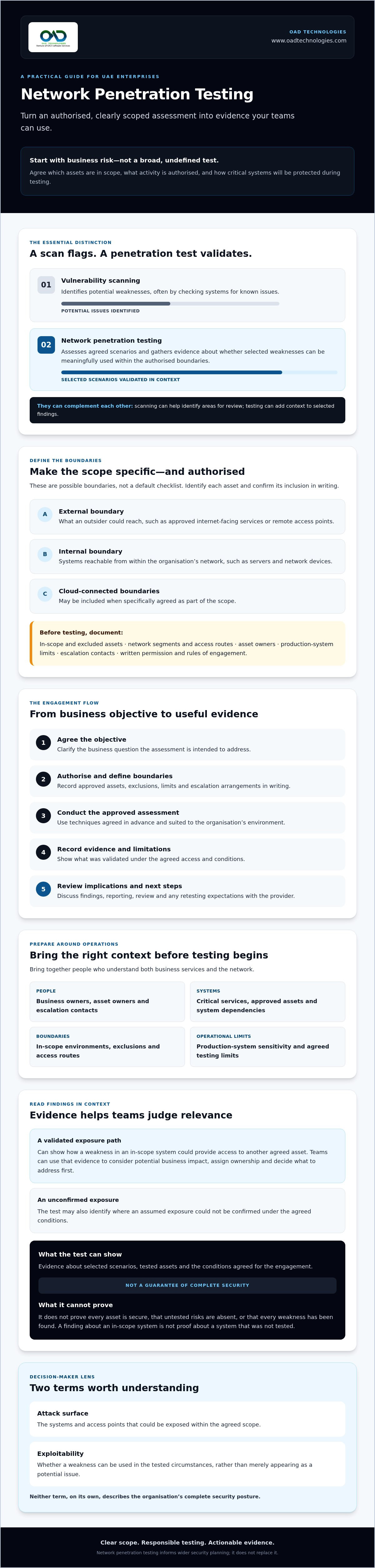
For organisations considering network penetration testing UAE, the distinction from vulnerability scanning matters. A scan identifies potential weaknesses, often by checking systems for known issues. A penetration test assesses agreed scenarios to gather evidence about whether those weaknesses can be meaningfully used. The approaches can complement each other: scanning can help identify areas for review, while testing can add context about selected findings.
Which network environments might fall within scope?
An external boundary is what an outsider could reach from outside the organisation, such as approved internet-facing services or remote access points. An internal boundary concerns systems reachable from within the organisation’s network, such as servers and network devices. A scope might also include agreed cloud-connected boundaries. These are examples, not a default checklist: every asset must be identified and included through written authorisation and confirmed scope.
Before work begins, stakeholders should clarify which network segments, devices, servers and access routes are in scope, who owns them, and what is explicitly excluded. This helps align the assessment with business priorities and reduces ambiguity about what the testing is authorised to examine.
What can a network penetration test tell decision-makers?
Validated findings can show a plausible exposure path, such as how a weakness in an in-scope system could provide access to another agreed asset. That evidence helps technical teams and leaders consider potential business impact, assign ownership and decide what to address first. The test can also identify where an assumed exposure could not be confirmed under the agreed conditions.
A network penetration test validates selected security scenarios within an authorised scope; it does not prove that every asset is secure or that untested risks are absent.
Read findings with their evidence and limitations. An observation about an in-scope server is not proof about a system that wasn’t tested, and a potential impact should not be presented as an observed outcome unless the evidence supports it. Results reflect the assets, access and conditions agreed for the engagement. They inform wider security planning, but don’t establish the organisation’s complete security posture or guarantee that all weaknesses have been found.
How Network Penetration Testing Works: Scope, Validation, and Evidence
A useful engagement follows a clear sequence: agree the business objectives, document authorisation and boundaries, conduct the approved assessment, record evidence, then review findings and their implications. The exact techniques depend on the organisation’s environment and must be agreed in advance. The NIST Technical Guide to Information Security Testing provides a general reference for planning and conducting security testing; it isn’t a substitute for defining the requirements of a particular UAE organisation.
Two terms help decision-makers assess what a proposed engagement is designed to establish. The attack surface is the set of systems and access points that could be exposed within the agreed scope. Exploitability describes whether a weakness can be used in the tested circumstances, rather than merely appearing in a list of potential issues. Neither term, on its own, describes the organisation’s complete security posture.
How should an organisation define a safe, authorised scope?
Start by bringing together the people who understand both the business services and the network. Identify the business owners, approved assets, excluded systems and escalation contacts. Clarify whether production systems are in scope and agree any limits that reflect their sensitivity. These decisions should be specific to the environment, not assumed from a standard package.
Record permission and rules of engagement in writing before testing begins. They should make clear what is authorised, which boundaries apply, and whom to contact if an unexpected issue arises. For network penetration testing UAE organisations should also confirm that the relevant asset owners have approved any systems included in the scope. Clear agreement helps prevent mistaken assumptions about access or authority.
How are findings supported by evidence?
A theoretical weakness is a possible issue that hasn’t been confirmed in the agreed conditions. A verified observation has evidence showing what was identified and, where authorised, what could be demonstrated. A report should distinguish those categories, explain the relevant limitations, and provide enough context for the organisation to understand and review the finding.
Useful evidence supports a technical team’s ability to reproduce or investigate an issue without exposing unnecessary sensitive information. It might describe the affected asset, the observed condition and the test context, with sensitive details handled appropriately. The organisation and provider should agree how evidence will be documented and shared, particularly where it contains operational or confidential information.
Scope and evidence determine how much a finding can support a decision. A confirmed issue on one approved asset doesn’t automatically establish exposure across connected systems, and an untested area remains unassessed. Organisations considering a defined engagement can discuss network testing requirements with OAD Technologies, which lists Vulnerability Assessment and Penetration Testing among its services.
Network Penetration Testing vs Vulnerability Scanning: What Should You Compare?
Scanning and penetration testing answer different security questions. A vulnerability scan identifies potential weaknesses across defined assets; a penetration test assesses selected scenarios within an authorised scope to establish whether those weaknesses can be validated in the agreed conditions. The NIST definition of penetration testing offers a useful reference point, but the value of either activity depends on how its scope, configuration and objectives fit your environment.
| Comparison | Vulnerability scanning | Penetration testing |
|---|---|---|
| Purpose | Identify potential weaknesses across specified assets. | Assess agreed scenarios to understand whether selected weaknesses can be validated. |
| Evidence | Produces findings that may need investigation to confirm relevance. | Records evidence from the agreed assessment, including what was and wasn’t demonstrated. |
| Human validation | Primarily identifies possible issues; the level of review depends on the activity. | Uses assessment and analysis to validate selected issues within scope. |
| Typical decision use | Help identify areas for remediation or further investigation. | Help understand exposure paths and prioritise responses to validated findings. |
When is scanning useful, and when is penetration testing useful?
Scanning can help teams review potential weaknesses across a defined set of network assets. Testing is useful when decision-makers need evidence about specific concerns, such as whether a weakness in an approved system could expose another in-scope asset. For network penetration testing UAE organisations should choose based on the business question, asset exposure and evidence needed, not on the assumption that one activity replaces the other.
Neither activity replaces security governance or continuous monitoring. A scan or test provides information within its own scope and conditions; it doesn’t establish how risks are managed over time or reveal every issue across the organisation.
How should leaders interpret severity and business impact?
Technical severity describes characteristics of a weakness, while business impact depends on the affected service, its role and the organisation’s exposure. CVSS can provide a consistent technical reference, but it shouldn’t be treated as a complete business-risk decision. Leaders should consider evidence alongside asset importance, dependencies and operational context.
Technical severity describes the weakness; organisational priority reflects its relevance to the business. Ask whether a finding was validated, which assets it affects, and what evidence supports the proposed impact before setting remediation priorities. OAD Technologies lists Vulnerability Assessment and Penetration Testing among its services; organisations can discuss network testing requirements when assessing a defined engagement.
How to Prepare for a UAE Network Penetration Test
A well-prepared engagement starts with shared clarity, not a technical checklist alone. For network penetration testing UAE organisations should align the test with business priorities, identify the people responsible for the relevant systems, and agree how the work will be authorised and communicated. These steps help ensure the assessment addresses the right questions without leaving important operational assumptions unresolved.
What should stakeholders agree before testing begins?
Before work is authorised, bring together business service owners, network or system owners, and the people responsible for coordinating the engagement. Confirm:
- Objectives: What business or security question should the assessment help answer?
- Assets and boundaries: Which network devices, servers, remote access points or connected environments are included?
- Exclusions and dependencies: Which systems are out of scope, and do any in-scope assets support business-critical services?
- Authority and change control: Who can approve the scope, and who can authorise a change if the proposed boundaries need to be revisited?
- Communications and escalation: Which stakeholders need to know about the test, and whom should the provider contact if an unexpected issue arises?
- Evidence handling: How should sensitive information gathered during the assessment be documented, shared and protected?
Document authorisation and rules of engagement in writing. Discuss production-system sensitivity and agree appropriate limits for the specific environment rather than assuming a standard procedure applies. If the organisation has sector-specific or regulatory expectations, confirm them against authoritative, current sources before treating them as requirements. Don’t assume that a test by itself demonstrates compliance.
What should a useful report contain?
Agree reporting expectations with the provider before the engagement. A decision-useful report should make it possible to understand what was assessed, what the evidence supports, and where the boundaries of the conclusions lie. Ask whether findings will identify the affected scope, explain the observed issue, and provide practical context to help technical teams assess remediation.
Look for a clear distinction between confirmed findings, potential weaknesses that weren’t validated, and areas that weren’t tested. Evidence should support investigation without exposing unnecessary confidential information. Ask how the report will describe limitations, dependencies or conditions that could affect interpretation. Don’t assume a particular format, deliverable or retesting activity is included; confirm what the provider will supply and agree any additional review requirements in advance.
OAD Technologies lists Vulnerability Assessment and Penetration Testing among its services. To discuss a defined scope, discuss your requirements or book a meeting.
Turning Network Penetration Testing Findings into a Security Plan
Test findings become useful when they lead to accountable decisions. For network penetration testing UAE organisations, the next step is to review each confirmed observation alongside its evidence and business context, then decide who owns the response and how progress will be tracked. A technically serious weakness may affect a lower-priority asset, while a less severe issue on a business-critical service may warrant prompt attention.
How should teams prioritise and track remediation?
Assess each finding using factors such as whether it was validated, how exposed the affected asset is, the importance of the service it supports, and what existing controls may reduce or change the risk. Technical severity can inform the discussion, but it shouldn’t dictate priority on its own.
Assign an accountable owner and record the agreed action, rationale and status through the organisation’s established governance process. Where remediation cannot happen immediately, document the decision and how the issue will be reviewed. Ask the provider whether retesting is available, what it would cover, and whether it’s included in the agreed engagement. Don’t assume a fix has been independently verified unless that has been confirmed. Remediation can reduce identified exposure, but it doesn’t guarantee security or regulatory compliance.
Network findings may also inform broader Vulnerability Assessment and Penetration Testing priorities by highlighting areas that warrant further review. For a wider comparison of assessment approaches, see the Vulnerability Assessment and Penetration Testing enterprise guide.
How can a business assess a potential testing provider?
Ask prospective providers to explain how they would define objectives, scope, written authorisation, exclusions and evidence expectations for your environment. Clarify how findings and limitations will be reported, what the proposed assessment can demonstrate, and how any retesting would be agreed. Ask for relevant experience and details of proposed capabilities, then verify these directly rather than relying on assumptions or broad claims.
OAD Technologies lists Vulnerability Assessment and Penetration Testing and Network Security Solutions among its offerings. A discussion can help clarify whether your requirements fit a defined testing engagement and what needs to be agreed before proceeding.
To explore your next steps, book a meeting or discuss your requirements.
Make Your Next Network Test Count
Effective network penetration testing UAE organisations can rely on starts with a clear purpose: validate agreed security scenarios, protect operational priorities through careful scoping, and produce evidence that supports informed decisions. The findings are most useful when teams connect them to business impact, assign ownership, and track remediation through established governance.
Remember, a test reflects its authorised scope and conditions. It can inform wider security planning, but it can’t demonstrate that every asset is secure or replace ongoing risk management. Agree reporting expectations and whether any retesting is included directly with the provider.
OAD Technologies lists Vulnerability Assessment and Penetration Testing (VAPT) and Network Security Solutions among its services. Confirm the specific engagement scope and proposed capabilities before proceeding. To explore how your requirements could be defined, discuss your network testing requirements.
With clear objectives and actionable evidence, your organisation can turn testing into a considered step towards stronger security decisions.
Frequently Asked Questions
What is network penetration testing?
Network penetration testing is an authorised assessment of specified network assets to determine whether selected weaknesses can be validated within agreed boundaries. It can help an organisation understand how an issue might expose an in-scope system or service, based on the evidence gathered under the test conditions. It doesn’t cover assets outside the agreed scope or prove that the entire network is secure.
Is network penetration testing the same as vulnerability scanning?
No. Vulnerability scanning identifies potential weaknesses across defined assets, while a penetration test assesses agreed scenarios to see whether selected weaknesses can be validated. The two activities can complement each other: scanning can flag issues for review, and testing can provide evidence about specific concerns. Their value depends on the assets, configuration and objectives agreed for each activity. Neither replaces wider security governance or continuous monitoring.
Can a network penetration test disrupt business operations?
Testing could affect operations, depending on the techniques, assets and conditions involved. Before work begins, identify production systems and business-critical services, confirm exclusions, and agree limits and escalation contacts with the provider. Ensure relevant asset owners understand the authorised scope and communications plan. These planning steps help manage operational considerations, but organisations should discuss potential impacts directly rather than assume a test carries no disruption risk.
How often should a UAE organisation conduct network penetration testing?
There’s no single testing frequency that suits every organisation. Consider the network’s risk, significant infrastructure or configuration changes, previous findings, and the business importance of exposed services when deciding when to reassess. If your organisation operates under sector-specific or regulatory expectations, verify applicable testing requirements with an authoritative current source. Set a review cadence that fits your environment, and confirm the scope and objectives for each engagement.
What should a network penetration testing report include?
A useful report should describe the objectives and scope, identify affected assets, explain findings and supporting evidence, and distinguish validated issues from theoretical weaknesses. It should also make clear what wasn’t tested and any limitations that affect interpretation. Look for practical remediation context that helps teams decide what to address. Confirm the expected report contents with the provider before the engagement, as format and deliverables can vary.
What happens after a network penetration test identifies a weakness?
Review the evidence and business context, then assign an accountable owner and track agreed remediation through your organisation’s established governance. Consider exploitability, asset exposure, service criticality and existing controls when setting priority. A completed fix doesn’t by itself establish that the issue has been independently verified. Ask the provider whether retesting is available and agree its scope and terms in advance. Findings can also inform broader Vulnerability Assessment and Penetration Testing planning.
Disclaimer
Content by OAD Technologies is for general informational purposes only and does not constitute professional or cybersecurity advice. No warranties are made regarding accuracy or completeness; reliance is at your own risk. OAD Technologies shall not be liable for any direct or indirect losses arising from use of this content.