

Buying enterprise data loss prevention software solves almost nothing on its own. While standard inspection engines flag data movement, un-tuned rules quickly drown security teams in false positives and disrupt business-critical employee workflows. This operational friction is why forward-thinking organizations rely on managed dlp services to bridge the gap between static software licenses and continuous, human-led governance.
You likely already feel the strain of constant alert fatigue alongside the extreme scarcity of specialized data governance engineers. When heavy-handed default policies interrupt daily productivity, internal teams face pressure to dial back enforcement, introducing major operational risks under demanding national data protection regulations.
Discover how managed DLP services eliminate alert fatigue, ensure national regulatory compliance, and protect sensitive enterprise data across endpoints, networks, and cloud environments. This guide breaks down modern service architectures, practical evaluation benchmarks, and the operational models needed to select the right partner for your organization in 2026.
Key Takeaways
- Discover why enterprise data governance requires managed dlp services to resolve chronic alert fatigue and refine policies without disrupting daily employee productivity.
- Explore the core architectural pillars needed to establish complete visibility across cloud applications, network egress points, and local endpoints.
- Compare the hidden operational friction of in-house administration and open-source tooling against the stability of an ongoing security partnership.
- Master a rigorous provider evaluation framework centered on practical deployment timelines, false-positive suppression, and escalation workflows.
- Learn how human-led engineering pairs with automated controls to maintain continuous alignment with national data protection regulations.
What Are Managed DLP Services and Why Do Enterprises Need Them?
Many organizations purchase sophisticated security platforms under the assumption that automation handles everything. In reality, traditional data loss prevention (DLP) software simply identifies movement based on static rules. Without continuous administrative intervention, that baseline capability provides little defensive value. Enterprise data governance requires consistent policy evolution, false-positive suppression, and incident triage. This operational demand is why adopting managed dlp services has shifted from a convenience to an architectural necessity.
The Core Definition of Managed Data Loss Prevention
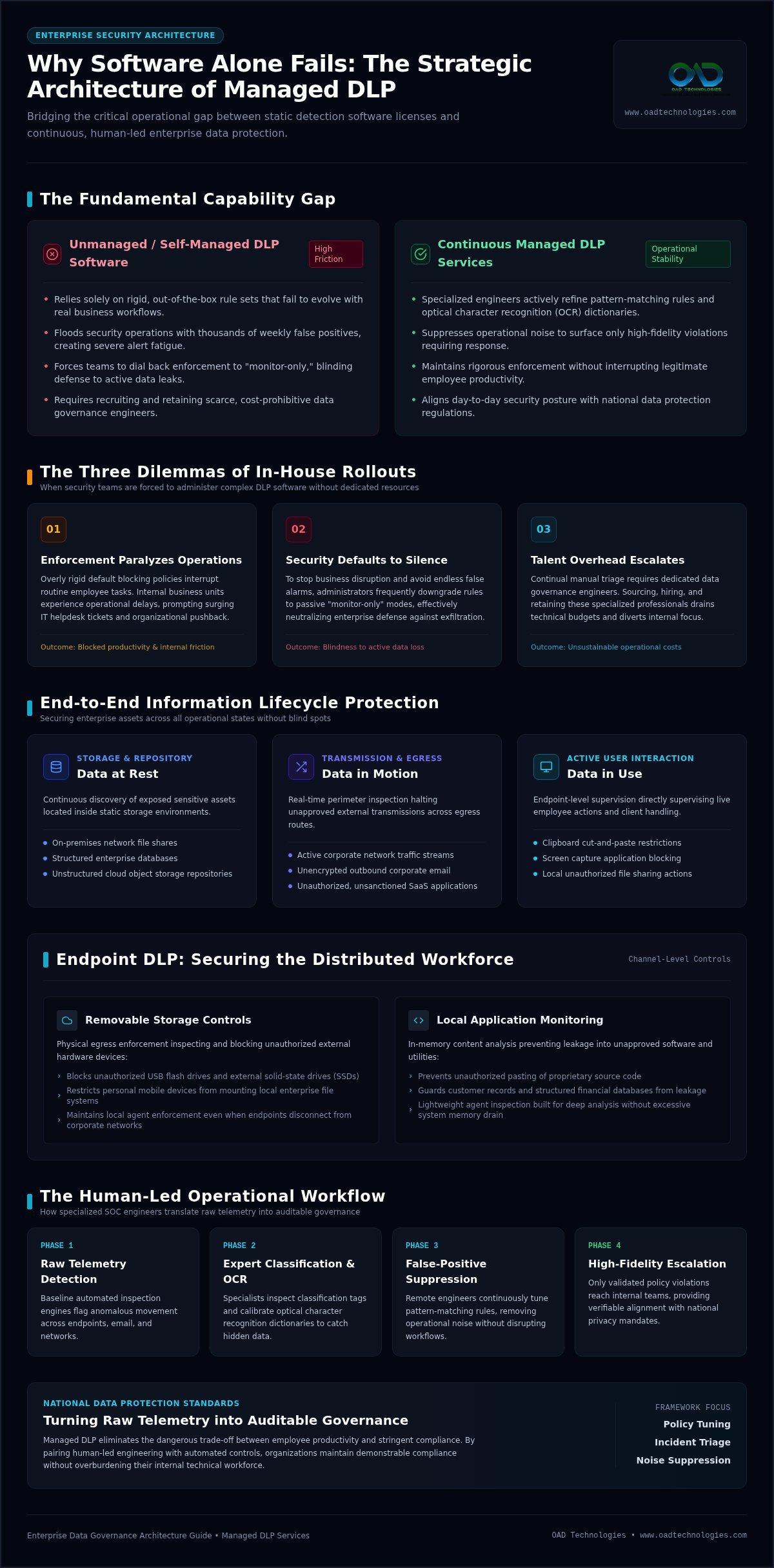
Managed DLP operates as an outsourced security discipline that oversees data identification, rule tuning, incident triage, and remediation. Instead of leaving internal teams to manage complex agent configurations, a managed service provider acts as an operational extension of your security operations center. Specialized engineers inspect classification tags, validate true risks, suppress operational noise, and escalate only high-fidelity policy violations that warrant immediate enterprise response.
The Reality of Software Fatigue in Self-Managed DLP
Unmanaged DLP rollouts often collapse under operational friction. Out-of-the-box rule sets trigger thousands of notifications each week, overwhelming internal analysts. When security teams face endless false positives, they usually respond in one of two ways:
- Enforcement paralyzes operations: Rigid blocking rules interrupt legitimate employee workflows, generating helpdesk tickets and frustrating business unit leaders.
- Security defaults to silence: Administrators revert strict controls back to monitor-only settings, blinding the enterprise to active data exfiltration.
- Talent overhead escalates: Recruiting and retaining full-time data governance engineers places an unsustainable drain on technical budgets.
Managed dlp services eliminate this dilemma. Remote specialists continually refine pattern-matching rules and optical character recognition dictionaries, ensuring enforcement remains precise without impeding daily employee productivity.
Coverage Across the Modern Enterprise Attack Surface
Hybrid operating models have dissolved the traditional security perimeter. Corporate assets constantly traverse endpoint operating systems, cloud-based productivity suites, and web gateways. Effective managed governance secures every state of the information lifecycle:
- Data at rest: Scanning on-premises file shares, databases, and unstructured cloud object storage to discover exposed confidential records.
- Data in motion: Inspecting network traffic, unencrypted outbound email, and unauthorized SaaS platforms to stop unsanctioned transfers.
- Data in use: Restricting clipboard copying, screen capture utilities, and unsanctioned file sharing directly at the user endpoint.
Modern service providers align these enforcement layers with comprehensive data loss prevention architectures. This structured oversight establishes demonstrable compliance with stringent national privacy mandates, turning raw telemetry into auditable governance.
The Architectural Pillars of a Modern Managed DLP Solution
Effective data governance requires more than isolated inspection tools. A resilient architecture unites multiple enforcement layers into a single operational fabric. Modern managed dlp services orchestrate these layers to track information across endpoints, corporate network perimeters, and multi-tenant SaaS environments, ensuring security teams maintain end-to-end oversight without blinding operational gaps.
Endpoint DLP: Securing the Distributed Workforce
Laptops and mobile workstations represent the most volatile egress points in modern enterprises. Distributed operations demand lightweight endpoint agents capable of deep content analysis without consuming excessive system memory. These local agents enforce governance rules even when devices disconnect from corporate networks, monitoring critical physical and virtual egress channels:
- Removable storage controls: Blocking unauthorized USB flash drives, external solid-state drives, or personal mobile devices from mounting file systems.
- Local application monitoring: Preventing users from pasting confidential source code, financial databases, or customer records into unvetted chat utilities and generative AI tools.
- Physical output interception: Disabling unauthorized screen capture utilities, print-to-PDF drivers, and physical printing protocols when sensitive files are open.
Network and Cloud Perimeter Data Controls
While endpoint controls govern user manipulation, network perimeter inspection secures enterprise communication pipelines. Automated inspection appliances sit directly at egress points to analyze outbound traffic, examining corporate email attachments, unencrypted web uploads, and secure file transfer protocols in real time.
Data governance must also encompass enterprise cloud ecosystems. Managed DLP architectures integrate directly with productivity suites like Microsoft 365 and Google Workspace through API connectors. This cloud access security brokerage monitors automated synchronization routines and public file-sharing links. When coupled with cloud security posture management (CSPM), engineering teams can continuously verify that shared cloud repositories, object storage buckets, and collaborative workspace permissions remain tightly restricted.
Intelligent Data Discovery and Classification
Protection policies fail if an organization cannot accurately identify its most valuable information. Modern platforms combine several classification techniques to eliminate ambiguity:
- Exact Data Matching (EDM): Hashing structured databases to identify proprietary client identification numbers or financial accounts with zero margin for error.
- Indexed Document Matching (IDM): Creating cryptographic fingerprints of proprietary documents, blueprints, and intellectual property records.
- Contextual machine learning: Evaluating user behavior, file metadata, and linguistic context to distinguish between routine business communication and unauthorized exfiltration attempts.
Automated algorithms often stumble over industry nuances. A specialized team from OAD Technologies provides the ongoing human engineering required to validate classification dictionaries, triage anomalies, and maintain high-fidelity controls across complex enterprise ecosystems.
In-House Management vs. Open-Source vs. Managed DLP Services
Selecting an operating model for enterprise data protection involves balancing capital investment against continuous operational risk. Organizations generally evaluate three distinct paths: maintaining an internal engineering team, assembling community open-source utilities, or enlisting specialized managed dlp services. Understanding the true resource allocation of each path prevents costly architectural restarts later.
Evaluating the Viability of Open-Source DLP Solutions
Community-driven scripts and open-source scanning tools hold obvious appeal for technical teams seeking to eliminate licensing overhead. Tools focused on repository secret detection or local pattern matching perform well within isolated development workflows. However, scaling these utilities across an enterprise introduces severe functional deficits:
- Missing endpoint agents: Community projects rarely support low-footprint, cross-platform kernel agents capable of real-time egress blocking.
- Fragile maintenance lifecycles: Internal developers must write, test, and maintain custom detection scripts whenever third-party cloud APIs change.
- Compliance reporting voids: Open tooling lacks verifiable audit trails, tamper-proof logging, and structured reporting aligned with national data privacy mandates.
The Operational Realities of In-House DLP Administration
Managing commercial software entirely in-house grants total direct control, but it carries immense operational overhead. Dedicated data custodians require ongoing technical certification. When high-tier talent turns over, customized classification policies lose context, leaving the security program vulnerable during transition periods.
The daily burden of alert triage also exacts a strategic toll. High-value cybersecurity personnel frequently spend their working hours validating false alerts rather than fortifying defensive postures. This reactive posture slows down enterprise project velocity and burns out talented staff.
The Strategic Advantages of the Managed Service Model
Partnering with an external provider converts unmanageable administrative friction into a predictable governance lifecycle. The managed approach delivers clear operational differentiators:
- Continuous specialist triage: Dedicated analysts evaluate policy exceptions, stopping unauthorized exfiltration attempts occurring outside local operating hours.
- Collective threat intelligence: Providers observe exfiltration patterns across numerous environments, instantly applying updated classifiers to prevent emerging zero-day extraction techniques.
- Rapid deployment velocity: Rather than spending eighteen months on exploratory internal tuning, structured onboarding templates establish audited policy baselines within weeks.
Adopting managed dlp services doesn't mean surrendering internal authority. Modern co-managed models handle baseline data discovery, policy refinement, and frontline alert verification while leaving final remediation authorizations firmly in the hands of enterprise stakeholders.
How to Evaluate and Select a Managed DLP Provider
Evaluating external partners requires looking past sales demonstrations and marketing claims. A provider must prove their operational capability to safeguard sensitive information without paralyzing day-to-day enterprise productivity. When vetting candidates for enterprise managed dlp services, technical leaders should measure prospective partners against three non-negotiable architectural benchmarks: telemetry integration, operational response commitments, and localized regulatory proficiency.
Ecosystem Integration: SIEM, EDR, and IAM Interoperability
Isolated data protection tools create visibility blind spots. A capable provider ensures policy telemetry integrates directly with your existing enterprise defense stack:
- Centralized telemetry ingestion: Providers must stream structured DLP logs directly into your SIEM deployment to correlate data exfiltration attempts against broader threat behaviors.
- Automated host containment: High-severity data events should instantly feed managed detection and response (MDR) playbooks, isolating compromised workstations before unauthorized transfers finalize.
- Identity correlation: The service should validate activity against enterprise directory services and access management tools, tracking whether anomalous movements originate from compromised privileged credentials.
Operational SLAs and Incident Escalation Protocols
Operational contracts must deliver contractual accountability rather than vague operational promises. Demand clear definitions for severity classifications and measurable response times for active intellectual property exfiltration. Inquire about the exact tier of analysts reviewing alerts, ensuring your internal team doesn't inherit basic triage duties.
Equally critical are agreed protocols for policy changes. When a standard rule disrupts legitimate operational tasks, the provider needs a defined pathway to tune classifications during core business hours without compromising broader defensive posture.
National Regulatory and Compliance Expertise
Deploying managed dlp services within the United Arab Emirates introduces distinct regulatory mandates. Providers must show deep familiarity with local legal frameworks, particularly the UAE Personal Data Protection Law (PDPL). This requires strict data residency controls to ensure that inspection telemetry, metadata, and user logs remain within domestic borders.
Finally, confirm that reporting outputs map cleanly into broader governance, risk, and compliance (GRC) audit cycles, transforming raw inspection data into auditable regulatory documentation.
Ready to benchmark your enterprise data governance against modern operational threats? Connect with the data protection specialists at OAD Technologies to design a resilient governance architecture tailored to your infrastructure.
Operationalizing Enterprise Data Protection with OAD Technologies
Transitioning from conceptual data defense to production enforcement requires strategic engineering, not just software installation. OAD Technologies serves as an enterprise cybersecurity partner across the United Arab Emirates, delivering specialized managed dlp services that combine automated telemetry with rigorous human analysis. By treating data governance as a collaborative lifecycle, organizations achieve continuous visibility across complex environments without disrupting everyday business operations.
The OAD Technologies Phased Deployment Methodology
Aggressive default enforcement often triggers operational resistance. To prevent business disruption, deployments follow a structured three-phase engineering framework:
- Phase 1: Passive asset discovery: Deploying sensors across endpoints, file stores, and cloud environments in monitor-only mode to locate unclassified data repositories and map standard business communication routes.
- Phase 2: Collaborative policy authoring: Collaborating directly with enterprise business unit owners to define exact classification boundaries, test matching patterns, and tune out false positives.
- Phase 3: Phased active enforcement: Applying progressive blocking controls, user educational prompts, and automated containment rules only after validation confirms zero disruption to approved business workflows.
Unified Defense: Bridging Data Protection and Threat Response
Standalone data alerts rarely tell the entire security story. OAD Technologies embeds data movement telemetry directly into broader enterprise security workflows. When an unauthorized egress attempt occurs, engineers cross-reference identity contexts, endpoint telemetry, and network flows to identify whether the event indicates malicious insider activity, unintentional employee negligence, or an active external credential compromise.
This integrated operational approach provides dual-level reporting. Executive dashboards translate technical trends into measurable risk reductions for C-level leadership, while granular audit logs satisfy national data sovereignty mandates and regulatory examinations.
Initiating Your Data Governance Roadmap
Embarking on a managed data governance journey starts with an objective baseline. Senior security engineers assess your current technical architecture, map regulatory exposure under national frameworks, and pinpoint critical data blind spots across your network, endpoint, and cloud assets.
Establishing full data governance is a systematic progression. Through a structured assessment and deployment roadmap, organizations can transition from fragmented visibility to mature, auditable enforcement within predictable timeframes. Schedule an enterprise data risk consultation with OAD Technologies to fortify your organization's sensitive data assets against modern exfiltration risks.
Securing Your Enterprise Data Frontier with Confidence
Data protection is no longer about deploying standalone tools and hoping for the best. Sustainable resilience requires transforming noisy alert queues into an active, disciplined operational workflow. Choosing managed dlp services frees internal technical teams from chronic alert fatigue while ensuring continuous visibility across distributed endpoints, network perimeters, and collaborative cloud storage.
True operational success relies on three critical pillars: specialized national security operations engineering, unified telemetry integration across SIEM, EDR, and IAM stacks, and rigorous alignment with national data protection laws. When human expertise guides automated controls, security stops being an impediment and becomes an enabler of frictionless business growth.
You don't have to navigate data governance challenges alone. Partner with OAD Technologies for Managed Data Loss Prevention to fortify your sensitive assets, streamline compliance, and build a resilient digital enterprise that thrives with complete confidence.
Frequently Asked Questions
How do managed DLP services differ from endpoint detection and response (EDR) solutions?
EDR secures endpoints against malware, unauthorized processes, and active cyberattacks, while managed dlp services focus specifically on governing sensitive content movement. EDR identifies how an adversary infiltrates a workstation, whereas DLP evaluates what confidential data users interact with, share, or extract. Integrating both creates a layered defense; if an endpoint exhibits suspicious activity, data policies can preemptively lock down outbound file transfers so data doesn't leak.
Can managed DLP services protect sensitive data without violating employee personal privacy?
Yes, enterprise policies selectively inspect corporate data without monitoring personal activities. Modern architectures use strict content definitions, cryptographic hashing, and application boundary rules to ignore personal browsing, banking, and private messaging. Telemetry logging can also pseudonymize user identifiers during initial triage, ensuring security analysts evaluate potential violations based entirely on risk parameters rather than monitoring individual employee behavior.
What happens when a managed DLP platform detects an unauthorized data transfer attempt?
The platform enforces predefined actions based on policy severity and business context. High-risk actions, like uploading source code or unencrypted customer databases to unauthorized cloud storage, trigger real-time blocks and educate the user via endpoint popups. Concurrently, the platform alerts managed analysts who evaluate contextual metadata, eliminate false alarms, and escalate verified security incidents to designated enterprise stakeholders.
Are managed DLP services suitable for organizations undergoing strict national regulatory audits?
Yes, managed DLP services provide continuous documentation required to satisfy national regulatory scrutiny, including the UAE Personal Data Protection Law. Providers maintain detailed audit logs, policy enforcement records, and data residency controls showing exactly where sensitive records reside and how they travel. This operational evidence demonstrates active governance to external auditors, replacing manual evidence gathering with defensible, system-generated compliance reporting.
How long does it typically take to transition an enterprise to a managed DLP service?
A typical enterprise rollout requires approximately six to twelve weeks, depending on existing infrastructure complexity and data sprawl. The initial weeks focus on agent deployment and passive discovery to map data repositories without user intervention. The following phase refines classification rules and eliminates operational false positives, ensuring that active blocking rules take effect smoothly without disrupting ongoing business workflows.
Will implementing managed DLP policies disrupt normal daily business operations and file sharing?
Properly phased deployments avoid business disruption entirely. Providers prevent operational paralysis by launching in passive monitoring mode, analyzing standard communication patterns before turning on active controls. Custom policies incorporate self-service justification prompts for legitimate business exceptions, allowing authorized personnel to complete urgent tasks while maintaining full accountability and alerting analysts to anomalous behavior.
Can managed DLP solutions monitor data across unmanaged personal devices in hybrid environments?
Yes, through agentless cloud access controls and identity integration. While personal devices can't run enterprise endpoint agents, managed platforms monitor access through cloud application APIs and reverse proxies. When an employee accesses corporate repositories like Microsoft 365 from an unmanaged laptop, the system can restrict document downloads, enforce read-only access, or block copy-paste actions directly within the browser session.
Disclaimer
Content by OAD Technologies is for general informational purposes only and does not constitute professional or cybersecurity advice. No warranties are made regarding accuracy or completeness; reliance is at your own risk. OAD Technologies shall not be liable for any direct or indirect losses arising from use of this content.