

A security provider that forwards an uncontextualized ticket at 2:00 AM isn't defending your infrastructure; they're simply transferring operational liability. For engineering teams overwhelmed by endless log noise, knowing exactly when to switch from mssp to mdr marks a crucial strategic inflection point. You already recognize the frustration of funding continuous monitoring, only to shoulder the actual burden of off-hours threat triage and containment within your own overworked internal staff.
In this guide, you'll discover the exact operational triggers, evaluation criteria, and migration steps needed to graduate from passive alert forwarding to proactive, human-led threat containment. We examine how to dramatically reduce your Mean Time to Detect (MTTD) and Mean Time to Respond (MTTR), satisfy rigorous compliance scrutiny, and execute a clear roadmap for phasing out outdated monitoring agreements without disrupting enterprise telemetry.
Key Takeaways
- Understand the architectural shift from passive alert forwarding to outcome-driven, proactive threat containment across modern hybrid environments.
- Identify the five operational friction points that signal precisely when to switch from mssp to mdr to stop analyst burnout and resolve internal alert fatigue.
- Evaluate managed providers using concrete enterprise benchmarks that demand codified response authority, identity correlation, and integrated endpoint telemetry.
- Deploy a phased migration methodology to phase out legacy monitoring contracts without introducing visibility gaps or off-hours operational vulnerabilities.
- Align technical assessments and active containment playbooks with rigorous national compliance mandates to deliver measurable risk reduction.
MSSP vs. MDR: The Fundamental Operational Shift from Alerting to Action
Traditional managed security was engineered for an era when threats stopped at network firewalls. Modern enterprise defense demands active neutralization rather than passive ticket dispatching. Deciding when to switch from mssp to mdr hinges on whether your organization requires simple perimeter surveillance or an accountable response partner capable of mitigating damage in real time.
The MSSP Paradigm: Log Collection, Perimeter Rules, and Alert Triage
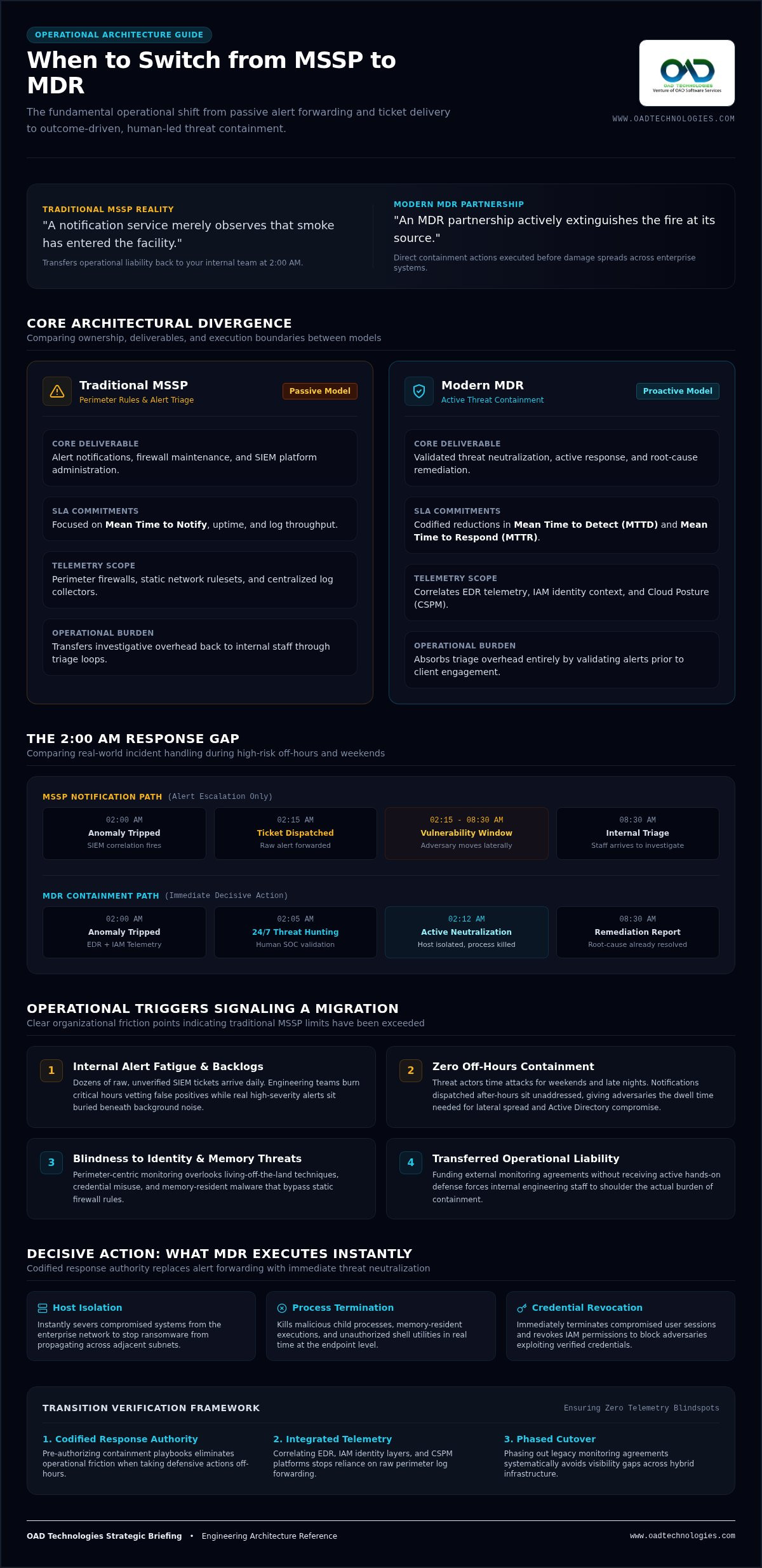
The historical model of a Managed Security Service Provider (MSSP) focuses on device hygiene, firewall maintenance, and centralizing logs into a Security Information and Event Management (SIEM) platform. MSSPs measure operational success through uptime, log throughput, and notification delivery SLAs. However, forwarding correlated events creates severe operational bottlenecks. Because perimeter-centric monitoring overlooks subtle identity abuse and memory-resident malware, providers routinely escalate unverified anomalies, transferring the costly investigative burden back to internal teams.
The MDR Mandate: Deep Telemetry, Threat Hunting, and Active Containment
Managed Detection and Response redefines enterprise protection as an outcome-driven discipline. Rather than relying solely on static rule sets, MDR correlates Endpoint Detection and Response (EDR) telemetry with Identity and Access Management (IAM) context and Cloud Security Posture Management (CSPM). Elite providers utilize dedicated 24 X 7 Security Operations Centers where human threat hunters actively search for evasive techniques like living-off-the-land attacks. Crucially, MDR providers don't just warn you; they execute decisive containment steps, including host isolation, malicious process termination, and credential revocation.
Operational Comparison: Deliverables, Ownership, and Outcome Ownership
The operational divide between alerting and containment directly impacts enterprise productivity:
- Core Deliverable: MSSPs supply alert notifications and SIEM administration; MDR delivers validated threat neutralization and root-cause remediation.
- SLA Commitments: MSSPs commit to Mean Time to Notify; MDR guarantees measurable reductions in Mean Time to Detect (MTTD) and Mean Time to Respond (MTTR).
- Operational Burden: MSSPs consume internal analyst hours through triage loops; MDR absorbs investigation overhead by validating alerts before engaging your staff.
A notification service merely observes that smoke has entered the facility, while an MDR partnership actively extinguishes the fire at its source. Recognizing this operational reality clarifies exactly when to switch from mssp to mdr to protect enterprise operations and ensure regulatory resilience.
5 Critical Indicators That Your Organization Has Outgrown Its Traditional MSSP
Operational strain rarely surfaces overnight. Instead, friction accumulates across your engineering department until an escalated notification exposes critical gaps in response capability. Recognizing when to switch from mssp to mdr requires an honest assessment of internal capacity, off-hours exposure, and shifting corporate infrastructure.
Industry research confirms this market evolution; analyst evaluations showing how Gartner and IDC both track MDR as a distinct discipline underline a structural shift toward hands-on containment over basic perimeter alerting. Here are five unmistakable indicators that your enterprise has outgrown legacy log management:
Internal Alert Fatigue and Escalating Backlogs
When external providers route dozens of raw tickets daily, your internal staff spends valuable engineering hours validating false positives rather than fortifying systems. Pervasive fatigue leads to dangerous oversights. High-severity indicators inevitably sit buried beneath low-priority SIEM noise, creating the extended dwell times attackers need to stage lateral movement and compromise Active Directory structures.
Lack of Real-Time Containment During Critical Off-Hours
Threat actors deliberately schedule payloads during weekends and holiday evenings. An MSSP dispatching a high-severity email alert at 2:00 AM leaves your organization defenseless until internal teams report to work hours later. By contrast, true MDR pairs continuous human inspection with immediate endpoint isolation, closing the vulnerability window before an adversary can deploy ransomware across core workloads.
Expanding Attack Surfaces Across Cloud, Identity, and Remote Work
Network boundary perimeters no longer reflect how national enterprises operate. Cloud sprawl, hybrid architectures, and remote access mean modern intrusions bypass firewall sensors entirely. Adversaries leverage compromised credentials rather than software exploits. If your monitoring cannot correlate cross-tenant cloud telemetry with Identity and Access Management (IAM) context, visibility collapses.
- Compliance and Insurance Pressure: Regulators and underwriters increasingly demand proof of verified active containment capabilities, not just passive log retention records.
- Negative Security ROI: Budget spent on external alert aggregators while retaining all internal remediation burden drains operational investment and exposes organizational leadership to scrutiny.
When daily operations revolve around parsing third-party alert tickets, your business model has decoupled from effective resilience. Transitioning to a dedicated partner like OAD Technologies restores operational balance by replacing unverified ticket handoffs with authoritative, 24 X 7 threat containment.
The Enterprise Evaluation Scorecard: Assessing MSSP vs. MDR Capabilities
Procurement teams often struggle to look past marketing claims when comparing external security vendors. Establishing an objective, vendor-neutral evaluation scorecard is vital when deciding when to switch from mssp to mdr. Instead of accepting generic promises of oversight, enterprises must assess prospective partners on operational ownership, integration flexibility, and legal response authority.
SLA Analysis: Time to Alert vs. Mean Time to Contain (MTTC)
Traditional monitoring contracts celebrate fifteen-minute notification windows. Yet, receiving an alert ticket while a critical database undergoes unauthorized exfiltration does nothing to halt an attacker. Modern defense mandates metrics built around Mean Time to Contain (MTTC). Effective SLAs guarantee that when malicious activity triggers an alert, designated containment actions happen within minutes, drastically reducing dwell time before an adversary achieves lateral persistence.
Response Capabilities: Advisory Guidance vs. Direct Remediation
A true strategic partnership hinges on legally codified response authority. As detailed by the Managed Detection and Response guidance published by industry bodies, modern teams require providers capable of executing pre-authorized containment steps without administrative delays. Comprehensive managed detection and response playbooks clearly define whether a provider can automatically terminate rogue processes, isolate compromised hosts, or revoke Active Directory session tokens during off-hours.
Telemetry Compatibility: Ingesting Identity, Data, and Infrastructure Signals
Modernization should never force organizations to discard functional infrastructure. Leading MDR operations ingest telemetry from enterprise SIEM systems, correlating raw log data with high-fidelity endpoint detections, Cloud Security Posture Management (CSPM), and Data Loss Prevention (DLP) rules. Evaluating these telemetry connections ensures your governance policies translate directly into active defense.
When engineering leaders build a procurement scorecard, the following criteria expose whether a vendor offers genuine containment or superficial monitoring:
- Containment Execution: Does the provider possess direct technical access to execute playbooks, or do they simply email procedural advice?
- Multi-Vector Telemetry: Can their threat hunting engine ingest identity context alongside cloud workloads, network traffic, and endpoint telemetry?
- Continuous Validation: Does the team couple managed operations with technical assessments like Vulnerability Assessment and Penetration Testing (VAPT) to test active defenses?
- Regulatory Alignment: Are investigative summaries delivered in formats structured for executive leadership and compliance reporting mandates?
Scoring prospective partners across these operational dimensions prevents costly misalignments and guarantees that your transition delivers genuine, measurable resilience.
The Migration Roadmap: Transitioning from an MSSP to MDR Without Security Blindspots
Replacing an incumbent security provider feels daunting because missteps can sever log collection pipelines. Knowing when to switch from mssp to mdr solves only half the strategic equation; you also need an orderly engineering plan to execute the shift. A structured, phased cutover guarantees that enterprise telemetry remains uninterrupted while your new defense capabilities come online.
Step 1: Audit Current Log Architecture and Contractual Timelines
Begin by mapping every telemetry forwarder, API connector, and storage repository tied to your current contract. Check termination notification windows in your Master Services Agreement (MSA), which typically demand 60 to 90 days of advance written notice. Secure full ownership and export capabilities for historical log archives; your national regulatory mandates require uninterrupted audit trails that survive vendor decommissioning.
Step 2: Deploy MDR Sensors and Establish Coexistence Protocols
Deploy Endpoint Detection and Response (EDR) agents alongside existing monitoring tools, allowing both platforms to run in parallel. This dual-visibility phase establishes behavioural baselines and ensures new containment hooks operate without conflicting with daily enterprise software. Validate these connections thoroughly by conducting vulnerability assessment and penetration testing exercises, confirming that active detection triggers correctly across both cloud and endpoint assets.
Step 3: Define Custom Response Playbooks and Formalize Cutover
Establish explicit, pre-authorized containment criteria before terminating legacy feeds. Your engineering leads and external analysts must codify exact actions for specific attack vectors, such as revoking compromised tokens, severing command-and-control IP links, or isolating mission-critical virtual hosts. Once validated through tabletop simulation exercises, decommission legacy collectors and transition primary operational oversight.
A disciplined migration lifecycle relies on four deliberate milestones:
- Contractual Mapping: Review existing termination windows, log storage ownership rights, and transition exit clauses.
- Telemetry Overlay: Ingest endpoint, identity, and cloud telemetry concurrently without altering production firewall policies.
- Playbook Codification: Define exact thresholds where your external partner can take automated or manual containment actions.
- Validated Sign-Off: Confirm sensor telemetry health and complete an adversary simulation before severing old MSSP connectors.
If your organization is evaluating when to switch from mssp to mdr, avoiding visibility gaps is entirely possible with disciplined planning. Partner with OAD Technologies to orchestrate a seamless cutover backed by customized enterprise containment playbooks.
Partnering for Resilience: Choosing the Right MDR Provider
Modern enterprise defense cannot rely on transactional, arm's-length alerting relationships. As adversaries develop techniques designed to evade automated rules, determining when to switch from mssp to mdr comes down to securing an embedded, proactive ally. Organizations don't need another noisy ticketing dashboard; they require technical specialists who understand their operational dependencies and actively safeguard business continuity.
Evaluating Human Expertise, SOC Culture, and Collaborative Fit
Automated telemetry accelerates correlation, but human ingenuity ultimately neutralizes determined adversaries. When vetting prospective partners, look past canned platform demonstrations to examine analyst tenure, engineering culture, and Security Operations Center (SOC) methodologies. Top-tier MDR teams operate as a direct extension of your internal engineering department, offering:
- Direct Analyst Collaboration: Immediate access to tier-3 threat hunters rather than tiered helpdesk dispatchers.
- Bespoke Containment Playbooks: Response protocols tailored around your unique infrastructure, operational tolerances, and uptime requirements.
- Actionable Root-Cause Analysis: Forensic investigations that identify initial compromise vectors to eliminate persistent security vulnerabilities.
Strengthening Long-Term Posture Through Unified Cyber Defense
Proactive containment yields immediate tactical dividends while systematically maturing your overarching defense posture. High-fidelity incident telemetry directly feeds into corporate governance, risk, and compliance initiatives, satisfying strict national regulatory standards and board-level risk expectations. Each contained incident reveals actionable intelligence, allowing teams to tighten Data Loss Prevention (DLP) configurations, eliminate Identity and Access Management (IAM) privilege creep, and reinforce cloud security settings. This continuous feedback loop transforms your security function from an administrative overhead cost into a resilient business enabler.
Architecting Your Enterprise MDR Strategy with OAD Technologies
OAD Technologies delivers advanced managed defense across national enterprises, bridging the gap between strategic risk governance and hands-on operational containment. Operating through a dedicated 24 X 7 Security Operations Center, our technical specialists combine human-led threat hunting with decisive containment playbooks that isolate malicious activity before lateral propagation occurs. We integrate seamlessly with your existing SIEM investments, endpoint telemetry, and identity directories to maximize defensive returns without infrastructure disruption.
If uncontextualized alert tickets are depleting your engineering bandwidth and leaving off-hours blindspots, the strategic moment for when to switch from mssp to mdr is now. Connect with OAD Technologies today to initiate a confidential architecture evaluation and build an outcome-focused containment roadmap for your enterprise.
Transforming Detection Into Active Enterprise Defense
Passive log collection can no longer defend modern architectures against credential misuse and stealthy lateral movement. Recognizing when to switch from mssp to mdr empowers technology leaders to eliminate analyst fatigue, meet stringent compliance requirements, and guarantee decisive off-hours containment. Replacing transactional ticket notifications with verified, human-led response ensures your security posture keeps pace with modern threats.
OAD Technologies accelerates this operational transition without disrupting active telemetry. Backed by a dedicated 24 X 7 Security Operations Center, our specialists deliver proactive threat hunting, validated containment playbooks, and unified integration across EDR, SIEM, IAM, and Data Loss Prevention (DLP) environments. You don't have to carry the burden of alert triage alone. Consult with OAD Technologies to modernize your threat detection and response architecture and secure the operational resilience your enterprise deserves.
Frequently Asked Questions
What is the primary operational difference between an MSSP and an MDR provider?
The core distinction lies in alert escalation versus verified threat containment. An MSSP focuses on perimeter device monitoring, log collection, and notifying your team when anomalies appear. In contrast, an MDR provider conducts continuous threat hunting across endpoints, identities, and cloud workloads. Instead of forwarding raw tickets, MDR analysts investigate root causes and take direct containment actions to neutralize attacks before damage spreads.
Can an enterprise transition to MDR while keeping its existing SIEM investment?
Yes, modern MDR platforms integrate directly with existing enterprise SIEM environments rather than replacing them. High-fidelity endpoint, identity, and cloud telemetry feed into your central SIEM, preserving historical audit repositories and compliance dashboards. The MDR provider's Security Operations Center correlates these data streams in real time, delivering proactive investigation and active containment while allowing your organization to maximize its existing software investments.
How does MDR handle false positives differently than a traditional MSSP?
Traditional MSSPs routinely pass unvetted anomalies down to internal teams to satisfy notification SLAs, accelerating alert fatigue. MDR providers resolve this friction by triaging alerts internally before escalation occurs. Dedicated analysts enrich detections with behavioral analytics, process telemetry, and identity context. Your engineering team only receives verified, high-context incident briefings, drastically reducing investigative overhead. This reduction in noise is a major factor in knowing when to switch from mssp to mdr.
What response actions can an MDR provider take directly on enterprise endpoints?
Based on pre-approved response playbooks, an MDR provider executes decisive containment actions directly through integrated Endpoint Detection and Response (EDR) agents. These measures include isolating compromised machines from the corporate network, terminating malicious running processes, and removing unauthorized persistence mechanisms. MDR analysts can also blacklist suspicious hashes and revoke hijacked user credentials across identity directories, preventing attackers from moving laterally during off-hours.
How long does a typical enterprise migration from an MSSP to MDR take?
A standard enterprise migration generally spans 30 to 60 days, aligned with legacy contractual termination windows. The process begins with auditing current log feeds, followed by deploying endpoint agents and cloud connectors in parallel with incumbent monitoring. After establishing baseline behavioral telemetry and codifying custom containment playbooks, the engineering team conducts validation testing before executing a seamless cutover, ensuring zero visibility gaps across critical infrastructure.
Will switching from an MSSP to MDR help satisfy national compliance and audit mandates?
Yes, upgrading to MDR directly addresses stringent regulatory expectations across the United Arab Emirates. Modern data protection frameworks and governance mandates require organizations to demonstrate active incident containment capabilities, not just passive log storage. MDR providers deliver detailed forensic timelines, verified root-cause analysis, and continuous compliance reporting, helping national enterprises prove operational resilience to internal auditors, sector regulators, and cyber insurance underwriters.
What happens if an attack occurs while transitioning between security providers?
Phased migration protocols eliminate transition vulnerabilities through intentional coexistence. By running MDR telemetry simultaneously alongside incumbent MSSP log collectors during deployment, your systems maintain unbroken visibility. If an intrusion occurs during onboarding, pre-authorized containment playbooks activate immediately via the newly installed endpoint sensors. Understanding how dual-monitoring prevents exposure clarifies when to switch from mssp to mdr without introducing blindspots or operational risks.
Disclaimer
Content by OAD Technologies is for general informational purposes only and does not constitute professional or cybersecurity advice. No warranties are made regarding accuracy or completeness; reliance is at your own risk. OAD Technologies shall not be liable for any direct or indirect losses arising from use of this content.