

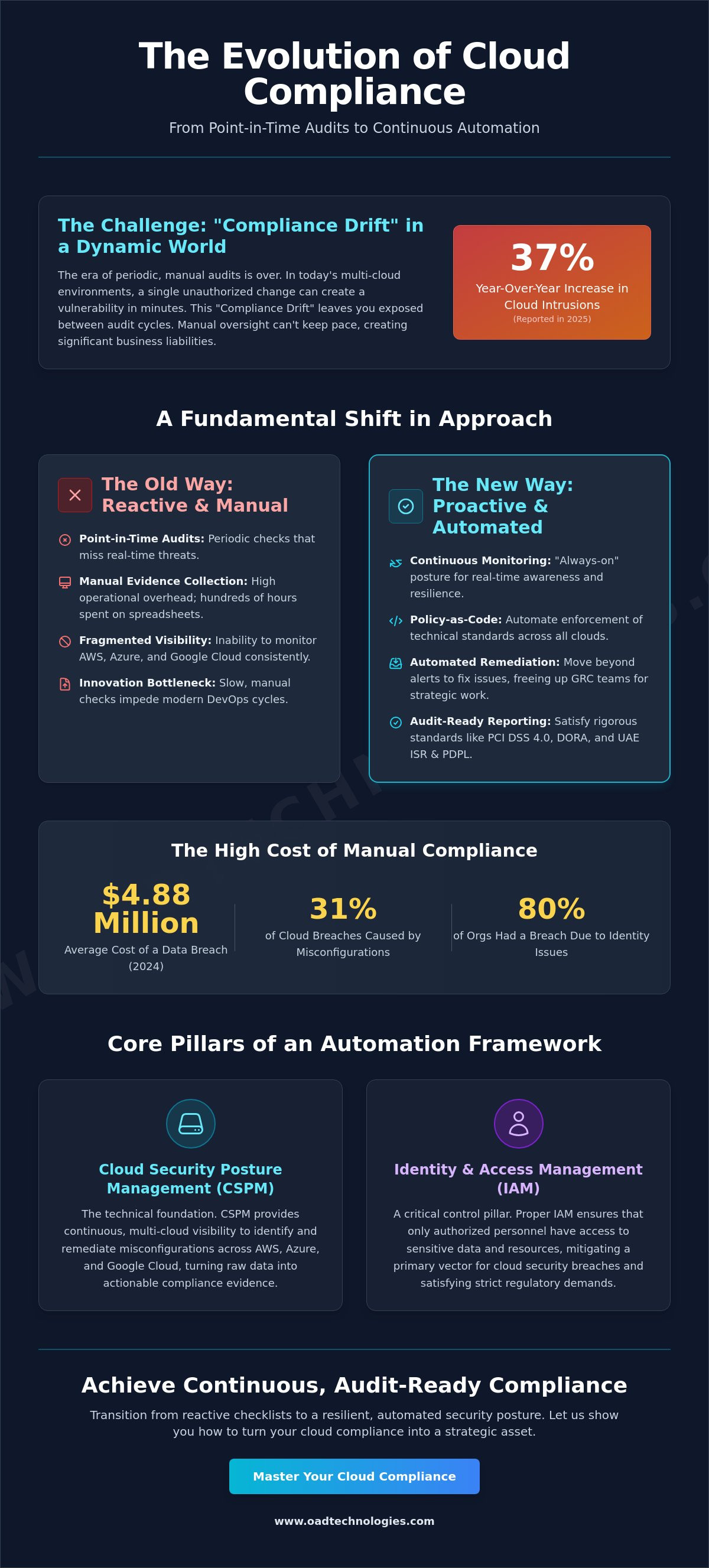
The era of the point-in-time audit is officially over; if your compliance posture isn't visible in real-time, it effectively doesn't exist. You likely feel the mounting pressure of maintaining fragmented visibility across AWS, Azure, and Google Cloud while manual evidence collection drains your GRC team's resources. It's a frustrating cycle where compliance drift occurs the moment an auditor leaves the room, leaving you vulnerable to the 37% year-over-year increase in cloud intrusions reported in 2025.
We understand that manual oversight can't keep pace with the dynamic nature of modern infrastructure. This guide will show you how to master the transition to continuous cloud compliance monitoring automation, turning your security posture into a strategic asset rather than a reactive checklist. You'll learn how to implement compliance-as-code to reduce operational overhead and achieve audit-ready reporting that satisfies rigorous standards like PCI DSS 4.0 and the Digital Operational Resilience Act (DORA). We'll examine the specific frameworks and architectural shifts required to maintain enterprise resilience in an increasingly scrutinized digital landscape.
Key Takeaways
- Transition from periodic, manual audits to a continuous state of awareness that eliminates compliance drift between reporting cycles.
- Implement cloud compliance monitoring automation through Policy-as-Code to ensure technical standards are enforced across multi-cloud environments without manual intervention.
- Reduce operational overhead by moving beyond simple alerts to automated remediation, allowing your GRC teams to focus on strategic risk management rather than repetitive tasks.
- Follow a structured five-step roadmap to map complex regulatory requirements like PCI DSS 4.0 and DORA directly to automated technical controls.
- Discover how integrating advanced Cloud Security Posture Management (CSPM) with strategic GRC consulting creates a resilient, audit-ready infrastructure for 2026.
The Evolution of Cloud Compliance: From Manual Audits to Continuous Monitoring
Traditional compliance used to be a seasonal event. Auditors arrived, spreadsheets were filled, and boxes were checked to satisfy a point-in-time requirement. By 2026, this reactive approach has become a significant business liability. The Evolution of Cloud Compliance requires a fundamental shift toward cloud compliance monitoring automation. This isn't just a software layer; it's a continuous loop of discovery and remediation that ensures your infrastructure remains secure every second of the day, not just during an audit window.
The core challenge in modern environments is "Compliance Drift." In a dynamic multi-cloud setup, a single unauthorized configuration change, such as a developer temporarily opening a storage bucket for testing, can move your entire system away from its secure baseline. This drift happens in minutes. If you rely on manual checks, these vulnerabilities remain open for weeks or months until the next scheduled review. Transitioning to an "always-on" monitoring posture allows you to move from checking boxes to maintaining true operational resilience, where compliance is a byproduct of a well-architected system.
The High Cost of Manual Compliance Management
Spreadsheet-based tracking is a hidden drain on enterprise resources. GRC teams often spend hundreds of hours on manual evidence collection, a process that's prone to human error and high operational overhead. When you consider that the average cost of a data breach reached $4.88 million in 2024, the risk of a missed configuration in a complex multi-cloud environment is too high to ignore. Manual processes simply can't scale at the speed of modern DevOps cycles. While your developers deploy code multiple times a day, manual compliance checks act as a bottleneck that either slows down innovation or, worse, gets bypassed entirely.
Meeting UAE Regulatory Standards (ISR and PDPL)
For organizations operating within the Middle East, cloud compliance monitoring automation is no longer optional. The UAE Personal Data Protection Law (PDPL) and various Information Assurance (IA) standards for national entities demand a level of data sovereignty and protection that manual reporting can't sustain. Regulators now look for proof of continuous oversight rather than static reports. To satisfy UAE-specific audits, you need systems that provide granular, real-time evidence of how sensitive data is handled across AWS, Azure, and Google Cloud. Automation ensures that your regional compliance posture is as sophisticated as the global standards you strive to meet, providing a clear roadmap for long-term digital relevance.
Core Pillars of a Cloud Compliance Monitoring Automation Framework
Building a resilient cloud environment in 2026 requires more than just scanning for open ports; it demands a structured approach to cloud compliance monitoring automation that bridges the gap between technical infrastructure and regulatory governance. This framework relies on four critical pillars that work in tandem to ensure your multi-cloud environment remains audit-ready without constant manual intervention. By treating compliance as a continuous operational state rather than a periodic hurdle, you create a system that's both secure and scalable.
At the heart of this architecture lies cloud security posture management (CSPM). CSPM acts as the technical foundation, providing the visibility needed to identify misconfigurations across AWS, Azure, and Google Cloud simultaneously. When integrated with your broader GRC strategy, CSPM transforms raw technical data into meaningful compliance evidence. This synergy is vital for solving the alert fatigue problem by ensuring that your team receives context-rich information instead of a flood of disconnected logs. Considering that misconfigurations account for 31% of cloud breaches, having a robust CSPM engine is a non-negotiable first step.
Identity and Access Management (IAM) serves as another essential pillar. In a landscape where 80% of organizations experienced a cloud security breach in the past year, monitoring who has access to what is a primary compliance requirement. Automated evidence collection ties these pillars together, providing GRC teams with a continuous stream of validated data. This removes the burden of manual collection and ensures that you can produce an audit-ready report at any moment, regardless of how quickly your infrastructure scales.
CSPM: The Engine of Automated Monitoring
Modern CSPM tools do more than just flag errors; they map every cloud resource against specific regulatory controls in real-time. This allows for immediate discovery of issues like unencrypted databases or overly permissive network rules. By centralizing this data into your GRC reporting, you gain a single pane of glass view into your global compliance status. This visibility is essential for maintaining the long-term viability of your digital assets.
Policy-as-Code and Automated Guardrails
Policy-as-Code (PaC) involves writing your compliance requirements directly into your infrastructure deployment scripts. This "shift-left" approach catches potential violations during the development phase, long before they reach production. Automated guardrails act as an invisible safety net, preventing non-compliant resources from being deployed in the first place. If you're ready to move beyond manual checklists, our specialists at OAD Technologies can help you design a customized PaC strategy tailored to your specific regulatory needs.
Solving the Alert Fatigue Problem with Automated Remediation
The most common objection to cloud compliance monitoring automation isn't about its technical capability but about the noise it creates. Security teams are already buried under a mountain of notifications. If a system identifies a thousand misconfigurations but requires a human to fix every single one, it hasn't solved the problem; it has just highlighted the scale of the failure. To achieve true enterprise resilience in 2026, you must move beyond passive alerting toward active, automated remediation.
The difference between an automated alert and an automated action is the difference between a smoke detector and a sprinkler system. While an alert tells you something is wrong, an action fixes it before it can be exploited. This "self-healing" cloud concept allows your infrastructure to revert to a known secure state automatically when it drifts from your baseline. We recommend a hierarchy of remediation to maintain operational control. For low-risk, high-frequency issues, full auto-fix is the standard. For complex architectural changes, a "human-in-the-loop" model ensures a strategic expert approves a pre-staged fix with a single click.
Moving from Passive Alerting to Active Orchestration
Effective orchestration requires prioritizing alerts based on business risk and asset criticality. Not all storage buckets are equal. A misconfigured bucket containing public marketing assets is less critical than one holding encrypted customer PII. Security Orchestration, Automation, and Response (SOAR) plays a pivotal role here by connecting your compliance tools with your ticketing and communication systems. Automated remediation is the process of programmatically correcting a security control without manual intervention. By integrating these workflows, you ensure that your response time matches the speed of a potential cloud intrusion, which grew by 37% year-over-year in 2025.
Building Trust in Automated Self-Healing
Confidence in automation doesn't happen overnight. Organizations should start with "safe" auto-remediations that have zero risk of breaking production environments. Closing an open S3 bucket or disabling an unused IAM key are excellent starting points. As trust grows, you can expand these scripts to cover more complex scenarios. Every automated action must leave a detailed audit trail to satisfy the Core Pillars of a Cloud Compliance Monitoring Automation Framework as defined by industry leaders. Balancing these automated triggers with human oversight is a cornerstone of modern governance risk and compliance frameworks. This ensures that while the machines handle the repetitive heavy lifting, your strategic experts retain final authority over the system's architecture.
A 5-Step Roadmap for Implementing Compliance Automation
Modernizing your security posture requires a deliberate, structured approach. Moving toward cloud compliance monitoring automation isn't a one-time installation; it's the implementation of a resilient lifecycle that scales with your multi-cloud footprint. By following a clear roadmap, you ensure that technical controls align perfectly with your broader business objectives and regulatory obligations. This process turns a complex web of requirements into a manageable, automated engine of growth.
- Step 1: Inventory and Asset Discovery: You can't secure what you don't know exists. Automated discovery tools must scan all cloud environments to identify every instance, database, and serverless function.
- Step 2: Mapping Regulatory Requirements: Translate high-level mandates like SOC 2, ISO 27001, and the UAE PDPL into specific technical configuration checks.
- Step 3: Deploying CSPM and IAM Monitoring Tools: Establish the technical guardrails that provide the real-time visibility discussed in previous sections.
- Step 4: Establishing Automated Reporting: Configure centralized dashboards that transform raw technical data into audit-ready reports for stakeholders.
- Step 5: Iterative Remediation: Use the data gathered to refine your automation scripts, moving from simple alerts to the sophisticated self-healing workflows we've explored.
Mapping Controls to Frameworks
The most difficult part of compliance is translating vague legal language into binary technical checks. For instance, a requirement to "ensure data integrity" must be translated into specific automated checks for encryption-at-rest and versioning on storage buckets. Using pre-built compliance templates for common standards significantly accelerates this phase. This mapping must also integrate deeply with your identity and access management strategy to ensure that user permissions are scrutinized with the same rigor as your infrastructure configurations. This alignment prevents the "compliance gap" that often occurs when technical teams and GRC teams work in silos.
Establishing the Single Source of Truth
A centralized compliance dashboard is the heartbeat of your resilience strategy. It provides executives and auditors with a real-time view of your risk posture, replacing the need for frantic evidence collection before an audit. By delivering these automated, real-time reports, you build trust with stakeholders and demonstrate a proactive commitment to security. For a truly robust defense, these signals should be integrated into a broader managed detection and response strategy. This ensures that compliance violations aren't just logged but are treated as potential security incidents that require immediate orchestration. If you're ready to modernize your posture, partner with our architects at OAD Technologies to build a customized implementation roadmap for your enterprise.
Why OAD Technologies is the Strategic Partner for Automated Compliance
At OAD Technologies, we act as master designers of systems rather than mere resellers of software. We understand that cloud compliance monitoring automation is most effective when it bridges the gap between high-level innovation and practical business results. Our role is to serve as a visionary partner, helping you shape a security posture that doesn't just keep pace with technology but actively anticipates the future of regulatory scrutiny. We don't believe in replacing your people with tools; instead, we focus on the synergy between human insight and technological capacity to empower your GRC teams.
Our approach is rooted in technical authority and a proactive, solution-oriented mindset. By choosing OAD, you gain access to a team that values long-term success over quick fixes. We ground every technological solution in a business context, focusing on investment returns and operational performance. This commitment to precision ensures that your compliance framework remains a guardian of your ongoing digital relevance in an ever-changing market. We act as an extension of your own team, providing the rigorous engineering standards required to secure complex multi-cloud architectures.
Bespoke Compliance Architectures
We reject the standardized, "one-size-fits-all" approaches that often leave enterprises vulnerable to edge-case drifts. Every environment is unique, requiring a customized integration of security controls. This includes the seamless incorporation of data loss prevention (DLP) into your cloud compliance stack to protect sensitive assets at the point of creation. For enterprises operating within the UAE, our mastery of regional data laws like PDPL and ISR is a critical advantage. We help you navigate these local complexities while maintaining alignment with global standards, ensuring your cloud compliance monitoring automation strategy is both locally compliant and globally resilient.
Managed Resilience and Expert Support
True resilience requires continuous validation. Our Managed Detection and Response (MDR) services provide the real-time oversight needed to monitor cloud threats and compliance violations simultaneously. This active voice in security creates a sense of momentum and direct accountability for your digital assets. We complement our automated systems with periodic Vulnerability Assessment and Penetration Testing (VAPT) to validate that your automated guardrails are performing as expected. This combination of continuous monitoring and expert assessment protects your strategic expansion. If you're ready to secure your future, contact OAD Technologies today to design a compliance framework built for the challenges of 2026 and beyond.
Securing Your Digital Future through Automated Resilience
Building a resilient enterprise in 2026 requires a departure from the static security models of the past. By embracing cloud compliance monitoring automation, you transform compliance from a resource-draining obligation into a real-time operational advantage. We've moved beyond simple detection to a world where automated remediation and self-healing systems maintain your secure baseline without manual intervention. This proactive stance ensures your multi-cloud environment remains audit-ready while your team focuses on high-value strategic growth rather than repetitive evidence collection.
Maintaining this level of technical precision across complex environments demands a partner who understands both the global landscape and the specific nuances of UAE-based GRC and CSPM requirements. OAD Technologies acts as a specialized systems integrator for multi-cloud environments, offering advanced Managed Detection and Response (MDR) capabilities to protect your digital assets. It's time to transition from reactive checklists to a posture of continuous, visionary security that scales with your ambition.
Partner with OAD Technologies for Strategic Cloud Compliance and ensure your organization remains both secure and relevant in an ever-changing market. Your roadmap to automated resilience starts today.
Frequently Asked Questions
What is the difference between cloud compliance and cloud security?
Cloud security focuses on the technical measures and controls used to protect data and infrastructure from threats, while cloud compliance is the act of proving those controls meet specific regulatory or contractual standards. Security is about staying safe; compliance is about staying legal and audit-ready. Using cloud compliance monitoring automation helps bridge this gap by continuously validating that security configurations align with mandated frameworks in real-time.
How does automation help with the UAE Personal Data Protection Law (PDPL)?
Automation provides the real-time oversight required to manage data residency and processing consent as mandated by the UAE PDPL. Instead of manual checks, automated systems continuously monitor where sensitive data is stored and who has access to it. This ensures that any deviation from PDPL requirements is identified and corrected immediately, providing a transparent and defensible audit trail for regional regulators.
Can I use native cloud tools for compliance monitoring automation?
Native tools like AWS Config or Azure Policy offer foundational monitoring, but they often lack the cross-platform visibility required for multi-cloud environments. Relying solely on native tools creates fragmented silos of data that make centralized GRC reporting difficult. For comprehensive cloud compliance monitoring automation, enterprises typically integrate native signals into a unified platform that provides a single pane of glass across all cloud providers.
What are the most common cloud misconfigurations that lead to non-compliance?
The most frequent issues include publicly accessible storage buckets, unencrypted databases, and overly permissive Identity and Access Management (IAM) roles. Misconfigurations like these accounted for 31% of cloud breaches in recent industry reports. Automated monitoring identifies these gaps instantly, preventing them from becoming long-term compliance violations that could lead to heavy fines or data exposure during a formal regulatory audit.
How often should automated compliance reports be generated?
Reports should be generated continuously in real-time, although formal executive summaries are typically reviewed on a weekly or monthly basis. The goal of automation is to move away from the outdated "point-in-time" reporting model. By maintaining an always-on reporting dashboard, your organization stays in a state of constant audit-readiness, allowing stakeholders to pull validated compliance data at any moment without a manual collection process.
Does compliance automation replace the need for manual penetration testing?
Automation doesn't replace manual Vulnerability Assessment and Penetration Testing (VAPT); rather, it complements it by handling repetitive, configuration-based checks. While automation catches misconfigurations in real-time, manual VAPT is essential for identifying complex logic flaws and creative exploit chains that software might miss. Using both ensures a rigorous security posture that satisfies both technical and regulatory requirements for enterprise resilience.
How do I handle false positives in automated compliance monitoring?
Handling false positives requires a structured approach to refining your Policy-as-Code (PaC) rules and establishing clear exclusion lists for known safe configurations. You should use risk-based filtering to prioritize high-impact alerts while tuning the system to recognize legitimate business exceptions. This iterative process reduces noise and ensures that your GRC team only spends time on genuine security risks and significant compliance drifts.
Is cloud compliance automation suitable for hybrid cloud environments?
Cloud compliance automation is highly suitable and often necessary for hybrid environments to maintain a consistent security baseline across on-premises and cloud infrastructure. Unified platforms can ingest signals from both legacy data centers and modern cloud providers. This ensures that your governance policies are enforced uniformly, preventing security gaps that often occur when managing disparate environments with different manual processes.
Disclaimer
Content by OAD Technologies is for general informational purposes only and does not constitute professional or cybersecurity advice. No warranties are made regarding accuracy or completeness; reliance is at your own risk. OAD Technologies shall not be liable for any direct or indirect losses arising from use of this content.


