

Between April 2025 and March 2026, publicly disclosed ransomware victims surged by 24.9%, signaling an aggressive shift in how attackers target UAE enterprise infrastructure. You've likely felt the weight of this trend through relentless alert fatigue or the uphill battle of recruiting specialized SOC analysts in a competitive local market. Evaluating edr vs mdr for ransomware is now a critical priority for leaders who need to stop sophisticated multi-cloud threats from bypassing standard defenses while their internal teams are buried in technical noise.
This decision is no longer just a technical checkbox. It's a strategic pivot that determines your organization's survival in a landscape where ransomware now factors into 44% of all data breaches. This guide clarifies the critical differences between these solutions so you can determine which path best secures your digital assets. We'll provide a clear framework for your selection, ensuring your strategy aligns with UAE national cybersecurity standards. You'll learn how to move beyond simple detection to build a foundation for genuine ransomware resilience in 2026.
Key Takeaways
- Understand why deep endpoint visibility is the non-negotiable baseline for defending against the stealthy double-extortion tactics of 2026.
- Evaluate edr vs mdr for ransomware to determine if your enterprise needs specialized software tools or a comprehensive, human-led response service.
- Identify how managed services solve the persistent challenge of recruiting and retaining high-tier SOC analysts within the competitive UAE market.
- Learn to align your detection and response protocols with UAE Information Assurance standards and national data protection requirements for incident reporting.
- Discover a stage-by-stage framework for stopping ransomware during the critical windows of initial access and lateral movement.
Ransomware Resilience in 2026: Why Endpoint Visibility is the New Baseline
In 2026, ransomware isn't just about locking files; it's a multi-layered extortion tactic designed to paralyze operations. Threat actors now prioritize data exfiltration to hold brand reputation hostage alongside digital assets. With a 24.9% increase in publicly disclosed ransomware victims globally over the last year, UAE enterprises face a landscape where speed and stealth are the enemy's primary assets. Because 90% of modern attacks originate at the endpoint, visibility into these entry points has become the non-negotiable baseline for defense. This shift forces a critical architectural choice: edr vs mdr for ransomware. Moving beyond reactive cleanup requires a proactive stance that prioritizes detection over simple perimeter blocks.
The Evolution of Ransomware Tactics
Ransomware groups have industrialized their operations through Ransomware-as-a-Service (RaaS) models. These attackers leverage AI-driven tools to bypass traditional signature-based antivirus solutions, often remaining undetected for weeks. During this dwell time, they map network vulnerabilities and identify high-value data assets. The goal isn't just a quick payout; it's a deep compromise that maximizes pressure. By the time encryption begins, the damage is often already done through massive data theft. This evolution means that observing endpoint behavior in real-time is the only way to catch a breach before it escalates into a national headline. UAE organizations must recognize that stealth is now the standard, not the exception.
Defining the Detection and Response Framework
Traditional Endpoint Protection Platforms (EPP) focus on prevention, but they fail against advanced persistent threats that use legitimate system tools to move laterally. Modern resilience depends on an Endpoint Detection and Response (EDR) framework that records every process and connection. However, raw data is only useful if you have the capacity to interpret it. This is where the choice between internal tool management and a broader managed detection and response strategy becomes vital. While EDR provides the necessary eyes on your devices, the decision of edr vs mdr for ransomware hinges on who is watching the screens and how fast they can act. In a market where the median ransom demand has reached approximately 4.85 million AED, the cost of a delayed response is simply too high for most enterprises to absorb. This decision shapes your long-term viability and your ability to meet increasingly stringent national security protocols.
EDR (Endpoint Detection and Response): The Technical Frontline
EDR serves as the granular sensory system for your digital environment. It acts as a specialized software layer installed on laptops, servers, and workstations to provide deep, continuous visibility into every event occurring at the edge of your network. Unlike traditional antivirus that looks for known files, EDR records telemetry to identify suspicious patterns. When weighing edr vs mdr for ransomware, it's essential to view EDR as the sophisticated engine that powers detection, though it still requires a skilled driver to navigate.
Core Capabilities of EDR Software
EDR provides high-fidelity data by logging process executions, file modifications, and network connections. This level of detail allows security teams to reconstruct an attack's timeline. Key technical functions include:
- Endpoint Telemetry: Maintaining a historical record of all activity to aid in forensic investigations.
- Automated Remediation: Instantly isolating a compromised host from the network to prevent lateral movement.
- Threat Hunting: Proactively searching for Indicators of Compromise (IoCs) across the entire fleet.
By utilizing behavioral analysis, EDR can stop a process that suddenly begins encrypting files, even if the specific ransomware variant hasn't been seen before. This capability is vital for catching zero-day attacks that bypass legacy filters.
The Operational Reality of EDR
While the software is powerful, the "Tool-First" nature of EDR presents a significant management burden. A single enterprise can generate thousands of alerts daily, and many of these are false positives. This "alert fatigue" often leads to critical signals being missed. Managing an EDR solution effectively requires a 24 X 7 internal team capable of interpreting complex telemetry and making split-second decisions. Making Sense Of Threat Detection And Response Acronyms helps leaders understand that EDR is the foundation, but not the complete architecture.
For many UAE enterprises, EDR is the first step toward a more mature SIEM integration, where endpoint data is correlated with network logs. However, the recurring challenge remains the talent gap. If your team isn't staffed to handle midnight alerts, the tool alone won't stop a breach. You might consider how specialized endpoint security can bridge these operational gaps before they become vulnerabilities. The debate of edr vs mdr for ransomware ultimately centers on whether you possess the in-house expertise to transform raw telemetry into actionable defense.
MDR (Managed Detection and Response): The Strategic Command Center
MDR represents a fundamental shift from possessing technology to achieving specific security outcomes. It acts as the strategic layer that combines EDR telemetry with a 24 X 7 Security Operations Center (SOC) and elite human intelligence. When assessing edr vs mdr for ransomware, enterprises must look beyond the software dashboard. MDR providers don't just notify you of a potential breach; they execute immediate mitigation. This proactive intervention is crucial in a UAE context, where global threat intelligence feeds are localized to identify regional attack patterns before they reach your network edge.
The Human Element in Ransomware Defense
Machine-speed detection is a prerequisite for modern defense, but it's often insufficient against adversaries who use "Living-off-the-Land" (LotL) techniques. These attackers exploit legitimate system tools to blend in with normal administrative activity, making them invisible to many automated filters. A recent CISA report on EDR bypass highlights how 12 major ransomware gangs have successfully evaded standard automated defenses. Human incident responders provide the critical validation step, distinguishing between a routine admin task and a stealthy lateral move. This synergy between algorithmic speed and human intuition ensures that complex threats are contained before encryption can begin.
MDR as a Business Enabler
For many UAE organizations, the primary obstacle to resilience isn't a lack of budget for tools, but a lack of available talent. The regional cybersecurity skills shortage makes hiring and retaining a full-time, 24 X 7 SOC team both difficult and prohibitively expensive. MDR solves this by providing a predictable cost model that scales with your infrastructure without the overhead of internal recruitment. By offloading the burden of alert triage, your internal IT staff can focus on strategic growth rather than chasing false positives.
This model significantly improves Mean Time to Detect (MTTD) and Mean Time to Respond (MTTR). These are the only metrics that truly matter when a ransomware payload is active. Choosing between edr vs mdr for ransomware often comes down to whether you want to manage a tool or secure your business continuity through a strategic partnership. This approach ensures your organization remains resilient against the evolving extortion tactics expected in 2026.
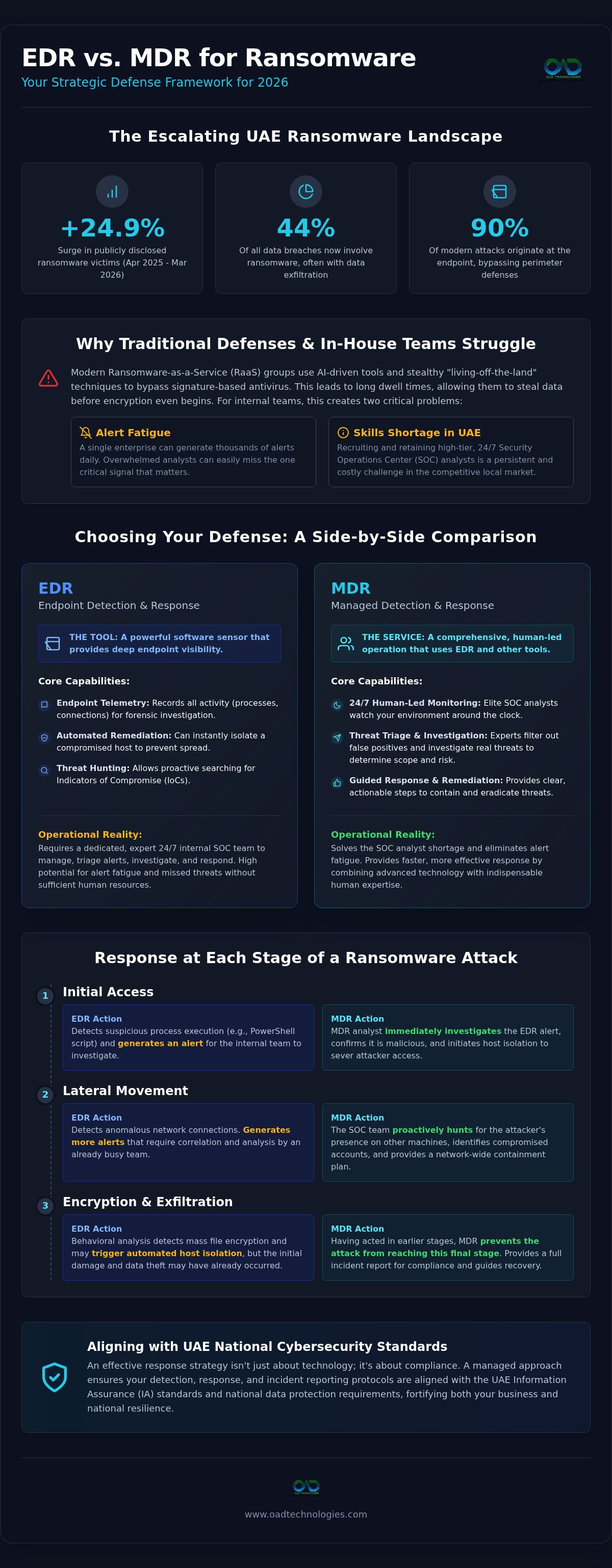
EDR vs MDR for Ransomware: A Stage-by-Stage Comparison
Understanding the lifecycle of an attack is the only way to effectively weigh edr vs mdr for ransomware. While software provides the necessary visibility, human-led response determines whether an incident becomes a minor hiccup or a business-ending catastrophe. Ransomware in 2026 moves with incredible velocity, requiring a defense that matches its speed across every phase of the kill chain.
- Stage 1: Initial Access: EDR software flags suspicious file executions or credential use. MDR validates these alerts in real-time, filtering out the noise that often leads to internal burnout.
- Stage 2: Lateral Movement: While EDR monitors for process anomalies, MDR analysts actively hunt for the attacker's footprint. They look for subtle signs of "living-off-the-land" tactics that automated tools might ignore.
- Stage 3: Data Exfiltration: This is where the synergy between MDR and DLP becomes vital. EDR alone struggles to distinguish between a legitimate cloud backup and a malicious transfer to a rogue server.
- Stage 4: Encryption: EDR automates the "kill" command to stop encryption in its tracks. MDR manages the entire recovery process, ensuring the environment is clean before systems go back online.
Performance Matrix: EDR vs MDR
EDR software is typically faster to deploy, but it carries a heavy management overhead that many UAE enterprises can't sustain. MDR provides a slightly slower onboarding process but delivers immediate actionability. It converts raw telemetry into defended assets without requiring you to hire more staff. MDR is the superior choice for organizations with limited internal security staff because it provides a complete security outcome rather than just a technical capability.
The "Double Extortion" Protection Gap
Modern ransomware gangs prioritize stealing data before they lock it. This "slow and low" egress often bypasses traditional EDR filters because the traffic looks like normal administrative activity. MDR monitors for these anomalous data egress patterns, catching the theft before the ransom note ever appears. By correlating endpoint events with network behavior, MDR closes the gap that attackers exploit during the dwell time phase. If you're ready to secure your infrastructure against these evolving threats, explore our managed detection and response solutions today.
Fortifying UAE Enterprises: Integrating EDR and MDR for National Resilience
National resilience requires more than just deploying agents on devices; it demands a security architecture that mirrors the UAE's sophisticated regulatory framework. As organizations navigate the nuances of edr vs mdr for ransomware, they must ensure their chosen path aligns with the UAE Information Assurance (IA) standards. OAD Technologies acts as a strategic partner, bridging the gap between raw technical telemetry and the high-level requirements of local governance. We focus on turning endpoint data into evidence of compliance, ensuring that your defense isn't just effective, but also legally sound.
Compliance and Governance in the UAE
Your security strategy shouldn't exist in a vacuum. A robust Governance Risk and Compliance (GRC) framework must inform your detection and response choices. Under the UAE Personal Data Protection Law (PDPL), mandatory breach notification timelines are strict. Relying solely on internal teams to manage EDR often leads to reporting delays during a crisis. MDR services ensure that incident validation happens in minutes, not days, providing the documented proof required for regulatory authorities. This approach also secures data sovereignty by ensuring that local security standards are upheld throughout the incident lifecycle.
Selecting the Right Partner
A local UAE partner understands the regional threat landscape with a depth that global-only vendors often miss. When evaluating an MDR provider, CISOs should ask specific questions about their ransomware containment protocols and how they handle the September 16, 2026, CBUAE licensing requirements for expanded entities. Achieving a true Zero Trust model requires integrating endpoint security with Identity and Access Management (IAM). This ensures that even if an endpoint is compromised, the attacker's ability to use stolen credentials for lateral movement is severely restricted.
The final step for any CISO is a candid assessment of current "Response" maturity. If your team cannot confidently contain a multi-cloud ransomware threat at 3:00 AM on a Friday, the tool-only approach of EDR is likely insufficient. Moving toward a managed model isn't an admission of weakness; it's a strategic optimization of resources. Choosing between edr vs mdr for ransomware is a defining moment for your 2026 security roadmap. While EDR offers the necessary visibility, MDR provides the operational velocity required to protect your organization's long-term viability in an increasingly volatile market.
Securing Your Enterprise Legacy in an Evolving Threat Landscape
The choice between edr vs mdr for ransomware defines your organization's ability to withstand the sophisticated extortion tactics of 2026. While EDR provides the necessary technical visibility, MDR offers the operational velocity and human insight required to stop a breach before it escalates. Resilience isn't just about having the right tools; it's about having the right partners to manage them under the pressure of real-world attacks. By aligning your endpoint strategy with UAE national cybersecurity standards and integrating data loss prevention, you create a defense that's both technically robust and legally compliant.
Strengthen your ransomware defense with OAD Technologies’ MDR services. Our specialized UAE-based Security Operations Center ensures the seamless integration of DLP and endpoint security to keep your digital assets protected. You have the power to transform your security posture from a reactive cost center into a proactive pillar of business continuity. With a strategic roadmap and the right expertise, your organization can stay ahead of even the most persistent adversaries.
Frequently Asked Questions
Is EDR enough to stop ransomware in 2026?
No, EDR software alone is often insufficient because it requires skilled human analysts to interpret and act on the complex telemetry it generates. While the software records file changes and network connections, attackers in 2026 use "living-off-the-land" techniques that blend in with normal administrative tasks. Without a dedicated team to validate these signals, a critical threat might remain undetected until the encryption phase begins.
What is the main difference between EDR and MDR for ransomware?
The primary distinction lies in the delivery of a managed outcome versus a technical tool. EDR is the software installed on your endpoints to collect data, while MDR is a comprehensive service that includes EDR tools, 24 X 7 monitoring, and expert human response. When comparing edr vs mdr for ransomware, remember that MDR provides the "brain and hands" needed to contain threats, whereas EDR provides the "eyes" to see them.
How does MDR help with UAE PDPL compliance?
MDR assists with UAE Personal Data Protection Law (PDPL) compliance by providing the rapid incident validation and forensic documentation required for mandatory breach notifications. The law demands strict reporting timelines that are difficult to meet without continuous monitoring. Managed services ensure every step of the response is logged, helping your organization prove to regulators that personal data was protected according to national standards.
Do I need an internal SOC if I have an MDR service?
You generally don't need a full-scale internal Security Operations Center (SOC) if you utilize a comprehensive MDR service. The MDR provider acts as your external SOC, handling the 24 X 7 heavy lifting of alert triage, threat hunting, and incident remediation. This allows your internal IT staff to focus on strategic business projects while maintaining a high security posture without the overhead of recruiting specialized analysts.
Can EDR prevent data exfiltration during a ransomware attack?
EDR can identify the processes used for exfiltration, but it often struggles to distinguish malicious data egress from legitimate cloud backups without human intervention. This is why a combined strategy of edr vs mdr for ransomware is vital. MDR analysts correlate endpoint activity with network behavior to catch "slow and low" data theft that automated EDR filters might ignore, preventing sensitive enterprise data from leaving the network.
What happens if a ransomware attack occurs outside of business hours?
An MDR service provides 24 X 7 protection, ensuring an attack occurring at 3:00 AM on a weekend is met with an immediate response. Ransomware doesn't follow a 9-to-5 schedule; it often strikes when internal teams are offline to maximize impact. Managed services bridge this gap by providing around-the-clock monitoring and automated containment protocols that stop lateral movement and encryption before your team even starts their workday.
How does OAD Technologies integrate EDR and MDR for UAE clients?
OAD Technologies integrates these solutions by acting as a specialized system integrator that aligns technical telemetry with your broader business resilience goals. We combine elite EDR tools with our UAE-based expertise to provide a managed service that meets national Information Assurance standards. Our approach ensures endpoint security works in synergy with Data Loss Prevention (DLP) and Identity and Access Management (IAM) for a unified defense.
Disclaimer
Content by OAD Technologies is for general informational purposes only and does not constitute professional or cybersecurity advice. No warranties are made regarding accuracy or completeness; reliance is at your own risk. OAD Technologies shall not be liable for any direct or indirect losses arising from use of this content.