

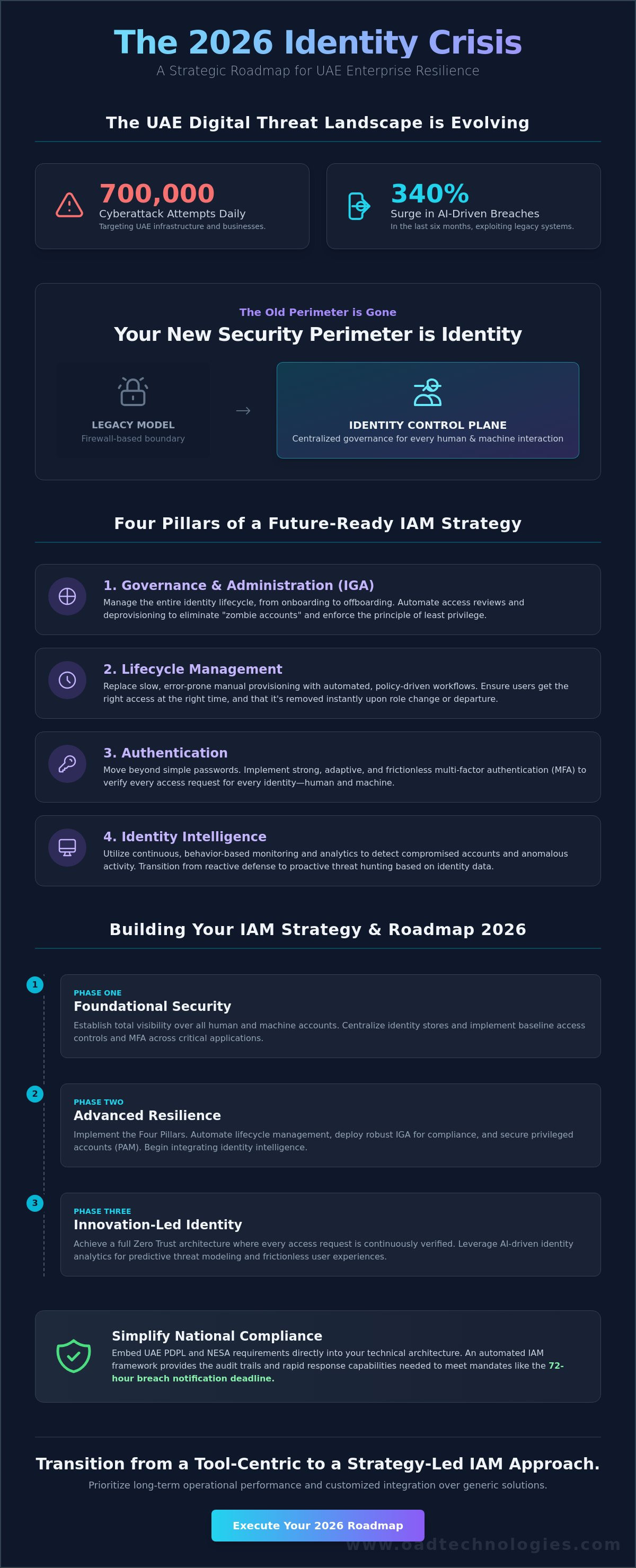
With the UAE facing up to 700,000 cyberattack attempts daily and AI-driven breaches surging by 340% in the last six months, your legacy security perimeter isn't just aging; it's effectively gone. For many local CISOs, the struggle isn't just about blocking external threats but managing the explosion of human and machine identities across fragmented hybrid environments. Developing a robust iam strategy and roadmap 2026 is no longer a support function. It's the primary control plane for enterprise risk and national resilience in an era of sophisticated digital warfare.
You've likely felt the friction of trying to mesh Zero Trust principles with legacy systems while keeping pace with stringent UAE PDPL and NESA requirements. It's a complex balancing act where one misstep leads to a 72-hour breach notification deadline you might not be ready to meet. This guide promises to help you master these complexities by providing a clear, phased framework for identity maturity. We'll explore how to achieve total visibility over every account and align your technical architecture with the latest national data protection standards to ensure long-term viability.
Key Takeaways
- Redefine your security perimeter by establishing an "Identity Control Plane" that manages both human users and the surge of machine identities like AI agents and bots.
- Implement a balanced framework built on the four pillars of governance, lifecycle management, authentication, and identity intelligence to replace manual provisioning with automated policies.
- Adopt a phased iam strategy and roadmap 2026 to move your organization methodically from foundational security to advanced, innovation-led identity resilience.
- Simplify compliance with UAE PDPL and national data protection regulations by embedding regulatory requirements directly into your technical architecture.
- Transition from tool-centric deployments to a strategy-led approach that prioritizes long-term operational performance and customized integration over generic vendor solutions.
The 2026 Identity Crisis: Why Traditional IAM Strategies Fail
Traditional security models relied on a clear boundary between the trusted internal network and the untrusted internet. That boundary has vanished. In the current UAE digital landscape, your security perimeter is no longer defined by a firewall; it is defined by identity. The shift toward an Identity Control Plane represents a fundamental change in how we protect assets. This centralized layer governs every interaction, whether it originates from a remote employee in Dubai or an automated script in a cloud instance. Without a modernized iam strategy and roadmap 2026, organizations remain anchored to static, perimeter-based logic that fails to stop modern, identity-based attacks.
The challenge is compounded by the explosion of non-human identities. In the UAE, the rapid adoption of AI and automation has led to a surge in APIs, bots, and AI agents that require access to sensitive data. These entities often outnumber human users but lack the same level of oversight. When these machine identities are left unmanaged, they become silent gateways for attackers. We have moved past the era where security was just about who has access. Today, the critical question is: what are they doing with that access? Transitioning to continuous, behavioral monitoring is the only way to detect a compromised account before it leads to a full-scale breach.
Foundational knowledge of Identity and access management (IAM) is essential, but local enterprises must go further. They need to integrate these concepts into a resilient, technical framework that accounts for the specific threats facing the region, including the 340% surge in AI-driven breaches reported in early 2026.
The Dissolving Perimeter and Identity Sprawl
Remote work and multi-cloud environments have finalized the collapse of the traditional network edge. This shift created identity sprawl, where users and machines hold fragmented permissions across dozens of disconnected platforms. This sprawl creates massive visibility gaps, making it nearly impossible for IT teams to audit effective permissions. Identity-first security is the 2026 gold standard for enterprise resilience.
The High Cost of Identity-Based Breaches
There is a direct correlation between weak governance and successful data exfiltration. In the UAE, where 52% of cyber incidents are financially motivated, compromised privileged accounts pose a strategic risk to national infrastructure. A single hijacked administrative credential can bypass millions of dollars in network security investment. To mitigate this, organizations should align with a proven Identity and Access Management (IAM): A Strategic Framework for 2026. This approach ensures that identity is treated as a core business risk rather than just a technical checkbox, facilitating compliance with the 72-hour breach notification mandate under the UAE PDPL.
The Four Pillars of a Future-Ready IAM Strategy
Building a resilient iam strategy and roadmap 2026 requires a shift from fragmented toolsets to a unified, four-pillar framework: Governance, Lifecycle, Authentication, and Intelligence. Visibility serves as the absolute prerequisite for this transition. If you can't see an identity, you can't secure it. By moving away from manual provisioning toward automated, policy-driven governance, organizations can eliminate the human error that often leads to over-privileged accounts. This transition must also prioritize user experience. Reducing security friction ensures that employees remain productive without seeking insecure workarounds that jeopardize the enterprise.
Aligning with IAM recommended best practices helps UAE organizations build a foundation that scales alongside their digital transformation. Consulting with a specialized security partner can further bridge the gap between high-level strategic vision and the practical realities of technical execution.
Identity Governance and Administration (IGA)
Simple access management only addresses the entry point. True Identity Governance and Administration (IGA) manages the entire identity lifecycle from onboarding to offboarding. Automated deprovisioning is a critical component of this pillar. It prevents the creation of "zombie" accounts—orphaned credentials from former employees that remain active and vulnerable. Robust IGA doesn't just improve security; it ensures constant audit readiness for national compliance standards like the UAE PDPL by providing a clear trail of who has access to what.
Governing Machine and AI Identities
Machine identities, including secrets, certificates, and service accounts, are the new frontier of enterprise risk. These non-human entities often possess high-level privileges but lack the oversight typically applied to human users. As UAE enterprises integrate autonomous systems, Agentic AI governance becomes a mandatory requirement for managing how AI agents interact with sensitive data. A unified, secure vault for machine credentials is the only way to maintain control over a digital workforce that operates at machine speed.
Identity Threat Detection and Response (ITDR)
Multi-factor authentication (MFA) is no longer a silver bullet. The rise of session hijacking and MFA fatigue attacks means that static credentials, even when layered, are insufficient. Identity Threat Detection and Response (ITDR) provides the necessary mechanism for monitoring behavioral anomalies in real-time. By identifying patterns like impossible travel or unusual resource requests, ITDR acts as an early warning system. For maximum impact, ITDR should integrate with Managed Detection and Response (MDR), allowing identity signals to be correlated with broader network and endpoint telemetry for holistic protection.
Building Your 2026 IAM Roadmap: A Multi-Phase Implementation Guide
Successful identity security isn't a commodity you buy off a shelf; it's a strategic architecture you build. Many organizations struggle because they approach identity as a series of disconnected software purchases rather than a unified discipline. A resilient iam strategy and roadmap 2026 follows a "security-first, not tool-first" philosophy. By prioritizing the protection of high-risk identities, specifically privileged accounts, you create immediate risk reduction while laying the groundwork for more sophisticated capabilities. This phased transition moves your organization from a reactive posture to a proactive, resilient state that can withstand the evolving threat landscape.
Phase 1: The Foundation (Months 1-6)
The initial six months focus on regaining control over identity sprawl. You must conduct a comprehensive inventory that maps every account across on-premises legacy systems and multi-cloud environments. Once you have visibility, implement the Principle of Least Privilege (PoLP) for all critical assets to minimize the potential blast radius of a credential compromise. Consolidating fragmented Single Sign-On (SSO) and Multi-Factor Authentication (MFA) solutions into a unified platform at this stage reduces administrative overhead and closes the security gaps created by "shadow" identity providers.
Phase 2: Optimization and Governance (Months 6-18)
With the foundation set, the focus shifts to operational efficiency and deeper integration. Deploying Identity Governance and Administration (IGA) tools allows you to automate the joiner-mover-leaver (JML) process, ensuring that access is granted accurately and revoked instantly when a user changes roles or leaves the company. At this stage, integrating your identity stack with Data Loss Prevention (DLP) is vital. This synergy allows you to monitor not just who has access, but how they interact with sensitive data. Establishing continuous compliance monitoring ensures your technical controls remain aligned with UAE national standards like NESA and the PDPL.
Phase 3: The Innovation Horizon (Months 18+)
The final phase moves toward a frictionless, intelligence-led environment. Implementing passwordless authentication and risk-based conditional access removes the primary target for phishing, the password, while adjusting security requirements based on real-time context. Deploying AI-driven analytics enables predictive risk scoring, identifying anomalous behavior before it manifests as a breach. Finally, extend your governance framework to your entire supply chain, ensuring that third-party vendors meet the same rigorous identity standards as your internal teams.
Navigating National Compliance and Integration Complexity
A common objection among local CISOs is that a comprehensive identity overhaul is too complex to implement within a highly regulated environment. They fear that modernizing identity controls will break legacy ERP systems or disrupt sensitive HR workflows. However, the reality is that an unmanaged identity landscape is far more complex and dangerous than a structured migration. A well-defined iam strategy and roadmap 2026 actually serves as a simplification engine. It replaces hundreds of manual, siloed access rules with a unified, policy-based architecture that scales with your business rather than hindering it.
Technical integration remains the primary hurdle for most UAE enterprises. Connecting modern cloud identity providers with on-premises legacy systems requires more than just standard connectors; it requires deep architectural knowledge. Success depends on the ability to bridge the gap between "identity-aware" modern apps and "identity-blind" legacy databases. This is where local expertise becomes indispensable. Understanding the nuances of national cybersecurity standards ensures that your technical integration doesn't just work—it stays compliant. If you are ready to modernize your infrastructure, you can consult with our identity architects to design a bespoke integration plan.
Aligning IAM with UAE PDPL and NESA
The UAE PDPL grants individuals the "right to be forgotten," a mandate that is impossible to fulfill without automated deprovisioning. When an identity is deleted or modified in your central directory, a mature IAM system ensures that every trace of that user's access is wiped across all connected platforms. Beyond privacy rights, data residency is a critical concern. Identity metadata often contains sensitive PII that must remain within the UAE's borders to satisfy NESA requirements. Aligning your roadmap with the Governance Risk and Compliance (GRC) pillar ensures that your identity controls are legally defensible and audit-ready.
Cross-Stack Synergy: IAM, DLP, and SIEM
Identity doesn't exist in a vacuum. It provides the essential context (the "who") for every security alert generated by your other tools. For instance, a Data Loss Prevention (DLP) alert telling you that sensitive files were moved is helpful, but knowing that the move was performed by a service account that hasn't been used in six months is actionable intelligence. Feeding these enriched identity logs into your SIEM enables more effective threat hunting and reduces false positives. This level of stack integration is the most effective way to reduce your mean time to respond (MTTR), allowing your team to neutralize threats before they escalate into breaches.
Executing Your 2026 Roadmap with OAD Technologies
OAD Technologies acts as the master designer for your identity ecosystem. We reject the standard vendor-led approach that often results in a collection of expensive, disconnected tools. Instead, we focus on strategy-led solutions that align with your specific operational goals. In a market where the UAE faces up to 700,000 daily cyberattack attempts, having a national partner who understands the local regulatory landscape isn't just a benefit. It's a requirement for resilience. Our team ensures your iam strategy and roadmap 2026 isn't just a document but a living architecture that protects your most critical assets. We bridge the gap between high-level innovation and practical business results, ensuring that your security posture supports, rather than hinders, your digital growth.
The OAD Advantage: Beyond Tool Implementation
Our engagement begins with rigorous technical security assessments and Vulnerability Assessment and Penetration Testing (VAPT) specifically tailored for the identity plane. We don't just look for open ports. We hunt for over-privileged accounts and orphaned credentials that attackers exploit during the 340% surge in AI-driven breaches reported in early 2026. As a strategic partner, our MSSP model provides continuous monitoring of your identity environment, ensuring that visibility remains absolute. We focus on the long-term viability of your systems, designing architectures that can adapt as your cloud footprint expands. This future-proofing ensures that your investment today continues to deliver value as technology evolves. We believe in the synergy between human insight and technological capacity, empowering your team to manage complex systems with confidence.
Next Steps: Your Journey to Identity Resilience
Your journey toward identity resilience starts with a strategic discovery workshop led by our senior architects. This session isn't a generic presentation. It's a deep dive into your current state, identifying the friction points between your legacy systems and your security goals. The primary deliverables include a comprehensive GAP analysis and a detailed Phase 1 execution plan tailored to your specific iam strategy and roadmap 2026. We define exactly where your vulnerabilities lie and provide the technical path to close them. We also ensure that your plan accounts for the 72-hour breach notification deadline mandated by the UAE PDPL, giving you a clear response framework. Secure your 2026 digital assets today by partnering with a team that values precision engineering and strategic alignment. Contact us to schedule your strategic IAM maturity assessment and take the first step toward a more resilient enterprise.
Securing Your Digital Future through Identity Resilience
OAD Technologies stands ready as your UAE-based strategic cybersecurity specialist. We bring deep expertise in national GRC and PDPL compliance to every engagement, ensuring your technical architecture meets the highest legal standards. Our comprehensive portfolio, spanning IAM, DLP, and MDR, ensures your ecosystem is resilient, integrated, and audit-ready. You don't have to navigate these complexities alone. Our team acts as an extension of your own, providing the engineering precision needed for long-term success.
Architect Your 2026 Identity Roadmap with OAD Technologies
Your journey toward a more secure, identity-first enterprise starts with a single strategic step. We look forward to helping you shape a resilient future that empowers your people and protects your assets.
Frequently Asked Questions
What is the most critical component of an IAM strategy in 2026?
The most critical component is moving beyond static authentication toward continuous, real-time identity intelligence. Static credentials and traditional MFA are no longer enough to stop sophisticated session hijacking or AI-driven phishing. You need a system that constantly evaluates behavioral patterns and environmental context to verify trust for every single transaction. This shift ensures that even if a credential is stolen, the attacker's unusual behavior triggers an immediate response.
How does an IAM roadmap help with UAE Personal Data Protection Law (PDPL) compliance?
A structured roadmap simplifies compliance by automating the technical workflows required for the UAE Personal Data Protection Law (PDPL). For instance, it enables the "right to be forgotten" through automated, cross-platform deprovisioning. It also ensures that identity metadata remains within UAE borders to satisfy national data residency mandates. This alignment turns legal requirements into repeatable, technical processes that pass every audit.
What is the difference between Identity Governance (IGA) and Access Management?
Access Management focuses on the initial login through tools like SSO and MFA to ensure the right person enters. Identity Governance and Administration (IGA) manages the entire lifecycle of that user from onboarding to offboarding. While Access Management acts as the gatekeeper, IGA provides the oversight, policy enforcement, and audit trails needed to ensure access remains appropriate over time.
How long does it typically take to implement a full-scale IAM roadmap?
A comprehensive iam strategy and roadmap 2026 typically takes 18 to 24 months to reach full maturity. This timeline allows for a phased approach, starting with a six-month foundational stage to secure privileged accounts. Subsequent phases focus on optimizing governance and implementing advanced innovations like passwordless authentication. This steady pace ensures that security improvements are sustainable and don't disrupt your core business operations.
Why are machine identities becoming a major security risk in 2026?
Machine identities, such as service accounts and AI agents, are high-value targets because they often lack the same security oversight as human accounts. These non-human entities frequently hold excessive permissions and use hardcoded secrets that are rarely rotated. In the current landscape, the sheer volume and privilege level of these machine identities make them the primary vector for silent, lateral movement within enterprise networks.
Can OAD Technologies integrate modern IAM solutions with my legacy on-prem systems?
OAD Technologies specializes in bridging the gap between modern cloud identity providers and complex legacy on-premises systems. We act as master designers, creating bespoke integration layers that allow your legacy ERP or HR databases to communicate with modern security stacks. This approach ensures you don't have to choose between keeping your established systems and adopting a modern, identity-first security posture.
What is Identity Threat Detection and Response (ITDR) and why do I need it?
Identity Threat Detection and Response (ITDR) is a specialized security layer designed to detect and neutralize attacks targeting the identity infrastructure itself. You need it because traditional tools often miss identity-based techniques like MFA fatigue or credential stuffing. ITDR monitors for anomalies in account behavior, providing the real-time visibility required to stop a breach before data exfiltration occurs.
How does Zero Trust Architecture change my IAM roadmap requirements?
Zero Trust Architecture fundamentally shifts your roadmap requirements from perimeter-based trust to granular, request-level verification. It mandates that every access attempt, regardless of its origin, is authenticated, authorized, and continuously validated. This requires your IAM framework to integrate deeply with device health signals and network telemetry to make informed, context-aware access decisions for every resource.
Disclaimer
Content by OAD Technologies is for general informational purposes only and does not constitute professional or cybersecurity advice. No warranties are made regarding accuracy or completeness; reliance is at your own risk. OAD Technologies shall not be liable for any direct or indirect losses arising from use of this content.


