

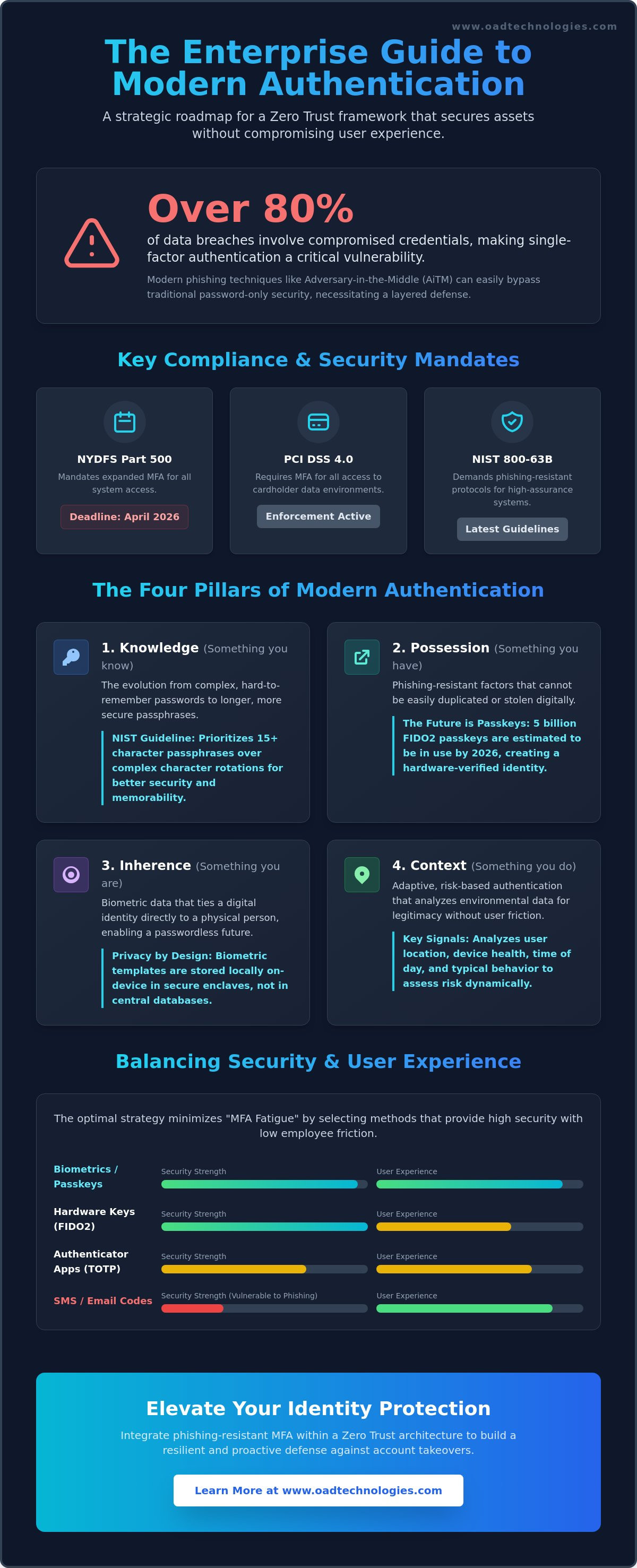
Over 80% of data breaches involve compromised credentials, a reality that positions multi-factor authentication for enterprise as the most critical enforcement point in your digital architecture. While MFA is your primary defense, many teams face "MFA fatigue" where employees actively seek bypass methods to avoid daily friction. You've likely seen how this tension creates gaps in your identity perimeter, particularly when you're forced to bridge legacy on-premise systems with modern cloud requirements. It's a complex balance to strike, especially with the April 2026 NYDFS compliance deadline and the latest NIST 800-63B guidelines demanding phishing-resistant protocols.
Key Takeaways
- Understand why single-factor authentication fails against modern phishing and why a layered identity defense is now the baseline for enterprise security.
- Master the strategic implementation of multi-factor authentication for enterprise to satisfy rigorous national regulations, including the latest NIST and PCI DSS updates.
- Evaluate the technical trade-offs of various authentication methods to find the optimal balance between high-assurance security and employee productivity.
- Discover how to integrate MFA within a Zero Trust architecture and Single Sign-On systems to eliminate fragmented security silos.
- Learn how identity telemetry enhances Managed Detection and Response (MDR) to provide a more resilient and proactive defense against account takeovers.
Beyond Passwords: Why MFA is the Baseline for Enterprise Security
Passwords aren't enough. In fact, they're often the weakest link in your security chain. Modern multi-factor authentication for enterprise isn't just a security add-on; it's the core of your identity perimeter. By requiring two or more independent credentials, you create a defense-in-depth model that stops attackers even if they've harvested a valid password. With over 80% of data breaches involving compromised credentials, relying on a single factor is a risk no modern business can afford. Sophisticated phishing attacks, including Adversary-in-the-Middle (AiTM) techniques, have rendered traditional single-factor authentication obsolete. MFA acts as your primary shield against Account Takeover (ATO) attacks, ensuring that a stolen password doesn't equate to a total system compromise.
The Evolution from 2FA to Multi-Factor Ecosystems
The industry has moved beyond simple two-factor authentication (2FA). While 2FA typically involves a password and a single secondary code, multi-factor authentication incorporates diverse signals like biometrics, hardware keys, and behavioral patterns. For high-privilege access, your organization needs more than just two factors to verify identity with certainty. Modern systems now utilize context-aware authentication, which analyzes the user's location, device health, and login time to assess risk dynamically. This shift from static to dynamic verification ensures that security scales with the sensitivity of the data being accessed, providing a customized layer of protection for every user interaction.
Regulatory Drivers for MFA Adoption
National cybersecurity standards are no longer treating MFA as a suggestion. For instance, the NYDFS Cybersecurity Regulation (23 NYCRR Part 500) mandates expanded MFA for all individuals accessing information systems, with a strict certification deadline of April 15, 2026. Similarly, PCI DSS 4.0 now requires MFA for all access to cardholder data environments. Implementing robust multi-factor authentication for enterprise helps you satisfy these rigorous audit requirements and maintain your standing with national security agencies. Beyond compliance, it's a prerequisite for cyber insurance. Most underwriters now refuse to issue or renew policies without verified MFA across all administrative and remote access points, as it directly reduces the likelihood of high-payout claims. It's a strategic investment that protects your balance sheet as much as your data.
The Four Pillars of Modern Authentication Factors
Building a resilient identity perimeter requires a move beyond simple check-box security. Modern multi-factor authentication for enterprise is built upon four distinct pillars: knowledge, possession, inherence, and context. While legacy systems often stop at the first two, high-assurance environments in 2026 utilize all four to create a nearly impenetrable barrier against unauthorized access. Aligning your strategy with CISA's MFA guidelines ensures you're building on a foundation of proven best practices that account for these diverse factors.
The first pillar, knowledge, is evolving. NIST 800-63B Revision 4, finalized in July 2025, now prioritizes 15-character passphrases over complex character rotations. The second pillar, possession, has seen a massive shift toward FIDO2 security keys and passkeys. As of May 2026, the FIDO Alliance estimates that 5 billion passkeys are in use worldwide, providing a phishing-resistant alternative to traditional hardware tokens. Inherence, the third pillar, utilizes biometrics like facial recognition and iris scans to tie an identity to a physical person. Finally, context has emerged as the fourth pillar, using environmental data to verify a login's legitimacy without user intervention.
Biometrics and the Passwordless Future
Biometrics offer the strongest link between a digital identity and a physical human. In 2026, inherence-based factors are central to passwordless enterprise environments, significantly reducing employee friction. To address privacy concerns, modern systems store biometric templates locally on the device's secure enclave rather than in a central database. This decentralized approach, powered by FIDO2 and WebAuthn, ensures that even if a server is compromised, your employees' biometric data remains secure. As you design these layers, our team at OAD Technologies can help you architect an identity perimeter that balances these four pillars without introducing unnecessary complexity.
Behavioral and Contextual Authentication
Contextual authentication acts as a silent guardian, analyzing risk behind the scenes. AI models now evaluate subtle behavioral signals like typing speed, mouse movements, and typical login times to detect anomalies. If an attacker bypasses a password and a physical key, a sudden change in typing rhythm can trigger an immediate block. Geofencing further strengthens this by restricting access based on national network boundaries, a critical requirement for organizations meeting strict national security standards. This risk-based approach ensures that you only escalate MFA requirements when the session risk actually warrants it, preserving the user experience for legitimate daily tasks.
MFA Methods: Balancing Security, Cost, and User Friction
Selecting the right multi-factor authentication for enterprise requires a nuanced understanding of the threat landscape. While any MFA is better than none, legacy methods like SMS and Voice are increasingly precarious. Attackers frequently use SIM swapping to intercept one-time codes, a vulnerability that led NIST to discourage these "out-of-band" methods in their 800-63B guidelines. These channels are too easily intercepted by motivated actors, making them a liability for high-assurance environments where data integrity is paramount.
Time-based One-Time Passwords (TOTP) offer a more secure, offline alternative by generating codes on a localized application. They don't rely on the cellular network, which eliminates the SIM swapping risk. However, they aren't immune to phishing. If a user is tricked into entering a TOTP code on a fraudulent site, an attacker can use it immediately. Push notifications solve the friction problem by allowing one-tap approval, but they've introduced a new risk: MFA fatigue. In these attacks, bad actors bombard a user with requests until they accidentally or out of frustration tap "Approve." This human-element vulnerability is why modern push notifications now often require "number matching" to ensure the user is physically present at the login screen.
Evaluating Phishing-Resistant MFA
Phishing-resistant MFA is defined by its ability to withstand Adversary-in-the-Middle (AiTM) attacks. In these scenarios, attackers intercept the authentication traffic in real-time, capturing both passwords and traditional MFA codes. Legacy methods fail here because they don't verify the origin of the request or the destination of the credential. FIDO2 is the industry standard for hardware-backed security. By utilizing public-key cryptography, FIDO2 ensures the credential never leaves the device and is cryptographically bound to the specific service, making it impossible for an attacker to reuse a captured signal on a different domain.
Total Cost of Ownership (TCO) for Enterprise MFA
Calculating TCO involves more than just license fees. Hardware tokens provide high security but come with logistics costs and the inevitable helpdesk burden of replacing lost physical keys. Conversely, software-based authenticators are cheaper to deploy but may increase helpdesk tickets for device re-registration when employees upgrade their smartphones. A centralized approach to Identity and Access Management (IAM) is essential for reducing these hidden costs. By unifying authentication streams, you streamline the user experience and lower the operational overhead of managing diverse multi-factor authentication for enterprise deployments. This strategic consolidation ensures that your security investment yields long-term dividends rather than mounting technical debt.
Implementing MFA within a Zero Trust Framework
Zero Trust isn't just a strategy; it's the operational reality of 2026. At its core lies the principle of "Never Trust, Always Verify," where multi-factor authentication for enterprise serves as the primary enforcement mechanism. You can't assume a user's legitimacy based on their network location. Instead, every access request must be verified through multiple independent signals. By integrating MFA with your Single Sign-On (SSO) solution, you provide a unified entry point that balances high security with a seamless user experience. This architecture allows you to enforce strict verification at the application, network, and database layers, ensuring that the Principle of Least Privilege is maintained throughout the entire user session.
MFA for Legacy and On-Premise Systems
Many organizations still manage legacy infrastructure that doesn't natively support modern authentication protocols like OIDC or SAML. These "un-agentable" systems often create dangerous blind spots in your security posture. You can solve this by deploying MFA proxies and identity-aware gateways that sit in front of these older resources. These tools intercept traffic and require a successful multi-factor challenge before allowing the connection to proceed. This approach ensures that your security policies remain consistent across hybrid cloud environments, preventing attackers from exploiting weaker authentication on older, on-premise hardware.
Combating MFA Fatigue and Social Engineering
As technical defenses improve, attackers have pivoted to social engineering tactics like MFA bombardment. To stop these "fatigue" attacks, you must move beyond simple "Approve/Deny" prompts. Implementing number matching and providing additional context, such as the requesting application's name and geographic location, empowers users to make informed decisions. Training your workforce to recognize these bombardment patterns is essential, but it must be backed by a strong policy framework. Robust Governance Risk and Compliance (GRC) programs help define these authentication standards, ensuring your MFA deployment meets both security goals and national regulatory requirements.
If you're ready to modernize your identity posture and eliminate these vulnerabilities, partner with OAD Technologies to design a customized Zero Trust roadmap for your organization.
Elevating Identity Protection with OAD Technologies
OAD Technologies understands that multi-factor authentication for enterprise is the heartbeat of a modern security operations center. We don't treat identity as a siloed function. Instead, we view it as a primary data protection enforcement point that informs every other layer of your defense. When you implement MFA, you aren't just verifying a user; you're generating rich telemetry that reveals who is accessing what, from where, and under what conditions. This data is the fuel for our Managed Detection and Response (MDR) platform, allowing us to spot the subtle signs of credential harvesting or lateral movement before they escalate into full-scale breaches.
Our approach goes beyond the initial tool deployment. We provide strategic consulting to ensure your Identity and Access Management (IAM) framework remains resilient against the evolving threat landscape of 2026. By aligning multi-factor authentication for enterprise with your broader business goals, we help you navigate the complexities of national regulatory environments. We ensure your authentication policies aren't just secure, but also fully compliant with local data sovereignty and cybersecurity mandates, providing a customized roadmap for long-term identity resilience.
Identity-First Security Operations
Holistic visibility is the only way to manage modern risk. We integrate your identity signals directly into our SIEM architecture, creating a unified view of your security posture. This integration allows our analysts to perform proactive threat hunting based on anomalous authentication patterns that a standalone MFA tool might miss. If an employee successfully authenticates from a known device but shows unusual behavioral patterns, our system flags the session for immediate review. This rapid incident response capability ensures that even if a credential is compromised, the window of opportunity for an attacker is minimized through automated containment and expert analysis.
Your Strategic Partner in the UAE
In a market where standardized solutions are the norm, OAD Technologies stands apart through high-quality craftsmanship and customized security architecture. We act as a master designer of systems, bridging the gap between high-level innovation and practical business results. Our commitment to your digital relevance means we don't just solve today's access problems; we build a foundation for your future growth. We invite you to consult with OAD Technologies on your MFA strategy and discover how a sophisticated approach to identity can transform your enterprise resilience. Our team acts as an extension of yours, ensuring your organization remains a guardian of its own data in an ever-changing global market.
Architecting a Resilient Identity Future
The landscape of digital identity has shifted from simple access control to a sophisticated enforcement point for data protection. Implementing multi-factor authentication for enterprise is no longer just a best practice; it's a mandatory requirement for navigating the complex regulatory and threat environments of 2026. By layering phishing-resistant factors with behavioral context, you close the gaps that legacy systems and human error often leave open. This strategic approach ensures your organization doesn't just survive an audit but actively thwarts sophisticated account takeover attempts.
At OAD Technologies, we provide the specialized UAE-based cybersecurity expertise needed to bridge the gap between high-level innovation and practical results. From comprehensive IAM and GRC consulting to advanced MDR and SIEM integration, we act as a master designer of your security architecture. We invite you to secure your enterprise identity with OAD Technologies and ensure your long-term digital relevance. You have the tools to build a resilient, identity-first future. Let's start building it today.
Frequently Asked Questions
What is the difference between 2FA and MFA for enterprises?
Two-factor authentication (2FA) is a subset of MFA that requires exactly two credentials to verify an identity. Multi-factor authentication allows for two or more factors and often incorporates additional signals like device health or geographic location. For high-privilege accounts, enterprises use MFA to create a more robust defense that goes beyond the simple combination of a password and a mobile code.
Why is SMS-based MFA considered insecure for corporate use?
SMS-based authentication is vulnerable to SIM swapping and carrier-level interception. Because these codes travel over unencrypted cellular networks, they don't provide the cryptographic binding needed to stop modern man-in-the-middle attacks. NIST guidelines now discourage the use of SMS for high-assurance environments because it's too easy for motivated actors to redirect or harvest the one-time codes.
How does MFA fit into a Zero Trust security model?
MFA serves as the primary enforcement engine for the "Never Trust, Always Verify" principle. In a Zero Trust architecture, identity is not assumed based on network location. Instead, every access request triggers a multi-factor challenge that evaluates real-time risk signals. This ensures that access is granted only after the user's identity and device posture are fully validated for that specific session.
What is MFA fatigue and how can businesses prevent it?
MFA fatigue occurs when an attacker bombards a user with push notifications until they accidentally or out of frustration approve a fraudulent login. You can prevent these attacks by implementing number matching, which requires the user to type a code shown on the login screen into their mobile app. Providing additional context, such as the application name and location, also helps users identify suspicious requests.
Can MFA be implemented for legacy systems that do not support it natively?
Yes, you can implement multi-factor authentication for enterprise legacy systems by using identity-aware proxies or MFA gateways. These tools act as a protective layer that sits in front of your on-premise infrastructure. They intercept access requests and require a successful multi-factor challenge before allowing the connection to reach the older, non-native application, ensuring consistent security across your entire environment.
How does enterprise MFA help with national regulatory compliance?
Implementing multi-factor authentication for enterprise directly satisfies strict mandates like PCI DSS 4.0 and the NYDFS Cybersecurity Regulation. These laws require organizations to prove that only authorized individuals can access sensitive data environments. MFA provides the necessary technical safeguards and audit trails to certify compliance with these national security standards, helping you avoid significant legal and financial penalties.
What are phishing-resistant MFA methods?
Phishing-resistant MFA methods include FIDO2 security keys and passkeys that utilize public-key cryptography. Unlike traditional codes or push prompts, these credentials are cryptographically bound to a specific domain and device. This prevents an attacker from using a captured credential on a different site, effectively neutralizing the threat of Adversary-in-the-Middle attacks that bypass legacy authentication methods.
Is biometric authentication safe for enterprise employees?
Biometric authentication is safe because modern systems store biometric templates locally on a device's secure hardware rather than in a central database. The actual fingerprint or facial data never leaves the user's smartphone or security key. This decentralized approach protects employee privacy while providing a high-assurance factor that's much harder to replicate or steal than a traditional alphanumeric password.
Disclaimer
Content by OAD Technologies is for general informational purposes only and does not constitute professional or cybersecurity advice. No warranties are made regarding accuracy or completeness; reliance is at your own risk. OAD Technologies shall not be liable for any direct or indirect losses arising from use of this content.


