

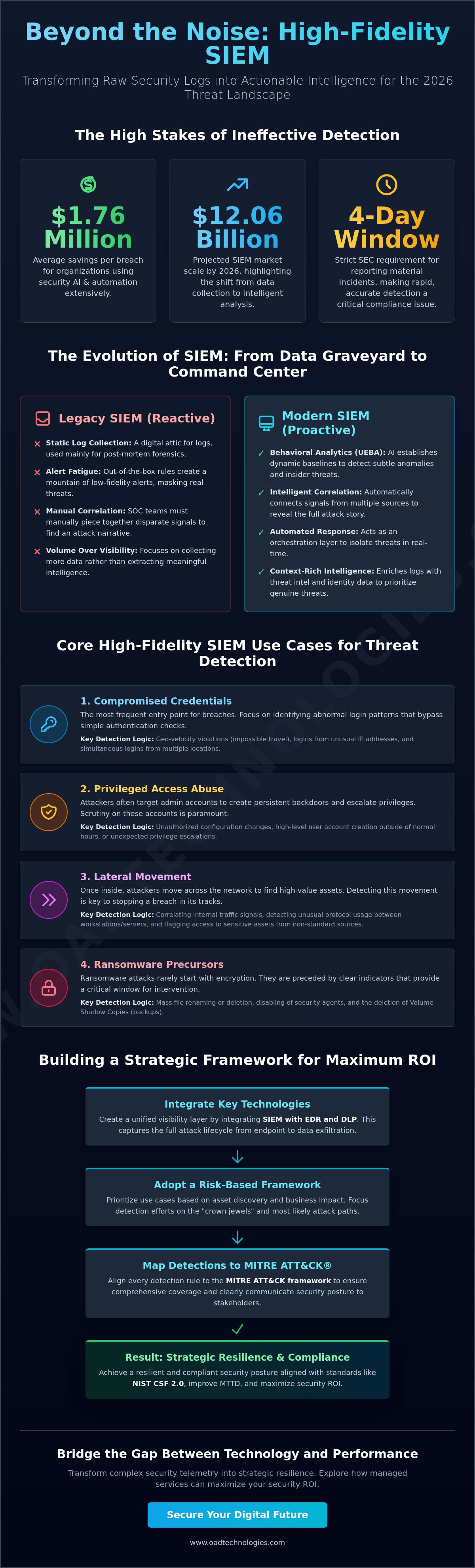
Organizations using security AI and automation extensively save an average of $1.76 million per breach compared to those that don't, yet many SOC teams still find themselves buried under a mountain of low-fidelity alerts. As the SIEM market scales toward a projected $12.06 billion in 2026, the challenge isn't collecting more data; it's engineering siem use cases for threat detection that surface the actual narratives of a breach. You likely feel the pressure of the SEC's four-day reporting requirement and the complexity of aligning every detection to the MITRE ATT&CK framework. It's a relentless cycle that often prioritizes volume over visibility.
We're here to help you break that cycle and transform raw security logs into actionable intelligence. This guide provides a prioritized list of high-fidelity use cases designed for the 2026 threat landscape, ensuring your defenses are both resilient and compliant with updated NIST CSF 2.0 standards. We'll explore how to integrate your SIEM with EDR and DLP to capture the full attack lifecycle. By the end of this article, you'll have a strategic roadmap to improve your mean time to detect (MTTD) and secure your enterprise's digital future.
Key Takeaways
- Transition from static log aggregation to advanced behavioral analytics and UEBA to detect sophisticated threats that bypass traditional perimeter defenses.
- Prioritize high-fidelity siem use cases for threat detection specifically designed to identify compromised credentials and privileged access abuse.
- Integrate SIEM with Data Loss Prevention (DLP) to create a unified visibility layer that streamlines compliance with national regulations like the UAE PDPL.
- Adopt a risk-based framework for asset discovery and prioritization that maps directly to the MITRE ATT&CK framework for maximum security ROI.
- Explore how managed services transform complex security telemetry into strategic resilience by bridging the gap between technology and operational performance.
The Evolution of SIEM: Why Static Log Collection Fails in 2026
Legacy systems often treated security data like a digital attic, a place to store logs until they were needed for a forensic post-mortem. In 2026, this approach is a liability. Modern Security Information and Event Management (SIEM) has evolved into the central nervous system of the enterprise security stack. It no longer functions as a passive repository. Instead, it acts as an active orchestration layer that integrates telemetry from across the environment to provide a real-time view of the threat landscape. For a modern security operations center (SOC), the goal is to shift from reactive log management to proactive, automated response.
Standard "out-of-the-box" configurations frequently fail because they lack the nuance of your specific business context. When every minor deviation triggers a high-priority alert, the result is debilitating alert fatigue that masks genuine threats. Effective siem use cases for threat detection require more than just a list of pre-configured rules. They demand a logic-driven approach that correlates disparate signals into a coherent story of an attack. SIEM use cases are the logic applied to data to identify specific security risks.
From Log Management to Intelligent Correlation
The transition from raw storage to intelligent correlation marks the divide between legacy and next-gen security operations. AI-native SIEM platforms now utilize machine learning to establish dynamic baselines for "normal" behavior. This allows the system to identify subtle anomalies, such as a user accessing sensitive files from an unusual IP address while simultaneously disabling security agents on their endpoint. By enriching raw logs with threat intelligence and identity data, the SIEM provides the context necessary to distinguish between a routine administrative task and a sophisticated lateral movement attempt.
The Cost of Ineffective Detection Scenarios
Inefficiency carries a heavy price tag. According to 2026 industry data, organizations using security AI and automation extensively save an average of $1.76 million per breach compared to those that don't. Beyond the financial impact, ineffective detection creates dangerous blind spots, particularly within unmonitored cloud environments or shadow IT assets. With the full implementation of SEC cybersecurity risk management rules, firms now face a strict four-day window to report material incidents. Failing to detect an intrusion due to poorly tuned logic is no longer just a technical failure; it's a significant regulatory risk that can lead to enhanced enforcement actions.
Core SIEM Use Cases for Advanced Threat Detection
Identifying siem use cases for threat detection is a strategic exercise in risk prioritization. It isn't enough to collect logs; you must apply logic that mirrors the attacker's journey. High-fidelity detections focus on the transition points where an intruder moves from an initial foothold to full environment compromise. While many organizations rely on common SIEM use cases, true resilience requires customized logic that reflects your specific operational risks.
Compromised credentials continue to be the most frequent entry point for breaches. Your SIEM should identify abnormal login patterns, such as geo-velocity violations where a single user appears to travel thousands of miles in minutes. Similarly, monitoring privileged access abuse focuses on administrative accounts. Any unauthorized configuration change or account creation by a high-level user demands immediate scrutiny to prevent persistent backdoors. For organizations seeking to refine these detections, exploring a customized security strategy can bridge the gap between technology and results.
Once inside, attackers move laterally to find high-value assets. Correlating internal traffic signals allows SOC teams to stop these movements before they reach the "crown jewels." Detecting ransomware precursors is equally vital. Indicators like mass file renaming or the deletion of volume shadow copies are clear signals of an impending encryption event. These early warnings provide the necessary time to isolate affected systems and prevent a full-scale catastrophe.
Detecting the Human Element: Insider Threats
The human element introduces a layer of unpredictability that traditional perimeter defenses can't catch. By correlating HR data with system access logs, organizations can identify "at-risk" employee behavior. Monitoring for unauthorized data staging or unusual after-hours activity helps mitigate the risk of data theft. Using User and Entity Behavior Analytics (UEBA) allows the system to detect subtle deviations from an individual's established baseline, providing a more nuanced approach than static rules. This is a critical component of modern siem use cases for threat detection.
Network and Infrastructure Integrity
Infrastructure integrity relies on constant vigilance and real-time correlation. Detecting beaconing activity to known Command and Control (C2) servers identifies active infections that traditional firewalls might miss. Identifying rogue devices or unauthorized wireless access points within the corporate perimeter ensures your network remains a trusted environment. Integrating endpoint detection and response signals ensures that every device on the network is accounted for and secured, providing the granular visibility needed for modern defense.
Strategic Integration: SIEM, DLP, and Compliance
While identity and network integrity are foundational, the ultimate objective of most cyberattacks is data exfiltration. Integrating your SIEM with data loss prevention (DLP) creates a sophisticated visibility layer that tracks sensitive information from initial access to final egress. This synergy allows security teams to move beyond generic alerts and focus on siem use cases for threat detection that specifically target the movement of intellectual property. By mapping data movement to user behavior, you can distinguish between legitimate business processes and malicious exfiltration attempts.
Monitoring for unauthorized cloud storage usage, often called Shadow IT, is essential because these platforms frequently bypass standard corporate DLP controls. By correlating Identity and Access Management (IAM) failures with subsequent attempts to access sensitive directories, the SIEM can flag targeted attacks where an adversary is methodically testing permissions. These essential SIEM security functions ensure that data remains protected even as traditional network boundaries dissolve in a hybrid cloud environment.
For organizations operating in the Middle East, automating compliance reporting for the UAE Personal Data Protection Law (PDPL) is a strategic necessity. A well-configured SIEM doesn't just detect threats; it serves as a central evidence repository for regulatory audits. It ensures that data processing activities are logged and retained according to local requirements, reducing the risk of significant fines and reputational damage. This proactive stance transforms compliance from a reactive burden into a documented pillar of enterprise resilience.
Data-Centric Detection Scenarios
Detection logic must prioritize your "crown jewels" to be effective. High-priority scenarios include identifying mass data downloads to unencrypted USB devices or personal cloud accounts, which often signal an active insider threat or a compromised workstation. Monitoring for sudden changes in file permissions on critical financial or legal directories provides another layer of defense against unauthorized access. A 'Data-First' SIEM approach represents the ultimate defense against exfiltration by anchoring detection logic to the organization's most valuable assets.
Compliance as a Continuous Process
Compliance shouldn't be a seasonal scramble. Modern SIEM dashboards provide real-time visibility into your Governance, Risk, and Compliance (GRC) health, allowing for proactive adjustments before an audit begins. Automating the collection of evidence for national cybersecurity audits saves hundreds of manual hours and ensures the accuracy of your reporting. By optimizing log retention strategies, enterprises can meet local regulatory demands without bloating storage costs or sacrificing the search performance required for siem use cases for threat detection.
Building a Strategic SIEM Use Case Framework
A resilient security posture isn't built on a collection of static rules; it's the result of a disciplined, repeatable engineering lifecycle. Moving from raw data to actionable intelligence requires a framework that accounts for the constant evolution of adversary tactics. To maximize your investment, you must move beyond the "set and forget" mentality that plagues legacy SOC operations. A structured approach ensures that your siem use cases for threat detection remain relevant as your digital footprint expands.
The implementation process follows five critical stages:
- Step 1: Asset Discovery and Data Source Identification. You can't protect what you can't see. Catalog all critical assets and identify high-fidelity data sources, including EDR telemetry, firewall logs, and cloud-native audit trails.
- Step 2: Risk-Based Prioritization. Align your detection strategy with the MITRE ATT&CK framework. Focus on the techniques most likely to impact your specific industry, such as credential access or data exfiltration.
- Step 3: Logic Development and Threshold Tuning. Engineering detection logic is a balancing act. Fine-tune thresholds to distinguish between legitimate administrative activity and malicious intent, which helps minimize false positives.
- Step 4: Continuous Validation. Use Breach and Attack Simulation (BAS) or Red Teaming to test your detections against real-world scenarios. This confirms that your alerts actually trigger when an adversary strikes.
- Step 5: Regular Review and Retirement. Threats change, and so should your rules. Establish a quarterly cadence to retire low-value or obsolete detection logic that only contributes to alert noise.
If managing this lifecycle internally feels overwhelming, consider partnering with an expert to implement a managed detection and response strategy that scales with your growth.
Mapping to the MITRE ATT&CK Framework
Effective detection requires visibility across the entire cyber kill chain. By mapping your current capabilities to the MITRE ATT&CK framework, you can identify dangerous gaps in your coverage. It's vital to maintain a balance between "North-South" monitoring at the perimeter and "East-West" monitoring for internal lateral movement. Prioritizing siem use cases for threat detection based on the likelihood and impact of specific adversary techniques ensures that your team focuses on the threats that matter most to your business continuity.
Operationalizing Use Case Management
Operational excellence is what separates a world-class SOC from a reactive one. You should establish a formal process for requesting, approving, and documenting every new detection rule. Every alert must include the original "intent" and clear remediation steps to assist analysts during high-pressure incidents. Measure your success through performance metrics like the True Positive Rate and the Actionable Alert Ratio. These data points provide the transparency needed to prove the ROI of your security investments to executive leadership.
Maximizing Security ROI with OAD Technologies' Managed SIEM
Technology alone doesn't stop modern breaches; the synergy between engineering and human insight does. OAD Technologies bridges the gap between complex security telemetry and tangible business outcomes by treating your SIEM as a strategic asset rather than a passive storage bucket. By adopting a unified managed detection and response (MDR) approach, we ensure that your siem use cases for threat detection are continuously refined to meet the shifting tactics of sophisticated adversaries. This is particularly critical for UAE enterprises navigating the specific requirements of the PDPL and national cybersecurity standards.
Our methodology focuses on creating a holistic defense by integrating SIEM data with GRC frameworks and identity and access management (IAM). This integration ensures that every alert is grounded in business context. Instead of chasing isolated digital ghosts, your security team receives high-fidelity narratives that connect identity, endpoint, and data movement signals. This strategic alignment transforms your security stack from a collection of silos into a unified engine for enterprise resilience.
Beyond Technology: The Human-Led SOC
The most advanced algorithms still require human intuition to interpret the "why" behind a signal. OAD experts augment your in-house teams to provide 24 X 7 monitoring, ensuring that critical alerts never go unnoticed during off-peak hours. Proactive threat hunting is a core component of our service, where our analysts hunt for hidden indicators of compromise that automated rules might overlook. In one regional engagement, we helped a client reduce their incident response time by 45% simply by optimizing their siem use cases for threat detection and eliminating redundant telemetry that caused analyst burnout.
Future-Proofing Your Security Infrastructure
Building for 2026 requires a focus on long-term viability and scalability. We utilize cloud-native SIEM architectures that grow alongside your digital footprint, whether you're expanding into new markets or migrating legacy workloads. Our framework integrates emerging technologies like Cloud Security Posture Management (CSPM) and Security Orchestration, Automation, and Response (SOAR) into the detection lifecycle. This ensures your organization doesn't just keep pace with technology but actively shapes its application for ongoing digital relevance. Schedule a strategic SIEM assessment with OAD Technologies today to identify gaps in your current detection coverage and build a roadmap for resilience.
Securing Your Digital Future through Engineering Excellence
Resilience in 2026 isn't achieved by simply collecting more data; it's earned through the precision of your detection logic. We've explored how transitioning from static log management to behavioral analytics allows your SOC to outpace modern adversaries. By integrating DLP signals and mapping your strategy to the MITRE ATT&CK framework, you transform your security stack into a proactive defense system. Implementing high-fidelity siem use cases for threat detection ensures your team remains focused on material risks rather than chasing low-value noise.
OAD Technologies acts as your strategic partner to bridge the gap between technical complexity and business performance. Our team brings deep expertise in UAE PDPL and GRC compliance, providing advanced DLP-integrated threat detection and proactive 24 X 7 managed security operations. We don't just provide tools; we offer a roadmap for long-term digital relevance in an increasingly volatile market. Secure your enterprise with OAD Technologies' specialized SIEM and MDR solutions. Your journey toward a more resilient and compliant future starts with a single, strategic step forward.
Frequently Asked Questions
What is a SIEM use case?
A SIEM use case is a defined set of logical conditions and correlation rules applied to security telemetry to identify a specific threat or risk. It acts as a blueprint for detection by specifying which data sources to monitor and what patterns indicate a security incident. This structured approach transforms raw logs into actionable intelligence by focusing on measurable adversary techniques.
How many SIEM use cases should an enterprise ideally have?
There is no universal number; quality always supersedes quantity in resilient security operations. Most mature enterprises maintain between 20 and 50 high-fidelity use cases that cover their most critical assets and known risks. Attempting to manage hundreds of rules often leads to debilitating alert fatigue and obscures genuine threats within the noise of the SOC.
What is the difference between a SIEM use case and a security alert?
A use case is the underlying logic and framework, while an alert is the specific notification triggered when those conditions are met. Think of the use case as the strategic design for detection and the alert as the tactical signal that sounds when a breach is identified. Effective siem use cases for threat detection ensure that every alert is high-fidelity and actionable for the analyst.
How do I prioritize which SIEM use cases to implement first?
Prioritization should follow a risk-based approach aligned with the MITRE ATT&CK framework and your organization's most valuable assets. Start with detections for compromised credentials and privileged access abuse, as these are the most frequent entry points for modern breaches. Focus on scenarios with the highest likelihood of occurrence and the most significant potential impact on your business continuity.
Can SIEM use cases help with UAE PDPL compliance?
Yes, SIEM use cases are essential for meeting the data monitoring and incident reporting requirements of the UAE Personal Data Protection Law. By engineering detections that track unauthorized access to personal data, you create a documented audit trail for regulators. This proactive monitoring demonstrates the technical and organizational measures required to protect data subject privacy in a digital environment.
How often should SIEM use cases be updated or reviewed?
Organizations should conduct a formal review of their detection logic at least quarterly to maintain relevance. Threat landscapes evolve rapidly, making older rules obsolete as attackers change their tactics and tools. Regular validation through breach and attack simulation ensures that your siem use cases for threat detection still trigger correctly against modern adversary techniques and newly discovered vulnerabilities.
Is it better to build custom SIEM use cases or use out-of-the-box ones?
A hybrid approach is usually most effective, but deep customization is where true resilience is built. Out-of-the-box rules provide a baseline for common threats, yet they lack the specific context of your unique business environment. Custom use cases allow you to tune thresholds and correlate data from specific internal systems, which significantly reduces the rate of false positives.
What are the most common challenges in implementing SIEM use cases?
The primary challenges include poor data quality, lack of specialized personnel, and excessive alert noise. Many teams struggle to ingest clean, structured data from disparate sources like hybrid clouds and legacy endpoints. Without proper tuning and a structured framework, use cases often generate too many low-value alerts, which eventually causes SOC analyst burnout and operational inefficiency.
Disclaimer
Content by OAD Technologies is for general informational purposes only and does not constitute professional or cybersecurity advice. No warranties are made regarding accuracy or completeness; reliance is at your own risk. OAD Technologies shall not be liable for any direct or indirect losses arising from use of this content.


