

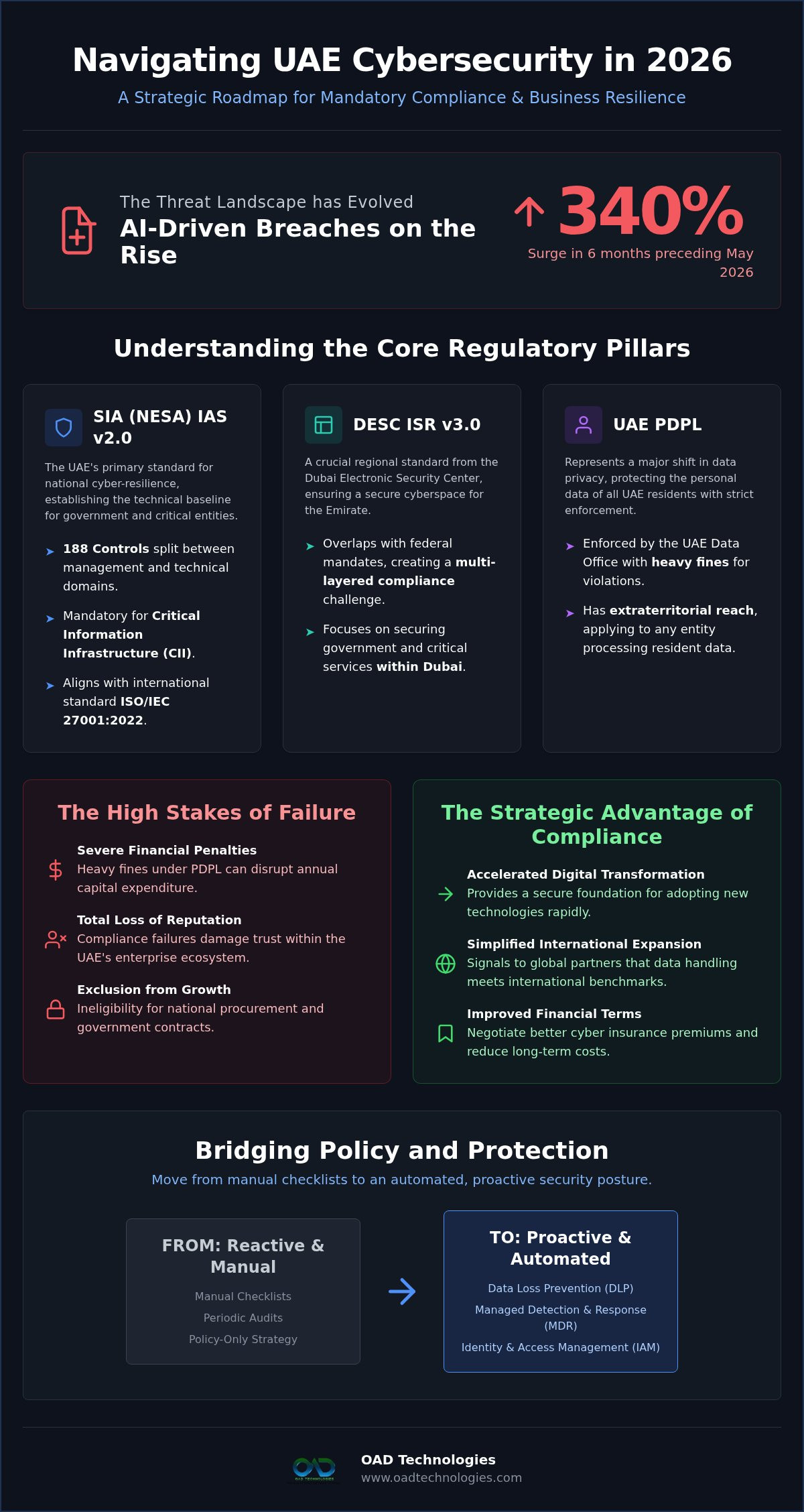
With AI-driven breaches surging by 340% in the six months preceding May 2026, the margin for error in your digital defense has vanished. Achieving robust cybersecurity compliance uae is no longer just a legal hurdle; it's a fundamental requirement for operational resilience. You likely feel the mounting pressure of overlapping mandates like SIA (formerly NESA) and DESC ISR v3.0, coupled with the fear of heavy fines under the strictly enforced PDPL. It's often difficult to find a partner who can bridge the gap between high-level governance and the technical implementation required to automate these controls.
This guide provides a strategic roadmap to full regulatory alignment by integrating compliance directly into your technical architecture. We'll explore how to move beyond manual checklists toward automated technical controls like Data Loss Prevention (DLP) and Managed Detection and Response (MDR). By the end, you'll understand how to transform regulatory requirements into a cohesive security stack that protects your data and ensures long-term business viability across the Emirates.
Key Takeaways
- Transition from voluntary standards to mandatory enforcement by aligning your security architecture with the latest 2026 federal requirements.
- Master the core requirements of SIA standards, DESC ISR v3.0, and the UAE PDPL to mitigate the risk of data breaches and legal penalties.
- Bridge the gap between GRC policy and practical protection by deploying automated technical controls like Data Loss Prevention and Identity and Access Management.
- Utilize our buyer’s framework to select partners who offer deep technical expertise alongside a thorough understanding of the local regulatory landscape.
- Build a sustainable roadmap for cybersecurity compliance uae that prioritizes long-term digital relevance and proactive risk management.
Navigating the UAE Cybersecurity Regulatory Landscape in 2026
The UAE has moved past the era of optional security guidelines. By 2026, the regulatory environment has matured into a complex, mandatory ecosystem where achieving cybersecurity compliance uae is a prerequisite for any enterprise operating within the national borders. This isn't a single checklist but a multi-layered requirement. It involves federal decree-laws, sector-specific mandates from bodies like the CBUAE, and regional standards such as DESC ISR v3.0. The UAE Cybersecurity Council acts as the primary architect of this landscape, driving a national shift toward "active defense."
A significant part of this evolution is the role of the Signals Intelligence Agency (SIA). They oversee the UAE Information Assurance Standards (IAS) version 2.0, which now aligns closely with ISO/IEC 27001:2022. For organizations handling Critical Information Infrastructure (CII), the National Cyber Accreditation Programme (NCAP) is now mandatory. Relying on a "compliance-only" strategy is a recipe for failure; if your security posture is purely reactive, you're already behind the curve. In a market where AI-driven breaches surged by 340% in early 2026, compliance must be the floor of your strategy, not the ceiling.
The Cost of Non-Compliance: Legal and Financial Risks
The financial implications of ignoring these mandates are severe. Under the UAE Personal Data Protection Law (PDPL), the UAE Data Office is strictly enforcing regulations with the power to impose heavy fines that can disrupt your annual capital expenditure. However, the legal penalties are just the starting point. Within the UAE's tightly-knit enterprise ecosystem, a compliance failure often leads to a total loss of reputation. You'll likely find your organization ineligible for national-level procurement and government contracts. This effectively locks your business out of the most lucrative growth opportunities in the region, as government entities now require proof of NCAP accreditation or ISR alignment before signing any service agreements.
Compliance as a Strategic Business Enabler
Smart leadership teams view cybersecurity compliance uae as a competitive advantage rather than a burden. A robust security framework accelerates digital transformation by providing a secure foundation for rapid technological adoption. When you align with local standards, you're also signaling to global partners that your data handling meets international benchmarks. This alignment simplifies international expansion and streamlines cross-border data transfers. From a financial perspective, a verified compliance status allows you to negotiate significantly better terms for cyber insurance premiums and reduces the long-term costs of incident response. It's about building digital relevance that lasts.
Core Frameworks: NESA, DESC ISR, and UAE PDPL
The architecture of cybersecurity compliance uae is built on several pillars that work in tandem to protect the nation's digital economy. At the federal level, the UAE Information Assurance (IA) Regulation establishes the technical baseline for government and critical entities. This is complemented by sector-specific mandates, such as the Central Bank of the UAE (CBUAE) requirements, which now demand a complete phase-out of SMS and email-based one-time passwords by March 31, 2026. For healthcare providers, the ADHICS standard remains the essential framework for safeguarding patient data and ensuring clinical system resilience.
Decoding NESA IAS: The 188 Controls
NESA is the UAE's primary standard for national cyber-resilience. It defines a comprehensive set of 188 controls split between management and technical domains. These controls are prioritized into tiers to help organizations focus their resources on the most critical vulnerabilities first. While Priority 1 controls represent the mandatory foundation for critical infrastructure, achieving full alignment requires a sophisticated technical integration that goes beyond basic security settings. If you're navigating these tiers, our GRC consulting team can help design a roadmap that bridges these policy requirements with your existing technical capacity.
The UAE PDPL: Protecting Data in the Digital Age
The UAE Personal Data Protection Law (PDPL) represents a major shift in how organizations handle resident information. In 2026, the UAE Data Office enforces this law with strict extraterritorial reach, applying to any entity processing the data of UAE residents regardless of their physical location. Key requirements include:
- Mandatory DPO: Organizations must appoint a Data Protection Officer to manage compliance and serve as a liaison with the Data Office.
- Data Subject Rights: You must provide clear mechanisms for individuals to access, rectify, or delete their personal data upon request.
- Technical Safeguards: Cross-border data transfers are restricted unless specific technical protections, such as robust encryption or localized storage, are in place.
For government and semi-government entities, the Information Security Regulation (ISR) Version 3.0, issued by the Electronic Security Center, provides the mandatory framework for protecting information assets. This version places a heavy emphasis on supply-chain security and the protection of IoT devices. Whether you're aligning with federal IA standards or sector-specific ISR mandates, compliance is no longer a one-time project; it's a state of continuous operational readiness.
Technical Requirements: Bridging Policy and Protection
Achieving cybersecurity compliance uae requires a shift from static policy documents to dynamic technical enforcement. While GRC frameworks define the "what," your security stack defines the "how." For example, NESA's technical assessment requirements aren't met by a simple scan. They demand rigorous VAPT to identify and remediate deep-seated vulnerabilities before they can be exploited. Likewise, the CBUAE’s 2026 mandate to phase out traditional OTPs forces a move toward advanced Identity and Access Management (IAM) that utilizes biometrics and passkeys to satisfy ISR access control standards.
DLP: The Technical Enforcement of Privacy Policy
Under the UAE PDPL, the legal responsibility for data protection is non-negotiable. Data Loss Prevention (DLP) serves as the primary technical tool for enforcing these privacy mandates. It automates the discovery and classification of sensitive information, ensuring that personal data is handled according to its sensitivity level. A mature DLP strategy prevents the unauthorized exfiltration of national data, whether through accidental sharing or malicious intent. To streamline your governance, we recommend integrating DLP with your SIEM. This allows for unified reporting, providing a single pane of glass that demonstrates compliance to auditors and stakeholders alike.
MDR and Incident Response: Meeting Reporting Timelines
The 2026 regulatory landscape leaves no room for delayed responses. DESC ISR v3.0 and other sector-specific laws impose tight notification windows for security incidents. Relying on manual monitoring is a liability. Instead, enterprises are turning to MDR and SIEM to ensure 24 X 7 visibility. Managed Detection and Response (MDR) combines automated EDR and XDR tools with human threat hunters who can distinguish between a false positive and a sophisticated state-sponsored attack. This proactive posture is vital for:
- Rapid Containment: Stopping an attack in its tracks to minimize data loss.
- Forensic Readiness: Ensuring all logs are preserved for regulatory investigations.
- Timely Reporting: Generating the necessary data to meet mandatory breach notification deadlines.
By treating these technical requirements as an integrated system, you don't just check a box. You build a resilient architecture that protects your business while satisfying every layer of cybersecurity compliance uae. This synergy between human insight and technological capacity is what ultimately ensures your long-term digital relevance.
Evaluating Cybersecurity Compliance Partners: A Buyer’s Framework
Selecting a partner for cybersecurity compliance uae requires a departure from traditional procurement models. Many businesses mistake hardware resellers for security experts, but a box of servers won't satisfy a DESC auditor. You need a partner who understands the nuances of the local regulatory bodies and has the technical depth to implement complex tools like DLP and IAM. This is particularly vital as the UAE moves toward mandatory NCAP accreditation for critical infrastructure by the end of 2026.
A strategic partner doesn't just hand over a report; they act as a visionary extension of your team. They should provide a bridge between high-level governance and practical engineering. For organizations leveraging hybrid infrastructure, they must offer CSPM to ensure cloud configurations remain compliant in real-time. This level of integration ensures that your security stack evolves alongside the threat landscape, protecting your investment and your reputation.
Technical Integrator vs. Traditional Auditor
Traditional auditors excel at identifying gaps but often lack the hands-on experience to remediate them. This "gap-only" approach leaves your team with a long list of problems and no roadmap for resolution. A technical integrator, however, manages the full security lifecycle from assessment to implementation and ongoing management. When you evaluate an MSSP, look closely at their Security Operations Center (SOC) capabilities. A SOC that utilizes human threat hunters alongside automated tools ensures that your compliance isn't just a snapshot in time but a continuous state of readiness. It's the difference between knowing you have a problem and having a partner who has already fixed it.
The 2026 Compliance Partner Checklist
To ensure your investment yields long-term resilience, use this structured checklist during your evaluation process:
- Step 1: Verify a national UAE presence and a proven track record with local regulators like the UAE Cybersecurity Council.
- Step 2: Assess their technical capability in emerging technologies, specifically Zero Trust architectures and Cloud Security.
- Step 3: Ensure they offer integrated GRC consulting that aligns directly with their technical service delivery.
Compliance is a journey toward ongoing digital relevance in an ever-changing market. If you're ready to move beyond basic audits and build a resilient, automated security architecture, contact our strategic advisory team to begin your comprehensive compliance assessment.
OAD Technologies: Integrated GRC and Managed Security
OAD Technologies operates as a master designer of resilient digital ecosystems. We reject the standardized, one-size-fits-all approach that often leaves organizations vulnerable to the 32% rise in phishing incidents seen across the region in early 2026. Instead, we provide highly customized architectures that bridge the gap between high-level governance and practical engineering. Our team focuses on national-scale support for UAE enterprises, ensuring that your cybersecurity compliance uae strategy is both a shield and a business enabler. We don't just identify gaps; we build the systems that close them for good.
The synergy between our GRC consulting and high-performance technical tools like DLP and MDR creates a unified defense. This integrated approach allows executive leadership to see the direct return on their security investment through reduced risk and improved operational performance. By aligning your technical stack with the UAE's specific regulatory evolution, we ensure your business remains a leader in the digital economy. We act as an extension of your own team, bringing a proactive, solution-oriented mindset to every challenge.
Our Approach to Data Loss Prevention (DLP)
Data Loss Prevention is the cornerstone of our strategy for achieving PDPL compliance. We move beyond simple blocking mechanisms to implement a strategic data governance framework. This approach empowers human insight through advanced technical capacity, allowing your team to understand exactly how sensitive national data moves through your organization. We position DLP as a guardian of your corporate relevance. It ensures that your most valuable assets are protected from both external threats and internal errors. Our solutions are designed for long-term viability, adapting as your data strategy expands into new markets or cloud environments.
Strategic Partnership for Continuous Compliance
Compliance is not a destination; it's a state of constant readiness. We develop long-term roadmaps that anticipate evolving UAE regulations, such as the transition to post-quantum cryptography mandated by the National Encryption Policy. Our partnership model includes proactive threat hunting and vulnerability management as a managed service, ensuring your defenses are never static. We provide the steady, deliberate rhythm required for a well-managed security lifecycle. If you're ready to secure your future in the UAE's digital landscape, contact OAD Technologies for a Strategic Compliance Assessment. Together, we'll design a system that protects your people and your progress.
Future-Proofing Your Digital Resilience in the UAE
The transition from manual checklists to automated technical controls is now a fundamental requirement for operational survival. Achieving cybersecurity compliance uae requires a deep integration of GRC strategy with high-performance tools like Data Loss Prevention and Managed Detection and Response. By bridging the gap between high-level policy and practical engineering, your organization doesn't just satisfy auditors; it builds a foundation for long-term digital relevance and trust with international partners. This strategic alignment ensures your business remains competitive in an increasingly complex regulatory environment.
Choosing the right partner means finding a technical integrator that understands the nuances of the local landscape. OAD Technologies offers specialized UAE GRC expertise and advanced DLP & MDR integration to act as a master designer of your security systems. We're committed to a strategic long-term security partnership that evolves alongside your business growth. Secure your UAE enterprise with a customized compliance roadmap from OAD Technologies and lead the market with a proactive defense posture. Your journey toward a resilient digital future is well within reach.
Frequently Asked Questions
What are the primary cybersecurity regulations for businesses in the UAE?
The primary regulations include the Information Assurance (IA) standards managed by the Signals Intelligence Agency (SIA) and the Electronic Security Center’s Information Security Regulation (ISR). Additionally, the UAE Personal Data Protection Law (PDPL) governs privacy across all sectors. Financial institutions must also adhere to Central Bank of the UAE (CBUAE) mandates. These frameworks ensure a multi-layered approach to cybersecurity compliance uae by addressing both national infrastructure security and individual data privacy rights.
Is NESA compliance mandatory for private companies in the UAE?
NESA (now SIA) compliance is mandatory for all government entities and organizations identified as part of the UAE’s Critical Information Infrastructure (CII). While not universally mandatory for all private companies, many private enterprises in the supply chain must comply to maintain contract eligibility. Following these standards is a best practice for any organization aiming for robust cybersecurity compliance uae, as it provides a rigorous framework for mitigating advanced persistent threats.
How does the UAE Personal Data Protection Law (PDPL) affect cybersecurity strategy?
The UAE PDPL shifts cybersecurity strategy toward data-centric protection. Organizations must implement technical controls like Data Loss Prevention (DLP) to prevent unauthorized exfiltration and ensure data subject rights are upheld. Strategy now requires automated data discovery and classification to manage personal data throughout its lifecycle. This law forces a transition from perimeter-based security to a model that prioritizes the confidentiality and integrity of the specific data being processed or stored.
What is the difference between DESC ISR and NESA compliance?
The SIA (formerly NESA) provides a federal framework focused on protecting critical infrastructure across the Emirates. In contrast, the Information Security Regulation (ISR) from the Electronic Security Center is a mandate often applied to government and semi-government entities. While both share similar technical controls, the ISR version 3.0 includes unique requirements for cloud security and IoT. Organizations must determine which jurisdiction applies to their specific operations to ensure they meet the correct reporting lines.
How often should a UAE enterprise conduct VAPT for compliance purposes?
Most UAE regulatory frameworks require a Vulnerability Assessment and Penetration Testing (VAPT) exercise at least once per year. However, high-risk sectors or those undergoing significant infrastructure changes should conduct assessments more frequently. For instance, ISR often necessitates reassessment following any major system update or deployment of new digital services. Regular testing ensures that your technical defenses remain effective against evolving threat vectors and provides documented proof of security diligence for auditors.
Can an MDR service help with UAE regulatory reporting requirements?
A Managed Detection and Response (MDR) service is vital for meeting mandatory breach notification windows. MDR providers use automated tools and human insight to document incident timelines, which are required for reporting to the Data Office or other regulators. By maintaining detailed logs and providing 24 X 7 monitoring, an MDR service ensures that your organization can produce the forensic evidence needed during an investigation, significantly reducing the risk of non-compliance penalties.
What is the role of a Data Protection Officer (DPO) under UAE law?
Under the UAE PDPL, the Data Protection Officer (DPO) acts as the primary guardian of data privacy within an organization. Their role involves monitoring compliance with the law, advising on data protection impact assessments, and serving as the official point of contact for the UAE Data Office. The DPO ensures that data processing activities align with legal requirements and that the rights of data subjects are consistently protected through both policy and technical enforcement.
How does Cloud Security Posture Management (CSPM) fit into UAE compliance?
Cloud Security Posture Management (CSPM) is essential for maintaining real-time compliance in hybrid and multi-cloud environments. It automatically identifies misconfigurations that could lead to data breaches, ensuring that your cloud infrastructure aligns with SIA and ISR standards. As enterprises increasingly migrate to the cloud, CSPM provides the visibility needed to manage risks across different platforms. It acts as a continuous audit tool, allowing you to remediate vulnerabilities before they result in regulatory failures.
Disclaimer
Content by OAD Technologies is for general informational purposes only and does not constitute professional or cybersecurity advice. No warranties are made regarding accuracy or completeness; reliance is at your own risk. OAD Technologies shall not be liable for any direct or indirect losses arising from use of this content.