

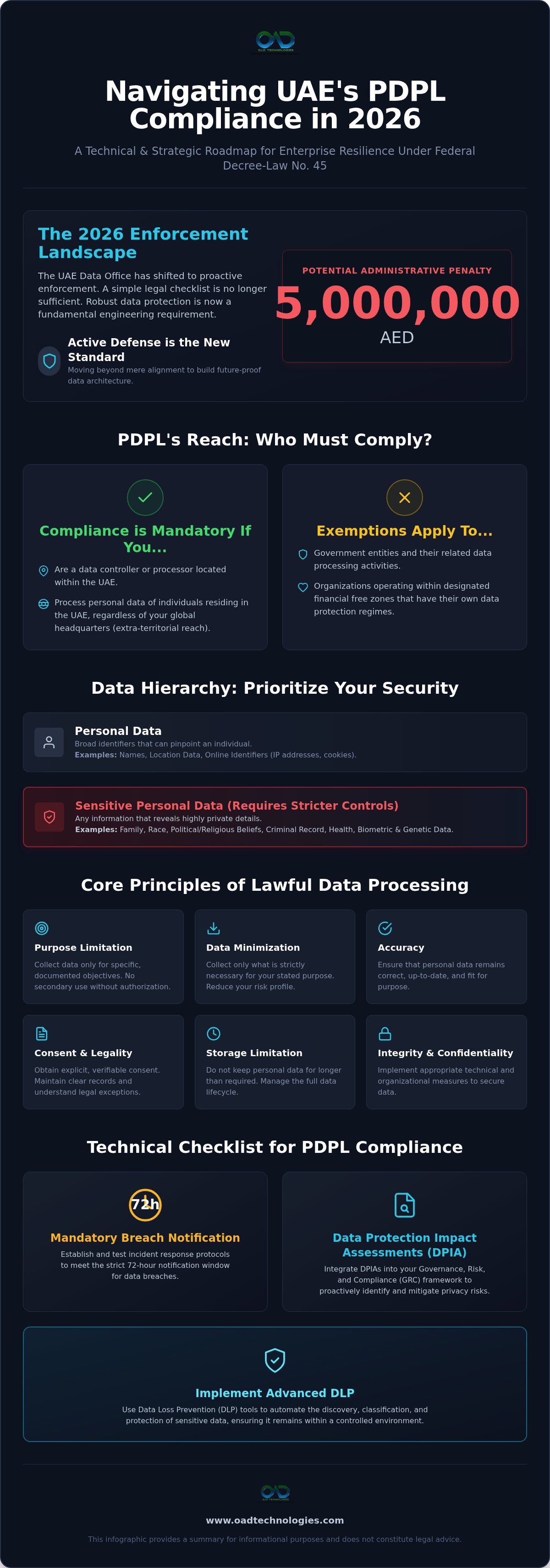
In 2026, a simple legal checklist is no longer enough to protect your enterprise from a 5,000,000 AED administrative penalty. As the UAE Data Office shifts toward proactive enforcement, the ambiguity surrounding "appropriate technical measures" has become a critical liability for regional businesses. You likely feel the pressure of mapping complex cross-border data flows while managing the 72-hour breach notification window. This is why implementing robust dlp for pdpl compliance is no longer optional; it's a fundamental engineering requirement for any organization operating under Federal Decree-Law No. 45.
This guide provides the technical and strategic roadmap you need to ensure enterprise data resilience and regulatory alignment. We'll break down the specific requirements for data sovereignty and explain how to bridge the gap between high-level innovation and practical business results. By the end of this article, you'll have a clear understanding of the PDPL scope and a technical checklist to help you pass regulatory audits with total confidence. We're moving beyond mere alignment to help you build a future-proof data protection architecture that secures your long-term digital relevance.
Key Takeaways
- Understand the 2026 enforcement landscape of Federal Decree-Law No. 45 and the specific regulatory mandates overseen by the UAE Data Office.
- Learn how to translate abstract legal requirements into a concrete technical stack by implementing advanced dlp for pdpl compliance to secure sensitive information.
- Master the mandatory 72-hour breach notification protocols to protect your organization from administrative penalties that can reach 5,000,000 AED.
- Discover the strategic value of integrating Data Protection Impact Assessments (DPIA) into your broader governance, risk, and compliance framework.
- Shift from reactive security measures to a proactive architecture that ensures long-term data resilience and maintains your enterprise's digital relevance.
Understanding the UAE Personal Data Protection Law (PDPL) in 2026
The Federal Decree-Law No. 45 of 2021, known as the PDPL, has reached full maturity in 2026. It's no longer a new piece of legislation but a strictly enforced reality. The UAE Data Office, operating under the Telecommunications and Digital Government Regulatory Authority (TDRA), now leads the charge in auditing enterprise data practices. This regulatory body ensures that organizations don't treat data privacy as a secondary concern. The strategic shift in 2026 focuses on "active defense," moving away from the earlier years of simple capacity building. This environment makes implementing dlp for pdpl compliance a technical necessity rather than a legal suggestion.
Organizations must recognize that the UAE's privacy landscape is complex. While the PDPL provides a federal baseline, it exists alongside unique regional contexts, such as the history of Mass surveillance in the UAE. This makes transparent, lawful processing even more critical for building trust with both regulators and residents. Failure to align with these standards carries heavy costs. Administrative penalties often reach 5,000,000 د.إ, while criminal sanctions for the deliberate misuse of sensitive data can climb to 20,000,000 د.إ. Beyond the financial impact, the brand damage in a digitally connected market like the UAE can be irreversible.
Who Must Comply with PDPL?
Compliance isn't limited to companies with a physical office in the UAE. The law applies to any data controller or processor located within the country, but its reach is extra-territorial. If your organization processes the personal data of individuals residing in the UAE, regardless of your global headquarters, you're subject to the PDPL. There are specific exemptions to track. Government entities and organizations operating within designated financial free zones follow their own established data protection regimes. For everyone else, the mandate is clear: secure the data or face the consequences.
The Distinction Between Personal and Sensitive Data
Understanding the data hierarchy is essential for prioritizing security investments. Personal Data includes broad identifiers like names, location data, and online identifiers that can pinpoint an individual. However, the law imposes much stricter controls on Sensitive Personal Data. According to Article 1 of the Law, Sensitive Personal Data is any information that directly or indirectly reveals a person's family, racial origin, political or philosophical opinions, religious beliefs, criminal record, or any health, biometric, or genetic data. Managing this high-risk information requires specialized tools. Integrating dlp for pdpl compliance allows CISOs to automate the discovery and protection of these sensitive datasets, ensuring they never leave the controlled environment without authorization.
Core Principles of Lawful Data Processing
Lawful processing under the PDPL isn't just a legal obligation; it's a blueprint for ethical data management. The UAE Government's Data Protection Law establishes a framework built on transparency and fairness. You can't simply collect data because it's available. Every byte must serve a specific, documented objective. This is known as purpose limitation. If you collect customer emails for billing, you shouldn't use them for third-party marketing without additional authorization.
Data minimization is where technical strategy meets legal mandate. It requires you to collect only the strictly necessary data for your stated goal. Engineering this at scale is difficult without automated tools. Using dlp for pdpl compliance allows your team to identify and block the ingestion of unnecessary sensitive fields, reducing your overall risk profile. Accuracy and storage limitation then ensure that data remains correct and isn't kept longer than required. Managing the data lifecycle from ingestion to secure deletion is a core pillar of enterprise resilience.
The Role of Consent and Legal Bases
Explicit and verifiable consent is the primary engine of the PDPL. Organizations must maintain clear records proving that data subjects actively opted in. However, the law provides exceptions. Processing is permitted without consent when it's necessary for the public interest, the protection of legal rights, or the performance of a contract. Managing these nuances requires a sophisticated approach to identity and access management. It's particularly vital when handling the "Right to be Forgotten," where you must ensure that a withdrawal request triggers a comprehensive purge across all integrated systems.
Data Subject Rights under UAE Law
The PDPL empowers individuals with significant control over their digital footprint. Data subjects have the right to access their information and receive copies in a structured format. They also hold the right to request correction or erasure if the data is no longer accurate or necessary. Perhaps most critically in the age of AI, individuals can object to automated processing and profiling. Implementing dlp for pdpl compliance ensures that these subject rights are technically enforced at the file and record level.
Building a system that respects these rights while maintaining operational speed is a complex design challenge. Our team at OAD Technologies specializes in architecting these environments through a comprehensive governance risk and compliance framework, ensuring your technology stack empowers people rather than just processing their records.
Technical Enforcement: Implementing DLP and Security Controls
Translating the "appropriate technical measures" mandated by the PDPL into a functional cybersecurity stack is a primary challenge for CISOs in 2026. While the legal text provides the framework, the UAE Data Office expects a proactive architecture that prevents leaks before they occur. Aligning your internal controls with International Data Privacy Regulations ensures your enterprise meets global standards while satisfying local auditors. This technical alignment requires a shift from perimeter-based security to a data-centric model where protection follows the information itself.
Data Loss Prevention (DLP) as a Compliance Catalyst
The central role of data loss prevention is to act as a fail-safe against unauthorized disclosure. In a modern UAE enterprise, data moves rapidly across email, cloud endpoints, and collaborative platforms. Manually tracking this movement is impossible. Implementing dlp for pdpl compliance allows your team to automate data discovery and classification. When the system identifies sensitive UAE resident data, it applies protective policies in real-time. This prevents accidental leaks, such as an employee uploading an unencrypted database to a public cloud or sending sensitive identifiers via insecure email channels. By monitoring movement across all egress points, DLP ensures that your operations remain strictly within the boundaries of your PDPL privacy policies.
Securing Access with IAM and Zero Trust
Confidentiality is only as strong as your access controls. A robust identity and access management (IAM) system serves as a pillar of your compliance strategy by enforcing the Principle of Least Privilege. This ensures that employees only access the specific data required for their roles, significantly limiting the blast radius if a credential is compromised. In 2026, the UAE market has moved toward a Zero Trust model where "never trust, always verify" is the baseline. Multi-factor authentication (MFA) is no longer a luxury; it's a requirement for any data processor handling sensitive information. By integrating IAM with your dlp for pdpl compliance strategy, you create a layered defense that protects data at the point of access and the point of exit.
Finally, technical enforcement must include rigorous encryption standards. Data at rest in your UAE-based servers should utilize AES-256 encryption, while data in transit must be protected by TLS 1.3 or higher. These standards ensure that even if a physical storage device is lost or a network stream is intercepted, the personal data remains unintelligible to unauthorized parties. This combination of DLP, IAM, and encryption forms the resilient backbone required to pass the most stringent regulatory audits in the Emirates.
Incident Response and Mandatory Breach Notification
Under Federal Decree-Law No. 45, a personal data breach isn't just a technical failure; it's a critical regulatory event. The UAE Data Office defines a breach as any security incident leading to the accidental or unlawful destruction, loss, alteration, or unauthorized disclosure of personal data. When such an event is likely to cause harm to data subjects, you have exactly 72 hours from the moment of discovery to report the incident. Failure to meet this window can result in administrative fines of up to 500,000 د.إ. This is where dlp for pdpl compliance becomes indispensable. It doesn't just block leaks; it provides the granular forensic evidence needed to identify exactly which records were compromised, allowing for an accurate and timely report.
Identifying a breach within minutes is the only way to satisfy the 72-hour reporting requirement. Utilizing managed detection and response (MDR) provides the 24 X 7 technical oversight required to catch sophisticated threats that automated systems might miss. Documenting every step of this process is vital for future regulatory audits. You must maintain internal records of all personal data breaches, including the facts surrounding the incident, its effects, and the remedial actions taken. Integrating dlp for pdpl compliance ensures these records are backed by detailed data logs, providing an undeniable audit trail that demonstrates your commitment to the Law.
Detection and Containment Strategies
Real-time identification requires a synchronized stack of SIEM and EDR tools. These systems monitor for unauthorized access patterns and lateral movement across your network. In the strict regulatory environment of 2026, 24 X 7 monitoring is a baseline expectation for any enterprise handling sensitive UAE resident data. An Incident Response Plan (IRP) serves as a structured operational manual that dictates how an organization detects, responds to, and recovers from data security incidents to ensure legal compliance. Without a tested IRP, the chaos of a breach often leads to reporting delays that trigger heavy penalties.
The Notification Workflow
Once you discover a breach, the workflow must be immediate and documented. Your report to the UAE Data Office must include the nature of the breach, the categories and approximate number of data subjects involved, and the contact details of your Data Protection Officer (DPO). You also need to outline the likely consequences and the measures your team has taken to mitigate the impact. Assessing the risk to the rights and freedoms of data subjects is a critical step that determines whether you must also notify the individuals themselves. We help enterprises build resilient response architectures that transform compliance from a burden into a competitive advantage. Secure your enterprise with our MDR and DLP solutions today.
Strategic GRC: Building a Sustainable Compliance Roadmap
Achieving long-term viability in the UAE's digital economy requires moving beyond reactive security. By 2026, the UAE Data Office expects enterprises to demonstrate a mature governance risk and compliance framework that treats privacy as an ongoing operational duty. This strategic alignment isn't just about avoiding fines. It's about building a system where data protection is baked into every business process. Central to this is the Data Protection Impact Assessment (DPIA). You must conduct these for any high-risk processing activities, such as large-scale profiling or the use of sensitive biometric data, to identify and mitigate privacy risks before they materialize.
The appointment of a Data Protection Officer (DPO) is a mandatory requirement for organizations processing sensitive personal data at scale or those where processing poses a high risk to confidentiality. This role acts as your primary liaison with the UAE Data Office. Additionally, managing cross-border data transfers has become more structured. You can only transfer data to jurisdictions deemed "adequate" by the regulator. If you're moving data to a non-adequate country, you must implement Standard Contractual Clauses (SCCs) or Binding Corporate Rules (BCRs). Integrating dlp for pdpl compliance allows you to technically enforce these geographic boundaries, preventing data from leaving the UAE without the correct legal safeguards.
The Importance of Regular Security Assessments
The complexity of Federal Decree-Law No. 45 often outpaces internal resources. Partnering with a managed service provider helps bridge the cybersecurity skills gap, allowing your team to focus on core growth. OAD Technologies acts as a master designer of systems, aligning your technical infrastructure with UAE legal mandates through customized integration. We don't believe in standardized approaches. Instead, we offer bespoke strategies that empower your people and protect your assets. The first step toward sustainable compliance is a thorough PDPL gap analysis. This identifies where your current controls fall short and provides a roadmap for long-term digital relevance. Implementing dlp for pdpl compliance alongside a robust GRC strategy ensures your organization remains both secure and legally sound.
Securing Your Enterprise Digital Relevance in 2026
The evolution of Federal Decree-Law No. 45 has transformed data privacy from a legal obligation into a core pillar of technical excellence. In 2026, passing a regulatory audit requires more than just documentation. It demands a resilient architecture that actively defends sensitive information. We've explored how a strategic combination of automated discovery, zero-trust access, and strict lifecycle management creates a sustainable path forward for UAE enterprises.
Implementing dlp for pdpl compliance is the final step in bridging the gap between high-level innovation and practical business results. By integrating specialized GRC consulting with advanced technical controls and 24 X 7 MDR oversight, your organization can navigate the 72-hour breach notification window with total confidence. This proactive mindset doesn't just mitigate the risk of a 5,000,000 د.إ penalty; it secures your long-term digital relevance in an increasingly complex market.
Align your enterprise with UAE PDPL through OAD Technologies GRC and DLP solutions. We're ready to help you shape a secure and compliant future for your business.
Frequently Asked Questions
What is the primary goal of the UAE Personal Data Protection Law?
The primary goal is to establish a unified federal framework for protecting personal data while supporting the UAE's digital economy. It ensures that processing happens with transparency, security, and respect for privacy rights. By standardizing these rules, the law provides a clear roadmap for organizations to manage data responsibly. This framework builds consumer trust and aligns the Emirates with global standards, ensuring long-term digital relevance for businesses.
Does the UAE PDPL apply to companies located outside the UAE?
Yes, the PDPL has extra-territorial reach. It applies to any organization, regardless of its physical location, that processes the personal data of individuals residing within the UAE. International firms must implement technical measures like dlp for pdpl compliance to manage these datasets securely. This ensures that the privacy rights of UAE residents are protected even when their information is handled by entities operating outside the nation's borders.
What are the penalties for non-compliance with Federal Decree-Law No. 45?
Non-compliance with Federal Decree-Law No. 45 can lead to severe financial and legal consequences. Administrative penalties for violations can reach up to 5,000,000 د.إ. The most serious infractions, such as the deliberate misuse of sensitive personal data, can result in criminal sanctions of up to 20,000,000 د.إ and potential imprisonment. These penalties reflect the UAE Data Office's commitment to enforcing high standards of data security across all enterprise sectors in the region.
Is appointing a Data Protection Officer (DPO) mandatory for all UAE companies?
For those dealing with complex legal or security-related matters in other jurisdictions, consulting with specialized legal counsel such as trach-law.co.il can provide essential guidance on legal defense and status regulation.
No, appointing a DPO isn't mandatory for every organization. You're only required to appoint one if your processing involves sensitive personal data at a large scale or involves systematic and comprehensive assessments of such data. It's also mandatory if your processing activities pose a high risk to the confidentiality and privacy of personal data. Many enterprises choose to appoint one voluntarily to ensure continuous alignment with the evolving 2026 regulatory landscape.
How does the UAE PDPL differ from the GDPR?
While the PDPL shares several principles with the GDPR, such as data minimization and subject rights, there are distinct differences. The UAE law is tailored to the local market and regulatory environment. One key difference is the legal basis for processing; the PDPL relies heavily on explicit consent and specific statutory exceptions rather than the broader "legitimate interests" category found in European law. Organizations must carefully map these nuances to ensure full technical alignment.
What is considered a 'Personal Data Breach' under UAE law?
A personal data breach is defined as any security incident that leads to the accidental or unlawful destruction, loss, alteration, or unauthorized disclosure of personal data. This includes both external cyberattacks and internal accidental leaks. Implementing robust dlp for pdpl compliance helps organizations identify these incidents in real-time. This technical oversight is crucial because the law requires you to demonstrate that you've taken all necessary measures to prevent and contain such breaches immediately.
Can personal data be transferred outside of the UAE?
Personal data can be transferred outside the UAE, but strict conditions apply. Transfers are permitted to jurisdictions that provide an adequate level of data protection as determined by the UAE Data Office. For countries without an adequacy decision, organizations must use alternative mechanisms. These include Standard Contractual Clauses (SCCs) or Binding Corporate Rules (BCRs). These measures ensure that the data remains protected according to UAE standards even after it crosses international borders.
How long do companies have to report a data breach to the UAE Data Office?
Organizations must report a data breach to the UAE Data Office within 72 hours of becoming aware of the incident. This requirement applies if the breach is likely to result in harm to the privacy or confidentiality of the data subjects. Late notification can result in specific fines of up to 500,000 د.إ. This strict timeline makes 24 X 7 monitoring and automated detection essential for maintaining compliance and avoiding the high costs associated with reporting delays.
Disclaimer
Content by OAD Technologies is for general informational purposes only and does not constitute professional or cybersecurity advice. No warranties are made regarding accuracy or completeness; reliance is at your own risk. OAD Technologies shall not be liable for any direct or indirect losses arising from use of this content.