

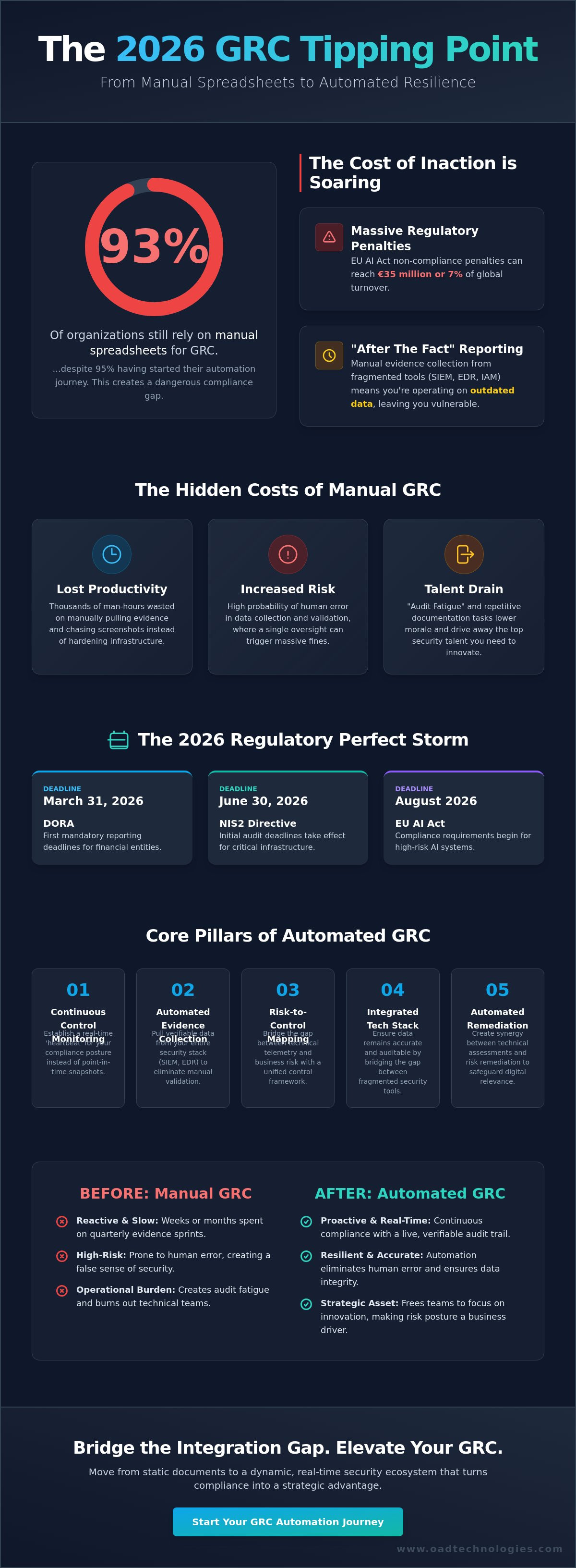
While 95% of organizations have started their automation journey, a staggering 93% still rely on manual spreadsheets for their primary GRC functions in 2026. This reliance creates a dangerous gap when you consider that penalties for EU AI Act non-compliance can now reach €35 million or 7% of global turnover. If your team spends weeks manually pulling evidence from fragmented SIEM, EDR, and IAM tools, you aren't just wasting time. You're operating on "after the fact" data that leaves you vulnerable to modern regulatory speed. Automating GRC reporting is no longer a luxury for the few. It's a survival requirement for the enterprise.
We understand that the transition from static documents to a dynamic security ecosystem feels daunting. You want to move toward continuous compliance without dismantling the workflows your technical teams rely on. This article provides a strategic framework to help you bridge that integration gap. We'll show you how to move from manual collection to high-velocity automation that drives real business value. We will explore how to build real-time compliance dashboards and reduce audit fatigue, ensuring your risk posture remains a strategic asset rather than an operational burden.
Key Takeaways
- Understand why manual spreadsheets have become a significant liability and how to transition your organization toward a proactive, automated governance model.
- Establish a 'heartbeat' for your compliance posture by implementing Continuous Control Monitoring and automated evidence collection across your entire security stack.
- Develop a scalable roadmap for automating grc reporting that aligns baseline assessments with precise control mapping for long-term strategic value.
- Bridge the integration gap between fragmented security tools to ensure your compliance data remains accurate, real-time, and auditable.
- Discover how customized GRC ecosystems create synergy between technical assessments and automated risk remediation to safeguard your digital relevance.
The Evolution of GRC: From Static Spreadsheets to Automated Orchestration
The era of managing Governance, risk, and compliance (GRC) through static spreadsheets has reached its end. For years, organizations treated reporting as a quarterly sprint; it was a frantic race to gather evidence before an auditor arrived. This "Compliance Trap" creates a false sense of security. It relies on data that is often weeks or months old. In a landscape where digital assets evolve in seconds, "after the fact" reporting is no longer sufficient. Automating GRC reporting represents a fundamental shift in enterprise strategy. It moves compliance away from being a reactive burden and positions it as a proactive, data-driven discipline. By establishing an automated orchestration layer, businesses gain the visibility needed to make high-stakes decisions with confidence.
The Hidden Costs of Manual Reporting
Manual reporting is expensive, but the true costs are often hidden beneath the surface. It isn't just about the thousands of man-hours lost to evidence collection. The real danger lies in the high probability of human error. In 2026, where a single oversight in an IAM or EDR configuration can trigger massive regulatory penalties, relying on manual validation is a high-risk gamble. Audit fatigue also takes a heavy toll on technical teams. When senior engineers spend their time chasing screenshots instead of hardening infrastructure, morale drops. This repetitive work drives away the very talent you need to maintain your security posture. Automation removes this friction, allowing your team to focus on innovation rather than documentation.
Why 2026 is the Tipping Point for GRC Automation
We've reached a regulatory "perfect storm" that makes automation mandatory. By March 31, 2026, financial entities must meet the first mandatory reporting deadlines for DORA. By June 30, 2026, the NIS2 Directive's initial audit deadlines take effect. These regulations, alongside the EU AI Act's requirements for high-risk systems starting in August, demand a level of precision that manual processes cannot provide. A modern governance risk and compliance framework must be integrated directly into your security stack. By automating GRC reporting, you ensure that your DLP, SIEM, and vulnerability assessments provide a continuous stream of verifiable data. This isn't just about avoiding fines. It's about building a resilient foundation that can withstand the velocity of the modern market.
Core Pillars of Automated Compliance Reporting
Building a resilient compliance posture requires moving beyond the "point-in-time" mindset that has plagued enterprise risk management for decades. A modern framework relies on five core pillars that transform static data into a dynamic security narrative. By automating grc reporting, organizations create a persistent connection between their operational tools and their regulatory obligations. This shift ensures that every configuration change in your cloud environment or every login attempt captured by your IAM system contributes to a live audit trail. This isn't just about speed; it's about the precision required to meet the March 2026 reporting deadlines for DORA and the June 2026 audit requirements of NIS2.
The foundation of this architecture is Risk-to-Control Mapping. This process creates a unified language that bridges the gap between technical leads and compliance officers. Instead of translating security logs into spreadsheet cells, you map specific technical telemetry directly to regulatory controls. When a control fails, the system doesn't just flag an error; it identifies the specific business risk associated with that failure. This integration allows for policy management that reflects operational reality, ensuring your corporate standards aren't just documents on a shelf but active parameters within your security stack.
Evidence Orchestration and Data Integrity
Automated evidence collection eliminates the friction of manual validation. By pulling real-time telemetry from your SIEM and EDR platforms, you create a seamless data flow that satisfies even the most rigorous auditors. The key here is maintaining a digital "Chain of Custody." Every piece of evidence must be accompanied by immutable logs that prove the data hasn't been tampered with since its creation. This level of integrity builds deep trust with national regulators, especially as transparency obligations for high-risk AI systems under the EU AI Act take effect in August 2026. If you're ready to move away from manual collection, you can explore our customized GRC solutions to see how we architect these data flows.
Real-Time Risk Visualization
The final pillar is the transition from static PDFs to interactive compliance heatmaps. Executive leadership doesn't have the time to parse 50-page reports; they need a high-level view of the organization's risk posture at any given moment. Dynamic dashboards provide this visibility on demand, allowing stakeholders to drill down into specific technical controls when necessary. These systems also include automated alerts for "control drift." If a firewall configuration changes or a user's access rights violate a policy, the system notifies the relevant team immediately. This proactive approach ensures you address vulnerabilities before they escalate into a breach or a non-compliance event. Automating grc reporting provides the "heartbeat" your organization needs to maintain a state of continuous readiness.
Overcoming the 'Integration Gap' in GRC Automation
Most software vendors promise a "one-click" solution to compliance. In reality, large enterprises face a persistent "Security Stack Silo" where disparate tools operate in isolation. Standardized API connectors frequently fail because they lack the depth to capture the nuanced data required for high-stakes audits. They often strip away the context that explains why a specific configuration exists. Automating grc reporting requires a more sophisticated approach. It demands customized integration pathways that can bridge the gap between modern cloud environments and the legacy systems that still house mission-critical data. Without this deep connectivity, your reporting remains fragmented and unreliable.
A significant part of this challenge involves identity and access management (IAM). In a manual environment, verifying who has access to what takes weeks of cross-referencing. In an automated ecosystem, IAM telemetry flows directly into your compliance framework. This creates an instantaneous record of permission changes, ensuring that your audit trail is always live. By January 2026, reports showed that while 95% of organizations adopted some automation, only 4% achieved full integration. Closing this gap is what separates compliant companies from those facing the heavy penalties of the EU AI Act or DORA.
Solving the Multi-Vendor Telemetry Puzzle
The technical hurdle lies in normalizing data formats across different tools like CSPM, DLP, and VAPT. Each vendor uses a different language to describe risk. To succeed, you must establish a "Single Source of Truth" that translates this telemetry into a unified risk register. When your managed detection and response (MDR) feed is integrated directly into your GRC platform, the board sees a clear picture of resilience rather than a confusing list of technical alerts. This level of orchestration ensures that every security event is automatically mapped to its corresponding regulatory control.
The Human Element: Why Tools Aren't Enough
Technology provides the engine, but human insight provides the steering. Tools alone cannot manage complex exceptions or the subtle nuances of risk appetite. GRC consultants play a vital role in defining the "Automation Logic" that governs how your systems react to data. While 100% of organizations adopting AI in GRC reported positive outcomes by early 2026, the most successful ones used these tools to empower their people. Automation should handle the repetitive evidence collection, freeing your experts to focus on high-level strategy and judgment. This synergy between human expertise and machine speed is the only way to maintain long-term digital relevance. Automating grc reporting isn't about replacing your team; it's about giving them the high-fidelity data they need to protect the business.
Building a Scalable Automation Roadmap
Transitioning from manual workflows to a high-velocity GRC ecosystem isn't a weekend project. It's a structured evolution that aligns technical capacity with business objectives. Organizations that attempt to automate everything at once often face "automation paralysis," where the complexity of the transition stalls progress. A successful roadmap breaks this journey into five digestible stages, ensuring that each phase delivers measurable value before expanding to the next. This deliberate pace allows your team to adjust to new workflows while maintaining the integrity of your current compliance posture.
- Phase 1: Baseline Assessment and Framework Selection. Identify whether your primary driver is ISO 27001, NIST, or specific national standards.
- Phase 2: Control Mapping and Data Source Identification. Pinpoint exactly where your evidence lives within your SIEM, EDR, and IAM platforms.
- Phase 3: Pilot Automation. Focus on high-impact, high-frequency controls to prove the concept and gain stakeholder buy-in.
- Phase 4: Full-Scale Orchestration. Deploy real-time dashboards and integrate your entire security stack into the GRC engine.
- Phase 5: Continuous Optimization. Establish a pulse-checking mechanism to adapt to new regulations and refine your automation logic.
Selecting the Right Framework for National Compliance
For enterprises operating in the Middle East, aligning with the UAE Personal Data Protection Law (PDPL) and Information Security Regulation (ISR) is a critical component of the roadmap. Automating grc reporting allows you to manage these local requirements alongside international standards like GDPR or SOC2 within a single dashboard. By adopting a "Unified Control Framework," you can test a control once and map the results to multiple regulatory requirements. This approach eliminates redundant testing and ensures that your compliance posture remains consistent across different jurisdictions, which is vital as the EU AI Act's transparency obligations take effect in August 2026.
Technical Implementation Best Practices
When you begin the technical rollout, prioritize the most painful manual tasks. User access reviews are a prime candidate for early automation; they're high-frequency, prone to error, and traditionally take weeks to complete. Setting realistic KPIs for the transition is essential for demonstrating ROI. Instead of aiming for 100% automation immediately, track the reduction in "time-to-evidence" and the decrease in audit-related downtime for technical teams. Long-term viability depends on a scalable architecture that can integrate new data sources as your security stack evolves. If you're ready to design your path forward, you can consult with our GRC architects to begin your roadmap assessment. Automating grc reporting is a journey of precision, and starting with a clear, phased strategy ensures you don't lose momentum.
Strategic Partnership: How OAD Technologies Elevates GRC
Most vendors treat compliance as a software problem that can be solved with a standardized widget. At OAD Technologies, we reject the "out-of-the-box" mentality. We view automating grc reporting as a sophisticated engineering challenge that requires a custom-designed ecosystem. Our role is to act as a master designer of systems, ensuring that your governance framework is deeply integrated with your technical reality. We don't just provide a platform; we build a strategic bridge between your security leads and executive leadership. This approach ensures that risk data is not only accurate but also actionable for the board.
A defining feature of our framework is the synergy between technical assessments and risk management. For example, findings from your VAPT shouldn't exist in a vacuum. We architect data flows that ensure vulnerability data feeds directly into your automated risk registers. This creates a closed-loop system where technical gaps trigger immediate visibility within your compliance reporting. By aligning operational activities with corporate standards, we help you maintain long-term digital relevance in a market that no longer tolerates manual delays.
Beyond Software: Managed Compliance and Support
OAD Technologies acts as a strategic partner rather than a distant vendor. We understand that navigating local regulatory nuances, such as the UAE’s Information Security Regulation (ISR), requires more than just code. It requires a commitment to precision and high-quality craftsmanship in every system we design. Our team works as an extension of your own, providing the intellectual rigor needed to manage complex exceptions and refine your automation logic. This collaborative model ensures that your GRC ecosystem evolves alongside your business, protecting your investment returns as your digital footprint expands.
Ready to Automate Your Compliance?
The journey toward high-velocity governance starts with a clear understanding of your current position. We begin every partnership with a comprehensive GRC maturity assessment to identify your integration gaps and prioritize your automation roadmap. Our promise is simple: we deliver long-term success through rigorous engineering standards and a proactive mindset. We don't believe in quick fixes that fail under the pressure of a real audit. Instead, we focus on building a resilient foundation that can withstand the regulatory challenges of 2026 and beyond.
If you're tired of manual evidence collection and fragmented data, it's time to transition to a high-velocity ecosystem. Automating grc reporting is the most effective way to reduce audit fatigue and align your security posture with your business goals. Connect with our master designers of systems today to begin architecting a compliance framework that drives genuine strategic value. Let's build a roadmap that ensures your organization remains a leader in digital resilience.
Secure Your Competitive Edge with Continuous Compliance
The shift toward automating grc reporting isn't just an operational upgrade; it's a strategic necessity for the 2026 regulatory landscape. By moving beyond static spreadsheets, your organization gains the real-time visibility required to navigate the complexities of the EU AI Act and DORA. You've seen how a phased roadmap and a unified control framework can dismantle the silos between your security stack and your governance goals. This transformation ensures that your compliance posture remains a driver of business value rather than a source of audit fatigue.
OAD Technologies brings specialized system integrator expertise to help you master this transition. We harmonize advanced technology with deep human insight to ensure your systems remain aligned with national regulations like PDPL and ISR. Our master designers don't just implement tools; we architect long-term resilience tailored to your unique infrastructure. You can design your automated GRC future with OAD Technologies today. It's time to build a framework that protects your digital relevance and empowers your team to lead with confidence.
Frequently Asked Questions
What is the difference between GRC automation and a standard GRC tool?
GRC automation differs from standard tools by creating a live connection between your security stack and your risk register. While standard platforms often act as simple document repositories, automation uses APIs to pull telemetry directly from sources like EDR and IAM. This shift ensures your reporting reflects the current state of your controls rather than a snapshot from the previous quarter.
Can GRC automation help with the UAE Personal Data Protection Law (PDPL) compliance?
Yes, automating grc reporting directly supports UAE Personal Data Protection Law (PDPL) compliance by mapping local data residency and processing requirements to technical controls. By integrating DLP and CSPM feeds into your GRC engine, you can provide real-time evidence of data protection measures. This approach ensures your organization meets national standards while maintaining a unified dashboard for global operations.
How long does it typically take to automate compliance reporting?
The timeline for automating compliance reporting typically follows a phased roadmap over three to six months. You can often see results from an initial pilot focused on high-frequency controls within four to six weeks. Achieving full orchestration across a complex, multi-vendor enterprise environment requires a steady, deliberate pace to ensure data integrity and system stability.
Will automating GRC reporting replace my compliance team?
Automation doesn't replace your compliance team; it liberates them from the "Compliance Trap" of manual evidence collection. By handling the repetitive tasks of pulling logs and validating configurations, the system allows your experts to focus on strategic risk management and nuanced judgment. It transforms their role from data gatherers to master designers of organizational resilience.
What are the common challenges when integrating SIEM with GRC platforms?
Common challenges when integrating SIEM with GRC platforms include data normalization and managing the high volume of security alerts. Standard connectors often struggle to translate raw technical logs into the specific language of regulatory controls. Successful integration requires customized pathways that filter out noise and ensure that only relevant, high-fidelity data feeds into your compliance dashboards.
How do I calculate the ROI of automating my GRC reporting?
You calculate the ROI of automating grc reporting by measuring the reduction in "time-to-evidence" and the decrease in audit-related downtime for technical leads. Consider the value of avoiding heavy penalties, such as the 7% global turnover fines under the EU AI Act. Additionally, look at the gain in operational efficiency when your team shifts focus from documentation to proactive risk remediation.
Is GRC automation suitable for small to medium enterprises or just large corporations?
GRC automation is essential for organizations of all sizes, though the implementation scale varies. Large corporations use it to manage massive, fragmented data sets across global jurisdictions. For small to medium enterprises, it provides a way to maintain rigorous security standards without the need for a large, manual compliance department, ensuring they stay competitive in a regulated market.
How does automated evidence collection handle non-technical controls?
Automated evidence collection handles non-technical controls through structured workflow automation and digital attestations. The system can automatically trigger requests for policy reviews or training confirmations, tracking completion in real-time. While technical tools pull data from SIEM or EDR, these automated workflows ensure that human-centric governance remains auditable and integrated into the broader risk ecosystem.
Disclaimer
Content by OAD Technologies is for general informational purposes only and does not constitute professional or cybersecurity advice. No warranties are made regarding accuracy or completeness; reliance is at your own risk. OAD Technologies shall not be liable for any direct or indirect losses arising from use of this content.


