

What if your compliance framework functioned as a strategic asset rather than a departmental bottleneck? For UAE enterprises facing the strict 72-hour incident reporting window for ADGM or the expanded AML/CFT scope of Cabinet Decision No. 134 of 2025, the stakes for building a grc framework from scratch have never been higher. It's easy to feel overwhelmed by the fragmented nature of NESA, ISR, and PDPL requirements. You're likely struggling to convince the board that GRC is more than just a paperwork exercise. We understand that quantifying risk for stakeholders is a complex task that requires more than just a standard template.
This guide provides a 2026 strategic blueprint to help you architect a robust Governance, Risk, and Compliance structure that aligns regulatory demands with operational resilience. You'll discover how to move toward continuous enforcement and create a unified view of organizational risk. We'll walk through the technical integration of security systems and business goals to ensure your compliance audits are streamlined and your IT security is strategically aligned for long-term viability.
Key Takeaways
- Learn why shifting from siloed compliance to an integrated GRC strategy is essential for maintaining operational resilience in the 2026 regulatory landscape.
- Discover how to secure executive buy-in by framing governance as a protector of long-term business value rather than a mere cost center.
- Master the process of building a grc framework from scratch by inventorying digital assets and identifying critical data flows to inform your risk assessment.
- Understand the technical synergy between governance policies and enforcement tools like Data Loss Prevention (DLP) and Identity and Access Management (IAM).
- Explore the roadmap for scaling maturity through automated GRC platforms that replace manual spreadsheets with continuous monitoring and feedback loops.
What is a GRC Framework and Why is it Essential in 2026?
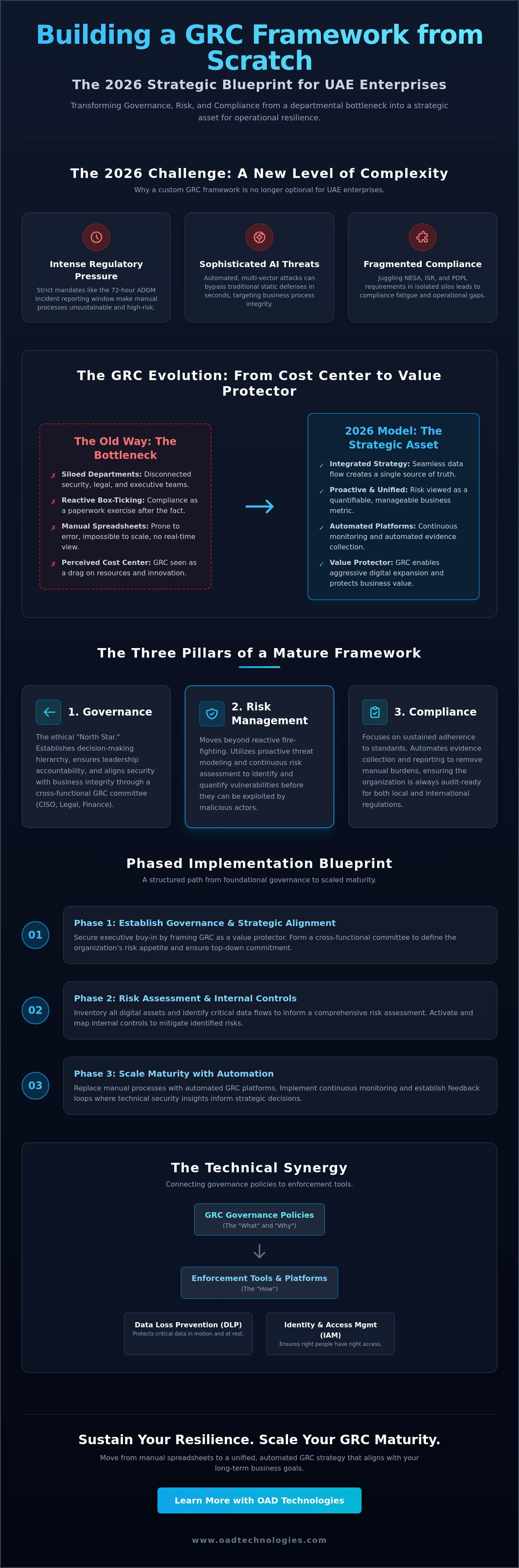
A GRC framework is the architectural blueprint that synchronizes an organization's ethical direction, its appetite for risk, and its legal obligations. It's the engine that drives operational resilience. In the current landscape, the old way of managing these departments as isolated silos has failed. We've entered the era of "Connected GRC," where data flows seamlessly between security, legal, and executive teams to provide a single source of truth. Building a grc framework from scratch allows an enterprise to move away from reactive box-ticking and toward a proactive, unified strategy that views risk as a quantifiable business metric.
The year 2026 has introduced a new level of complexity. AI-driven threats now launch automated, multi-vector attacks that can bypass traditional static defenses in seconds. These threats don't just target data; they target the integrity of the business process itself. This speed necessitates a framework that isn't just a document on a shelf but a living, breathing system. By integrating Governance, risk, and compliance (GRC) into your core operations, you ensure that every technical decision aligns with the organization's overarching business integrity. It creates a feedback loop where technical security insights directly inform the board's strategic roadmap.
The Three Pillars of a Mature Framework
A successful framework stands on three distinct yet interconnected pillars. Governance serves as your ethical North Star. It establishes the decision-making hierarchy and ensures that leadership stays accountable for the organization's digital trajectory. Risk Management moves beyond reactive fire-fighting. Mature frameworks now utilize proactive threat modeling to identify vulnerabilities before they can be exploited by malicious actors. Finally, Compliance focuses on adherence to standards. By automating evidence collection, you remove the manual burden from your teams and ensure you're always audit-ready for both local and international regulations.
Why UAE Enterprises Need a Custom Framework Now
The UAE's regulatory environment has matured rapidly. With the enforcement of NESA, ISR, and the 72-hour incident reporting window for ADGM firms, manual reporting is no longer sustainable. Standardized, "out of the box" approaches often lead to compliance fatigue, where teams spend more time documenting work than actually securing the business. A tailored governance risk and compliance strategy acts as a business enabler. It provides the clarity needed to scale safely in a market that demands both innovation and strict data sovereignty. Starting from the ground up ensures your framework respects the specific data flows of your UAE operations while meeting global expectations. When you're building a grc framework from scratch, you aren't just meeting a requirement; you're designing a system for long-term viability.
Phase 1: Establishing Governance and Strategic Alignment
Governance isn't a checklist; it's the foundation of every strategic move an enterprise makes. When you begin building a grc framework from scratch, your primary objective is to transform compliance from a perceived cost into a value protector. This requires securing executive buy-in by demonstrating how structured governance mitigates the multi-million dollar impact of data breaches. Leaders need to see GRC as the shield that allows for aggressive digital expansion. Without this top-down commitment, even the most sophisticated technical controls will eventually fail due to lack of resources or cultural friction.
Defining the GRC committee is your next critical step. This group shouldn't just be an IT gathering. It requires a cross-functional alliance between the CISO, who provides technical insight; the Legal lead, who interprets shifting mandates; and the Finance lead, who quantifies the fiscal impact of risk. Together, they establish the organization’s "Risk Appetite." This defines the threshold of acceptable risk, ensuring that security measures are proportionate to the business's goals and financial capacity. This alignment ensures that every dirham spent on security is an investment in business continuity.
Defining Leadership and Accountability
Effective governance requires a "Master Designer" to orchestrate cooperation between departments. This role ensures that individual business units don't operate in silos. By assigning specific "Risk Owners" within each department, you create a culture of local accountability. These owners report on a set cadence, allowing the GRC committee to provide the board with a clear, data-driven view of the organization’s maturity. This structure prevents the "paperwork-only" trap and makes risk management a part of daily operations.
Identifying Regulatory Benchmarks
UAE enterprises must navigate a unique and maturing regulatory landscape. Your framework must account for national standards like the Information Assurance Standards (ISR) and NESA requirements. If you operate globally, aligning these with ISO 27001 or NIST ensures interoperability across borders. Documenting your "Compliance Universe" creates a master list of every rule, from the UAE Personal Data Protection Law (PDPL) to sector-specific mandates. This comprehensive mapping prevents overlaps and ensures no requirement is missed during the design phase.
Establishing this strategic alignment early prevents the friction that often stalls digital transformation. If you're looking for a partner to help design these intricate systems, exploring professional Governance, Risk, and Compliance solutions can provide the structured roadmap your enterprise needs to thrive while building a grc framework from scratch.
Phase 2: Risk Assessment and Activating Internal Controls
Transitioning from high-level governance to operational reality requires a shift from theory to data. When you're building a grc framework from scratch, visibility is your most valuable currency. You can't protect what you haven't cataloged. This phase begins with a rigorous inventory of all digital assets and an identification of critical data flows. In the context of the UAE Personal Data Protection Law (PDPL), understanding how sensitive information moves across your network is a legal necessity, not just a technical preference. It's the only way to ensure your framework covers every vulnerability.
Following the inventory, you must conduct a comprehensive gap analysis. This process involves measuring your current security posture against your chosen benchmarks, whether they're national standards like NESA and ISR or international ones like ISO 27001. Once gaps are identified, the focus shifts to selecting and implementing technical and administrative controls. By mapping these controls to multiple regulations simultaneously, you achieve the "test once, comply many" efficiency that prevents compliance fatigue. This unified approach ensures that a single security measure satisfies various legal and operational requirements at once, saving significant time during audit cycles.
Methodologies for Risk Identification
Empirical data should always drive your risk models. We recommend utilizing vulnerability assessment and penetration testing to uncover the actual weaknesses within your infrastructure. This technical insight allows you to differentiate between inherent risk, which is the raw threat level without any safeguards, and residual risk, which remains after your controls are active. Enterprises must prioritize these risks based on their potential impact severity and the likelihood of occurrence. It's about focusing resources where they'll provide the highest return on resilience and business continuity.
Activating Robust Internal Controls
Internal controls are the technical and procedural safeguards that mitigate identified risks. Effective design involves a mix of three types: preventative controls to stop incidents before they happen; detective controls to alert you when a breach is attempted; and corrective controls to restore systems after a disruption. Policy documentation serves as the essential foundation of this process. It provides the evidence required for audits and ensures that every team member understands their role in the security chain. Without clear documentation, even the most advanced technical controls lack the governance needed for long-term viability. Building a grc framework from scratch ensures these controls are purpose-built for your specific operational needs rather than being retrofitted into a failing system.
The Technical Synergy: Linking GRC to DLP and Identity Management
Policy documents and spreadsheets are only half of the equation. When you're building a grc framework from scratch, the real power lies in the technical synergy between governance and enforcement. GRC acts as the brain of the operation. It provides the strategic "Why" behind every security tool you deploy. Without this context, technical solutions often operate in a vacuum, failing to address the specific risks that matter most to the board. By integrating data from SIEM and EDR platforms directly into your GRC dashboard, you transform passive compliance into a real-time risk monitoring system that responds to threats as they emerge.
This integration is what separates a visionary enterprise from one that's merely reactive. Your GRC framework should dictate the configuration of your security stack, ensuring that every control is purpose-built to satisfy a specific regulatory mandate. It creates a closed-loop system where technical telemetry constantly validates your compliance posture. If a control fails, your GRC platform should be the first to know, allowing for immediate remediation before a minor gap becomes a major breach.
GRC as the Brain, DLP as the Shield
Your risk assessments are the primary driver for effective data loss prevention strategies. Rather than applying generic rules, GRC allows you to define classification levels based on the actual business impact of data exposure. This is particularly vital for adhering to the UAE Personal Data Protection Law (PDPL). By automating compliance alerts when sensitive data moves outside of governed zones, you ensure that your shield is always aligned with your ethical "North Star." It prevents the accidental data leaks that often lead to heavy regulatory fines.
Identity Management as a Governance Control
Governance principles like "Least Privilege" are impossible to enforce manually at scale. This is where identity and access management (IAM) becomes a critical governance control. Mature frameworks use IAM tools to automate user provisioning and de-provisioning, significantly reducing the risk of orphaned accounts or unauthorized access. By integrating IAM logs directly into your GRC audits, you provide empirical proof of who has access to what. This level of transparency is essential for building a grc framework from scratch that stands up to the scrutiny of modern auditors.
Ready to bridge the gap between high-level policy and technical enforcement? Explore our customized GRC integration services to see how we synchronize your security stack with your strategic goals.
Sustaining Resilience: Scaling Your GRC Maturity with OAD Technologies
Relying on manual spreadsheets is a high-stakes gamble in the current regulatory climate. When you're building a grc framework from scratch, the transition to automated software platforms is the only way to maintain a real-time view of your risk profile. Automated systems eliminate the human error inherent in manual data entry and provide the continuous monitoring necessary for modern accountability. This creates a vital feedback loop; as your technical environment evolves, your framework automatically adjusts its risk calculations to reflect the actual state of your security posture.
Preparing for the future means incorporating predictive technologies into your architectural blueprint. The integration of machine learning into GRC platforms is projected to be a $4.2 billion opportunity by 2026, according to industry forecasts. This shift enables enterprises to move from reactive reporting to predictive risk management. As UAE firms expand their digital footprint, Cloud Security Posture Management (CSPM) must also be integrated into the GRC stack. This ensures visibility across multi-cloud environments and guarantees that your governance remains as agile as your infrastructure.
The Journey to GRC Maturity
Organizations typically move through distinct stages of maturity, starting from ad-hoc, siloed processes and culminating in an optimized state. In this final stage, GRC isn't just a requirement; it's a competitive advantage that informs every board-level decision. Regular internal audits are essential during this journey to verify that your controls remain effective against shifting threat actors. GRC maturity is the transition from reactive compliance to proactive strategic resilience.
Partnering for National Compliance Excellence
OAD Technologies acts as a strategic partner for enterprises navigating the complexities of UAE national security standards. We understand the specific nuances of NESA and ISR, ensuring your framework is built for local excellence and global interoperability. Our managed services, including Managed Detection and Response (MDR) and Security Information and Event Management (SIEM), provide the continuous telemetry required to feed your GRC engine with accurate, real-time data. We don't just provide tools; we design the systems that empower your people to lead with confidence. Building a grc framework from scratch with an expert partner ensures your organization remains relevant and protected in an ever-changing market.
Design your custom GRC framework with OAD Technologies today and bridge the gap between technical security and strategic business goals.
Architecting a Future-Ready Enterprise
Transitioning from fragmented, manual reporting to a unified technical architecture is the only way to thrive in the 2026 regulatory landscape. We've explored how governance provides the strategic foundation for tools like DLP and IAM, and why executive alignment remains the bedrock of any successful system. Building a grc framework from scratch isn't merely a compliance hurdle; it's an opportunity to synchronize your technical capacity with your business's long-term vision. It's about creating a system that protects your assets while empowering your people to innovate safely.
OAD Technologies brings a master designer philosophy to every project, ensuring your systems are bespoke rather than standardized. Our specialized UAE national compliance expertise allows us to bridge the gap between high-level strategy and technical enforcement through an integrated security approach. Secure your enterprise future with OAD's GRC consulting services and transform your risk management into a proactive engine for growth. Your path to operational resilience starts with a single, strategic blueprint designed for long-term viability.
Frequently Asked Questions
How long does it take to build a GRC framework from scratch?
Building a grc framework from scratch typically takes between six to twelve months to reach full operational maturity. The initial design and governance phase often requires three to four months of focused alignment. Timelines vary based on organizational size and the complexity of existing digital assets. Larger enterprises with multi-cloud environments may require a longer roadmap to ensure all controls are properly integrated and tested.
What are the most important UAE regulations to consider for GRC?
Key regulations include the UAE Federal Data Protection Law (PDPL) and the National Electronic Security Authority (NESA) Information Assurance standards. Enterprises in Dubai must also adhere to the Information Security Regulation (ISR). Financial firms in the Abu Dhabi Global Market (ADGM) are subject to specific cyber risk management frameworks, including the 72-hour incident reporting requirement. Aligning with these ensures both national compliance and operational resilience.
Can a small business implement a GRC framework effectively?
Small businesses can and should implement GRC frameworks by scaling the complexity to match their specific risk profile. Instead of attempting a massive enterprise-wide rollout, smaller entities often find success by focusing on critical data flows and essential controls first. This lean approach provides the necessary protection without overwhelming limited resources. It establishes a foundation that can grow alongside the business, ensuring long-term viability.
What is the difference between a GRC framework and an IT security policy?
An IT security policy is a specific set of rules or documents, while a GRC framework is the integrated strategy that manages those policies alongside risk and compliance. Think of the policy as a single instruction and the framework as the entire operating system. GRC provides the context and the strategic why behind the rules. It ensures that technical controls are not just active but are actually mitigating the risks that matter to the board.
How does GRC help with UAE Personal Data Protection Law (PDPL) compliance?
GRC provides the structured methodology required to meet the rigorous demands of the UAE Personal Data Protection Law (PDPL). It enables enterprises to classify sensitive data and map its movement across the organization. This visibility is essential for implementing the right technical controls, such as Data Loss Prevention (DLP). By centralizing this data, GRC makes it easier to provide empirical proof of compliance during regulatory audits.
Do I need specialized software to manage a GRC framework?
While you can begin building a grc framework from scratch using manual spreadsheets, specialized software becomes essential as your organization scales. Manual tracking often leads to compliance fatigue and increased human error. Automated platforms provide real-time telemetry and continuous monitoring, which are vital for maintaining resilience. Transitioning to a dedicated GRC tool allows your team to focus on strategic risk management rather than administrative data entry.
What happens if an organization fails to maintain its GRC framework?
Failure to maintain a GRC framework results in compliance drift, where security controls no longer match the evolving threat landscape. This increases the likelihood of data breaches and significant regulatory fines under laws like the PDPL. Beyond legal penalties, organizations face severe reputational damage and a loss of stakeholder trust. A stagnant framework fails to provide the board with accurate risk data, leading to poor strategic decision-making.
Disclaimer
Content by OAD Technologies is for general informational purposes only and does not constitute professional or cybersecurity advice. No warranties are made regarding accuracy or completeness; reliance is at your own risk. OAD Technologies shall not be liable for any direct or indirect losses arising from use of this content.


