

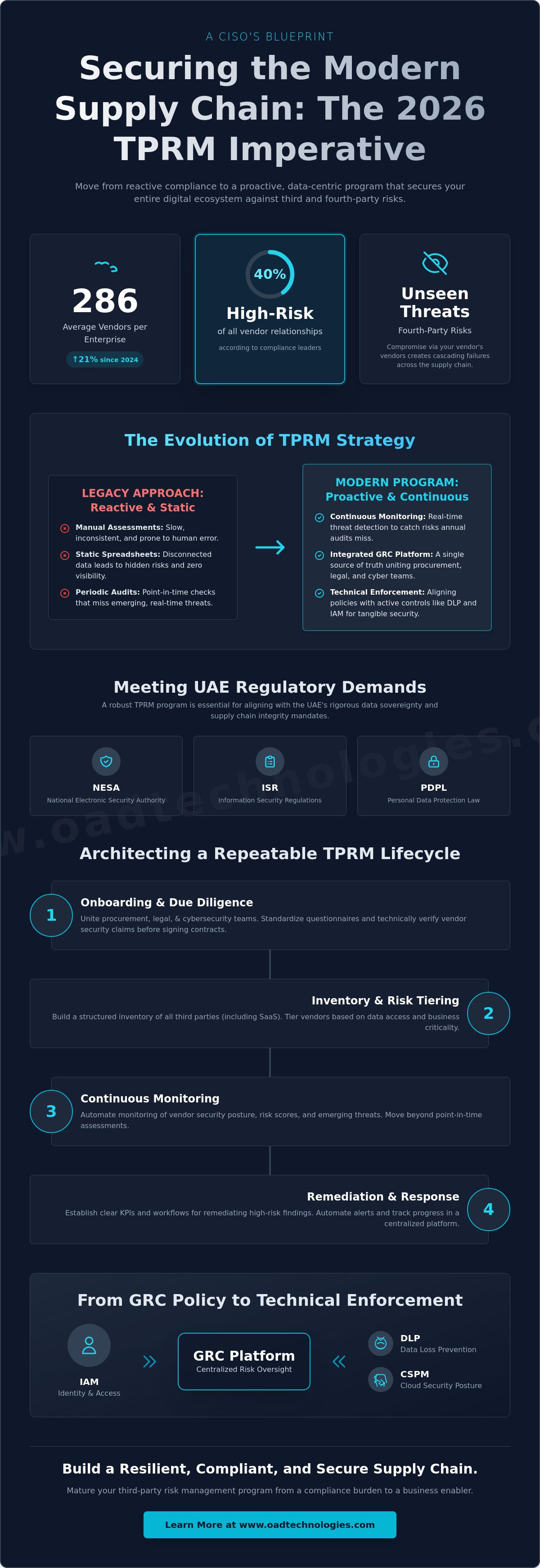
The average enterprise now manages 286 vendors, a nearly 21% increase since 2024, yet 40% of compliance leaders admit that up to 40% of these relationships are high-risk. You likely feel the weight of this sprawl as manual assessments fail to keep pace with the modern supply chain. It's a challenge compounded by intensifying pressure from UAE regulators, where NESA, ISR, and PDPL standards now demand more than just a checkbox approach to your third-party risk management program. Relying on static spreadsheets isn't just inefficient; it's a liability when fourth-party risks remain hidden in the shadows of your digital ecosystem.
We understand that true resilience requires moving beyond periodic audits toward continuous, technical enforcement. This article provides a comprehensive blueprint for CISOs to design and scale a program that secures your entire ecosystem. You'll learn how to integrate GRC frameworks with active security controls, such as Identity and Access Management and CSPM, ensuring your strategy meets 2026 regulatory deadlines while providing deep visibility into vendor vulnerabilities. We're moving from reactive compliance to a proactive, data-centric partnership that safeguards your long-term digital relevance.
Key Takeaways
- Move from legacy vendor audits to a strategic third-party risk management program that treats your supply chain as an integrated extension of your digital ecosystem.
- Develop a repeatable lifecycle that unites procurement, legal, and cybersecurity teams to ensure consistent risk oversight as your vendor list expands.
- Abandon the point-in-time assessment model in favor of continuous monitoring to detect emerging threats that annual audits inevitably miss.
- Build a structured inventory of all third-party relationships, including SaaS providers, and apply risk tiering based on the sensitivity of accessed data.
- Align your GRC efforts with technical enforcement tools like Data Loss Prevention to monitor and control the flow of sensitive assets across vendor boundaries.
The Critical Role of a Third-Party Risk Management Program in 2026
A sophisticated Third-Party Risk Management (TPRM) strategy is no longer a peripheral compliance task. By 2026, the concept of a third-party risk management program has matured into a core pillar of digital resilience. It functions as a strategic safeguard, protecting your organization's most critical assets as they flow through an increasingly interconnected supply chain. We've seen the industry move away from simple vendor management toward ecosystem resilience. This shift recognizes that your security posture is only as strong as the weakest link in your entire network of partners, service providers, and software vendors.
The cost of failure is staggering. With the average company managing 286 vendors in 2026, the surface area for attack has never been larger. Recent high-profile breaches demonstrate that a single overlooked vulnerability in a minor service provider can lead to total system compromise. Data from early 2026 shows that 40% of compliance leaders now classify up to 40% of their third-party relationships as high-risk. These aren't just statistics; they're indicators of a systemic vulnerability that only a structured program can mitigate. When executed correctly, your third-party risk management program becomes a catalyst for business growth, allowing you to enter new partnerships with confidence and speed.
The Evolving Threat Landscape of the Supply Chain
The supply chain threat landscape has expanded beyond direct partners. Attackers now target N-th party risks, where a breach at a vendor's vendor creates a cascading failure. In 2026, automated exploits and AI-driven reconnaissance allow threat actors to identify and exploit these trusted connections with surgical precision. These attackers don't just knock on your front door. They walk through the side entrance provided by a compromised SaaS platform or an unpatched API at a secondary service provider. This exploitation of trust makes traditional perimeters obsolete, requiring a program that monitors technical controls and identity boundaries continuously.
Regulatory Drivers for UAE Enterprises
For UAE enterprises, the stakes are uniquely high. Local regulators have intensified their scrutiny of data sovereignty and supply chain integrity. Aligning your program with the UAE Personal Data Protection Law (PDPL) is essential for any firm handling resident data. Meeting the rigorous standards of NESA and the Information Security Regulations (ISR) requires a proactive approach to risk. A robust program doesn't just satisfy local mandates; it serves as a universal passport for international compliance audits. This alignment ensures that your GRC efforts translate into tangible security outcomes that satisfy both local authorities and global stakeholders.
Architecting the TPRM Lifecycle: A Strategic Framework
A successful third-party risk management program requires more than a collection of disconnected security checks. It demands a repeatable, end to end lifecycle that scales alongside your organization's growth. In the complex UAE regulatory environment, where NESA and ISR mandates set a high bar for operational resilience, relying on manual spreadsheets is a recipe for oversight. Modern enterprises have moved toward automated risk management platforms that provide a single source of truth, allowing security teams to pivot from data entry to high value risk analysis. This transition is essential when managing the volume of vendors typical in 2026.
Just as digital systems require a robust blueprint, physical infrastructure must be designed with precision to support business continuity. For organizations expanding their regional presence, you can explore Architectural Design Services through Global Engineering Office to ensure your physical facilities meet the same high standards as your digital ones.
Efficiency in this framework depends on the synergy between procurement, legal, and cybersecurity teams. When these departments operate in silos, onboarding stalls and risks go unnoticed. We recommend establishing clear KPIs to measure the health of your program, such as the average time to remediate high risk findings or the percentage of vendors with verified technical controls. These metrics provide executive leadership with the visibility needed to treat supply chain security as a business enabler rather than a bottleneck. For organizations looking to mature their posture, our GRC solutions offer the structure needed to bridge these internal gaps.
Pre-Contract Due Diligence and Onboarding
Standardizing security questionnaires is the first step toward faster vendor screening, but self-reported data is rarely enough. In 2026, verifying technical claims is a non-negotiable requirement for high criticality vendors. Integrating Vulnerability Assessment and Penetration Testing (VAPT) into the onboarding phase allows you to validate a partner's security posture before any data exchange occurs. This technical evidence should inform the security expectations written into Service Level Agreements (SLAs), ensuring that compliance with UAE PDPL standards is legally and operationally enforceable from day one.
The "Golden Rule" of Secure Offboarding
The end of a vendor relationship is often the most vulnerable phase of the lifecycle. "Zombie" accounts and lingering access to cloud environments create massive backdoors for attackers to exploit. A rigorous offboarding process must include a verified data reclamation phase and a formal certificate of destruction for any sensitive assets held by the third party. By automating identity revocation through Identity and Access Management (IAM), you can ensure that access is terminated the moment a contract expires, eliminating the risk of human error and maintaining a clean, defensible audit trail for regulators.
Beyond Compliance: Why Static Assessments Fail Modern Enterprises
Relying on a point-in-time assessment creates a dangerous illusion of security. When a third-party risk management program depends solely on an annual audit, it ignores the reality that a vendor's threat profile can change in minutes. A clean report from six months ago won't protect your data from a vulnerability discovered this morning. This static approach often results in "compliance fatigue," where both your internal risk teams and your vendors' security officers treat questionnaires as a bureaucratic hurdle rather than a meaningful security exercise. This leads to superficial answers that fail to reflect the actual technical state of the environment.
The rise of shadow IT further complicates the landscape. Business units frequently integrate third-party SaaS tools or cloud services without involving the security department, bypassing the official third-party risk management program entirely. These unmanaged integrations create invisible backdoors into your network. To counter this, your program must evolve from a reactive check-the-box activity into a proactive hunt for risk. You need to identify where your data lives and who has access to it, regardless of whether the vendor appears on your official procurement list.
The Shift to Continuous Monitoring
Modern resilience requires moving toward continuous monitoring that integrates real-time threat intelligence directly into each vendor's risk profile. By leveraging Managed Detection and Response (MDR), organizations can spot anomalies originating from vendor connections before they escalate into full-scale breaches. This proactive stance includes automating alerts for vendor credential leaks on the dark web and monitoring for sudden changes in their public-facing security posture. This ensures that your risk data is always current and actionable.
Bridging the Gap Between GRC and Technical Reality
A policy that exists only on paper is a liability in a court of law and a gift to threat actors. Your Governance, Risk, and Compliance (GRC) framework must set the strategic vision, but it requires technical enforcement to be effective. Without a direct link between high-level risk assessments and the actual security controls in place, your organization remains vulnerable to "compliance drift" where security standards erode over time. The synergy between human oversight and automated scanning ensures that strategic risk decisions are always backed by real-time technical evidence.
Operationalising Your Program: Risk Tiering and Automation
Moving from strategy to execution requires a structured roadmap that replaces guesswork with data-driven workflows. To operationalize a third-party risk management program in 2026, organizations must adopt a tiered approach that recognizes not all vendors are created equal. With the average enterprise now managing 286 vendors, a one-size-fits-all assessment is mathematically impossible and strategically flawed. Efficiency is found through a five-step operational cycle:
- Step 1: Identify and inventory. Create a centralized registry of every third-party relationship. This must include shadow SaaS and cloud integrations that often bypass traditional procurement.
- Step 2: Implement risk tiering. Categorize vendors based on their level of data access and their criticality to your business continuity.
- Step 3: Conduct technical deep-dives. Perform rigorous assessments for Tier 1 partners. This is where technical evidence from VAPT becomes essential.
- Step 4: Establish remediation workflows. Define clear timelines for vendors to patch identified vulnerabilities. Ensure these expectations are legally enforceable.
- Step 5: Transition to continuous monitoring. Move high-risk partners into real-time oversight loops to detect shifts in their security posture immediately.
Practical Vendor Risk Tiering Models
Effective tiering must account for the specific regulatory environment of the UAE. While global models focus primarily on data volume, UAE-based organizations must factor in NESA and ISR requirements regarding data residency and geopolitical stability. A "Business Critical" vendor in 2026 is one that handles UAE resident data or provides infrastructure essential to national digital resilience. "Commodity" vendors, such as office supply providers with no network access, require significantly less scrutiny. This differentiation allows your team to focus its limited resources on the relationships that present the greatest risk to your PDPL compliance and operational uptime.
Leveraging AI and Automation in TPRM
Automation is the only way to maintain rigorous standards without ballooning your headcount. AI-driven tools can now parse complex SOC2 reports and ISO certifications, scoring them against your internal risk appetite in seconds. This technology automates the follow-up process for expired certifications, ensuring that no vendor falls out of compliance due to administrative oversight. By reducing the "time-to-onboard" through intelligent automation, you allow the business to move at its preferred speed while keeping security at the forefront. To streamline your compliance and technical oversight, explore our automated GRC frameworks designed for the modern supply chain.
Strengthening GRC: Integrating TPRM with Data Loss Prevention (DLP)
A strategic third-party risk management program identifies which partners present a threat, but it requires a technical anchor to prevent that threat from becoming a catastrophe. We view TPRM and data protection as two sides of the same security coin. While your risk assessments evaluate the trustworthiness of a vendor, Data Loss Prevention (DLP) enforces the practical limits of that trust. By integrating these two domains, you move from a strategy of "hopeful compliance" to one of "verified enforcement." This ensures that even if a vendor has access to your environment, they can only extract what is explicitly permitted by your GRC policies.
DLP serves as your last line of defense when a third party suffers a breach. If a vendor's credentials are compromised, as discussed in previous sections regarding dark web leaks, automated DLP controls can identify and block the unauthorized movement of sensitive files. This technical fail-safe prevents a localized vendor incident from escalating into a systemic data loss event for your organization. For the modern CISO, success lies in creating a unified dashboard that correlates vendor risk scores with real-time data movement, providing a single pane of glass for ecosystem oversight.
Controlling the Flow of Information
Managing external collaborators requires granular policies that go beyond simple "allow or block" rules. You must set specific boundaries for what data can be shared, edited, or downloaded by third-party users. Implementing encryption and digital rights management ensures that your assets remain protected even when they leave your immediate perimeter. We also recommend monitoring third-party APIs for unauthorized exfiltration patterns. These automated scans detect when a vendor's integration begins pulling more data than the contract allows, signaling a potential policy violation or a compromised connection before data reaches the open market.
The OAD Technologies Approach to Strategic TPRM
We believe that a resilient third-party risk management program must be as unique as the organization it protects. Our approach combines high-level GRC consulting with deep technical infrastructure protection, bridging the gap between legal requirements and engineering reality. As a national partner deeply rooted in the UAE, we understand the specific nuances of NESA, ISR, and PDPL compliance. We reject standardized, checkbox-driven models in favor of customized program designs that ensure long-term viability. By synchronizing human insight with automated technical controls, we empower your team to scale safely in an increasingly interconnected global economy.
Securing the Future of Your Supply Chain Ecosystem
The transition from static compliance to a dynamic, technical defense defines the mature third-party risk management program of 2026. By replacing annual audits with continuous monitoring, you close the visibility gaps that threat actors frequently exploit. Success in this landscape requires a dual commitment to aligning with UAE regulatory standards like NESA and PDPL while enforcing those policies through robust technical controls.
We help you bridge the gap between high-level governance and active infrastructure protection. Our team offers specialized GRC consulting tailored to the local landscape, supported by integrated DLP and MDR solutions that mitigate vendor risk in real time. Partner with OAD Technologies to build your resilient TPRM program and secure your organization's digital future. Your ecosystem's resilience is within reach, and we're ready to help you architect it.
Frequently Asked Questions
What is the primary goal of a third-party risk management program?
The primary goal is to protect an organization's digital assets and ensure operational resilience by identifying and mitigating risks introduced by external partners. A third-party risk management program establishes a structured framework to evaluate vendor security postures before and during the relationship. It aims to prevent data breaches, ensure compliance with local regulations, and maintain the integrity of the modern supply chain. This proactive approach turns security into a business enabler.
How does TPRM differ from Vendor Risk Management (VRM)?
While often used interchangeably, VRM focuses primarily on procurement and the lifecycle of the business contract. In contrast, a third-party risk management program is a broader security discipline that evaluates technical, operational, and reputational risks across the entire ecosystem. This includes gaining visibility into fourth-party and "N-th" party risks that a standard VRM process might overlook. TPRM prioritizes technical enforcement and data protection over simple administrative vendor tracking.
Is a TPRM program mandatory for businesses in the UAE?
Yes, for many organizations. UAE entities in critical sectors must comply with NESA and Information Security Regulations (ISR), which mandate strict supply chain security. Additionally, the UAE Personal Data Protection Law (PDPL) requires businesses to ensure that any third party processing resident data maintains high security standards. Failing to implement a robust program can lead to significant regulatory penalties and loss of license to operate in specific sectors.
How often should we conduct security assessments on our vendors?
You should conduct security assessments based on vendor criticality rather than a fixed calendar. While commodity vendors might only require annual reviews, Tier 1 partners demand continuous monitoring. We recommend performing a technical deep-dive, such as Vulnerability Assessment and Penetration Testing (VAPT), during the initial onboarding. If a vendor makes significant changes to their infrastructure or if a new global vulnerability emerges, a re-assessment is immediately necessary to maintain your security baseline.
What are the most common third-party risks to look for in 2026?
The most prevalent risks include AI-powered supply chain exploits and vulnerabilities within N-th party service providers. Attackers frequently target the "weakest link" in your ecosystem to bypass your internal perimeters. You must also monitor for unauthorized data exfiltration through unmanaged SaaS integrations and shadow IT. These risks require a program that integrates real-time threat intelligence and technical controls to detect anomalies before they result in a full-scale data breach.
Can we automate the entire TPRM process?
You can automate the high-volume, administrative portions of the program, but human insight remains essential. Automation is highly effective for parsing security documentation, tracking expired certifications, and scoring basic risk metrics. However, complex risk trade-offs and the final decision to onboard a high-risk partner require strategic human oversight. The most successful programs utilize automation to empower risk teams, allowing them to focus on high-value analysis rather than manual data entry.
How do we handle a vendor that refuses to comply with our security standards?
When a vendor falls short of your standards, you must enforce a clear remediation roadmap with strict deadlines. If the vendor cannot meet these requirements, you can apply compensating technical controls, such as restricted access via Identity and Access Management (IAM) or enhanced Data Loss Prevention (DLP) monitoring. If the residual risk remains above your organization's appetite, you must be prepared to terminate the relationship to protect your digital assets and regulatory standing.
What is the role of the Board of Directors in a TPRM program?
The Board of Directors is responsible for the ultimate oversight and strategic alignment of the program. Regulators in 2026 expect boards to demonstrate a clear understanding of the organization's third-party risk profile. Their role involves ensuring the program is adequately resourced and that risk management is integrated into the broader corporate strategy. By setting the "tone at the top," the Board ensures that security remains a priority across all business functions.
Disclaimer
Content by OAD Technologies is for general informational purposes only and does not constitute professional or cybersecurity advice. No warranties are made regarding accuracy or completeness; reliance is at your own risk. OAD Technologies shall not be liable for any direct or indirect losses arising from use of this content.


