

45% of all data breaches in 2026 now occur in the cloud, and nearly a third of those incidents stem from a single, preventable point of failure: cloud misconfigurations. For enterprise leaders, managing a sprawling multi-cloud environment across AWS, Azure, and GCP often feels like trying to secure a building where the doors are constantly moving. It’s understandable if your team feels overwhelmed by the complexity of tracking every over-privileged IAM role or unencrypted bucket, especially with the strict 72-hour breach notification window required by the UAE Personal Data Protection Law (PDPL).
You deserve a security architecture that acts as a strategic partner rather than a constant source of friction. This guide provides a framework to close the visibility gap by mastering the detection and remediation of these gaps, ensuring your security posture directly supports your long-term business objectives. We will examine the most critical vulnerabilities to audit today, from identity drift to permissive firewalls. You will also discover how to implement automated remediation workflows that maintain UAE regulatory compliance while empowering your human specialists to focus on high-level innovation.
Key Takeaways
- Identify the high-impact cloud misconfigurations currently exploited by adversaries, including over-privileged IAM roles and unencrypted data buckets.
- Understand the specific implications of the UAE Personal Data Protection Law (PDPL) for your cloud infrastructure and how to avoid costly 72-hour breach notification triggers.
- Transition from reactive, point-in-time audits to a continuous Cloud Security Posture Management (CSPM) framework that identifies configuration drift in real-time.
- Bridge the "visibility gap" by integrating automated posture management with strategic human oversight through Managed Detection and Response (MDR).
- Learn how to align your technical security settings with broader enterprise goals to ensure long-term viability and operational performance.
Understanding Cloud Misconfigurations: The Invisible Threat to Enterprise Integrity
Cloud misconfigurations are more than just technical glitches; they're the architectural flaws that turn your digital assets into public liabilities. These gaps occur when security settings are incorrectly implemented or left at default, creating unintentional entry points for adversaries. Many enterprises now rely on Infrastructure as Code (IaC) to deploy resources at scale. While IaC promotes speed, it often introduces configuration drift, where the live environment deviates from its original secure template due to manual tweaks or automated updates.
We've moved away from the traditional network perimeter. In a multi-cloud world, the perimeter is no longer a physical or virtual fence around a data center; it's the identity of the user or service accessing the data. This shift demands a more granular approach to security that follows the data rather than the network path.
The Visibility Gap is the primary driver of cloud vulnerabilities in 2026, representing the disconnect between an enterprise's perceived security posture and the actual, unmonitored state of its cloud assets.
The Anatomy of a Misconfiguration
Cloud providers prioritize accessibility and ease of use in their default settings to ensure quick adoption. However, a "secure by design" approach requires a proactive shift away from these baselines. Understanding the shared responsibility model is vital for every executive. While the provider manages the security of the physical infrastructure, you're responsible for everything within your tenant. This distinction is a core tenet of Cloud computing security.
Manual management is no longer a realistic option for enterprise-scale environments. With 32% of cloud infrastructure often sitting idle and untracked, human-led audits simply can't keep pace with the velocity of modern development. Relying on manual checks creates a false sense of security while leaving thousands of assets unmonitored and exposed.
Why Traditional Security Fails in the Cloud
Legacy firewalls were designed for static environments with fixed IP addresses. Cloud resources are dynamic, appearing and disappearing in seconds, which renders fixed, perimeter-based rules obsolete. When cloud misconfigurations exist, traditional defenses are easily bypassed because the threat often originates from within a trusted service or an over-privileged account.
- Lateral Movement: Once an attacker exploits a single misconfigured storage bucket, they don't stay in one place. They use that foothold to facilitate rapid lateral movement across your entire environment.
- Identity as the Target: Adversaries now target identity roles rather than network ports. A single over-privileged service account can provide a direct path to your most sensitive data.
This is why identity and access management has become the central control plane for modern security. It's the only way to enforce permissions that stick to the user or service, regardless of which cloud provider or resource they access, effectively neutralizing the risks posed by configuration errors.
Top 5 Critical Cloud Misconfigurations Exploited by Adversaries in 2026
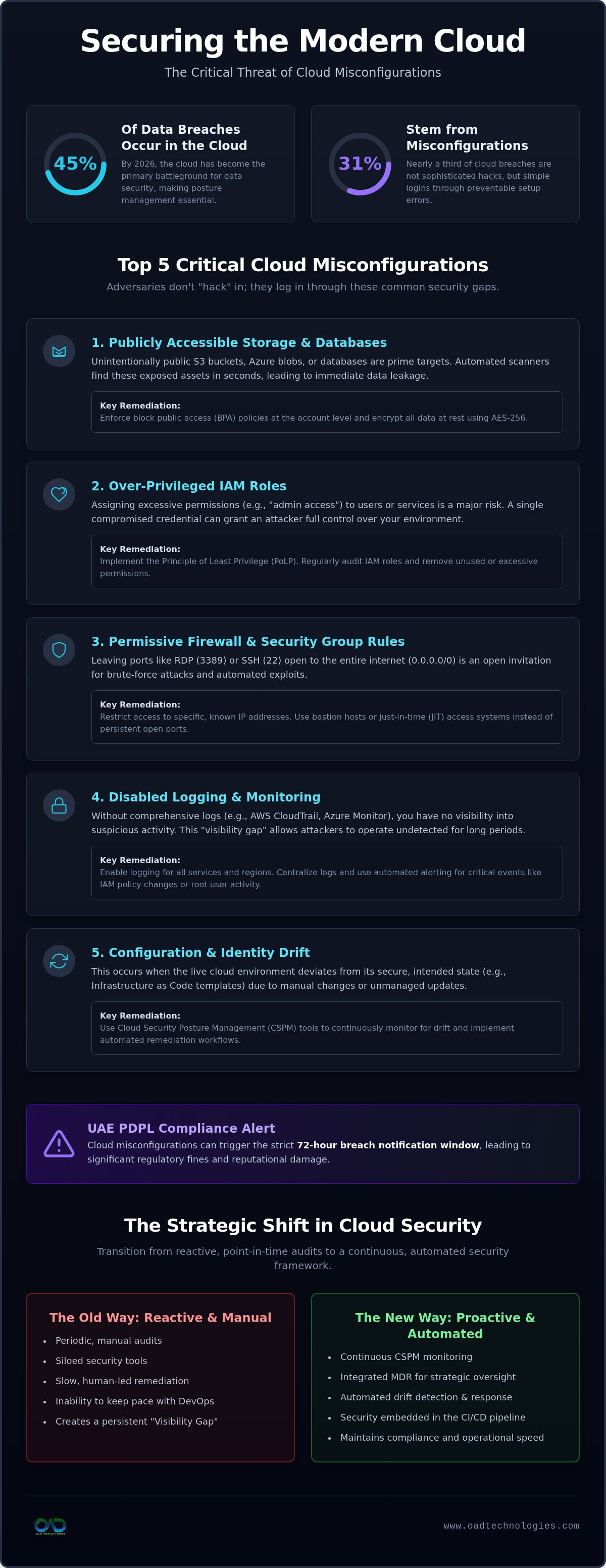
Adversaries in 2026 don't "hack" in; they simply log in through open doors. Modern cloud misconfigurations account for 31% of all cloud breaches, transforming minor oversights into catastrophic exposures. To protect your enterprise assets, you need a proactive data loss prevention strategy that addresses these common attack vectors before they become headlines. Relying on manual oversight is no longer a viable defense against the speed of automated exploitation.
Publicly Accessible Storage Buckets and Databases
Leaky S3 buckets and Azure blobs remain a persistent thorn for security teams. This usually happens when a developer sets a bucket to "public" for a quick test and forgets to revert it. Adversaries use automated scanners to index these repositories in seconds. If your data isn't encrypted at rest with AES-256 as per UAE standards, it's effectively public. You can remediate this by implementing cloud-native "block public access" policies at the account level, ensuring no individual can accidentally expose a database to the world. It’s a simple fix that prevents massive exfiltration.
Overly Permissive IAM Roles and Shadow Admins
The "Shadow Admin" problem is a silent threat. It occurs when users accumulate permissions over time, eventually gaining administrative rights they don't actually need. Research shows that weak IAM controls affect up to 98% of cloud accounts in 2026. Hardcoding API keys in application code also provides a direct path for attackers. Enforcing the Principle of Least Privilege (PoLP) is the only way to stop this. You should regularly audit roles to ensure that identities only have the specific permissions required for their current tasks. Reviewing Common Cloud Misconfiguration Types can help your team identify these patterns before they're exploited.
Unrestricted Inbound and Outbound Network Traffic
Leaving ports like SSH (22) or RDP (3389) open to the entire internet is an invitation for brute-force attacks. However, unrestricted outbound traffic is equally dangerous. It allows compromised instances to communicate with Command and Control (C2) servers, facilitating stealthy data exfiltration. You must utilize Security Groups and Network ACLs with a "Deny All" default stance. Only explicitly permit the traffic necessary for your business operations. If you're unsure where your perimeter currently stands, a professional vulnerability assessment can pinpoint these hidden entry points and help you secure your cloud misconfigurations effectively.
The Strategic Cost: Data Breaches and UAE Regulatory Compliance
In 2026, the average cost of a data breach has climbed to $4.99 million, representing a 12% increase from the previous year. For UAE enterprises, these figures aren't just abstract statistics; they reflect the tangible financial and reputational damage that follows a security failure. When cloud misconfigurations lead to an exposure, the impact ripples through the entire organization, affecting investor confidence and customer trust. Viewing these errors as isolated technical glitches is a dangerous oversight. They're fundamental governance failures that require a strategic, top-down response to ensure long-term viability.
The NSA guidance on mitigating cloud vulnerabilities identifies misconfiguration as the most prevalent class of vulnerability in cloud environments. This highlights why your technical defense must align with a broader governance risk and compliance framework. By treating security as a core business function, you transform it from a cost center into a strategic asset that protects your digital relevance.
Navigating the UAE Personal Data Protection Law (PDPL)
The UAE Personal Data Protection Law (PDPL), Federal Decree-Law No. 45 of 2021, places direct accountability on the data controller for securing personal information. If neglectful security configurations lead to a breach, organizations face severe penalties. A critical requirement is the 72-hour notification window; you must notify the UAE Data Office of any personal data breach within this timeframe. This mandate makes real-time detection essential. Regular security assessments and audits aren't just best practices in the UAE market; they're legal necessities to demonstrate that your organization has taken proactive steps to prevent cloud misconfigurations from exposing sensitive citizen data.
The Role of Data Sovereignty in Cloud Architecture
Data residency is a complex challenge for national enterprises utilizing global cloud providers like AWS or Azure. The CBUAE requires customer financial data to remain within the UAE, and the National Cloud Security Policy enforces a four-level data classification framework. Unintentional violations often occur through misconfigured cross-region replication, where data is automatically backed up to a server outside the country. To maintain compliance, you must:
- Utilize specific cloud Zones and Regions that are physically located within the UAE.
- Disable automated replication to international data centers for "Restricted" or "Confidential" data classes.
- Implement strict encryption standards, specifically AES-256 for data at rest, to meet the National Cloud Security Policy mandates.
By carefully aligning your cloud architecture with national regulations, you ensure that your innovation doesn't come at the cost of your legal standing.
Establishing a Cloud Security Posture Management (CSPM) Framework
Cloud security isn't a destination; it's a state of constant vigilance. CSPM represents a continuous process of discovering, monitoring, and remediating cloud risks across your entire infrastructure. In a dynamic environment where resources scale and terminate in seconds, point-in-time audits are fundamentally insufficient. They capture a snapshot of a moment that has already passed, leaving you blind to the configuration drift that occurs immediately after the audit concludes. A mature cloud security posture management framework integrates directly into your DevSecOps pipelines, functioning as a set of automated guardrails that ensure security is a prerequisite for deployment rather than a post-launch hurdle.
Automated Discovery and Continuous Monitoring
Managing AWS, Azure, and GCP simultaneously often leads to fragmented silos that hide cloud misconfigurations from even the most diligent teams. CSPM tools solve this by providing a single pane of glass view, aggregating telemetry across all providers into one unified dashboard. This high-level visibility allows your specialists to identify "identity drift" or unmonitored assets that often fall through the cracks of manual management. Real-time alerting ensures that when a developer inadvertently opens a port or disables a logging service, your security team is notified within seconds. In the cloud, visibility is the prerequisite for control; you cannot secure what you cannot see.
Remediation: Manual vs. Automated Approaches
The primary goal of a modern security framework is to minimize the "mean time to remediate" (MTTR). Auto-remediation is highly effective for low-risk, high-frequency cloud misconfigurations, such as unencrypted storage buckets or publicly accessible snapshots. By automating these fixes, you remove the burden of repetitive tasks from your security personnel. However, complex architectural changes still require human oversight to avoid unintended operational downtime. You must strike a balance that utilizes technology to empower people rather than just replacing their judgment with rigid scripts. Use the following checklist to determine your remediation path:
- Automate: If the fix is standardized, low-risk, and addresses a recurring "known" issue.
- Manual: If the change affects core production traffic or requires cross-departmental approval.
- Automate: For non-compliant resource tags or missing encryption settings on new volumes.
- Manual: For complex IAM permission changes that could break service-to-service communication.
Aligning your technical posture with your business goals requires a nuanced approach that considers both speed and stability. If you're ready to move beyond reactive fixes and establish a resilient foundation, our team can help you design a customized CSPM strategy tailored to your enterprise's unique multi-cloud architecture.
Beyond Detection: Integrating CSPM with Managed Security Services
Automated tools are indispensable for identifying cloud misconfigurations at scale, but software alone isn't a strategy. It's a signal. Without expert management, that signal quickly becomes noise that overwhelms your security team. At OAD Technologies, we bridge the gap between high-level innovation and practical business results by integrating Cloud Security Posture Management (CSPM) with a robust managed detection and response (MDR) framework. This synergy ensures that every alert is not just detected but contextualized and remediated by specialists who understand your unique business goals.
A customized security architecture serves as the ultimate defense against configuration drift. By moving beyond standardized, one-size-fits-all settings, you create a resilient foundation that adapts to your growth. This proactive approach transforms security from a reactive hurdle into a strategic asset that protects your long-term digital relevance.
The Synergy of Human Insight and Technological Capacity
Expert analysts bring a level of intuition that algorithms haven't yet mastered. They interpret CSPM data to identify sophisticated attack patterns that might look like routine administrative changes to an automated system. Instead of relying on out-of-the-box configurations, we prioritize custom-tailored security postures designed for your specific multi-cloud footprint. This individualized approach ensures that your defenses are precise and effective. By offloading the burden of continuous monitoring to a managed service, your internal teams are empowered to focus on core business growth and strategic expansion rather than chasing false positives.
Validating Posture with VAPT
A secure posture on paper doesn't always translate to security in practice. This is where vulnerability assessment and penetration testing (VAPT) serves as the "truth serum" for your cloud architecture. While CSPM monitors for known cloud misconfigurations, VAPT simulates real-world adversary tactics to test if your alerts actually trigger under pressure. It's the difference between knowing a door is locked and knowing that lock can withstand a professional bypass attempt.
Testing the effectiveness of your CSPM alerts through these simulations allows you to move from reactive patching to a state of proactive posture management. You aren't just fixing errors; you're hardening the system based on empirical evidence. This journey ensures that your digital assets remain protected and your enterprise stays resilient in an ever-changing threat landscape. By validating every configuration through the lens of an attacker, you ensure your security measures are as robust in reality as they are in your strategy documents.
Building a Resilient Foundation for the Cloud Era
The transition from identifying a visibility gap to establishing a continuous CSPM framework is the cornerstone of modern digital relevance. By bridging technical innovation with strategic governance, your enterprise can move beyond the fear of non-compliance and embrace the full potential of a multi-cloud landscape. True security isn't found in a one-size-fits-all approach; it lives in the synergy between automated tools and expert human insight that can interpret complex threat patterns.
OAD Technologies stands as your strategic partner in this evolution. With deep, UAE-based expertise in PDPL and national security standards, we provide integrated MDR and CSPM solutions that offer 360-degree visibility into your infrastructure. Our team designs highly customized security architectures that prioritize long-term viability over quick fixes, ensuring your defenses are as unique as your business goals. You're now equipped to turn cloud misconfigurations from a looming threat into a solved challenge.
It's time to transform your security posture into a competitive advantage. Secure your cloud environment with OAD Technologies’ strategic CSPM solutions. Your path to a secure, compliant, and innovative future starts with a proactive commitment to precision engineering and strategic foresight.
Frequently Asked Questions
What is the most common cause of cloud misconfigurations?
Human error remains the primary driver, accounting for the vast majority of cloud security failures through 2026. These gaps usually occur during manual adjustments or when developers prioritize speed over security in rapid DevOps cycles. Errors often stem from configuration drift, where live environments deviate from their original secure templates because of untracked changes or temporary workarounds that are never reverted. Managing this requires moving away from manual oversight toward automated guardrails.
How does cloud misconfiguration differ from a software vulnerability?
A software vulnerability is a flaw in the code itself, such as a logic bug, that requires a vendor patch to resolve. In contrast, cloud misconfigurations are errors in how that infrastructure or software is set up and managed. It’s the difference between a broken lock and leaving a perfectly functional door wide open. Both offer entry points for adversaries, but misconfigurations are often easier to exploit because they don't require specialized malware.
Can cloud providers fix misconfigurations for me?
Cloud providers operate under a shared responsibility model where they secure the underlying infrastructure, but you are responsible for the configuration of your specific resources. While providers offer tools to help identify errors, they won't automatically fix settings that might disrupt your unique business logic. You must manage your own tenant's security posture to ensure compliance with national standards and meet your organization's specific risk appetite and operational requirements.
Is automated remediation safe for production environments?
Automated remediation is safe and highly effective for standardized, low-risk issues like unencrypted storage buckets or missing resource tags. However, it requires a tiered approach to prevent unintended operational downtime. For complex changes involving IAM roles or core network routes, you should utilize automated alerts that trigger human review. This balance allows your team to eliminate high-frequency risks instantly while maintaining stability for sensitive production workloads and critical service communications.
How often should we audit our cloud security posture?
You should audit your posture continuously rather than relying on periodic or annual checks. In dynamic environments where assets change by the second, a point-in-time audit is obsolete the moment it's finished. Continuous monitoring ensures that you detect configuration drift in real-time. This proactive stance is essential for maintaining the 72-hour breach notification window mandated by the UAE Data Office, ensuring your enterprise remains compliant with national data protection laws.
What is the impact of the UAE PDPL on cloud security requirements?
The UAE Personal Data Protection Law (PDPL) mandates strict security measures for personal data and requires organizations to notify the Data Office of breaches within 72 hours. This shifts the burden of accountability directly onto the data controller, making the detection of configuration errors a legal priority. Failure to maintain secure settings can lead to significant penalties, especially if neglect results in the unauthorized exposure of citizen data across your multi-cloud environment.
What is the difference between CSPM and CWPP?
Cloud Security Posture Management (CSPM) focuses on the control plane, identifying misconfigured settings and ensuring compliance across the infrastructure. Cloud Workload Protection Platforms (CWPP) focus on the workloads themselves, such as virtual machines or containers, providing runtime protection. While CSPM secures the cloud environment by checking its settings, CWPP secures the running applications. Integrating both is necessary for a comprehensive security strategy that protects both the platform and the data it processes.
Disclaimer
Content by OAD Technologies is for general informational purposes only and does not constitute professional or cybersecurity advice. No warranties are made regarding accuracy or completeness; reliance is at your own risk. OAD Technologies shall not be liable for any direct or indirect losses arising from use of this content.