
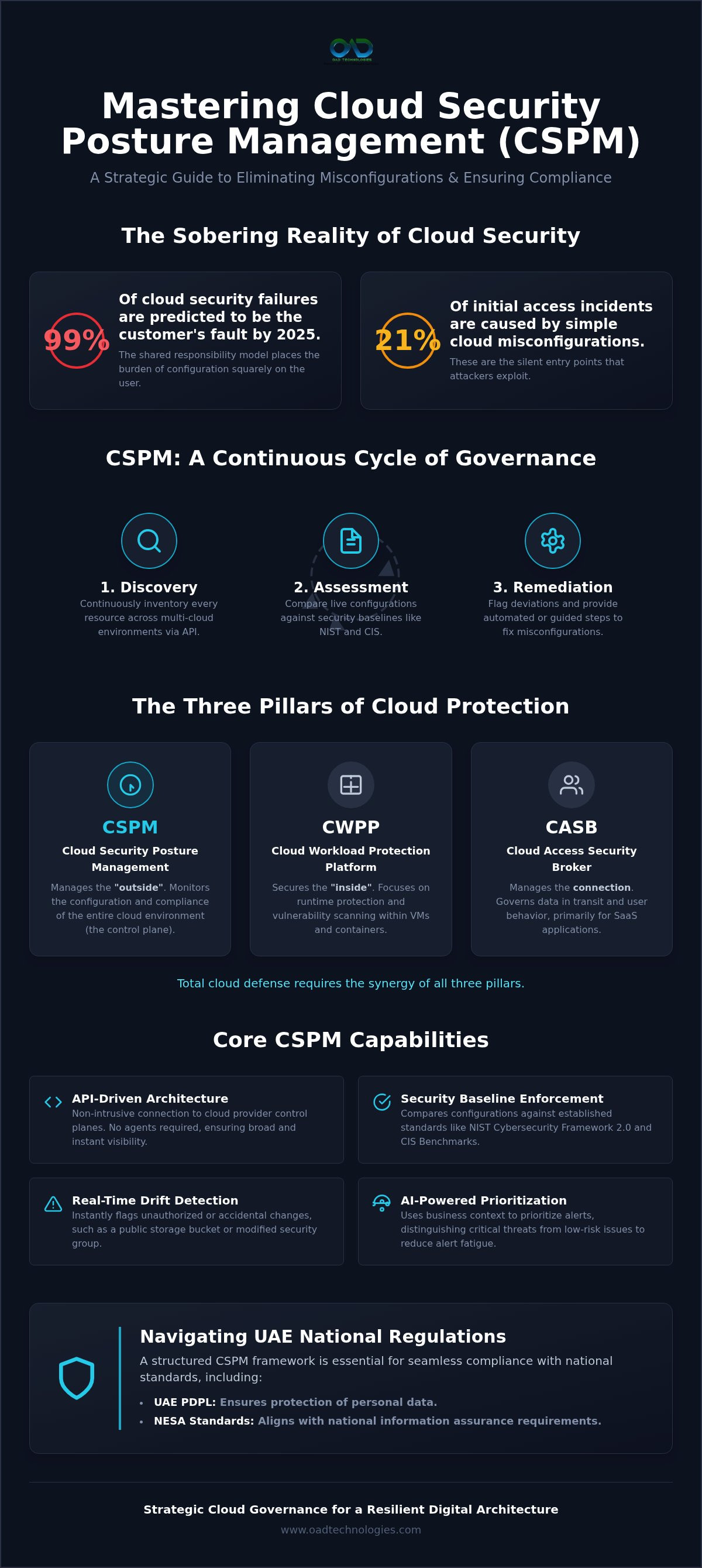
By the end of 2025, industry analysts predict that a staggering 99 percent of cloud security failures will be the customer's fault. It's a sobering reality for any organization operating in a multi-cloud environment, especially when misconfigurations already account for 21 percent of initial access incidents. You likely feel the weight of this responsibility every time a new service is deployed or a compliance audit looms. Managing cloud security posture management (CSPM) shouldn't feel like a constant battle against visibility gaps and an overwhelming volume of security alerts that obscure real threats.
We understand that your goal isn't just to check a box; it's to build a resilient, sovereign digital architecture. This guide provides the technical and strategic essentials you need to eliminate misconfigurations and ensure strict alignment with national regulations like the UAE PDPL. You'll learn how to achieve zero-misconfiguration status through automated reporting and a sophisticated integration of human expertise with modern security tools. We'll move beyond basic monitoring to show you how a proactive CSPM strategy secures your long-term digital relevance and operational performance.
Key Takeaways
- Understand why cloud security posture management must evolve from a one-time audit into a continuous process of dynamic governance to secure sprawling multi-cloud environments.
- Master the mechanics of API-based discovery and automated remediation to establish firm security baselines grounded in NIST and CIS standards.
- Address the primary driver of cloud breaches by identifying and resolving complex IAM "permission creep" before it results in a critical data exposure.
- Navigate UAE national regulatory requirements with a structured implementation framework designed to ensure seamless compliance with PDPL and NESA standards.
- Learn how to bridge the gap between automated tools and human expertise by integrating CSPM with Managed Detection and Response for enterprise-grade resilience.
Defining Cloud Security Posture Management in the Modern Multi-Cloud Era
Cloud security posture management isn't a one-time project or a static audit report. In 2026, cloud security posture management represents a continuous cycle of discovery, assessment, and remediation across distributed environments. As enterprises move away from legacy perimeter models, they're finding that traditional firewalls can't secure a borderless infrastructure. Instead, security must be dynamic. It acts as a governance bridge that ensures every cloud resource, from a simple storage bucket to a complex Kubernetes cluster, adheres to a strict architectural standard.
The core challenge lies in the shared responsibility model. While providers secure the physical infrastructure, the customer remains responsible for everything inside the cloud. Research indicates that 99 percent of cloud security failures through 2025 will be the customer's fault, often due to simple misconfigurations. Enterprises fail when they assume the provider handles everything. Without total visibility across hybrid and multi-cloud architectures, "shadow IT" and forgotten instances become silent entry points for attackers. Achieving a resilient cloud security strategy requires a shift from reactive patching to proactive governance.
The Evolution of Cloud Security: From CISPA to CSPM
Cloud security began with manual assessments like Cloud Information Security Proactive Assessment (CISPA). These were point-in-time checks that quickly became obsolete as developers spun up resources in seconds. Manual verification can't keep pace with 2026 deployment speeds. Modern security has shifted toward "Security as Code." By integrating CSPM directly into the CI/CD pipeline, organizations treat security configurations as programmable assets. This shift ensures that compliance isn't just checked after deployment; it's baked into the infrastructure template itself.
CSPM vs. CASB and CWPP: Understanding the Cloud Security Trinity
To build a resilient defense, you must distinguish between the three pillars of cloud protection. Cloud Access Security Brokers (CASB) focus on data in transit and user behavior, primarily for SaaS applications. Cloud Workload Protection Platforms (CWPP) secure the "inside" of the resource, focusing on runtime protection and vulnerability scanning within containers or VMs. In contrast, CSPM focuses on the "outside" or the control plane. It monitors the configurations that govern how these workloads interact with the world. Total cloud defense requires the synergy of all three:
- CASB manages the connection between the user and the cloud.
- CWPP manages the workload integrity within the cloud.
- CSPM manages the configuration and compliance of the cloud environment itself.
This integrated approach eliminates the visibility gaps that lead to catastrophic breaches. By treating these tools as a unified system rather than isolated products, organizations can maintain a high-quality security posture that scales with their growth.
How CSPM Works: Continuous Monitoring, Automation, and Remediation
Modern cloud security posture management functions through a non-intrusive, API-driven architecture. Unlike legacy tools that require agents on every virtual machine, CSPM connects directly to the cloud provider's control plane. It queries the environment to inventory every resource, from virtual networks to serverless functions. This process establishes a definitive security baseline by comparing live configurations against industry standards such as the NIST Cybersecurity Framework 2.0 and CIS Benchmarks. When a setting deviates from these established "gold standards," the system flags it as a risk.
The real power of this technology lies in its ability to detect "configuration drift" in real time. If a developer accidentally modifies a security group or changes a storage bucket's permissions to public, the API detects the change immediately. In 2026, sophisticated AI models now prioritize these alerts based on business context. Instead of a flat list of vulnerabilities, the system understands if a misconfiguration exists on a critical production server housing sensitive UAE data or a low-risk development sandbox. This intelligence suppresses alert fatigue and allows your team to focus on the threats that actually jeopardize your operational performance.
The Discovery Phase: Mapping the Invisible Cloud
Automated discovery is the prerequisite for cloud resilience. It acts as a continuous inventory tool that uncovers "shadow IT"—those unmanaged assets spun up outside of official procurement channels. CSPM provides full-stack visibility that extends beyond simple compute instances to include the intricate web of IAM roles and permissions. By mapping these relationships, you can identify "permission creep" where users or services accumulate excessive rights over time. This transparency ensures that no asset remains invisible and every connection is accounted for within your strategic architecture.
Automated Remediation: Balancing Speed and Safety
Automation must be applied with precision to avoid disrupting business continuity. Modern workflows distinguish between "auto-fix" capabilities for low-risk issues and guided remediation for complex architectural changes. For instance, a CSPM tool might automatically close an unused, open port but only provide a step-by-step guide for reconfiguring a database's encryption settings. This balanced approach prevents automated changes from inadvertently breaking production environments. The most successful enterprises rely on a synergy between human oversight and automated response to maintain a proactive security posture without sacrificing system stability.
Beyond the Dashboard: Resolving the Cloud Misconfiguration Crisis
Misconfigurations aren't merely technical oversights; they're the primary gateway for modern cyberattacks. Even in 2026, configuration errors remain the leading cause of cloud breaches because the speed of deployment often outpaces the speed of governance. When developers prioritize rapid delivery, security settings are frequently overlooked. Effective cloud security posture management addresses this by moving beyond simple alerts to identify the root causes of these recurring vulnerabilities. It's about establishing a system where security is a prerequisite for deployment, not an afterthought.
Native cloud provider tools often provide a baseline level of visibility, but they rarely meet the needs of a sophisticated enterprise. These tools are typically siloed within their own ecosystem, leaving security teams to manually piece together a fragmented view of their multi-cloud environment. A centralized CSPM strategy normalizes data across all providers, ensuring that a security policy in one cloud is consistently applied in another. This unified approach eliminates the blind spots that attackers exploit when they move laterally between different cloud infrastructures.
Shifting security to the earliest stages of development is the most effective way to resolve the misconfiguration crisis. By integrating Infrastructure as Code (IaC) scanning, you can identify risks in Terraform or CloudFormation templates before they're ever provisioned. If a template contains a hardcoded credential or an open storage bucket, the system blocks the deployment. This "shift left" philosophy ensures that your production environment remains clean and reduces the burden on your operational teams to fix live issues.
The High Cost of Default Settings
Default configurations are designed for accessibility, not enterprise-grade resilience. Out-of-the-box settings frequently leave administrative ports open or utilize weak encryption standards that don't meet UAE regulatory requirements. We've seen catastrophic data exposures occur simply because a storage instance was set to "public" by default. While CSPM identifies these errors, integrating Data Loss Prevention (DLP) acts as a critical secondary defense. If a misconfiguration does occur, DLP ensures that sensitive data remains encrypted and unreadable to unauthorized parties.
Securing Identity: The New Perimeter
Identity has replaced the physical network as the modern security perimeter. The intersection of cloud security posture management and Identity and Access Management (IAM) is where true resilience is built. CSPM tools are essential for identifying "permission creep," where users and service accounts accumulate excessive rights that they no longer require. By enforcing the Principle of Least Privilege, you ensure that every entity in your cloud has exactly the access it needs to perform its function and nothing more. This strategy drastically reduces your attack surface and limits the potential impact of a compromised credential.
A 5-Step Framework for Implementing CSPM in UAE Enterprises
Establishing a robust cloud security posture management strategy in the UAE requires more than just deploying a tool; it demands a structured alignment with national digital sovereignty goals. We recommend a phased approach that bridges the gap between high-level innovation and practical business results. This framework ensures that your cloud evolution remains secure, compliant, and scalable.
- Step 1: Define Scope and Regulatory Requirements. Identify all cloud assets that process personal data of UAE residents to ensure alignment with the Federal Decree-Law No. 45 of 2021 (PDPL) and NESA requirements.
- Step 2: Establish a Unified Security Baseline. Standardize your security configurations across all providers using industry-recognized benchmarks like NIST or CIS, rather than relying on disparate, provider-specific defaults.
- Step 3: Integrate CSPM into the CI/CD Pipeline. Embed security scanning directly into your development lifecycle to identify and block misconfigurations before they reach production.
- Step 4: Configure Automated Alerting and Remediation. Develop intelligent workflows that prioritize critical risks while providing a clear path for human intervention in complex architectural changes.
- Step 5: Continuous Review and Strategic Alignment. Regularly audit your posture to ensure it evolves alongside your broader Governance Risk and Compliance (GRC) objectives.
Aligning Cloud Posture with National Compliance
In the UAE market, data residency and sovereignty are not optional. Cloud security posture management automates the evidence-gathering process required to prove compliance with the PDPL, which has been in effect since January 2022. Instead of manual spreadsheets, CSPM provides real-time dashboards that demonstrate you've implemented the "appropriate technical and organizational measures" mandated by law. This automation transforms compliance from a periodic burden into a continuous, verifiable state of resilience.
Shifting Left: Integrating Security into Development
Shifting left means moving security checks to the earliest possible stage of your infrastructure deployment. By using CSPM to scan Terraform or CloudFormation templates, you can catch a "public" storage bucket or an overly permissive IAM role before a single resource is provisioned. This proactive approach requires a cultural shift where security and DevOps teams act as collaborative partners. When security is treated as code, you eliminate the friction of post-deployment patching and ensure that every new instance is secure by design.
Ready to secure your multi-cloud environment with a strategy tailored to national standards? Explore how our expert team can help you design a customized cloud security architecture today.
Strategic Cloud Governance: The OAD Technologies Approach
OAD Technologies doesn't just deploy security software; we act as a master designer of customized digital ecosystems. While cloud security posture management provides the essential visibility into your infrastructure, our approach ensures that this visibility translates into actionable, strategic intelligence. We bridge the gap between automated tools and the specialized human insight required to solve complex digital challenges. By positioning ourselves as an extension of your own team, we move beyond the vendor-client relationship to become a long-term partner in your digital evolution.
Our methodology combines the continuous monitoring of CSPM with the proactive defense of Managed Detection and Response (MDR). This integration creates a feedback loop where configuration risks are identified and any subsequent threat activity is neutralized 24 X 7. To ensure your defenses remain impenetrable, we utilize Vulnerability Assessment and Penetration Testing (VAPT) to validate our CSPM findings. This rigorous engineering standard confirms that your security baselines aren't just theoretical but are hardened against real-world attack vectors.
Beyond Tooling: Managed Cloud Security
A security tool without a managed strategy inevitably leads to alert fatigue. When your dashboard is flooded with thousands of low-priority warnings, critical misconfigurations can easily go unnoticed. OAD takes a proactive, solution-oriented mindset to manage "cloud drift" on your behalf. We don't just notify you of a problem; we provide the architectural guidance to resolve it permanently. This focus on high-quality craftsmanship ensures the long-term viability of your security posture, allowing your executive leadership to focus on strategic expansion rather than firefighting technical debt.
Securing the Future of UAE Business
We're deeply committed to the national digital resilience of the UAE. As a local strategic partner, we understand the nuances of the regulatory landscape, from the specifics of the PDPL to the evolving NESA standards. Our goal is to act as a guardian of your digital relevance in an ever-changing market. We don't believe in standardized, one-size-fits-all security. Instead, we provide individualized solutions that respect your unique business context and investment returns. To build a cloud environment that is secure by design and compliant by default, consult with our cloud security experts today.
Building a Resilient Future in the Cloud
The shift toward multi-cloud complexity demands a transition from reactive patching to a continuous, automated governance model. By mastering cloud security posture management, your organization moves beyond surface-level dashboards to achieve true architectural resilience. This journey requires a precise alignment between your technical configurations and national regulatory mandates like the UAE PDPL. You've seen how "shifting left" and automating remediation can eliminate the misconfiguration crisis before it impacts your bottom line.
As a UAE National Security Specialist, OAD Technologies provides the strategic partnership needed to navigate this landscape. Our integrated approach combines MDR, GRC, and CSPM to ensure your digital assets remain secure and compliant. We don't just provide tools; we offer a master-designed system that empowers your team through a synergy of human expertise and technological capacity. It's time to transform your security from a bottleneck into a competitive advantage. Secure Your Cloud Infrastructure with OAD Technologies and ensure your long-term digital relevance today.
Frequently Asked Questions
What is the primary difference between CSPM and traditional firewalls?
Traditional firewalls function as gatekeepers for network traffic, monitoring data as it enters or leaves your environment. In contrast, cloud security posture management focuses on the control plane of the cloud itself. It identifies misconfigured storage buckets, overly permissive IAM roles, and non-compliant network settings. While firewalls protect the perimeter, CSPM ensures the underlying infrastructure is architecturally sound and free from the configuration errors that lead to the majority of cloud breaches.
Can CSPM help our organization comply with the UAE Personal Data Protection Law (PDPL)?
CSPM is a critical tool for demonstrating compliance with the UAE Personal Data Protection Law (PDPL). It automates the monitoring of technical measures required to protect personal data, such as encryption and access controls. By providing real-time evidence of your security state, it simplifies the audit process and ensures that your cloud environment adheres to national data sovereignty requirements. This proactive approach helps you avoid the severe penalties associated with non-compliance in the UAE market.
How does CSPM integrate with our existing SIEM or EDR solutions?
Modern CSPM tools are designed to work in synergy with your existing security stack. Configuration alerts from the cloud control plane are typically pushed to your SIEM for centralized correlation and incident response. While EDR protects the individual workloads and endpoints, CSPM secures the environment they inhabit. This integrated approach ensures that a misconfiguration identified by your posture management tool can be cross-referenced with threat activity detected by your MDR or SIEM for total visibility.
Is CSPM necessary if we only use a single cloud provider like AWS?
Even organizations utilizing a single provider like AWS or Azure require a dedicated posture management strategy. While native tools offer basic visibility, they often lack the depth of analysis and customized governance required for enterprise-grade resilience. A dedicated CSPM solution provides a more rigorous assessment against international standards like NIST and CIS. It ensures that your security isn't just "good enough" for the provider, but specifically tailored to your organization's unique risk profile and strategic goals.
How often should we review our cloud security posture baselines?
In the fast-moving cloud landscape of 2026, periodic reviews are no longer sufficient. You should utilize continuous monitoring to detect configuration drift the moment it occurs. While a deep strategic review of your security baselines might happen quarterly to align with new GRC goals, the actual posture management should be a real-time process. This ensures that a single accidental change by a developer doesn't leave your sensitive data exposed for weeks until the next scheduled audit.
Does CSPM impact the performance of our cloud applications?
CSPM has zero impact on the performance or latency of your cloud applications. Because these tools utilize non-intrusive API connections to communicate with the cloud provider's management layer, they don't require agents on your virtual machines or containers. The monitoring happens entirely out-of-band. You can maintain a high-quality security posture and ensure strict regulatory compliance without sacrificing the speed, scalability, or operational performance of your customer-facing digital services.
What is the role of AI in modern cloud security posture management?
AI plays a transformative role by prioritizing risks based on your specific business context. Instead of overwhelming your team with a flat list of thousands of alerts, AI models analyze which misconfigurations actually jeopardize critical production data. It also powers automated remediation workflows, allowing the system to fix low-risk issues instantly while flagging complex problems for human review. This synergy between machine intelligence and human expertise is what defines a truly proactive cloud security posture management strategy.
Disclaimer
Content by OAD Technologies is for general informational purposes only and does not constitute professional or cybersecurity advice. No warranties are made regarding accuracy or completeness; reliance is at your own risk. OAD Technologies shall not be liable for any direct or indirect losses arising from use of this content.