

With AI-driven breaches in the UAE surging by 340% in the first quarter of 2026 alone, the margin for error in your digital defense has vanished. You likely feel the mounting pressure of audit fatigue while trying to keep pace with NESA, ISR, and the latest CBUAE mandates. It's frustrating to invest significant capital into checkbox exercises that satisfy a regulator's list but leave your critical assets vulnerable to the 800,000 attacks the nation faces daily. Sophisticated compliance-driven penetration testing shouldn't be a repetitive burden; it's actually your most effective tool for validating resilience in an increasingly hostile landscape.
We understand that your goal is more than just avoiding heavy fines or meeting the March 2026 CBUAE deadline for secure authentication. You want a security posture that justifies every dirham spent. This guide will show you how to transform regulatory requirements into a robust security advantage through strategic, technical precision. You'll see how aligning your VAPT and GRC frameworks with UAE national standards creates a roadmap for successful audits and long-term digital relevance.
In This Strategic Guide
- Beyond the Checkbox: Understand why shifting from a "tick-box" mentality to a high-fidelity assessment is critical for validating specific regulatory controls.
- Regulatory Navigation: Master the 2026 UAE compliance landscape, including NESA standards, ISR mandates, and the latest CBUAE supervisory requirements.
- Strategic Divergence: Learn to treat compliance as your operational floor rather than the ceiling by adopting a "Compliance-Aware, Security-First" testing philosophy.
- The 5-Step Framework: Implement a rigorous process for compliance-driven penetration testing that eliminates redundancy through framework mapping and adversarial scoping.
- The OAD Advantage: Discover how customized VAPT and GRC solutions transform mandatory audits into a catalyst for long-term digital resilience and system growth.
Defining Compliance-Driven Penetration Testing: Beyond the Checkbox
In 2026, the definition of a standard penetration test has shifted from a generic security exercise to a highly specialized instrument of validation. Compliance-driven penetration testing is a targeted assessment designed to prove that specific regulatory controls are not just present, but functional and resilient against modern threats. It moves beyond identifying generic flaws to simulating the exact tactics, techniques, and procedures (TTPs) that regulators expect you to defend against. This isn't a surface-level scan; it's a deep-dive verification of your organization's adherence to legal and industry mandates.
Many organizations fall into the trap of the "checkbox mentality." This approach treats security as a hurdle to clear for an auditor rather than a shield for the business. While technically meeting the letter of the law, a checklist-only approach often misses complex logic flaws and lateral movement risks. It creates a dangerous gap between being "compliant" and being "secure." By 2026, testing has evolved from simple automated scripts to sophisticated adversarial simulations that mimic real-world attackers. These simulations are now essential for a modern governance risk and compliance framework, providing the empirical data needed to inform high-level strategic decisions.
The Core Objectives of Regulatory Testing
The primary goal here is to move beyond theoretical risk. You need to validate that the technical controls mandated by UAE authorities actually work under pressure. This process provides the documented evidence required for internal and external auditors to sign off on your resilience. By identifying these compliance gaps early, you avoid the legal and financial penalties that have become increasingly common as regulators tighten their grip. It's about ensuring that your security investments are actually performing the job they were designed to do.
Why Standard Vulnerability Scans Are Not Enough
Relying on automated tools is a common mistake that leads to a false sense of security. A standard vulnerability scan identifies known signatures but fails to understand business logic or chain multiple minor flaws together to gain unauthorized access. Most modern frameworks now require manual exploitation to prove real-world risk. Integrating a full vulnerability assessment and penetration testing (VAPT) program ensures you cover both the breadth of your attack surface and the depth of your critical systems. This dual approach is the only way to satisfy the rigorous demands of 2026 compliance standards while protecting your digital assets from sophisticated threats.
Navigating the Regulatory Landscape: UAE and International Mandates
The UAE regulatory environment has transitioned from encouraging best practices to enforcing mandatory resilience. By 2026, this shift is absolute. Organizations no longer view compliance-driven penetration testing as a luxury; it's a legal prerequisite for operation. This evolution is driven by a convergence of local mandates like NESA and international frameworks that demand more than just surface-level scans. Authorities have moved toward active defense, where the inability to prove technical resilience results in significant penalties and licensing risks.
Global Standards: PCI DSS, SOC 2, and ISO
PCI DSS 4.0 represents a fundamental change in how financial data is protected. It moved beyond periodic checks to a model of continuous security validation as of March 31, 2025. This framework specifically mandates manual testing to identify vulnerabilities that automated tools often miss. Similarly, SOC 2 Type II reports now heavily weight the effectiveness of your technical controls. Without rigorous testing, proving the Security and Confidentiality trust principles becomes nearly impossible. For those who transitioned to ISO 27001:2022 before the October 2025 deadline, Annex A controls now specifically demand technical vulnerability management. Following a structured NIST's Technical Guide to Information Security Testing approach is essential for maintaining these certifications.
UAE National Cybersecurity Requirements
UAE-based entities face a unique set of local requirements that often exceed global benchmarks. The National Electronic Security Authority (NESA) standards mandate technical testing for any organization handling critical information infrastructure. In 2026, this is strictly enforced through the National Cyber Accreditation Programme (NCAP). Parallel to this, the Information Assurance (IA) Regulation, or ISR, requires government and semi-government entities to align their testing with specific mandated information security cycles. These cycles ensure that defenses evolve as quickly as the 340% increase in AI-driven attacks seen in early 2026.
The UAE Personal Data Protection Law (PDPL) adds another layer of complexity. It necessitates regular security assessments to ensure that personal data remains resilient against unauthorized access. For financial institutions, the impact of the Central Bank’s Federal Decree-Law No. 6 of 2025 means that fintechs and payment providers must now embed cybersecurity directly into their licensing and operations. If your organization operates across borders, you must also account for the Digital Operational Resilience Act (DORA), which affects UAE firms with European ties. Managing these overlapping mandates requires a sophisticated governance, risk, and compliance strategy that treats testing as a continuous lifecycle rather than a one-time event.
The Strategic Divergence: Compliance-Driven vs. Security-Driven Testing
Successful organizations in the UAE treat regulatory mandates as the absolute floor of their security posture; never the ceiling. While compliance-driven penetration testing ensures you meet the minimum legal requirements to operate, it doesn't always account for the nuanced, evolving tactics of modern adversaries. The divergence between a "check-the-box" audit and a security-first assessment is where most businesses either find long-term resilience or face catastrophic blind spots. We advocate for a "Compliance-Aware, Security-First" approach that satisfies auditors while rigorously challenging your actual defense mechanisms.
Relying solely on a narrow scope to satisfy a specific regulator can lead to a false sense of safety. For instance, an assessment might pass an audit but fail to identify how an attacker could pivot from a low-risk segment to a critical database. Sophisticated enterprises now use managed detection and response (MDR) to monitor their environment during the testing phase. This integration validates whether your internal detection systems actually trigger alerts when the "compliant" testing activity occurs, bridging the gap between theoretical compliance and operational reality.
Scope vs. Depth: Finding the Balance
A "compliance scope" is often restricted to the specific systems that handle sensitive data, such as the cardholder data environment. However, real-world attackers don't respect these boundaries. They exploit lateral movement paths that auditors might overlook. To achieve true resilience, you must expand your testing to mirror actual threat actor behaviors. This includes testing the effectiveness of your identity and access management (IAM) policies, as compromised credentials remain the primary entry point for breaches. Even when following specific PCI DSS penetration testing requirements, the depth of manual exploitation should always aim to uncover the "why" behind a vulnerability, not just its existence.
Reporting for Two Audiences: Auditors and Engineers
Your testing results must serve two distinct masters. Auditors require high-level executive summaries that provide clear proof-of-effort and evidence of control validation. They need to see that you've satisfied the mandate. Conversely, your remediation teams require granular, technical data to fix the underlying issues. Effective reporting integrates SIEM logs to provide context for every discovery. This allows engineers to see exactly how an exploit was executed and how their existing monitoring tools performed. This dual-layered reporting ensures that your investment in compliance-driven penetration testing delivers both a clean audit report and a measurably stronger infrastructure.
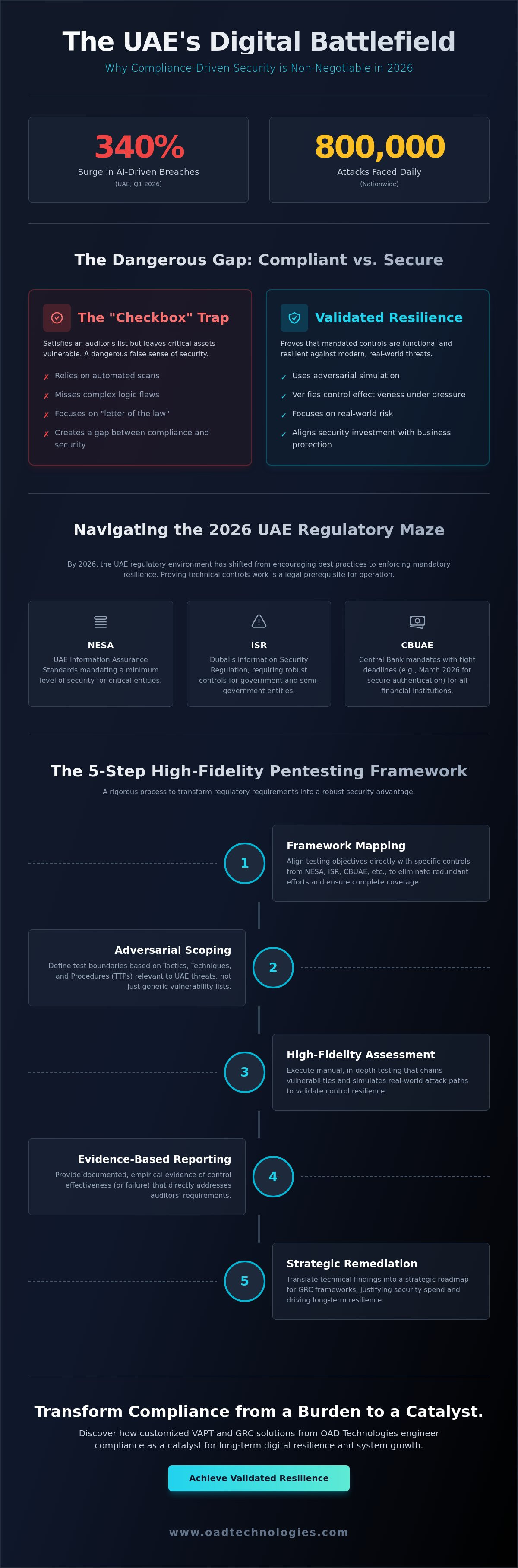
Executing a High-Fidelity Compliance Pentest: A 5-Step Framework
Executing compliance-driven penetration testing requires more than a simple scan and report. To achieve true resilience in the 2026 landscape, you need a framework that bridges the gap between technical exploitation and regulatory alignment. A high-fidelity approach ensures that every hour of testing contributes directly to your audit readiness while simultaneously hardening your infrastructure against the 340% increase in AI-driven breaches reported this year.
We utilize a structured five-step methodology to ensure no control is left unvalidated:
- Step 1: Framework Mapping – Identify all overlapping requirements from NESA, ISR, and PCI DSS 4.0. This eliminates testing redundancy and ensures a single assessment window satisfies multiple regulators.
- Step 2: Adversarial Scoping – Define a scope that satisfies auditor mandates while focusing on critical business logic. We test the paths that actually lead to your most sensitive data.
- Step 3: Execution and Exploitation – Move beyond automated signatures. Our manual testing identifies zero-day risks and complex exploit chains that standard tools miss.
- Step 4: GRC Integration – Map every finding directly to regulatory control IDs, such as NESA T1.1. This provides auditors with the exact evidence they need in a language they understand.
- Step 5: Continuous Validation – Transition from annual "snapshots" to a cycle of ongoing testing. This ensures your security posture doesn't degrade between formal audit periods.
Mapping Findings to Regulatory Controls
The most common failure in standard assessments is a report that engineers understand but auditors find useless. We solve this by tagging every vulnerability with specific ISO or NESA control numbers. This precision streamlines the audit process through pre-mapped remediation reports. When you present a report that explicitly shows how a patched vulnerability satisfies NESA T1.1, the audit moves faster and with fewer non-conformities. Re-testing is the final, vital component of this cycle; it proves to regulators that you've not only identified risks but successfully resolved them.
Leveraging Tech Synergy: Humans and Automation
Automated tools provide a necessary foundation, but they can't replicate human intuition or adversarial creativity. We use cloud security posture management (CSPM) to identify baseline misconfigurations before the manual pentest begins. This allows our engineers to focus their time on "Grey Box" testing, where they have partial knowledge of the system. This approach is significantly more efficient for compliance validation, as it simulates an attacker who has already bypassed initial perimeter defenses. If you're ready to move beyond checkbox exercises, you can explore our customized VAPT solutions designed for the UAE's unique regulatory environment.
OAD Technologies: Engineering Compliance as a Catalyst for Security
OAD Technologies acts as a master designer of digital resilience. We don't just run scans; we engineer security systems that withstand the pressures of the 2026 threat landscape. Our approach to compliance-driven penetration testing is rooted in a deep understanding of how technical vulnerabilities impact both business continuity and regulatory standing. By aligning our GRC expertise with advanced VAPT capabilities, we ensure that your compliance efforts serve as a strategic launchpad for a more secure, ambitious future. We bridge the gap between high-level innovation and practical, audit-ready results.
Our methodology focuses on long-term viability rather than quick fixes. We recognize that the UAE's shift toward mandatory resilience requires a partner that doesn't just identify problems but provides a roadmap for system growth. This proactive, solution-oriented mindset ensures that your security investments are grounded in reality and optimized for maximum return. We act as an extension of your own team, bringing rigorous engineering standards to every assessment we undertake.
Bespoke Assessments for UAE Enterprises
Standardized, "one-size-fits-all" testing fails to account for the specific operational nuances of UAE-based firms. We reject these generic models in favor of customized strategies that address the exact requirements of NESA, ISR, and the PDPL. Our engineers integrate human intelligence with sophisticated infrastructure protection to uncover risks that automated platforms simply can't see. Working with a partner that understands the regional regulatory climate means your reports aren't just lists of flaws; they're strategic documents that satisfy the most rigorous UAE authorities while protecting your long-term digital relevance.
Beyond the Test: Building a Resilient Future
A penetration test is only as valuable as the remediation that follows it. We support the entire security lifecycle, helping you implement robust data loss prevention (DLP) and identity management solutions to close the gaps discovered during testing. This process transforms what many see as a "compliance burden" into a distinct competitive advantage for your brand. By proving a level of security that exceeds basic mandates, you signal to your clients and partners that you are a reliable guardian of their data in an ever-changing market.
The 2026 cybersecurity market in the UAE is projected to reach USD 1.51 billion, reflecting a national commitment to active defense. Don't let your organization fall behind with outdated, checkbox-style testing that misses real-world vulnerabilities. We invite you to partner with a team that views compliance as the foundation of a sophisticated, high-performance security architecture. Contact OAD Technologies today for a strategic consultation to align your technical defenses with the nation's most stringent standards.
Securing Your Strategic Advantage in a Regulated Future
The UAE's 2026 regulatory environment leaves no room for checkbox security. You've seen how compliance-driven penetration testing acts as a bridge between meeting NESA or ISR mandates and achieving true operational resilience. By utilizing human-led adversarial simulations and full mapping to international standards like PCI DSS 4.0, you transform an audit burden into a measurable security advantage. This strategic alignment ensures your infrastructure is prepared for the sophisticated threats of today and the digital evolution of tomorrow.
OAD Technologies provides the specialized GRC and VAPT expertise required to navigate these complexities with precision. We don't just find flaws; we design systems that thrive under scrutiny. It's time to stop settling for snapshots and start building a continuous posture of strength. Our approach ensures your technical controls are robust enough to satisfy regulators while actually protecting your most critical data assets.
Secure Your Compliance and Your Infrastructure; Consult with OAD Technologies Today
The future of your digital enterprise is waiting; let's secure it together.
Frequently Asked Questions
Does NESA compliance require an annual penetration test?
Yes, NESA mandates regular technical security assessments for organizations identified as critical information infrastructure. In 2026, the National Cyber Accreditation Programme (NCAP) enforces these requirements more stringently. Regular testing ensures that your organization maintains its compliance status while protecting essential national services against evolving threats.
What is the difference between a vulnerability scan and a compliance-driven pentest?
Vulnerability scans are automated tools that identify known security signatures, whereas a compliance-driven penetration test involves manual, adversarial exploitation. Scans provide a broad overview of potential flaws; however, a pentest validates whether those flaws can actually be exploited to bypass specific regulatory controls. Most frameworks, including PCI DSS 4.0, now explicitly require manual testing to satisfy their technical requirements.
How much does a compliance-driven penetration test cost in the UAE?
Pricing for these assessments varies significantly based on the scope, complexity, and specific regulatory frameworks involved. Factors such as the number of web applications, network size, and the depth of manual exploitation required will influence the final investment. Organizations should consult with a specialized provider to receive a customized quote that aligns with their unique infrastructure and compliance-driven penetration testing mandates.
Can we use the same pentest report for both PCI DSS and ISO 27001?
You can often use a single assessment to satisfy multiple frameworks if you conduct comprehensive framework mapping during the scoping phase. By identifying overlapping requirements between PCI DSS 4.0 and ISO 27001:2022, you minimize testing redundancy. It's essential that the final report explicitly tags findings with the relevant control IDs for both standards to satisfy different auditors.
What happens if a penetration test identifies critical vulnerabilities during an audit?
Identifying vulnerabilities is a successful outcome of the testing process, provided you have a structured remediation plan in place. Auditors generally look for evidence that you've identified risks and are actively managing them. Most frameworks require a follow-up "clean" re-test to prove that critical non-conformities have been resolved before final certification is granted.
How long does a typical compliance-driven penetration test take to complete?
A typical engagement usually takes between two to four weeks, depending on the breadth of the environment. This timeline includes scoping, active exploitation, and the delivery of a detailed remediation report. More complex environments, such as those requiring internal network and Active Directory testing, may require additional time to ensure a high-fidelity assessment.
Is penetration testing mandatory under the UAE Personal Data Protection Law (PDPL)?
While the PDPL doesn't explicitly name "penetration testing" in every clause, it mandates that data controllers implement appropriate technical measures to protect personal data. Regular security assessments are the industry standard for proving that these measures are effective. In the event of a breach, having documented proof of recent testing can significantly mitigate legal and financial liabilities.
Who is qualified to perform a compliance-driven penetration test for UAE government entities?
UAE government entities must typically engage with accredited cybersecurity firms that align with the National Cybersecurity Strategy. These providers should demonstrate deep expertise in NESA and ISR standards. In 2026, organizations handling Critical Information Infrastructure are often required to use partners that hold specific NCAP accreditations to ensure the compliance-driven penetration testing meets national quality and security benchmarks.
Disclaimer
Content by OAD Technologies is for general informational purposes only and does not constitute professional or cybersecurity advice. No warranties are made regarding accuracy or completeness; reliance is at your own risk. OAD Technologies shall not be liable for any direct or indirect losses arising from use of this content.


