CrowdStrike Falcon is a cloud-native endpoint detection and response platform used by organisations evaluating endpoint protection and managed monitoring. Buying a licence is only one part of deployment: UAE organisations should verify the proposed subscription, current vendor authorisation, implementation responsibilities, data handling and ongoing operating model before selecting a provider.
Distributor discounts, marketing support and partner relationships may affect the commercial picture, but their value depends on the programme and the support provided. This article explains how to assess these factors alongside implementation needs, operational responsibilities and managed-service fit. It covers what to consider when reviewing a partner ecosystem, how to connect security requirements to a deployment plan, and when managed detection and response may help your team maintain oversight after implementation.
Key takeaways
- Assess partner support alongside any distributor discounts or marketing assistance, and consider how each fits your deployment and business needs.
- For work in Dubai or Abu Dhabi, compare how a partner would scope implementation, ongoing operations and local business requirements.
- Separate product capabilities from services such as deployment and managed detection, then map each to your organisation’s security responsibilities.
- Use clear evidence of authorisation and defined service responsibilities to assess whether a partner is equipped for your requirements.
- Structure any demo or proof of concept around specific operational goals, and consider how MDR, SIEM, VAPT or DLP can address wider security needs.
Partner ecosystem
CrowdStrike partners in the UAE can connect product access with implementation, managed monitoring and incident-response support. The partner ecosystem can also shape commercial terms and clarify how responsibilities continue after deployment.
Finding partners in Dubai and Abu Dhabi
A partner’s local presence can support coordination between business stakeholders, technical teams and distribution channels. For organisations operating in Dubai and Abu Dhabi, consider how the proposed relationship supports communication across locations without assuming that office presence alone defines service quality.
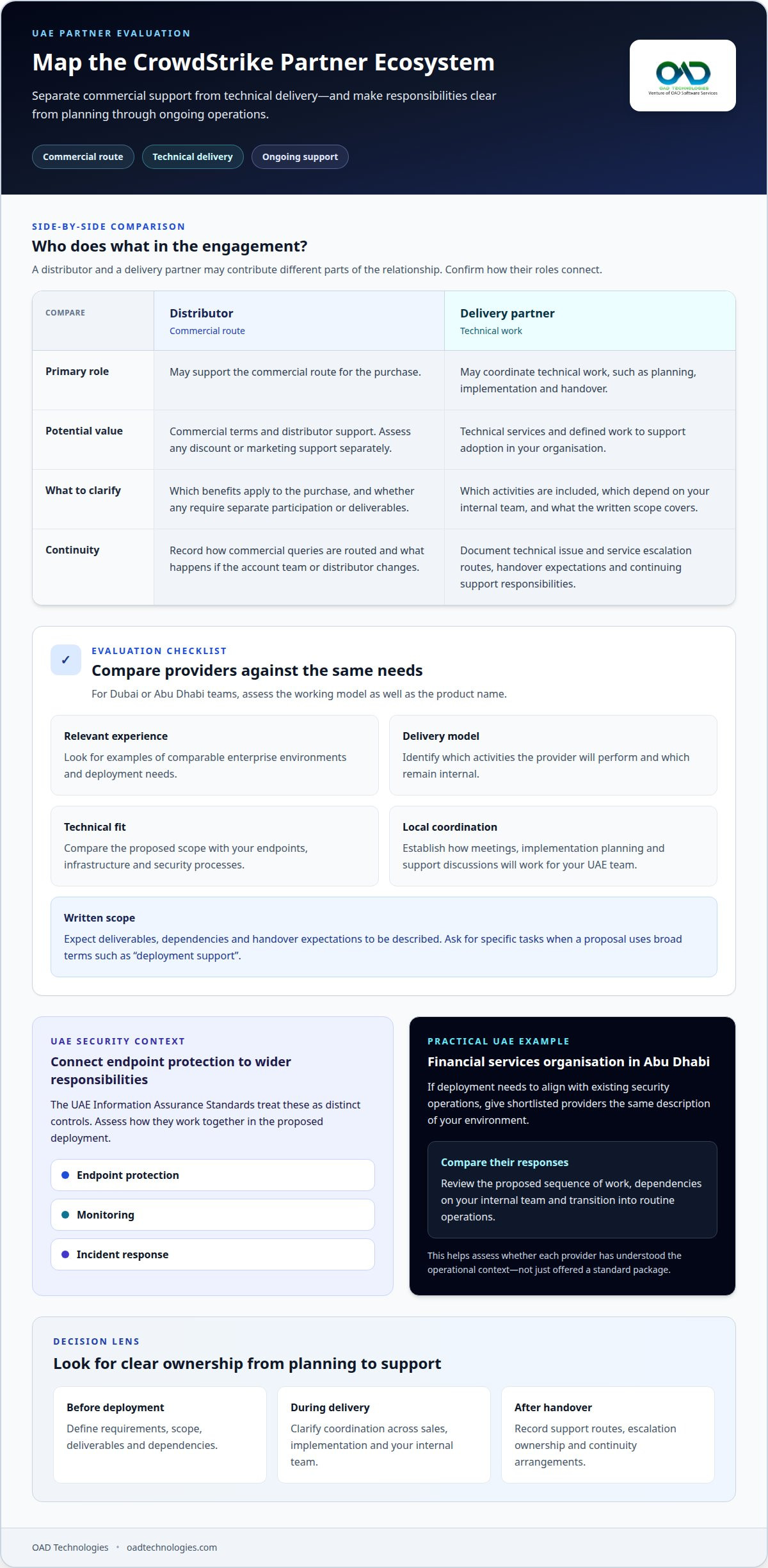
Map the roles involved in the engagement. A distributor may support the commercial route, while a delivery partner may coordinate technical work. Ask how those roles connect during planning and handover. This clarifies the relationship between sales, implementation and ongoing support.
Partner products and services
Partner ecosystems can offer value beyond the product through commercial programmes, marketing support and service delivery. Assess each element separately: a discount affects the commercial proposal, marketing support relates to partner activity, and technical services define the work delivered to your organisation.
For example, compare proposals by recording which benefits apply to your purchase and which require separate participation or deliverables. This helps ensure a promotional offer does not obscure the operational scope. It also clarifies how the partner plans to support adoption in your business.
Authorised partner verification
Authorisation is one part of the relationship, not a substitute for clear ownership of support. Consider how the partner ecosystem routes commercial queries, technical issues and service escalations. A documented route helps procurement and security teams understand where each matter belongs.
Include continuity in the discussion. If the account team, distributor or delivery organisation changes, your business needs a clear record of agreed responsibilities and support routes. This is especially useful during renewal planning, when teams can assess whether the original delivery model still meets their requirements.
Finally, assess how the partner ecosystem supports your organisation’s longer-term operating model. A useful engagement connects commercial terms, delivery coordination and continuing support while keeping their boundaries clear. For a UAE enterprise expanding its security programme, this clarity helps decision-makers plan adoption and internal ownership.
How can I find a CrowdStrike partner in Dubai or Abu Dhabi?
Begin with a defined requirement, not a broad search for a supplier. Decide whether you need help planning a Falcon deployment, integrating it into existing security operations, or supporting internal teams after launch. A concise scope lets you identify providers serving Dubai or Abu Dhabi whose stated capabilities match the work you need.
Build an initial shortlist of firms that describe CrowdStrike services for UAE organisations. Review service pages and proposal materials for specific delivery activities, rather than relying on a product name alone. Note whether the provider discusses technical planning, configuration, integration or ongoing operational support. These details help distinguish relevant specialists from companies whose public information describes software resale only.
Use the same practical criteria to assess each candidate:
- Relevant experience: look for examples of comparable enterprise environments and deployment needs.
- Delivery model: identify which activities the provider will perform and which remain internal.
- Technical fit: compare the proposed scope with your endpoints, infrastructure and security processes.
- Local coordination: establish how meetings, implementation planning and support discussions will work for your UAE team.
- Written scope: expect a proposal that describes deliverables, dependencies and handover expectations.
For example, a financial services organisation in Abu Dhabi may need a deployment that aligns with its existing security operations. It can give shortlisted providers the same description of its environment and ask each to outline the proposed sequence of work. Comparing responses reveals whether they have understood the operational context, rather than simply offering a standard package.
During discussions, ask providers to explain their proposed approach using your business scenario. A useful response should show how they would move from discovery to deployment planning, identify dependencies on your internal team, and explain how the work transitions into routine operations. Record assumptions as well as deliverables, particularly where existing tools or processes affect the design.
Compare proposals on scope and accountability, not presentation style. Check that each addresses the same requirements and distinguishes included work from optional activities. If a proposal uses broad terms such as “deployment support”, ask for the specific tasks covered in the written scope.
A shortlist should leave you with a clear view of technical fit, delivery responsibilities and the proposed working relationship. That gives decision-makers in Dubai or Abu Dhabi a grounded basis for selecting a provider and planning the next procurement step.
You can also broaden the shortlist by checking providers with a presence across the locations relevant to your team. OAD Technologies supports organisations across Dubai, Abu Dhabi and Sharjah, but local presence alone does not establish CrowdStrike authorisation or suitability. Verify the contracting entity and current vendor relationship directly, then assess the proposed delivery team, scope and accountability.
Before choosing a provider, confirm that its written response addresses your operational requirements and assigns responsibilities clearly. Ask for clarification where proposed activities, dependencies or transition arrangements are unclear. Location may help with coordination, but the fit between stated capabilities, the delivery plan and your needs should guide the decision.
What CrowdStrike products and services do UAE partners offer?
UAE partner proposals may combine CrowdStrike Falcon subscriptions with implementation or ongoing security services. The package depends on the agreement and the organisation’s requirements. Separate licensed technology from partner-delivered work so you understand what you are buying and who will perform each activity.
Start with the product scope. Ask the partner to identify the Falcon capabilities included in the proposed subscription, the systems covered and any exclusions. Check how the subscription period, renewals and scope changes are handled. A product name on a quote does not show which capabilities your teams will receive or how they fit your environment.
Service components can address different stages of deployment and operation. A provider may assist with planning, configuration, integration, monitoring or incident coordination only where its current authorisation, licensing route and written scope permit. Establish the owner, required client input and expected evidence for each activity.
A UAE logistics company, for example, may want to assess coverage across office users and operational endpoints. Its requirements could include deployment planning, integration with existing security processes and a defined route for escalating alerts. This illustrates why organisations should describe their environment and operational needs before accepting a standard package.
When reviewing a proposal, organise the scope into practical categories:
- Subscription: note the named capabilities, covered systems, term and renewal conditions.
- Implementation: identify planning, configuration, testing and handover tasks.
- Integration: record the existing tools or processes involved and any dependencies.
- Ongoing service: clarify whether monitoring, alert review or incident coordination is included.
- Responsibilities: distinguish partner duties from decisions retained by your organisation.
This separation also helps procurement compare proposals on equivalent terms. One partner may quote technology only, while another includes implementation. A managed service may add operational work, but its scope should explain what that work covers and how it relates to your internal security team.
Finally, connect each proposed component to a business requirement. If procurement simplicity is the priority, focus on subscription scope and renewal terms. If internal capacity is the concern, examine the division of operational responsibilities. A clear breakdown helps UAE organisations assess whether the proposed combination of Falcon products and partner services suits their environment, rather than treating every offer as the same package.
When evaluating an authorised provider, compare which operational tasks it will own, how exceptions reach your team and what evidence of completed work you will receive. Confirm current authorisation with CrowdStrike and define cloud, endpoint, SIEM and incident responsibilities in the agreement rather than assuming they are included.
How can I verify a CrowdStrike partner is officially authorised?
Verify the relationship with CrowdStrike directly, then match it to the company named in your UAE proposal. A partner badge, logo or sales presentation alone does not establish authorisation for a specific legal entity, territory or service. Ask for written confirmation identifying the entity and the work it may perform.
Begin with the exact contracting name. Compare the company name on the proposal, licence documentation and contract with the name in CrowdStrike’s confirmation. If a group company or subsidiary will deliver the work, ask which entity holds the relationship and which accepts contractual responsibility. This distinction matters when the seller, implementation team and managed-service operator are different entities.
Request evidence that addresses the relevant scope, rather than relying on a general claim of partnership. The confirmation should clarify whether the relationship covers product resale, implementation, managed services or another defined activity. Authorisation to resell Falcon, for example, does not identify who will deploy it or monitor alerts. Assess those responsibilities separately.
Use a short verification sequence:
- Record the legal entity name and the UAE territory covered by the proposed work.
- Request current written confirmation from CrowdStrike identifying the relationship and its scope.
- Match the confirmation to the seller and delivery entities named in the proposal.
- Ask CrowdStrike to clarify any mismatch in company name, territory or authorised activity.
- Retain the confirmation with procurement and contract records.
Next, compare the verified scope with the service description. A UAE enterprise buying Falcon deployment should identify who performs installation, configuration and handover. A managed monitoring proposal should separately name the operational provider and explain its alert-escalation responsibilities. Verification of a commercial relationship and assessment of delivery capability are related, but they answer different questions.
For a practical example, suppose a Dubai organisation receives a proposal from one entity, while another entity appears as the implementation team. Ask CrowdStrike to identify which entity is authorised, then require the proposal to state which company contracts, deploys and supports the service. That record can help procurement resolve discrepancies before approval.
Finally, keep evidence in a form that can be reviewed later. Store the dated confirmation, proposal, contracting-entity details and agreed scope together. If the relationship or delivery structure changes before renewal, repeat the comparison. A clear record helps the security team distinguish authorised product access from the separate capability to provide implementation or managed support.
Do CrowdStrike UAE partners offer demos, trials or proof-of-concept deployments?
UAE buyers can assess Falcon through a demonstration, trial or proof of concept when that format is part of the proposed engagement. Each serves a different purpose: a demonstration explains the proposed approach, a trial enables hands-on evaluation, and a proof of concept tests an agreed use case in a limited environment.
Start by choosing the format that answers your decision. A product demonstration can help security and procurement teams understand the proposed workflow before planning deployment. A trial gives designated users an opportunity to assess the product in their environment. A proof of concept tests defined requirements against a real business scenario.
Set the evaluation boundaries before access or deployment begins. Agree which systems and users are in scope, who can participate, what data or telemetry is involved, and how results will be reviewed. For a UAE organisation with offices in Dubai and Abu Dhabi, the scope might cover a representative endpoint group at each location. That provides a practical view of deployment coordination without assuming an organisation-wide rollout.
Use a written evaluation plan with clear decision criteria:
- Objective: state the business or security question the evaluation must answer.
- Scope: identify participating teams, endpoints, environments and exclusions.
- Responsibilities: name who configures, observes, supports and reviews the evaluation.
- Evidence: define which observations, reports or demonstrations will inform the decision.
- Exit: document how access ends, settings are removed or retained, and findings are handed over.
For example, a Dubai enterprise could test whether its security team can interpret a simulated endpoint alert and follow its internal escalation process. The exercise should define the scenario and expected observations beforehand. It should not treat a successful demonstration as proof that every production environment or attack scenario will behave identically.
Keep commercial and technical terms distinct. Put a trial’s access conditions, duration and included assistance in writing, alongside any subscription or purchase terms. A proof of concept should also state what happens to configurations and evaluation data when the activity ends. These details help teams compare proposals without confusing a limited evaluation with a complete managed service.
After reviewing the results, map each finding to a deployment decision, an operational owner or a remaining requirement. This turns a demonstration or test into useful evidence for procurement and security planning.
OAD Technologies
OAD Technologies provides enterprise-grade endpoint-security and Managed Technology Services on a Fully Managed, Defined Scope basis. Where CrowdStrike is proposed, the subscription, reseller or service-provider authorisation, implementation tasks and ongoing responsibilities must be verified and documented for the specific engagement. Alternative endpoint platforms should be assessed against the same workload, integration and operational criteria.
A defined service may connect endpoint telemetry with SIEM, SOC, email security, data protection, VAPT, cloud or recovery controls. Coverage, response targets, containment authority and vendor dependencies are agreed in writing; OAD does not present a universal response time or product as the best fit for every environment.
For example, a business evaluating endpoint monitoring can consider how alerts connect with its wider detection and response processes. The UAE Information Assurance Standards identify endpoint protection, monitoring and incident response as distinct controls, so it is useful to consider each responsibility separately. OAD Technologies can help define the relevant security scope around your organisation’s needs.
Turn your security priorities into a clear next step
Choosing a CrowdStrike partner in the UAE is part of a broader decision about how security responsibilities fit together. Before committing to a deployment, consider which risks need attention beyond endpoint monitoring and how those priorities connect to your operating model. A focused discussion can clarify where technology, internal ownership and specialist support meet.
OAD Technologies can deploy and manage CrowdStrike Falcon for you, and supports wider security work through Managed Detection & Response (MDR), SIEM and SOC monitoring, Vulnerability Assessment and Penetration Testing (VAPT), and Data Loss Prevention (DLP). These services address different needs, from detection and response to identifying weaknesses and protecting sensitive information. The right starting point depends on the security challenge your organisation needs to address.
Bring your current priorities and operational requirements into the conversation to shape a practical path forward.
With a clearly defined next step, your team can develop security capabilities around its needs and support ongoing business operations.
Disclaimer
Content by OAD Technologies is for general informational purposes only and does not constitute professional or cybersecurity advice. No warranties are made regarding accuracy or completeness; reliance is at your own risk. OAD Technologies shall not be liable for any direct or indirect losses arising from use of this content.