
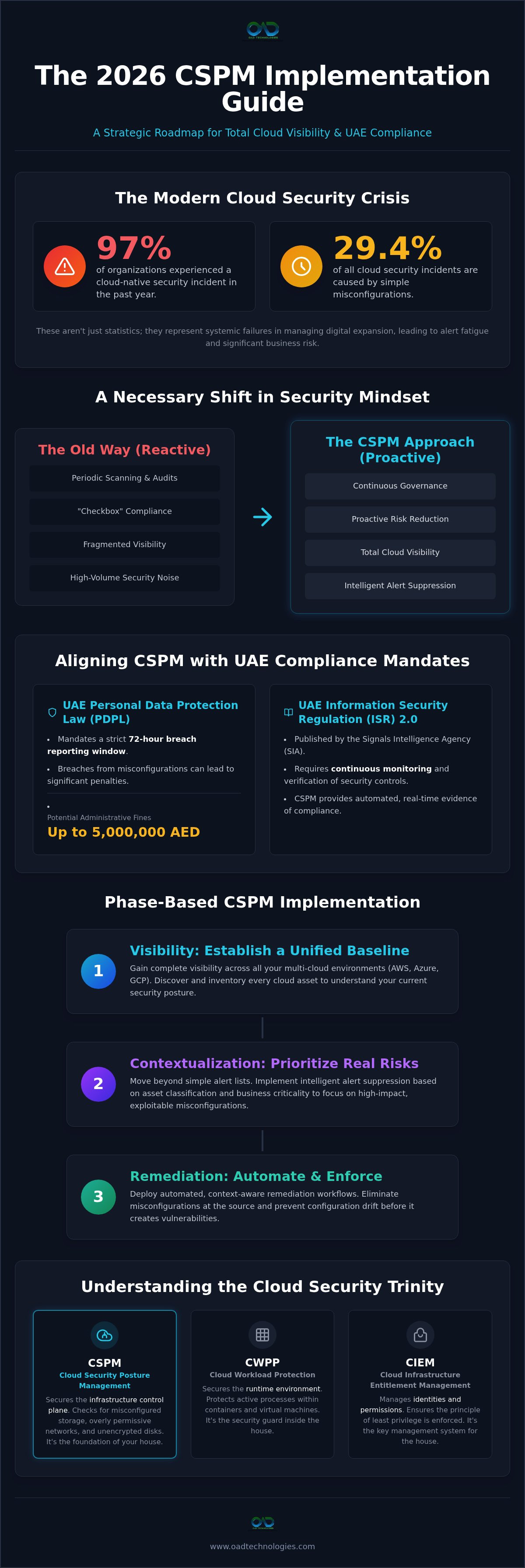
97% of organizations experienced at least one cloud-native security incident in the past year, according to the 2026 State of Cloud-Native Security Report. For many enterprises, this statistic isn't just a distant data point; it's a daily reality defined by overwhelming alert fatigue and the mounting pressure of maintaining compliance with the UAE Personal Data Protection Law (PDPL). You're likely struggling to maintain visibility across fragmented multi-cloud environments while ensuring your team can meet the strict 72-hour breach reporting window mandated by federal law.
This cspm implementation guide serves as your strategic roadmap for 2026, offering a clear path to move beyond "checkbox compliance" toward a state of total cloud visibility. We'll show you how to deploy automated remediation workflows that eliminate misconfigurations before they become exploitable vulnerabilities. We'll also preview how to align your cloud infrastructure with the latest UAE ISR 2.0 standards and the specific mandates of the Central Bank of the UAE. We're bridging the gap between high-level innovation and practical business results, ensuring your digital evolution remains both secure and resilient in an increasingly complex regulatory market.
Key Takeaways
- Understand why continuous governance is replacing periodic scanning as the standard for eliminating human-led misconfigurations in cloud-native environments.
- Learn to align your technical deployment with the latest UAE Information Security Regulation (ISR) 2.0 and PDPL mandates to avoid significant administrative penalties.
- Follow our comprehensive cspm implementation guide to move from initial multi-cloud visibility to automated, context-aware remediation workflows.
- Discover a strategic framework for reducing security noise by implementing intelligent alert suppression based on asset classification and business criticality.
- Explore the benefits of a customized security architecture that pairs CSPM with Managed Detection and Response (MDR) for proactive risk reduction.
The Cloud Misconfiguration Crisis: Why CSPM is Essential in 2026
Google Cloud's H2 2025 Cloud Threat Horizons report reveals that misconfigurations account for 29.4% of all cloud security incidents. This isn't just a technical glitch; it's a systemic failure in how organizations manage their digital expansion. Cloud Security Posture Management (CSPM) acts as a continuous governance framework that maintains infrastructure integrity across your entire environment. Any effective cspm implementation guide must acknowledge that the "set and forget" mentality of the past is no longer viable. We're operating in a landscape where a single manual error in a DevOps pipeline can expose sensitive data to the public internet in seconds.
Traditional perimeter security fails in modern, API-driven environments because there's no longer a physical or static boundary to defend. Security in 2026 requires a shift from "point-in-time" audits to real-time posture management. While a quarterly audit might satisfy a basic checkbox, it leaves you blind to the thousands of configuration changes that occur between assessments. CSPM provides the visibility needed to detect these shifts instantly, ensuring that your security baseline remains intact despite the speed of your development cycles.
CSPM vs. CWPP vs. CIEM: Understanding the Cloud Security Trinity
To build a resilient defense, you must understand how different tools interact within the broader cloud computing security ecosystem. CSPM focuses on the infrastructure control plane, checking for misconfigured storage buckets or unencrypted disks. Cloud Workload Protection (CWPP) is different; it secures the runtime environment and active processes within your containers or virtual machines. Cloud Infrastructure Entitlement Management (CIEM) rounds out the trio by managing the complexity of identities and permissions. While CWPP and CIEM are vital, CSPM is the foundational layer that ensures the house itself is built correctly.
The Business Impact of Configuration Drift
Configuration drift happens when manual changes bypass your Infrastructure as Code (IaC) security reviews. A developer might temporarily relax a security group setting to troubleshoot a connection and forget to revert it. This creates a "shadow" vulnerability that your standard deployment scripts won't catch. For UAE enterprises, these errors carry heavy consequences. Under the UAE Personal Data Protection Law (PDPL), a breach caused by an over-permissive IAM role could result in administrative fines of up to 5,000,000 AED. Beyond the financial hit, the loss of client trust in a competitive market can be terminal. This cspm implementation guide is designed to help you automate the detection of this drift, turning manual oversight into programmatic certainty.
The Strategic Framework: Aligning CSPM with UAE Compliance
Compliance in the UAE has evolved from a series of recommendations into a rigorous mandate for digital resilience. While Gartner's definition of CSPM highlights its role in identifying and remediating risk, UAE enterprises must view these tools through a national regulatory lens. A successful cspm implementation guide doesn't just list technical checks; it maps those checks to the legal realities of operating within the Emirates. This alignment ensures that your security posture supports a Zero Trust architecture by continuously verifying that your infrastructure adheres to the principle of least privilege and secure-by-default configurations.
Many organizations fall into the trap of "checkbox compliance," treating security as a static list of requirements. We reject this approach. Instead, we prioritize high-impact, exploitable misconfigurations that represent actual threats to your business continuity. By focusing on risk reduction rather than just meeting minimum standards, you create a more resilient environment that can withstand the scrutiny of both regulators and threat actors.
Navigating UAE Information Security Regulation (ISR)
The Information Security Regulation (ISR) 2.0, published in September 2025 by the Signals Intelligence Agency (SIA), demands continuous monitoring and verification of security controls. CSPM automates this verification, providing real-time evidence that your cloud environment remains compliant. This technical posture must integrate seamlessly with your broader Governance Risk and Compliance (GRC) strategy. For government entities and critical infrastructure providers, automated reporting isn't a luxury. It's a necessity to streamline the auditing process and ensure ongoing alignment with national standards.
Data Sovereignty and Cloud Security
The UAE Personal Data Protection Law (PDPL) introduces strict mandates regarding data residency and breach notification. CSPM helps you maintain compliance by ensuring that data storage configurations remain within regional boundaries and aren't inadvertently shifted to unauthorized locations during scaling. This is particularly critical when integrating your posture management with Data Loss Prevention (DLP) for holistic asset protection. If you're looking to strengthen your regional compliance posture, our team can help you design a bespoke security architecture that meets these specific requirements. By validating that encryption is active and access is restricted, you satisfy the PDPL's requirements for technical and organizational measures to protect personal data.
Phase-Based Implementation: From Visibility to Remediation
Implementing a cloud security strategy requires a methodical progression that balances agility with stability. A robust cspm implementation guide structures this journey into four distinct phases, moving your organization from initial visibility to a state of self-healing resilience. This structured approach ensures that security doesn't become a bottleneck for development but rather a programmatic enabler of it. By following a phased roadmap, you avoid the common pitfall of attempting full automation before you've achieved baseline visibility.
Phase 1: Establishing the Multi-Cloud Baseline
The first step involves connecting all your environments, including production, sandbox, and testing, via read-only APIs. This non-disruptive connection allows you to gain a unified view without risking operational downtime. We recommend adopting industry standards like the CIS AWS Foundations Benchmark v7.0.0 as your starting point to evaluate your current posture. A Baseline Scan is the definitive technical inventory of your cloud environment that establishes a "known good" state for measuring every subsequent configuration change. This foundation is critical for identifying drift as soon as it occurs, providing the ground truth for your entire security program.
Phases 2 and 3: Context and Integration
Phase 2 shifts focus toward contextual risk assessment. Not every misconfiguration carries the same weight; a public S3 bucket containing marketing assets is a lower priority than one containing PII regulated by the UAE PDPL. You must classify assets based on business criticality to ensure your team focuses on high-impact vulnerabilities first. In Phase 3, you operationalize these findings by integrating CSPM with your existing ITSM and incident response workflows. By routing alerts directly into tools like Jira or ServiceNow, you ensure that security issues are treated as standard tickets within the DevOps lifecycle rather than isolated security events.
Phase 4: Maturing into Automated Remediation
The final phase involves implementing automated remediation and "Guardrails" for continuous security. You must distinguish between non-destructive automation, such as enhanced logging and alerting, and active configuration changes that modify the environment. For technical teams seeking provider-specific configurations, Microsoft's CSPM implementation guide offers deep-dive documentation into Azure-native controls. Mature organizations utilize self-healing infrastructure to correct misconfigurations in real-time, such as automatically disabling an unauthorized public gateway. However, expert oversight remains essential. You need human insight to validate remediation logic and ensure that automated actions don't inadvertently disrupt complex business logic or critical service dependencies.
Operationalizing CSPM: Reducing Noise and Alert Fatigue
High-volume cloud environments often generate thousands of security alerts daily, leading to the "Alert Fatigue" phenomenon. When your team is buried under a mountain of low-priority notifications, critical risks—like an exposed production database—often go unnoticed. A strategic cspm implementation guide must prioritize the reduction of this noise to maintain operational velocity. By integrating your posture findings into a centralized SIEM, you create a unified visibility layer that correlates infrastructure drift with real-time threat telemetry. This integration allows your security operations center to see not just that a configuration changed, but whether that change is being actively scanned or exploited by a threat actor.
The goal of operationalization is to move away from reactive firefighting toward a structured, risk-based response. This requires a shift in mindset where technical findings are always framed within a business context. When you understand the "Blast Radius" of a potential misconfiguration, you can allocate your engineering resources where they'll have the greatest impact on reducing exploitable risk.
Contextual Suppression and Risk Acceptance
Effective operationalization requires a suppression strategy built on specific business context. You shouldn't treat a staging environment with the same urgency as a production database containing PDPL-regulated data. Utilize cloud tagging to automatically suppress alerts for assets that are public or unencrypted by design, such as public-facing marketing assets or static web content. This prevents "known issues" from cluttering your security operations dashboard. Every exception must be documented and justified within the CSPM platform to maintain a clear audit trail for UAE regulators. This level of rigor ensures that risk acceptance is a conscious business decision rather than a byproduct of manual oversight. It transforms your dashboard from a chaotic list of errors into a prioritized, actionable roadmap.
Prioritizing by Attack Path Analysis
Advanced CSPM tools go beyond isolated checks by performing "Blast Radius" analysis. They chain multiple misconfigurations together to identify exploitable attack paths that a single-point scan would miss. For example, an over-permissive IAM role combined with a public-facing API creates a "Toxic Combination" that an attacker could use to move laterally through your network and access sensitive financial records. You can further refine these findings by leveraging VAPT insights to validate whether a technical misconfiguration is actually reachable and exploitable in the real world. This multi-layered approach ensures your engineers spend their time fixing the 5% of issues that represent 95% of your actual risk. If you need assistance streamlining your security operations to focus on what matters most, contact our team for a custom CSPM architecture audit. By focusing on the synergy between human insight and automated scanning, you can eliminate the noise and secure your cloud with precision.
The OAD Advantage: Integrated Cloud Security Posture
While the technical phases of this cspm implementation guide provide a necessary foundation, the ultimate success of your cloud strategy depends on how these tools integrate into your unique business fabric. Standardized, "out-of-the-box" CSPM solutions often fail UAE enterprises because they lack the context required for regional mandates. They treat every environment with a generic lens, often resulting in rigid configurations that stifle innovation or overlook local nuances. OAD Technologies rejects this one-size-fits-all approach. We focus on bespoke architectures that bridge the gap between high-level innovation and practical business results, ensuring your security posture is a driver of growth rather than a bottleneck.
The true power of cloud resilience lies in the synergy between different security layers. By combining CSPM with Managed Detection and Response (MDR), you create a dual-layered defense that is both proactive and reactive. While CSPM ensures your infrastructure remains secure by default, MDR provides the continuous monitoring needed to detect and neutralize sophisticated threats that might exploit even the most secure configurations. This transition from reactive security to proactive, automated cloud governance ensures your organization isn't just keeping pace with technology but actively shaping its future application.
Bespoke Integration for UAE Enterprises
We customize CSPM platforms to align with specific UAE industry mandates, whether you're a financial institution governed by the Central Bank of the UAE or a government entity adhering to the latest SIA standards. This customization involves a deep synergy between human insight and technological capacity. Our experts act as master designers of systems, ensuring your tools empower your people rather than just replacing processes. We position ourselves as a strategic partner in your digital evolution, focusing on long-term viability and the rejection of "checkbox compliance" in favor of real risk reduction. Your infrastructure is unique; your security posture should be as well.
Taking the Next Step in Cloud Resilience
Moving toward a mature cloud posture starts with a Cloud Security Maturity Assessment. Our experts evaluate your current environment against the roadmap established in this cspm implementation guide, identifying critical gaps and developing a path for automated remediation. We provide a roadmap that ensures continuous compliance with the UAE PDPL and ISR 2.0 while maintaining the agility your developers require. We act as a guardian of your digital relevance in an ever-changing market. Consult with OAD Technologies for a tailored CSPM implementation strategy to ensure your cloud infrastructure is as ambitious and secure as your business goals.
Future-Proofing Your Cloud Infrastructure in the UAE
Cloud security in 2026 demands more than just automated scanning; it requires a strategic alignment of technical posture with national regulatory mandates. This cspm implementation guide has outlined a path from fragmented visibility to a mature, self-healing architecture. By focusing on high-impact, exploitable risks and utilizing advanced blast radius analysis, your team can finally eliminate the noise of alert fatigue. Success lies in moving beyond "checkbox compliance" toward a state of active defense that protects your operational integrity.
OAD Technologies stands as a UAE-market leader in ISR and PDPL regulatory alignment. We don't just deploy software; we design bespoke security architectures that leverage the synergy between Managed Detection and Response (MDR) and Data Loss Prevention (DLP). Our expert-led deployments focus on reducing your actual attack surface, ensuring that your digital evolution remains resilient against emerging threats. This approach transforms security from a reactive burden into a proactive business enabler that supports long-term growth.
The journey toward total cloud visibility is a continuous process of refinement and partnership. By bridging the gap between human insight and technological capacity, you can transform your security operations into a competitive advantage. Secure your cloud future with a bespoke CSPM strategy from OAD Technologies. We're ready to help you navigate the complexities of the modern cloud landscape with precision and confidence.
Frequently Asked Questions
What is the primary difference between CSPM and traditional firewalls?
Firewalls inspect network traffic at the perimeter, while CSPM monitors the configuration and security posture of the cloud infrastructure control plane. Traditional firewalls can't detect a publicly exposed S3 bucket or an over-permissive IAM role. CSPM provides visibility into the behind-the-scenes settings that define your cloud environment's integrity. It ensures that the structural components of your cloud remain secure, whereas firewalls focus on blocking malicious packets from entering the network.
How does CSPM help with UAE ISR compliance audits?
CSPM automates the continuous monitoring and evidence collection required for UAE Information Security Regulation (ISR) 2.0 audits. Instead of manual point-in-time checks, these tools provide real-time dashboards that map your technical configurations directly to SIA mandates. This systematic approach allows your team to generate compliance reports instantly. It reduces the administrative burden on your GRC team while ensuring your organization maintains the high standards expected by national regulators.
Can CSPM tools detect active data exfiltration during an attack?
CSPM primarily focuses on the configuration state, but it becomes a powerful detection tool when integrated with Managed Detection and Response (MDR). While standard CSPM identifies the open door, which is a misconfiguration, an integrated strategy uses SIEM and EDR telemetry to spot the actual exfiltration. By combining posture management with active threat monitoring, you can identify when a misconfigured asset is being utilized to move data out of your environment.
Is automated remediation safe for production environments?
Automated remediation is safe when implemented through a phased approach using non-destructive guardrails first. You should start by automating alerts and logging before moving to active configuration changes. Expert oversight is essential to ensure that a self-healing script doesn't accidentally disrupt critical business logic. This cspm implementation guide recommends testing all automated workflows in a sandbox environment to validate their impact before deploying them to your live UAE production workloads.
How long does a typical CSPM implementation take for a multi-cloud enterprise?
A typical implementation for a multi-cloud enterprise ranges from four to twelve weeks, depending on the complexity of your environment. The initial visibility phase, connecting APIs and establishing a baseline, can often be completed in days. The bulk of the timeline involves refining risk prioritization, integrating with ITSM tools, and tuning alert suppression. OAD Technologies focuses on a structured roadmap that ensures your deployment delivers measurable risk reduction without overwhelming your internal security operations.
Does CSPM integrate with my existing Identity and Access Management (IAM) solution?
Yes, modern CSPM tools integrate deeply with Identity and Access Management (IAM) solutions to identify over-privileged accounts. This integration allows you to see the toxic combination of a misconfigured network setting and an identity with excessive permissions. By analyzing the actual usage of permissions versus the assigned rights, CSPM helps you enforce the principle of least privilege. This is a critical component for achieving a Zero Trust architecture within your cloud environment.
What is configuration drift and how does CSPM prevent it?
Configuration drift occurs when your cloud environment's actual state deviates from your intended security baseline or Infrastructure as Code (IaC) templates. This often happens due to manual emergency changes or developer oversight. CSPM prevents the risks associated with drift by continuously scanning for these discrepancies and alerting your team instantly. It ensures that temporary fixes don't become permanent vulnerabilities, maintaining the long-term integrity of your digital infrastructure across all cloud providers.
Do I need CSPM if I am already using cloud-native security tools like AWS Security Hub?
While cloud-native tools like AWS Security Hub provide valuable insights, a dedicated CSPM is necessary for organizations operating multi-cloud or hybrid environments. Native tools are often siloed and lack the unified visibility needed to manage risk across Azure, GCP, and AWS simultaneously. A specialized cspm implementation guide emphasizes the need for a single source of truth. This ensures consistent policy enforcement and regulatory alignment across your entire enterprise, regardless of the underlying cloud provider.
Disclaimer
Content by OAD Technologies is for general informational purposes only and does not constitute professional or cybersecurity advice. No warranties are made regarding accuracy or completeness; reliance is at your own risk. OAD Technologies shall not be liable for any direct or indirect losses arising from use of this content.