

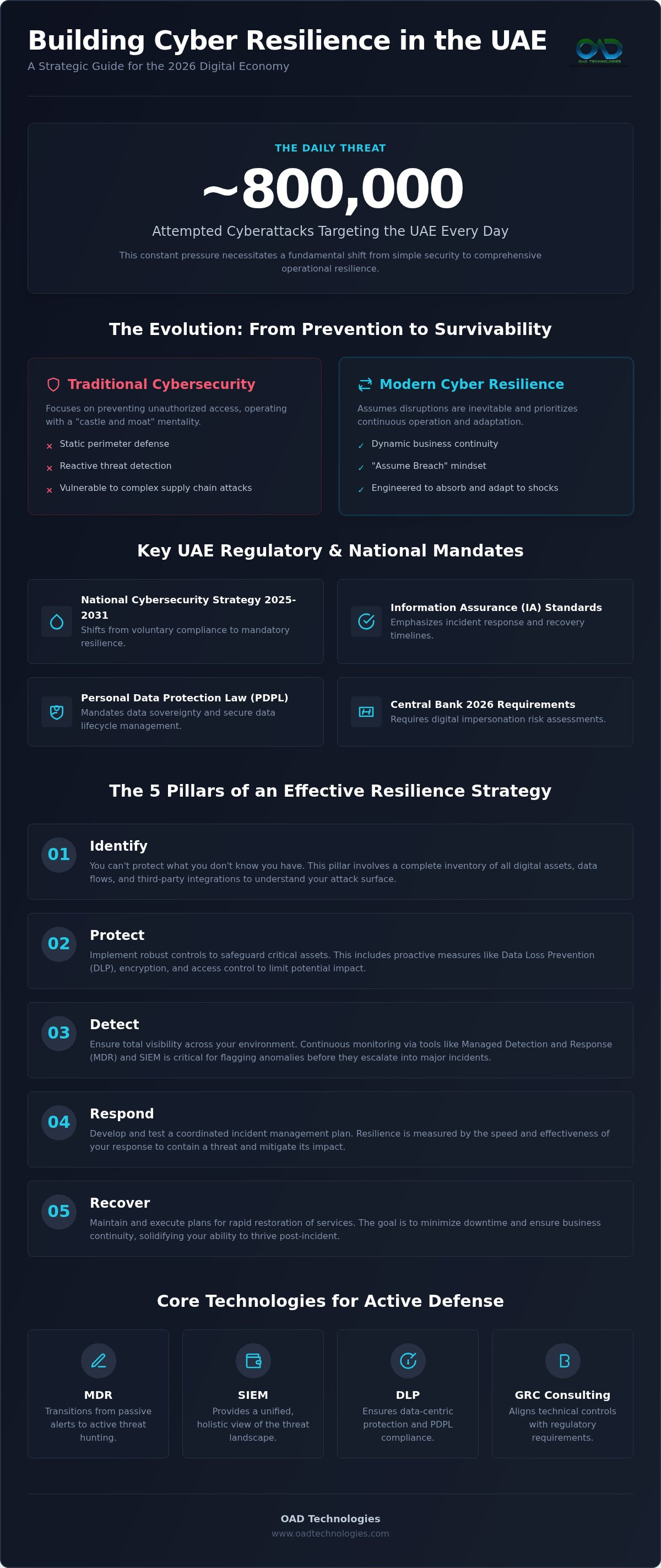
With the UAE facing nearly 800,000 attempted cyberattacks every single day, the traditional concept of a digital perimeter has effectively collapsed. You likely recognize that being secure is no longer enough when the National Cybersecurity Strategy for 2025-2031 has officially shifted the mandate from voluntary compliance to mandatory resilience. It's a high-pressure environment where reactive detection often feels like running a race you've already lost. Developing a robust cyber resilience strategy uae enterprises can rely on requires moving beyond simple defense to a state of continuous adaptation.
This guide provides a comprehensive roadmap to mastering that transition. You'll learn how to align your operations with the latest PDPL and ISR standards while meeting the Central Bank's 2026 requirements for digital impersonation risk assessments. We'll explore how to bridge the gap between human insight and advanced technical tools like Managed Detection and Response and GRC consulting to ensure your organization doesn't just survive an incident but thrives through it. By the end, you'll have a clear framework to reduce downtime and secure your long-term digital relevance in the Emirates.
Key Takeaways
- Understand why the 2026 digital economy requires a shift from static prevention to dynamic continuity to withstand inevitable disruptions.
- Learn how to build a comprehensive cyber resilience strategy uae enterprises can use to map assets and align with national Information Assurance standards.
- Discover how data-centric protection through Data Loss Prevention (DLP) ensures compliance with PDPL data sovereignty rules while securing your most critical assets.
- Transition from passive alerts to active threat hunting by integrating Managed Detection and Response (MDR) and SIEM for a unified view of the regional threat landscape.
- Explore the value of engineering a customized resilience framework that moves beyond standardized solutions to address your specific regulatory and technical requirements.
Understanding Cyber Resilience in the UAE’s 2026 Digital Economy
The 2026 UAE digital economy operates at a velocity that renders static defense obsolete. While traditional cybersecurity focuses on preventing unauthorized access, cyber resilience acknowledges that disruptions are an inevitable byproduct of a hyper-connected nation. True resilience is the capacity of an enterprise to anticipate, withstand, recover from, and adapt to adverse conditions. It's the evolution of foundational information security principles into a dynamic operational framework that prioritizes business continuity over mere perimeter protection.
Integrating a cyber resilience strategy uae enterprises can scale means moving beyond the "castle and moat" mentality. In an era where the UAE Cybersecurity Council reports approximately 800,000 daily attack attempts, a post-breach mindset is the only logical stance. This approach doesn't admit defeat. Instead, it prioritizes the continuity of essential services even while under active duress. By assuming that a breach will eventually occur, organizations can shift their engineering focus toward minimizing impact and accelerating restoration.
The Shift from Prevention to Survivability
Prevention strategies often collapse under the weight of complex, interconnected supply chains. As the UAE continues to lead in smart infrastructure, the blast radius of a single vulnerability expands significantly. Survivability is now a key metric for national market competitiveness. If your systems can absorb a digital shock and maintain core functions, you possess a distinct advantage over competitors who face total operational outages. Cyber resilience is a business-enabling function rather than a cost center.
A post-breach mindset focuses on the second half of the security equation: detection, containment, and restoration. This is critical because the 2026 landscape isn't just about external hackers; it's about systemic failures and sophisticated AI-driven threats. By designing systems with modularity and redundancy, you ensure that a compromise in one segment doesn't lead to a total organizational failure. This strategy allows your business to remain operational while the threat is being mitigated.
Regulatory Drivers: PDPL and National Standards
UAE regulations have matured from general guidelines to strict, mandatory mandates. The Personal Data Protection Law (PDPL) and national Information Assurance (IA) standards now emphasize incident response and recovery timelines as much as they do data protection. This shift places governance risk and compliance at the heart of business continuity. Aligning with these national standards ensures that your cyber resilience strategy uae framework is not just technically sound but legally defensible. Enterprises must now demonstrate they have the systems in place to manage the full lifecycle of a digital crisis, from initial detection to the final audit of the recovery process.
The 5 Pillars of an Effective UAE Cyber Resilience Strategy
A successful cyber resilience strategy uae enterprises implement must translate high-level national visions into granular operational reality. While government frameworks provide the "what," your internal framework must define the "how" across five core functional areas. This structured approach moves the organization from a reactive posture to one of sustained survivability. It ensures that when a disruption occurs, the business has the muscle memory and technical infrastructure to continue operations without catastrophic loss.
- Identify: You can't protect what you can't see. This phase involves a comprehensive inventory of all digital assets, including shadow IT and third-party integrations that touch your enterprise footprint.
- Protect: Use robust data loss prevention (DLP) and encryption to safeguard high-value information at rest and in transit.
- Detect: Visibility is your greatest asset. Continuous monitoring through managed detection and response (MDR) ensures that anomalies are flagged before they escalate.
- Respond: Resilience is measured by the speed and coordination of your incident management. It involves predefined playbooks that minimize operational downtime during a crisis.
- Recover: The final stage is about more than just backups. It's about restoring systems with integrity and integrating post-incident lessons into the long-term roadmap.
Continuous Vulnerability Management
Static security audits fail in a landscape where attack vectors evolve hourly. Moving beyond annual compliance checks to continuous vulnerability assessment and penetration testing (VAPT) allows you to identify weaknesses before adversaries do. By prioritizing remediation based on regional threat intelligence, you ensure that your most critical exposures are addressed first. This proactive approach ensures that VAPT results aren't just a checkbox; they are a foundational part of your broader resilience roadmap. It's often beneficial to consult with a strategic security partner to align these tests with the specific regulatory requirements of the UAE.
Identity as the New Perimeter
In a Zero Trust UAE environment, identity is the primary control plane. Implementing sophisticated identity and access management (IAM) ensures that only the right people have the right access at the right time. Protecting administrative credentials is vital to prevent "keys to the kingdom" scenarios that often lead to catastrophic failures. Multi-factor authentication (MFA) must be treated as a baseline requirement, not an optional layer. By securing the identity layer, you limit the lateral movement of attackers and significantly reduce the potential impact of a compromised account.
Data-Centric Resilience: Protecting the Core of UAE Enterprises
In the UAE's 2026 digital ecosystem, data isn't just an asset; it's the primary target for regional adversaries seeking leverage. This reality makes a data-centric approach essential for any cyber resilience strategy uae organizations deploy. By placing protection directly on the information itself, you ensure that even if the network perimeter is breached, the core value of your business remains inaccessible. Transitioning from network-centric to data-centric security allows for more granular control over how information is accessed and shared across the national infrastructure.
The UAE Personal Data Protection Law (PDPL) mandates strict data sovereignty and privacy controls. Implementing Data Loss Prevention (DLP) allows enterprises to automate these compliance requirements across their entire digital footprint. DLP doesn't just stop accidental leaks. It proactively blocks the "exfiltration" phase of modern ransomware attacks. Today's attackers often steal sensitive data before encrypting it to demand a second ransom, a tactic known as double extortion. A well-configured DLP solution detects and halts this unauthorized movement, effectively neutralizing the adversary's most damaging leverage.
Data Loss Prevention (DLP) and Business Continuity
Operational resilience depends heavily on data integrity and immediate availability. Without rigorous data classification, your response teams can't prioritize which assets to protect first during an active crisis. By identifying your "crown jewels" early, you can apply automated protection policies that significantly reduce the risk of human error. This systematic approach ensures that critical business data remains untampered and ready for restoration. Data Loss Prevention acts as a strategic safety net for UAE intellectual property by ensuring that sensitive information never leaves the authorized environment.
Cloud Security and Data Resilience
As enterprises migrate to national cloud infrastructures, the attack surface shifts toward complex, virtualized environments. Misconfigurations remain the leading cause of catastrophic data exposure in these cloud workloads. Utilizing cloud security posture management (CSPM) is vital for maintaining visibility across multi-cloud and hybrid setups. CSPM identifies these security gaps in real-time, allowing your team to remediate risks before they become entry points for attackers. This layer of oversight ensures that your data resilience extends beyond on-premise servers into the highly dynamic world of national cloud workloads, supporting long-term viability in an ever-changing market.
Implementing Active Defense: MDR and SIEM in the UAE Context
Active defense serves as the operational engine of any modern cyber resilience strategy uae enterprises deploy. While previous sections focused on data protection and governance, active defense is about the speed of execution during a live threat. It requires a transition from passive alert monitoring to a "hunt-first" mentality. By utilizing SIEM as a centralized intelligence hub, organizations gain a unified view of their national threat landscape. This visibility is the difference between a minor incident and a catastrophic outage that erodes public trust.
The 2026 threat landscape in the Emirates demands 24 X 7 security operations. Threat actors don't respect business hours; they specifically target periods of low staffing to maximize their impact. Moving toward managed detection and response (MDR) allows your team to move beyond simple detection. MDR focuses on active threat hunting, identifying the subtle indicators of compromise that automated tools might miss. This proactive stance ensures that your organization is constantly testing its own defenses against the latest regional attack patterns.
The Synergy of SIEM and EDR
Combining the broad visibility of SIEM with the granular telemetry of Endpoint Detection and Response (EDR) creates a powerful resilience loop. This integration is vital for reducing Mean Time to Detect (MTTD) and Mean Time to Respond (MTTR), the two most critical metrics in a crisis. When these systems work in tandem, you can leverage automated response playbooks to isolate infected hosts or block malicious IPs instantly. This rapid containment prevents lateral movement across your network, ensuring that the "Respond" phase of your resilience framework is both fast and precise.
Managed Security Services (MSSP) as a Resilience Multiplier
Building an in-house security operations center (SOC) is often prohibitively expensive and difficult due to the regional cybersecurity talent gap. Partnering with a specialized MSSP acts as a resilience multiplier by providing immediate access to expert analysts and advanced technology stacks. A localized SOC understands the specific threat actors targeting UAE infrastructure and can tailor your defense accordingly. This model allows you to scale your resilience capabilities without massive capital expenditure (CapEx), converting security into a predictable operational cost. To ensure your organization is prepared for the 2026 landscape, partner with a specialized UAE security provider to engineer your active defense framework.
OAD Technologies: Engineering National Cyber Resilience
OAD Technologies operates on a fundamental principle: standardized security is a vulnerability in itself. In a region where national infrastructure is increasingly targeted, a generic approach leaves critical gaps that adversaries are quick to exploit. We act as a strategic partner rather than a distant vendor, engineering a cyber resilience strategy uae enterprises can use to maintain operational momentum. Our philosophy centers on the synergy between human insight and rigorous engineering standards, ensuring that technology empowers your people during a crisis.
We recognize that the UAE's shift from voluntary compliance to mandatory resilience requires more than just software. It demands a master designer who understands the intricate relationship between local law and digital architecture. Our commitment extends beyond immediate fixes to the long-term digital viability of our clients. By securing individual enterprises, we contribute to the broader goal of national security, protecting the trust that drives the Emirates' economic growth. We don't just provide tools; we build the systems that keep your business relevant in an ever-changing market.
Strategic GRC and Compliance Alignment
We bridge the gap between high-level national policy and granular technical controls. Many organizations struggle to translate the UAE Information Assurance (IA) standards or the PDPL into actionable workflows. OAD's GRC consulting services simplify this complexity, helping you achieve and maintain compliance while building a genuine culture of resilience. We prioritize executive-level reporting that turns technical data into strategic business intelligence. This ensures that leadership can make informed decisions about risk and investment, especially as financial institutions approach the June 30, 2026, deadline for digital impersonation risk assessments mandated by the Central Bank.
Integrated Technical Defense
A strategy is only as strong as its execution. We provide the technical "teeth" required to withstand modern attacks by deploying customized DLP, IAM, and Cloud Security solutions. Whether it's replacing legacy systems with more agile alternatives or integrating Managed Detection and Response (MDR) into your existing stack, our focus is always on precision. We ensure that every tool in your defense is configured to meet the specific threat profile of your industry. This proactive, solution-oriented mindset ensures that your resilience framework is capable of absorbing shocks and recovering at speed. To secure your organization's future, schedule a strategic resilience assessment with OAD Technologies today.
Securing Long-Term Viability in the UAE Digital Landscape
The 2026 digital landscape in the Emirates doesn't reward those who simply build higher walls. It rewards organizations that can absorb shocks and maintain operations through active defense and data-centric protection. Implementing a comprehensive cyber resilience strategy uae enterprises can trust means moving beyond static compliance toward a state of continuous adaptation. You've seen how integrating advanced SIEM and MDR capabilities creates the visibility needed for rapid recovery, while specialized GRC consulting ensures you stay ahead of evolving national standards.
Success in this high-pressure environment requires a partner who understands the local regulatory nuances and the specific threat actors targeting regional infrastructure. As a UAE-based MSSP, OAD Technologies provides the deep regional expertise and end-to-end services needed to bridge the gap between high-level policy and technical execution. Whether you need a technical VAPT assessment, specialized PDPL and ISR compliance alignment, or managed response, we're here to engineer your survivability. Strengthen your enterprise resilience with OAD Technologies’ strategic cybersecurity solutions.
Your journey toward national resilience starts with a proactive mindset. Let's build a future where your digital assets remain secure and your business remains irrepressible.
Frequently Asked Questions
What is the difference between cybersecurity and cyber resilience in the UAE?
Cybersecurity focuses on building defenses to prevent unauthorized access and protect the digital perimeter. Cyber resilience, however, acknowledges that disruptions are inevitable and focuses on an organization's ability to withstand, recover from, and adapt to those incidents. In the UAE, this shift is driven by the National Cybersecurity Strategy 2025-2031, which prioritizes business continuity and the survivability of essential digital services over simple prevention.
How does the UAE Personal Data Protection Law (PDPL) affect my resilience strategy?
The PDPL mandates strict controls over how personal data is stored, processed, and protected during a breach. Your resilience strategy must incorporate automated detection and reporting mechanisms to meet legal notification timelines. It also requires a focus on data sovereignty, ensuring that your recovery processes don't compromise the privacy rights of UAE residents. Compliance is now a core component of operational continuity rather than a separate legal task.
Why is Data Loss Prevention (DLP) critical for cyber resilience?
DLP serves as a strategic safety net that prevents the unauthorized movement of sensitive information. By identifying and classifying your "crown jewels," DLP blocks the exfiltration phase of ransomware attacks, neutralizing an adversary's leverage. This protection is vital for a robust cyber resilience strategy uae organizations use to safeguard intellectual property. It ensures that even if a network is breached, the core value of the business remains protected.
What are the most common cyber threats facing UAE enterprises in 2026?
UAE enterprises face approximately 800,000 daily attack attempts, with AI-driven business email compromise and double-extortion ransomware leading the threat landscape. Digital impersonation has also become a significant risk, particularly for financial institutions. These threats leverage sophisticated automation to find vulnerabilities in national infrastructure. Organizations must move toward proactive risk management to disrupt these attack paths before they result in catastrophic downtime or data loss.
How often should a UAE-based company conduct VAPT for resilience?
Static annual audits don't provide the visibility needed to manage 2026 threat levels. Enterprises should move toward continuous vulnerability assessment and penetration testing (VAPT) to identify weaknesses in real-time. We recommend a hybrid approach: continuous automated scanning supplemented by quarterly deep-dive manual assessments. This frequency ensures that your resilience roadmap stays aligned with the latest regional attack vectors and national Information Assurance standards.
Can Managed Detection and Response (MDR) help with UAE regulatory compliance?
MDR provides the 24 X 7 monitoring and active threat hunting capabilities required by many UAE national standards. It helps organizations move beyond passive alerts to active incident containment, which is a key requirement of ISR and PDPL frameworks. By providing detailed forensic logs and evidence of rapid response, MDR demonstrates to regulators that your enterprise possesses the technical maturity to manage and recover from a digital crisis effectively.
What is the role of SIEM in a modern cyber resilience framework?
SIEM acts as the centralized intelligence hub for your entire security stack. It aggregates telemetry from across the national digital footprint, allowing for the real-time correlation of anomalies that might indicate a sophisticated attack. This unified view is essential for reducing the Mean Time to Detect (MTTD). By identifying threats earlier, SIEM allows for faster containment and recovery, which are the primary metrics of a resilient organization.
How do I start building a cyber resilience strategy for my UAE business?
Begin by conducting a comprehensive asset mapping to identify every component of your digital footprint. Align this inventory with UAE regulatory requirements to pinpoint critical compliance gaps. Most successful organizations partner with a specialized MSSP to engineer a customized cyber resilience strategy uae framework. This partnership integrates GRC consulting with technical defense layers like IAM and DLP, ensuring your business has a clear roadmap for long-term digital viability.
Disclaimer
Content by OAD Technologies is for general informational purposes only and does not constitute professional or cybersecurity advice. No warranties are made regarding accuracy or completeness; reliance is at your own risk. OAD Technologies shall not be liable for any direct or indirect losses arising from use of this content.