

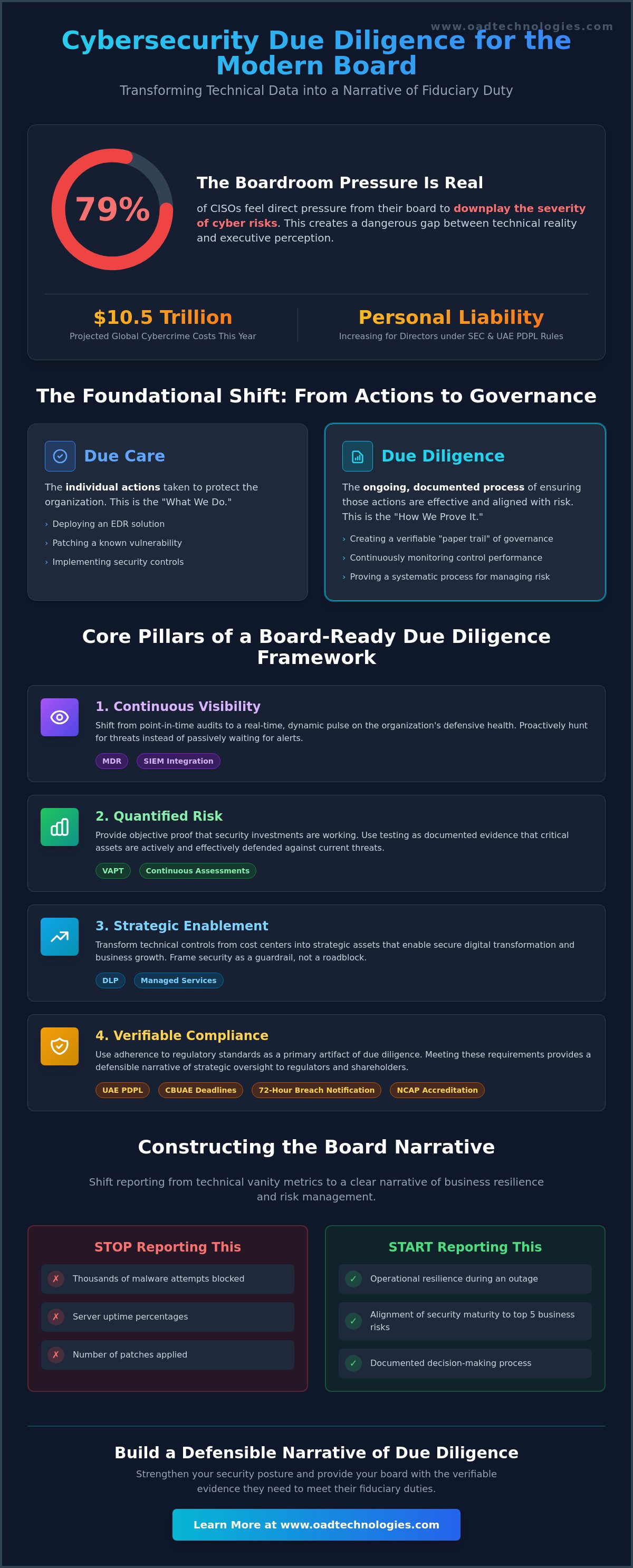
Did you know that 79% of CISOs reported feeling direct pressure from their boardroom to downplay the severity of cyber risks in 2026? This statistic from Trend Micro highlights a dangerous disconnect between technical reality and executive perception. As global cybercrime costs hit a projected $10.5 trillion this year, the challenge is no longer just stopping threats. It's about demonstrating cybersecurity due diligence to board members who are increasingly anxious about personal liability under the UAE PDPL and SEC disclosure rules.
We recognize that translating complex technical controls into a clear ROI narrative is difficult, especially when directors don't speak the language of VAPT or MDR. You're likely feeling the weight of the March 2026 CBUAE authentication deadlines or the 72-hour breach notification windows required by the UAE Data Office. This article provides a strategic framework to transform your security data into a verifiable narrative of fiduciary duty. We'll explore a structured reporting model that aligns your security strategy with business growth while ensuring your organization meets the latest NCAP accreditation standards.
Key Takeaways
- Discover how demonstrating cybersecurity due diligence to board members requires shifting from point-in-time audits to continuous, real-time visibility.
- Learn how to use Vulnerability Assessment and Penetration Testing (VAPT) as documented evidence that your security controls are actively defending critical assets.
- Transform technical investments like Data Loss Prevention (DLP) and Managed Detection and Response (MDR) into strategic assets that enable secure digital transformation.
- Understand the 2026 UAE regulatory landscape and how meeting standards like the PDPL serves as a primary artifact of fiduciary due diligence.
- Master a step-by-step reporting strategy that maps your technical maturity directly to the top five business risks identified by executive leadership.
What is Cybersecurity Due Diligence for the Modern Board?
In the high stakes environment of 2026, the concept of "reasonable care" has moved from a vague legal suggestion to a mandatory operational standard. For executive leadership, demonstrating cybersecurity due diligence to board members is no longer about proving the absence of attacks. Instead, it's about proving the presence of a systematic, documented process for managing risk. This shift mirrors the evolution of global cybersecurity regulations, which now demand that directors treat digital threats with the same fiduciary rigor as financial audits.
To understand this framework, we must distinguish between due care and due diligence. Due care represents the individual actions taken to protect the organization, such as deploying an EDR solution or patching a known vulnerability. Due diligence is the broader, ongoing process of ensuring those actions are effective and aligned with the company's risk profile. It's the "paper trail" of governance. If a breach occurs, regulators won't just ask if you had security tools; they'll ask for the records showing how leadership evaluated those tools and monitored their performance over time. Failing to provide this evidence can lead to severe personal liability for directors, significant financial penalties under the UAE PDPL, and a total collapse of shareholder trust.
The Shift from Technical Metrics to Fiduciary Duty
Board members don't need to know how many thousands of malware attempts your firewall blocked last month. These are vanity metrics that fail to communicate actual business risk. When reporting, you must translate raw technical data into terms of operational resilience and business continuity. Instead of discussing server uptime, discuss the organization's ability to maintain core functions during a localized outage. The board's primary role isn't to manage security operations; it's to define the risk appetite of the business. Your job is to provide the context they need to approve that appetite, ensuring that every security investment serves as a strategic guardrail for digital growth.
Why 'Safe' is No Longer a Measurable Objective
The narrative of being "100% safe" is a dangerous fallacy in 2026. With AI-driven threats shortening response windows to mere minutes, perfection is impossible. Modern due diligence focuses on resilience and compliance rather than total prevention. Directors are protected from liability not by the absence of incidents, but by the quality of their documented decision-making process before an incident occurs. Due diligence is a verifiable trail of risk-based decisions made by leadership. By shifting the focus to how the organization identifies, assesses, and mitigates threats through tools like VAPT and GRC frameworks, you provide the board with a defensible narrative of strategic oversight.
The Core Pillars of a Board-Ready Due Diligence Framework
Static, point-in-time audits have lost their relevance in the 2026 threat environment. With AI-driven attacks now capable of compromising legacy filters in minutes, the board requires a dynamic pulse on the organization's defensive health. A robust framework for demonstrating cybersecurity due diligence to board members must move beyond basic compliance checklists. It needs to provide a continuous narrative of active risk management that aligns with CISA's guidance on corporate cyber governance. This means shifting from "what we have" to "how we are performing."
Visibility Through MDR and SIEM Integration
Real-time monitoring is the backbone of any defensible security posture. By leveraging managed detection and response, you create a permanent paper trail of active defense. This isn't just about catching threats; it's about proving to the board that the organization is proactively hunting for anomalies rather than passively waiting for alerts. When paired with a sophisticated SIEM, these tools consolidate disparate logs into a unified evidence base. This level of integration allows leadership to see exactly how technical controls are responding to the 80% of phishing attacks that now utilize generative AI to bypass traditional defenses.
Quantifying Risk with VAPT and Continuous Assessments
The board needs objective proof that security investments are actually working. Regular vulnerability assessment and penetration testing acts as a third-party validation of your defensive layers. In 2026, simple vulnerability scans aren't enough. Red-teaming exercises that simulate sophisticated, neural-network-enhanced threat actors are essential for stress-testing your resilience. Instead of presenting a raw list of bugs, show the board a prioritized remediation roadmap. This demonstrates that management isn't just identifying problems but is systematically closing the gaps that could lead to personal director liability under new UAE regulations.
Strategic alignment ensures that every dollar spent on security matches the organization's unique risk profile. If the board's primary concern is the 72-hour notification window required by the UAE PDPL, your due diligence framework should emphasize rapid detection and incident response readiness. Proving that the organization can "fail gracefully" and recover quickly is a critical component of demonstrating cybersecurity due diligence to board directors. If you need to refine your current reporting structure, implementing modern GRC frameworks can help translate these technical pillars into a language that resonates with executive stakeholders.
Bridging the Gap: Technical Controls as Strategic Assets
The traditional view of cybersecurity as a bottomless cost center is obsolete. In 2026, forward-thinking executives view technical controls as essential guardrails that allow the business to innovate at speed without veering into catastrophic risk. When demonstrating cybersecurity due diligence to board members, you must frame these tools as strategic assets that protect the company's "crown jewels" while simultaneously reducing financial liabilities. For example, a demonstrably smaller attack surface doesn't just prevent breaches. It serves as a direct lever for negotiating lower cyber insurance premiums in an increasingly expensive market.
By moving beyond the "what" of security and focusing on the "how" of governance, you provide a narrative of active stewardship. This approach transforms abstract security concepts into tangible evidence of corporate responsibility. It proves that the organization isn't just reacting to threats but is actively shaping its digital future through rigorous engineering and strategic planning.
Data Loss Prevention (DLP) as a Business Continuity Asset
Effective data loss prevention is the ultimate proof of information stewardship. Boards are deeply concerned about intellectual property theft and the erosion of competitive advantage. By mapping DLP policies to these specific business risks, you show the board that leadership knows exactly where sensitive data resides and how it's protected. Reporting on DLP doesn't just show "blocked leaks." It shows a documented, risk-aware strategy for ensuring business continuity even when internal or external actors attempt to exfiltrate proprietary information.
The Role of IAM in Corporate Governance
If data is the fuel of the modern enterprise, identity and access management is the steering wheel. IAM provides the foundational governance framework for "who can do what" across your digital ecosystem. Demonstrating the "Principle of Least Privilege" isn't just a technical configuration; it's a core governance control that limits the blast radius of a potential compromise. For UAE-based organizations, IAM is particularly critical for mitigating insider threats, which remain a top boardroom concern in 2026. By presenting IAM as a governance tool, you provide the board with clear evidence that the organization maintains strict accountability over its most privileged access points.
This strategic positioning ensures that when you're demonstrating cybersecurity due diligence to board directors, they see a proactive leadership team that treats security as a fundamental component of the business's long-term viability. It shifts the conversation from technical maintenance to strategic expansion, where security is the very foundation of growth.
Demonstrating Compliance with UAE Regulatory Standards
The UAE regulatory environment in 2026 has transitioned from recommended best practices to mandatory enforcement with significant consequences for non-compliance. For directors, the Abu Dhabi Global Market (ADGM) FSRA Cyber Risk Management Framework, which became effective on January 31, 2026, represents a new era of accountability. Regulated firms must now report material incidents within 24 hours of detection. Demonstrating cybersecurity due diligence to board members in this context requires more than just a summary of activity. It requires a documented alignment with these specific legal timelines. Boards are no longer insulated from the technical failures of the IT department; they're now the primary targets of regulatory scrutiny.
To navigate this landscape, organizations must move beyond "check-the-box" compliance. True due diligence in 2026 is defined by a security-first approach where compliance is a natural byproduct of robust engineering. When you provide evidence of meeting the National Cyber Accreditation Programme (NCAP) standards, you aren't just showing a certificate. You're providing a primary artifact of due diligence that proves the board has exercised reasonable care in protecting Critical Information Infrastructure.
Aligning with the UAE Personal Data Protection Law (PDPL)
Federal Law No. 45 of 2021, known as the PDPL, is now actively enforced with strict mandates regarding data breach notifications. Specifically, the law requires a 72-hour notification window to the UAE Data Office. To meet this high-pressure requirement, organizations are utilizing sophisticated governance risk and compliance (GRC) tools to map every technical control directly to PDPL articles. This mapping provides the board with a clear view of their legal standing at any given moment. PDPL compliance is now a standard metric for UAE board reporting, serving as a critical artifact of fiduciary due diligence.
Automating GRC Reporting for Real-Time Oversight
Presenting stale or manual compliance data to the board is a significant risk. If the data is even a few weeks old, it fails to reflect the current threat landscape or the organization's actual readiness. Automation is the only way to maintain board confidence while reducing the operational burden on security teams. In cloud-native environments, CSPM plays a vital role in proving cloud compliance to the board by providing real-time snapshots of the organization's configuration health. This automated oversight ensures that the board has access to accurate, actionable information during every quarterly review.
Moving from manual spreadsheets to an automated, unified framework is the only way to manage multi-regulatory requirements effectively in 2026. If your current reporting process feels reactive rather than proactive, it's time to evaluate your UAE compliance strategy with OAD Technologies.
Constructing the Board Narrative: A Step-by-Step Reporting Strategy
Translating a year's worth of security telemetry into a twenty minute board presentation requires more than just a summary; it requires a narrative. A successful strategy for demonstrating cybersecurity due diligence to board members focuses on the intersection of risk, resilience, and responsibility. By following a structured reporting cadence, you move the conversation from "what happened" to "how we are prepared."
- Step 1: Identify the Top 5 Business Risks. Start by highlighting the risks that keep the board awake, such as supply chain disruption, intellectual property theft, or regulatory fines. Don't lead with technical threats; lead with business consequences.
- Step 2: Map Technical Maturity. Show how your investments in MDR, VAPT, and DLP directly mitigate those five risks. For instance, explain how your DLP policies protect specific trade secrets identified in Step 1.
- Step 3: Present a Resilience Scorecard. Replace the standard list of vulnerabilities with a high level scorecard. This should track maturity levels across different domains, showing progress over time rather than a static point in time snapshot.
- Step 4: Define Risk-Appetite Decisions. Explicitly ask the board to weigh in on key decisions. If a specific risk cannot be fully mitigated with the current budget, present the trade-offs and ask for a formal decision on whether to accept, transfer, or mitigate the risk.
- Step 5: Document Meeting Minutes. Ensure the board's discussions and decisions are captured in the minutes. This documentation serves as the ultimate record of due diligence, proving that leadership actively engaged with the risk.
The 'State of Resilience' Dashboard
A board-ready dashboard must be concise and impact oriented. It should include risk trends, current compliance status against UAE standards, and the effectiveness of your incident response drills. Exclude low level technical metrics like the number of emails scanned or the count of blocked firewall pings. These details create noise that can distract from strategic oversight. Instead, use visual aids to show how the organization's resilience compares to industry benchmarks, providing the board with the context they need to evaluate performance.
Engaging OAD Technologies for Strategic Board Advisory
Effective reporting is an art that requires a blend of technical depth and executive communication. OAD Technologies acts as a natural extension of the CISO's office, helping you prepare reports that satisfy even the most rigorous board level scrutiny. Independent, third party assessments provide an objective layer of validation that strengthens the CISO's narrative. By bringing in an external perspective, you demonstrate a commitment to transparency and high quality craftsmanship in your security governance. Contact OAD Technologies to strengthen your cybersecurity governance and ensure your board presentations reflect a truly resilient enterprise.
By implementing this step-by-step strategy, demonstrating cybersecurity due diligence to board directors becomes a repeatable, defensible process. It ensures that the organization remains agile in the face of 2026's evolving threat landscape while protecting leadership from the growing risks of personal and corporate liability.
Securing the Future of Fiduciary Oversight
The 2026 regulatory landscape leaves no room for ambiguity. Directors now face a reality where personal liability is tied directly to the quality of their digital oversight. Successfully demonstrating cybersecurity due diligence to board members requires a shift from reporting technical activity to presenting a verifiable narrative of risk management. By aligning technical controls with business outcomes and documenting every strategic decision, you transform security from a cost center into a resilient foundation for growth.
This journey doesn't have to be solitary. Partnering with experts who understand the nuances of the UAE regulatory environment ensures your reporting is both accurate and authoritative. OAD Technologies provides the technical authority you need, from national-scale MDR and SIEM operations to expert VAPT and technical assessment teams. Our specialized UAE GRC consulting helps you bridge the gap between complex architectures and executive expectations.
Secure your board's confidence with OAD's GRC and Strategic Advisory services. You have the tools and the strategy to lead your organization toward a secure, compliant, and prosperous future.
Frequently Asked Questions
What is the difference between cybersecurity due diligence and due care?
Due care is the immediate practice of security, such as deploying EDR or patching a known vulnerability. Due diligence is the broader governance framework that verifies these actions are happening consistently and effectively across the enterprise. It's the documented process that leadership uses to oversee risk and prove they've met their fiduciary duties during an audit or legal inquiry.
How can a board member be held personally liable for a cyberattack in the UAE?
Board members face personal liability if they fail to exercise reasonable oversight of data protection and cybersecurity risks. Under the UAE PDPL and ADGM FSRA frameworks, directors must ensure the organization has the necessary resources to detect and report breaches within mandatory windows. Failure to provide this strategic oversight can result in direct legal consequences and significant financial penalties for individual directors.
What are the most important cybersecurity KPIs to show a board of directors?
The most effective KPIs focus on business outcomes rather than technical counts. Boards need to see the organization's Resilience Scorecard, current compliance percentage with UAE standards, and Mean Time to Detect (MTTD) or Respond (MTTR). These metrics provide a clear view of how well the company can maintain business continuity during an attack without overwhelming directors with technical jargon.
How does the UAE Personal Data Protection Law (PDPL) affect board reporting?
The UAE PDPL mandates a 72-hour notification window to the Data Office for data breaches. This requirement forces boards to move away from passive oversight to active participation in incident response readiness. Successfully demonstrating cybersecurity due diligence to board directors now involves proving that the organization can meet these aggressive legal timelines through automated GRC and DLP controls.
How often should a CISO present cybersecurity due diligence to the board?
CISOs should present formal cybersecurity updates at least quarterly to align with typical board meeting cycles. However, material incidents or significant regulatory shifts, such as the 2026 CBUAE authentication mandates, require immediate briefings. This regular cadence ensures that security remains a strategic priority and that directors are never surprised by evolving threat landscapes or compliance gaps.
Can a company use cyber insurance as a substitute for due diligence?
Cyber insurance is a risk transfer mechanism, not a substitute for active risk mitigation. In 2026, insurers frequently require proof of robust security measures like VAPT and MDR before they will issue or renew policies. Failing to demonstrate due diligence can lead to denied claims or prohibitively high premiums, leaving the board exposed to the full financial impact of a breach.
What role does VAPT play in demonstrating board-level due diligence?
VAPT provides independent, third-party validation that your security architecture is resilient against modern attacks. It serves as a primary artifact for demonstrating cybersecurity due diligence to board members by showing that management is proactively identifying and remediating weaknesses. A documented VAPT roadmap proves that the board is taking reasonable care to secure the enterprise's most critical digital assets.
How do we prove due diligence for third-party vendor risks?
Proving due diligence for third-party risks requires a combination of continuous monitoring and structured GRC assessments. Organizations must map vendor security postures to their own internal risk appetite and maintain clear records of how they evaluate these external dependencies. This proactive approach ensures that a supply chain compromise doesn't become a failure of board oversight or a breach of fiduciary duty.
Disclaimer
Content by OAD Technologies is for general informational purposes only and does not constitute professional or cybersecurity advice. No warranties are made regarding accuracy or completeness; reliance is at your own risk. OAD Technologies shall not be liable for any direct or indirect losses arising from use of this content.


